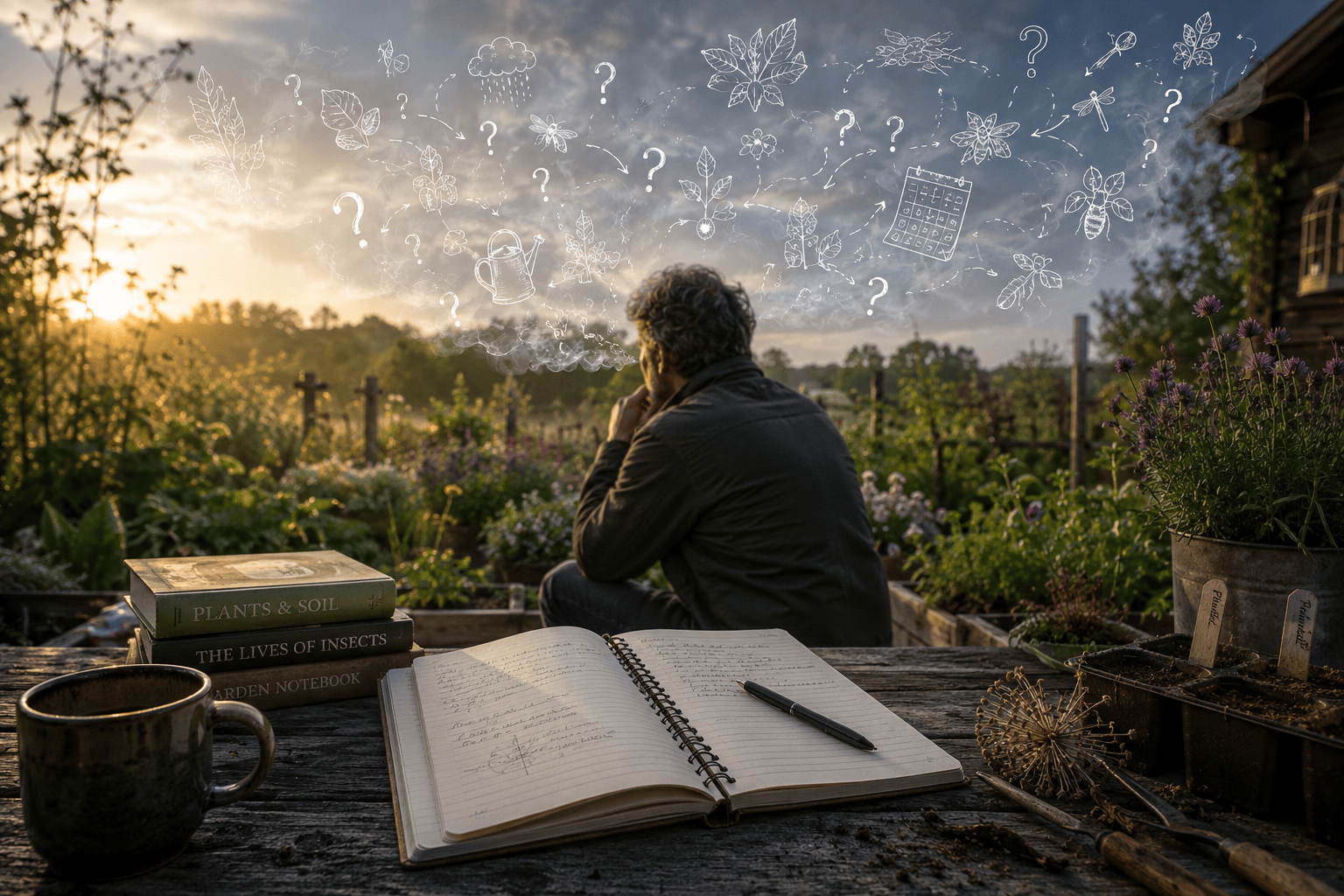
| We spend our days noticing, questioning, comparing, deciding and then forgetting most of it. Perhaps forgetting, however, isn’t quite the same thing as leaving nothing behind. |
| I was working recently when I became aware of just how many questions I was asking myself. They weren’t profound questions, and I doubt any of them would have detained a philosopher for very long. They were the ordinary questions that arise when you’re working in a garden, and something isn’t quite as expected. Why is that plant struggling when the one beside it isn’t? Was the soil this dry the last time I was here? Has that grown unusually quickly? Is that flowering earlier than I remember? Where are the insects I would normally expect to find around it? One observation seems to produce another, and before long something as ordinary as a slightly unhappy plant has started a small investigation. What struck me wasn’t that I was doing this, but how often I must do it without ever thinking about the thinking itself. Something catches my attention, I ask myself a question, consider several possibilities, perhaps reach a conclusion and do something as a result. Then I move on. An hour later, another garden problem has taken its place, and by the end of the day, I may remember very little of the original sequence. I know I was thinking throughout the day because I couldn’t have done the work otherwise, but most of the thoughts themselves have apparently vanished. That left me with a question considerably stranger than the ones about plants and soil: where does a thought go when we have finished with it? I don’t mean that mystically. I am not suggesting that discarded thoughts continue floating around somewhere behind us, waiting to be found again. I mean something much more ordinary. If we spend our waking lives noticing, comparing, questioning, remembering, predicting and making decisions, yet can later retrieve only a fraction of that mental activity, what has actually happened to the rest of it? And if one of those forgotten thoughts changes what we notice or do in the future, can we really say that it disappeared completely? Before we count thoughts, we have to decide what one is There are surprisingly confident claims online about how many thoughts a human being has every day. Numbers in the tens of thousands have been repeated so often that they can begin to sound like established measurements. The difficulty is that science doesn’t possess a universally agreed unit called one thought. Thought is continuous, overlapping and capable of changing direction without politely announcing where one idea ended and another began. Consider something as simple as noticing a wilting plant. I see that it looks unhappy and wonder why. I consider whether it needs water, whether the ground is particularly dry, whether heat from a nearby wall is affecting it, whether another plant is competing for roots, or whether there is some other problem I haven’t yet considered. I remember seeing something similar elsewhere, put my hand into the soil, discover that it is unusually dry and decide what to do about it. Calling all of that one thought seems inadequate, but calling every possibility a separate thought feels equally artificial. Researchers have nevertheless developed ways of investigating transitions in thinking without relying entirely upon people reporting every thought themselves. In 2020, neuroscientists Julie Tseng and Jordan Poppenk published research in Nature Communications examining large-scale transitions between patterns of brain activity, which they termed neural meta-state transitions. Their results showed that these transitions related to narrative events during movie viewing, appeared across both tasks and rest, and were associated with brain regions involved in spontaneous thought. The researchers proposed that such transitions could serve as neurobiological markers of new thoughts and approximate the rate at which a person’s thinking changes. That is fascinating, but it needs to be described carefully. It does not mean neuroscience has discovered a universally accepted method of placing a boundary around every individual thought, nor does it establish that every person has a fixed number of thoughts each day. It is a research method for investigating transitions in ongoing mental activity, and the authors propose an interpretation of what those neural transitions represent. That could tell us something useful before we go any further. Asking how many thoughts I have today? may be rather like asking how many separate movements there were in a stream. We can identify disturbances, changes, and shifts in direction, but deciding exactly where one movement ends and another begins may depend partly on what we have decided to call a movement in the first place. An observation can disappear while its consequence remains. Gardening provides a particularly useful way of thinking about this because so much of the work begins with noticing small differences. A plant is growing differently from the same species somewhere else. One area dries faster than another. A patch of ground behaves differently after heavy rain. An insect appears somewhere unexpected. Shade has moved as the season has changed. None of these observations needs to be dramatic, but each can influence what happens next. Suppose I notice that plant struggling beside a warm wall. The observation produces a question, the question starts an investigation, and eventually I decide that the ground there is considerably drier than I had realised. I water it, mulch the area and make a mental note to watch it. A few weeks later the plant has recovered, and my attention has moved elsewhere. Months later I may remember little about the incident; several years later I might not consciously remember it at all. Then I encounter another struggling plant beside another warm wall, and one of the first things to check is the soil moisture. This is where my original curiosity begins to overlap with something psychology has studied extensively: the distinction between consciously remembering an earlier experience and showing its effects. Research on implicit learning and memory demonstrates that certain forms of prior experience can alter subsequent performance without requiring conscious recollection of the original learning episode. Paul Reber’s review of neuropsychological and neuroimaging research, for example, describes implicit-learning mechanisms through which repetition and experience can improve subsequent performance without conscious awareness of what has been learned. That does not mean every forgotten gardening observation has been secretly filed away as an implicit memory, and it would be scientifically careless to suggest that it has. Memory and learning involve several interacting processes, and a personal example cannot tell us which particular neural mechanism is responsible. The broader point is more defensible and, more interesting: conscious recollection is not required for every effect of previous experience to be expressed later. We can therefore forget the occasion on which something was learned while still showing evidence that something has been learned. Experience is partly made from forgotten things. This made me reconsider what we mean when we describe somebody as experienced. We often talk about experience almost as a measurement of time: five years of experience, twenty years of experience, a lifetime of experience. Yet simply being around something for a long time doesn’t guarantee that much has been learned from it. What seems more important is the repeated cycle of encountering something, noticing what happens, comparing it with what happened before and adjusting what we do next. My own experiences have accumulated in different ways. I have been interested in insects since I was six and properly fascinated by them from around ten. My fascination with compost and practical work with it began much later, in 2016, while professional gardening began later still, in September 2022. Those aren’t interchangeable periods of experience, but they share something important: repeated observation gradually creates comparisons. Gardening accelerates that process because the same places keep changing before your eyes. Yesterday is compared with today, this spring with last spring, wet weather with drought, one soil with another and the same plant in two different positions. Some lessons are obvious enough to remember. Most probably aren’t. A small observation alters what you check next time; a mistake makes you more cautious about something; a successful decision becomes something you are more likely to try again. Over time, that begins to resemble an internal reference library whose contents are much larger than its catalogue. This may help explain the familiar experience of looking at a plant or part of a garden and feeling that something is “not quite right” before immediately being able to say why. There is no need to turn this into mysterious intuition. Pattern recognition provides a much more ordinary explanation. Something in the present differs from patterns built through earlier observations, and that discrepancy attracts attention. Conscious reasoning may then identify the dry soil, unusual colour, missing growth, changed light or whatever else prompted the concern. Here we reach an idea worth separating from the science surrounding it. Research supports the existence of learning and memory effects that do not depend upon conscious recollection. Still, the suggestion that experience itself may be, in part, the accumulated residue of forgotten observations is my interpretation of that evidence, not an established neuroscientific definition of experience. It is nevertheless an intriguing way of looking at it. How much do we notice without knowing that we’ve noticed it? Once we begin wondering about forgotten thoughts, an even earlier stage of the process becomes interesting. Before something becomes a deliberate thought, it must first become sufficiently important to warrant our attention. Stand in a garden, and the senses are receiving far more information than we could consciously consider at once. There is light, movement, temperature, wind, birdsong, traffic somewhere beyond the boundary, the colour and shape of vegetation, the texture of the ground beneath our feet, insects moving through the edge of vision, smells from plants and soil and countless changes in the scene as we move through it. Much of that information never becomes the subject of deliberate thought because there is no reason for it to do so. Psychologists studying inattentional blindness have demonstrated how selective conscious attention can be. When people concentrate on a demanding task, they can fail to report an unexpected visual stimulus that was physically present. In 2020, Alexandre de Pontes Nobre, Gabriela Mueller de Melo, Gustavo Gauer and Johan Wagemans published a systematic review and meta-analysis examining the more difficult question of whether unexpected visual stimuli that people did not report seeing were nevertheless processed. Their meta-analysis combined 59 behavioural experiments. Overall, the results supported the possibility that visual stimuli can undergo processing when unattended and unnoticed. There is an important qualification, however. The researchers also found that conclusions were affected by the methods used to determine whether participants were genuinely unaware of the unexpected stimulus. In other words, even establishing what somebody has or hasn’t consciously noticed is methodologically more complicated than it might appear. This is not evidence for an unconscious observer recording everything around us, and we shouldn’t turn it into one. What it does demonstrate is that not consciously reporting something and the nervous system doing absolutely nothing with the information are not necessarily the same thing. For a gardener, that seems strangely familiar. Sometimes a sound stops and only then do you realise you had been hearing it. Something moves, and suddenly the background becomes an insect. A plant catches your attention because its colour is slightly wrong, although you couldn’t immediately say what comparison made it wrong. Conscious thought may arrive only after earlier perceptual processing has already made something sufficiently unusual or relevant to attract attention. We might loosely imagine a progression from sensation to observation, observation to question, thought question, thought to conclusion and conclusion to action. Memory may follow, but it doesn’t necessarily preserve every stage. At each point, enormous amounts of information can fall away while some of what remains alters what happens next. Perhaps the remarkable thing isn’t simply how much we forget. It is how much the brain manages without requiring us to supervise every part of the process consciously. Memory was never a perfect diary. There is another assumption worth questioning here: that memory ought to preserve an accurate and complete record of everything that happens to us. It sounds attractive until you consider what “everything” would actually involve. Every passing thought, every glance, every minor decision, every irrelevant sound, every abandoned possibility and every half-formed question would remain equally available. Finding something useful amongst all of that might become considerably harder rather than easier. Human memory does not behave like a perfect recording. Neuroscience distinguishes processes involved in acquiring information, stabilising memories over time and later retrieving them. The concept of memory consolidation describes the processes by which newly acquired memories become more stable over time. Research into reconsolidation has added another complication to the old idea that memory is stored and left untouched. In a major 2009 review, Karim Nader and Oliver Hardt examined evidence that previously consolidated memories can, under certain conditions, enter a temporarily unstable or modifiable state after being reactivated and subsequently require restabilisation. The precise boundaries and mechanisms of reconsolidation remain areas of scientific investigation, so it would be an exaggeration to say that every act of remembering automatically rewrites every memory. What the research challenges is the simple picture of long-term memory as something permanently fixed once it has been stored. That should make us cautious about imagining memory as a filing cabinet containing perfect records of our days. What survives from an event can depend on attention, learning, later experiences, and the circumstances under which something is subsequently remembered. It also makes one of memory’s everyday peculiarities rather wonderful. We can spend an hour deliberately discussing something important and, a year later, remember very little of the conversation. Yet an apparently insignificant moment — an insect landing on a leaf, a particular smell, the quality of the light one afternoon, something somebody said while walking through a garden — can remain vivid for decades. Memory does not always align with our opinion about what deserves to be important. Try remembering what you thought yesterday. There is a simple experiment available to all of us that requires no brain scanner. Try to remember what you thought about yesterday. Not what you did yesterday. Most of us can reconstruct the broad events reasonably well. Try instead to recover the thoughts themselves. What question crossed your mind while making tea? What did you briefly notice through the window? What tiny problem did you solve without mentioning it to anybody? What possibility did you consider for fifteen seconds and reject? What changed your mind about something? What were you thinking at 10.17 yesterday morning? For most of us, much of it is inaccessible. Yet yesterday wasn’t mentally empty. We were continually processing information, making predictions, recalling things, recognising people and places, adjusting movements, considering possibilities and responding to whatever happened around us. The fact that we cannot now retrieve most of that activity does not mean it wasn’t happening. This is why I have become less interested in the popular question of exactly how many thoughts we have each day. Even if somebody eventually produced a widely accepted measurement, the number would not tell us very much. The more interesting fact is that an enormous amount of mental activity can contribute to a day while leaving remarkably little that we can deliberately reconstruct afterwards. Some of it presumably deserves to vanish. Not every thought I have while pushing a wheelbarrow represents an irreplaceable contribution to human knowledge. Minds wander, repeat themselves, consider nonsense, abandon ideas and eventually remember what they were supposed to be doing. Forgetting some of that may be useful rather than defective. But previous experience can also leave consequences that outlive our conscious recollection of how they arose, returning us to the original problem. What exactly has been lost? Psychology has long distinguished between forms of memory that involve conscious recollection and forms in which earlier experience is expressed through later behaviour or performance without deliberate remembering. These categories are more complicated than a simple division of the brain into two separate filing systems, but the distinction itself is important. It undermines the assumption that if we cannot consciously remember something, it can have had no continuing effect upon us. A person may not remember when they first learned to approach a particular problem in a particular way. A gardener may not remember which plant first prompted them to investigate soil moisture beside a hot wall. Someone who has watched insects for years may recognise unusual behaviour without being able to compare the present observation against hundreds of earlier ones. We need to be careful here. None of the scientific research allows us to take an individual forgotten thought and confidently announce where it has gone in the brain. Some thoughts may contribute to durable learning; some may become consciously retrievable memories; some may influence associations; and many may leave no consequence we could meaningfully detect. Neuroscience does not currently provide a ledger of the fate of each thought after consciousness shifts elsewhere. What the evidence does tell us is subtler. The inability to consciously retrieve an earlier experience does not, by itself, prove that the experience left nothing behind. That is enough to make the original question interesting. Where, then, does a thought go? I began with three fairly innocent curiosities. How many observations do I make in a day? How many questions do those observations produce? And how many thoughts pass through my mind before the day is finished? I still don’t know, and science cannot currently provide a simple universal answer. Researchers can investigate transitions in ongoing mental activity, attention, perception, learning and memory, but that is very different from possessing a reliable counter that clicks every time a human being has another thought. Yet the science has taken me somewhere more interesting than a number would have done. There is evidence that previous experience can affect later performance without conscious recollection of the learning episode. There is evidence that visual information can sometimes be processed even when not consciously reported. And there is substantial evidence that human memory is dynamic rather than a perfect permanent recording of everything we experience. None of those findings tells us exactly where yesterday’s forgotten thought went, but together they make it difficult to assume that forgotten must always mean without consequence. That brings me back to experience. Perhaps experience isn’t simply a collection of events we can consciously remember. Perhaps — and here I am deliberately moving from established research into reflection — it is also partly the accumulated residue of observations, comparisons, questions, mistakes and conclusions whose individual origins have disappeared from view. A forgotten observation might have altered what we notice next time. A mistake might have changed what we check. A conclusion might have influenced the next decision without bringing the original event back with it. Thousands of tiny episodes could therefore contribute to how we approach tomorrow, even though we could never reconstruct them individually. I rather like that possibility because it gives forgetting a different character. Instead of imagining our days as enormous quantities of thought followed by enormous quantities of loss, perhaps some of what appears to have vanished has ceased to exist in a form we can consciously revisit. Which leaves me almost where I started. Where does a thought go when we have finished with it? Some thoughts presumably disappear without any detectable consequence. Some become memories. Some may contribute to learning or alter the patterns against which later experiences are judged. For most individual thoughts, we cannot know. But if I have completely forgotten a thought, and something about that experience has permanently changed what I subsequently notice, expect, or do, I am no longer certain that “gone” is quite the right word. And that, rather inconveniently, has given me another question to think about. |
| Scientific sources & further reading Tseng, J. & Poppenk, J. (2020) — Brain meta-state transitions demarcate thoughts across task contexts exposing the mental noise of trait neuroticism. Nature Communications, 11, 3480. The researchers developed a method for detecting large-scale neural meta-state transitions. They proposed that these transitions can provide implicit neurobiological markers of new thoughts and approximate rates of mentation. The study should not be interpreted as establishing a universally accepted fixed number of thoughts experienced by every person each day. de Pontes Nobre, A., Mueller de Melo, G., Gauer, G. & Wagemans, J. (2020) — Implicit processing during inattentional blindness: A systematic review and meta-analysis. Neuroscience & Biobehavioral Reviews, 119, 355–375. This systematic review examined research into processing of unexpected visual stimuli during inattentional blindness. Its meta-analysis combined 59 behavioural experiments and found evidence of processing of unattended and unnoticed stimuli, while also demonstrating that conclusions are affected by the criteria used to measure awareness. Reber, P. J. (2013) — The neural basis of implicit learning and memory: A review of neuropsychological and neuroimaging research. Neuropsychologia, 51(10), 2026–2042. A review of implicit learning and memory, including mechanisms through which repeated experience can improve later performance without conscious awareness of what has been learned. Roediger, H. L. III (1990) — Implicit memory: Retention without remembering. American Psychologist, 45(9), 1043–1056. An influential review of the distinction between conscious remembering and effects of previous experience that can be demonstrated through later performance. Dudai, Y. (2004) — The Neurobiology of Consolidations, Or, How Stable is the Engram?. Annual Review of Psychology, 55, 51–86. A review examining memory consolidation and the biological processes associated with stabilising memory over time. Nader, K. & Hardt, O. (2009) — A single standard for memory: the case for reconsolidation. Nature Reviews Neuroscience, 10, 224–234. A review of evidence that consolidated memories can, under certain conditions, enter temporarily unstable states following reactivation and subsequently require restabilisation. Tseng & Poppenk — Nature Communications, de Pontes Nobre et al. — PubMed, Reber — PubMed, and Nader & Hardt — Nature Reviews Neuroscience. |
| About our writing & imagery Most articles reflect our real gardening experience and reflection. Some use AI in drafting or research, but never for voice or authority. Featured images may show our photos, original AI-generated visuals, or, where stated, credited images shared by others. All content is shaped and edited by Earthly Comforts, expressing our own views. |

