| An Introduction Strange Is Often Just Something We Haven’t Understood Yet |
| I have been interested in insects for almost as long as I can remember. I was about six when they first began properly attracting my attention. However, by ten it had become something rather more than the usual childhood business of turning over stones to see what was underneath. There were ant farms and bug farms, occasionally kept under my bed in Australia, and a general tendency to catch things simply because I wanted to have a closer look at them. I suspect plenty of parents have discovered similar collections in jam jars and assorted containers over the years. Mine just had the inconvenience of being indoors. Before that, there had been Malaysia. We lived there between 1968 and 1971, and insects were simply part of the surroundings. I remember leaf insects and stick insects in the garden, and mantises too. Cicadas are an even stronger memory, although not necessarily because I saw them particularly often. I remember hearing them in the tropical growth behind where we lived and, in the evening, from across the way around the kampung. There were insects in the monsoon drains, enormous butterflies that we used to catch, and mosquitoes which were rather harder to regard with uncomplicated childhood enthusiasm because malaria was a very real presence. Australia provided another collection of memories: bull ants, cicadas, beetles, caterpillars and large wasps, including ones associated with spiders. I remember fiddler beetles, leaf beetles, green loopers and she-oak moths, alongside the spiders that inevitably attracted my attention as well. Redbacks, huntsmen, trapdoors and funnel-webs were not insects, of course. Still, when you’re a child fascinated by small creatures with rather more legs than yourself, taxonomic boundaries don’t necessarily determine what gets investigated. That interest never entirely disappeared. From 1993 to 2013 I worked professionally in the exotic livestock business. Mammals were the main part of that work, but insects crossed my path frequently as well, particularly through supplying live insects to reptile collectors and keepers. I also encountered insects in collections, exhibits and small zoos. Looking back, I may have seen a greater variety of insects during those twenty years than I did during the childhood that first sparked my interest in them. And now I garden. That has brought me back to insects from an entirely different direction. Aphids being attended by ants, parasitoid wasps investigating potential hosts, strange growths appearing on plants, beetles disappearing into compost and creatures skating across the surface of ponds all become part of an ordinary working day if you notice them. Gardening has a rather good way of reminding you that insects aren’t a specialist subject happening somewhere else. Much of their world is taking place underneath, above and occasionally on the plant you’re trying to prune. Yet there is a word we frequently use when we encounter something particularly unfamiliar. Strange. It is a useful word, but I’m increasingly unsure how much it tells us about the animal. |
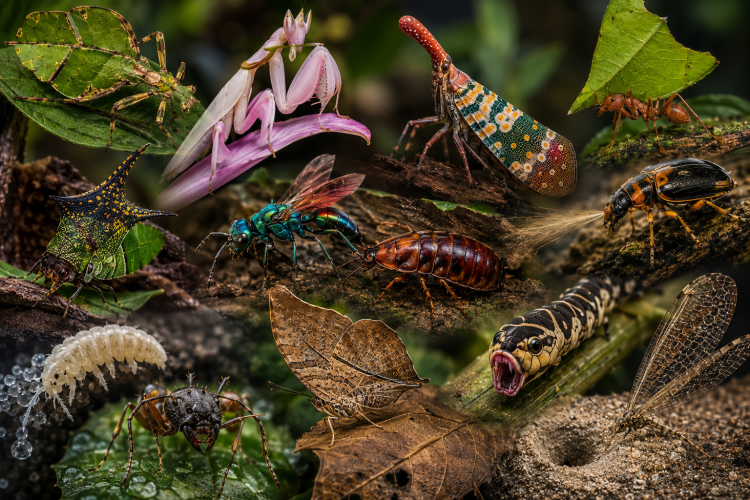
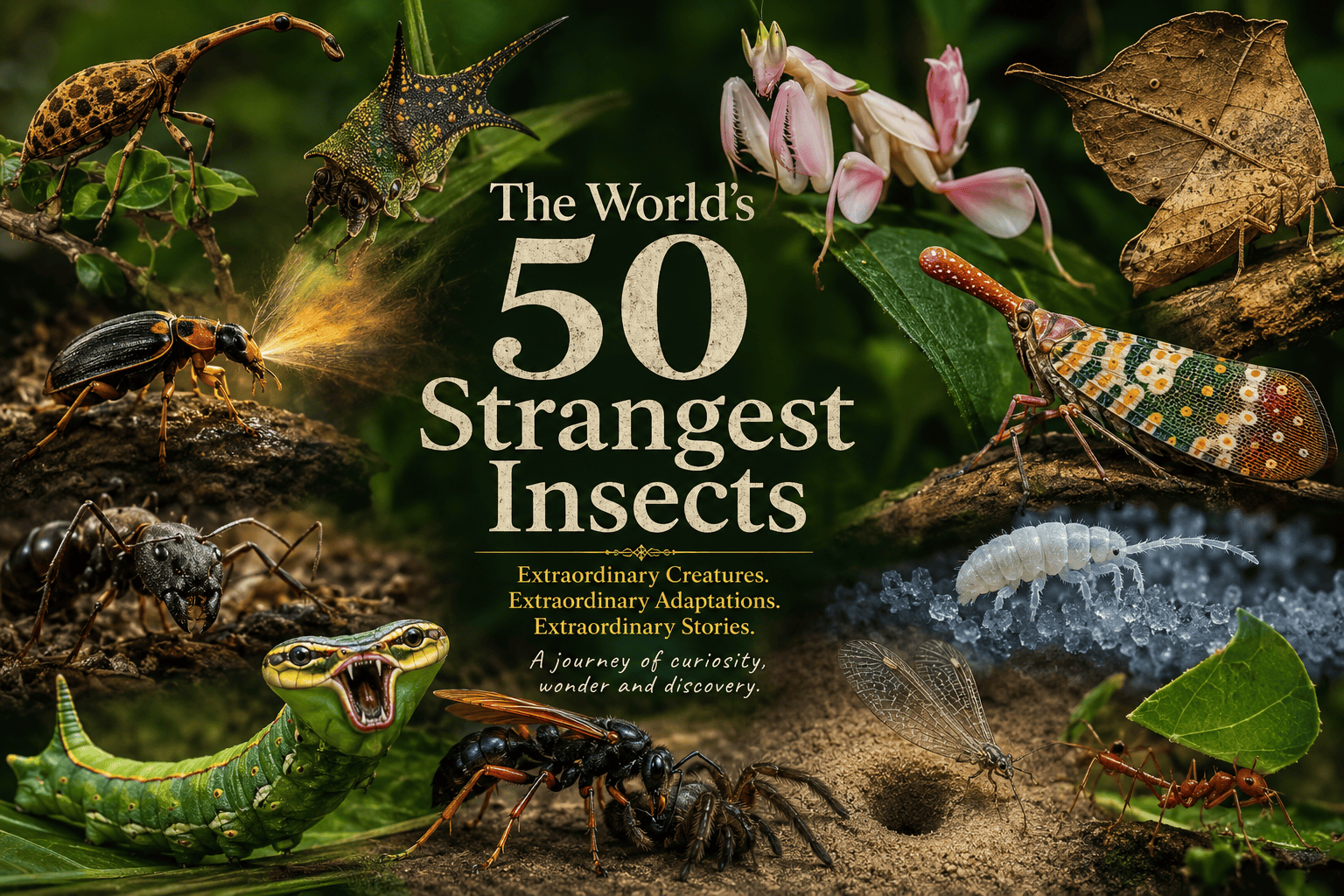
| What exactly makes an insect strange? There is, unsurprisingly, no scientific category called “strange insect”. A beetle does not become strange because its head looks peculiar to us, nor does a caterpillar qualify because somebody has taken an especially dramatic photograph of it. What interests me much more is what lies behind the appearance. Why would an insect resemble a dead leaf so convincingly that even the damaged edges appear to be there? Why would an ant rupture its own body? Why would a beetle produce a chemical spray sufficiently dramatic to earn it the name bombardier? Why would a caterpillar abandon eating plants and become a predator? Why should an insect spend thirteen or seventeen years underground before enormous numbers of its kind appear almost simultaneously? Then some insects don’t look especially peculiar at all. Aphids are familiar to almost every gardener. They hardly seem candidates for a collection of the world’s strangest insects until we begin examining their reproductive biology. Ants are equally familiar, but some cultivate fungi, some use their own larvae as silk-producing tools, some turn workers into living food stores and others construct temporary nests from their own bodies. The more closely we look, the less useful appearance becomes as our measure of strangeness. That is what this series is really about. Fifty different solutions Over ten episodes, we are going to meet fifty insects from around the world. Some will come from tropical forests, others from deserts, freshwater, mountains and ordinary gardens. We will travel from Madagascar and Malaysia to Australia, the Americas, Africa, Europe, Hawaii and even Antarctica. Some of the insects will be immediately spectacular. The giraffe weevil of Madagascar has a neck that looks as though somebody became rather carried away with the design. The Brazilian treehopper carries an extraordinary structure above its body. Orchid and devil’s flower mantises have taken on a resemblance to vegetation in ways that can initially seem almost implausible. Others will require us to look more closely. There are insects that farm, insects that construct, insects that deceive and insects that glow. There are hunters, parasites, mimics and animals capable of surviving environments that seem particularly unwelcoming to insect life. Some manipulate plants. Others depend upon extraordinarily intimate relationships with fungi, bacteria or other animals. Occasionally we will discover that the popular story surrounding an insect isn’t quite true. At other times, rather wonderfully, we may discover that the apparently ridiculous story is essentially correct. Where science doesn’t yet have an answer, we won’t invent one. Evolution hasn’t produced fifty curiosities for our entertainment. It has produced different ways of solving problems: finding food, avoiding becoming food, reproducing, protecting offspring, surviving drought or cold, attracting a mate, fooling a predator and occupying an ecological opportunity before something else does. That is why I want to begin with the word strange, but I’m not entirely sure I want us to finish with it. By insect number fifty, we may have found a better word. |
| Series Directory |
| Episode 1 — Masters of Disguise 1. Giraffe weevil — Trachelophorus giraffa Madagascar, Africa 2. Brazilian treehopper — Bocydium globulare Tropical South America 3. Dead-leaf butterfly — Kallima spp. South, Southeast and East Asia 4. Orchid mantis — Hymenopus coronatus Southeast Asia 5. Malaysian giant leaf insect — Pulchriphyllium giganteum Malaysia and Borneo, Asia Five insects that immediately challenge our eyes, although looking peculiar to us is only the beginning of their stories. |
| Episode 2 — Defence by Extraordinary Means 6. Bombardier beetle — Brachinus spp. and relatives Widely distributed 7. Exploding ant — Colobopsis explodens group Borneo, Asia 8. Corpse-carrying assassin bug — Acanthaspis petax East Africa 9. Tortoise beetles — Cassidinae Worldwide 10. Golden tortoise beetle — Charidotella sexpunctata The Americas Chemical weapons, protective shields, disguise and one defensive strategy that involves making the ultimate sacrifice. |
| Episode 3 — Light, Illusion and Deception 11. Antlion — Myrmeleontidae Widely distributed 12. Railroad worm — Phengodidae The Americas 13. Firefly — Lampyridae Worldwide 14. Lanternfly — Fulgoridae Primarily tropical and subtropical regions 15. Peanut-headed lanternfly — Fulgora laternaria Central and South America An episode in which appearances become increasingly unreliable, light becomes a language, and some old natural-history stories require another look. |
| Episode 4 — Living Between Water, Ice and Desert 16. Thorn bug — Umbonia crassicornis The Americas 17. Waxy planthoppers — Fulgoroidea Worldwide 18. Water scorpion — Nepidae Worldwide 19. Giant water bug — Belostomatidae Worldwide 20. Water strider — Gerridae Worldwide From plant stems to freshwater, these insects demonstrate how apparently ordinary habitats harbour decidedly unusual survival strategies. |
| Episode 5 — Where Insects Shouldn’t Really Work 21. Hawaiian aquatic caterpillars — Hyposmocoma spp. Hawaiian Islands, Pacific 22. Ice crawler — Grylloblattodea North America and East Asia 23. Antarctic midge — Belgica antarctica Antarctica 24. Desert locust — Schistocerca gregaria Africa and Asia 25. Periodical cicadas — Magicicada spp. Eastern North America Underwater caterpillars, insects associated with ice, an Antarctic survivor, a transformation from solitary grasshopper to swarm and an animal prepared to wait seventeen years for its moment. |
| Episode 6 — When Another Organism Becomes Part of the Plan 26. Massospora-infected periodical cicadas — Magicicada spp. North America 27. Twisted-wing parasites — Strepsiptera Worldwide 28. Emerald cockroach wasp — Ampulex compressa Africa and Asia 29. Tarantula hawks — Pepsini Several continents 30. Fairyflies — Mymaridae Worldwide Some of the most extraordinary relationships in insect biology, where another animal can become host, nursery, transport or something rather more unsettling. |
| Episode 7 — Farmers, Builders and Plant Manipulators 31. Fig wasps — Agaonidae and associated fig wasps Tropical and subtropical regions 32. Gall wasps — Cynipidae Especially temperate Northern Hemisphere regions 33. Leafcutter ants — Atta and Acromyrmex The Americas 34. Honeypot ants Australia, North America and other arid regions 35. Weaver ants — Oecophylla Africa, Asia and Australia Agriculture didn’t begin with us. Neither did sophisticated construction, food storage or manipulating another organism to provide precisely what was needed. |
| Episode 8 — The Extraordinary Society of Insects 36. Army ants Tropical Africa, Asia and the Americas 37. Slave-making ants Europe, Asia and North America 38. Aphids — Aphidoidea Worldwide 39. Scale insects — Coccoidea Worldwide 40. Cochineal — Dactylopius coccus Originally the Americas Some live in immense moving societies; others barely move at all. Here we look at cooperation, exploitation, extraordinary reproduction and insects whose influence has reached surprisingly far into human history. |
| Episode 9 — Lives That Take Unexpected Turns 41. Bagworm moths — Psychidae Worldwide 42. Hawaiian carnivorous caterpillars — Eupithecia spp. Hawaiian Islands 43. Bone-house wasp — Deuteragenia ossarium Southeast China 44. Bee-wolf — Philanthus triangulum Europe, Africa and Asia 45. Oil beetles — Meloe spp. Europe and other temperate regions Portable homes, predatory caterpillars, nests protected with dead ants, bacterial partnerships and young beetles that use other insects as transport. |
| Episode 10 — One Last Look at What an Insect Can Be 46. Devil’s flower mantis — Idolomantis diabolica East Africa 47. Walking stick insects — Phasmatodea Worldwide, particularly tropical regions 48. Dragon-headed caterpillars — Polyura spp. Asia and Australasia 49. Scorpionflies — Mecoptera Mainly temperate regions of the Northern Hemisphere 50. Termites — Termitoidae Worldwide, especially tropical and subtropical regions We finish with mimicry, transformation, unusual courtship and some of the most sophisticated insect-built environments on Earth, before returning to the question with which we began: after meeting all fifty, do they still seem quite so strange? |
| Ten episodes. Fifty insects. Fifty rather different ways of being alive. Some I recognise from gardens, some connect with insects I encountered during childhood or my years working with exotic livestock, and many I have never encountered at all. That is a good reason to investigate them. Because there is one thing that hasn’t changed much since I was the boy keeping bug farms under his bed. I still want to know what they’re doing. And why. |
| About our writing & imagery Most articles reflect our real gardening experience and reflection. Some use AI in drafting or research, but never for voice or authority. Featured images may show our photos, original AI-generated visuals, or, where stated, images credited to others. All content is shaped and edited by Earthly Comforts, expressing our own views. |

