| A 5-Part Series |
| A curated exploration of North America’s most iconic, curious, and ecologically important insects |
| Part One Ants, Bees & Wasps: Networks Across Extremes |
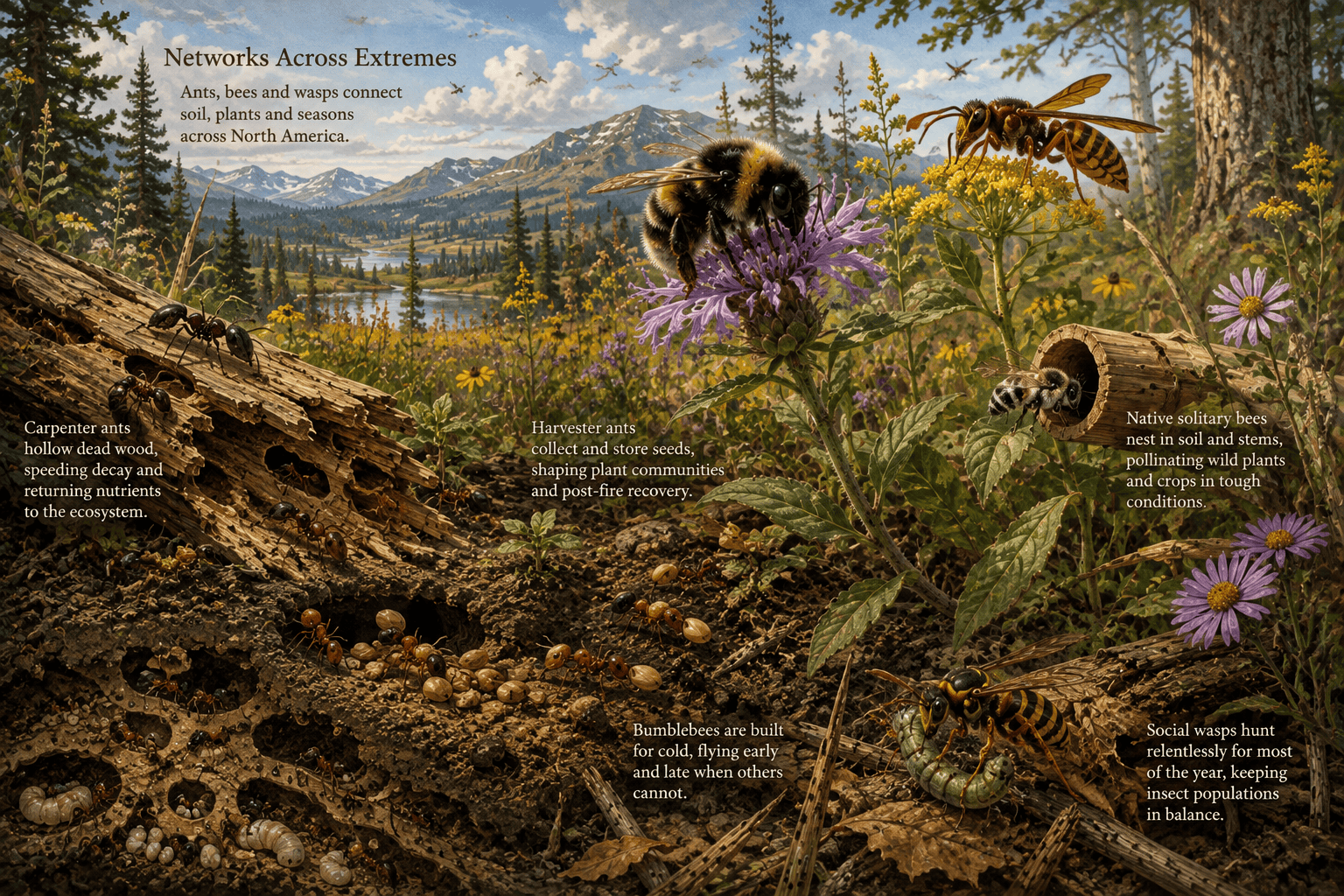
| North America is a continent of contrasts. In the far north, insects must endure frozen ground, short summers and narrow windows for feeding and reproduction. Further south, heat, drought and long dry periods create entirely different pressures. Between the two lie forests, prairies, deserts, mountains, wetlands, farmland and cities, each presenting its own opportunities and difficulties. Ants, bees and wasps thrive across all of them, partly because of their flexibility but also because of the systems they create around themselves. Ants move soil and seeds, bees connect flowering plants across considerable distances, and wasps regulate insect populations that can rise rapidly during favourable seasons. Their influence is often far greater than their size suggests. A colony in a cold northern region may spend months protected beneath the soil, while another species in a hot, dry landscape times its activity around brief changes in temperature and moisture. The problem is fundamentally the same — survive long enough to reproduce — but the solutions vary enormously. For a gardener, there is something familiar in this. Plants behave differently according to where they grow, and insects are no different. The creatures occupying a damp woodland will not behave exactly like those living on open prairie, desert margins or at altitude. Yet the underlying principle remains remarkably consistent: successful species become very good at reading the conditions around them. Ants beneath the landscape Ants are among the most important soil-moving insects on the continent. Their colonies transport fine particles, organic matter and seeds, continually altering the ground beneath them. From the surface, their activity may appear insignificant — a little mound of earth beside a path or a line of workers disappearing into a crack — but underground the system can be extensive. Their nests also function as miniature climate regulators. Tunnels and chambers provide more stable conditions than those found at the surface, protecting colonies from extremes of temperature and moisture. In cold regions, ants can retreat deeper into the soil where temperatures fluctuate less sharply. In hot areas, many adjust their activity to avoid dangerous surface heat, emerging during cooler periods or responding quickly when moisture becomes available. Gardeners sometimes regard ant nests primarily as a nuisance because they disturb soil or appear beneath paving. Ecologically, however, that movement can be beneficial. Soil is loosened, air and water penetrate more easily, and organic material is carried below the surface. An ant colony beneath a patio can be genuinely inconvenient, whereas the same activity in open soil contributes to soil structure. As so often happens in gardening, whether something is a problem depends very much on where it happens. Carpenter ants and the value of decay Carpenter ants are particularly misunderstood because of their association with timber. Unlike termites, they do not consume wood as food. Instead, they excavate galleries within dead, damp or weakened timber to create nesting space. In buildings, this can certainly become troublesome, particularly where structural timber is already compromised, but in woodland their activity forms part of a much larger process of decomposition. Dead wood is not wasted material. Fallen trunks, branches and old stumps contain nutrients that eventually need to return to the soil. By opening galleries in timber, carpenter ants allow moisture, fungi, and other decomposing organisms to gain access. The solid structure gradually softens and breaks apart, eventually becoming part of the ground from which new growth emerges. This is worth remembering in gardens, where dead wood has traditionally been treated as something to remove. A stump allowed to decay or a few logs left somewhere unobtrusive can support beetles, fungi, ants and numerous other organisms. There is obviously a difference between useful deadwood habitat and leaving hazardous branches or diseased material lying around, but ecological tidiness is not always the same thing as visual tidiness. Harvester ants and the future of plants In drier landscapes, harvester ants specialise in collecting seeds. Large quantities are carried underground and stored, providing food when surface resources become scarce. These subterranean granaries help colonies survive difficult periods, but they also influence the vegetation growing above them. Some collected seeds are eaten, while others are dropped, discarded or moved into locations where they may eventually germinate. After drought or fire, this redistribution can help determine which plants return and where they establish. What looks like a simple act of gathering food can therefore have consequences for the landscape’s future composition. Gardeners encounter smaller versions of this constantly. Plants appear in places where nobody deliberately planted them because wind, birds, mammals or insects have carried seeds. We tend to call them self-seeders, although the plant itself may have had remarkably little say in where the seed eventually landed. Harvester ants remind us that insects continually rearrange vegetation around them, often in ways that become visible only much later. The quiet majority of bees When people think of bees in North America, managed honeybees often receive most of the attention. Yet the continent supports an extraordinary diversity of native bees, and many live solitary rather than social lives. Individual females create nests in soil, hollow stems, old beetle holes, banks, and other sheltered spaces, often emerging for relatively short periods that closely coincide with the flowering of particular plants. Their work can easily pass unnoticed because there is no large hive announcing their presence. Nevertheless, native solitary bees contribute enormously to the pollination of wild plants and crops. Some operate in weather or conditions that make other pollinators less effective, and certain species are particularly well suited to particular flowers. This challenges the widespread assumption that supporting bees means planting flowers or keeping honeybees. Flowers are obviously important, but insects also need somewhere to complete the rest of their lives. Bare patches of soil, hollow stems, old timber and relatively undisturbed corners may provide nesting habitat that an immaculate garden lacks. Sometimes helping wildlife requires adding something; occasionally it simply requires leaving something alone. Bumblebees built for cold Bumblebees occupy another distinctive niche. Their comparatively large bodies and dense covering of hairs help them retain heat. At the same time, muscular activity allows them to raise their body temperature sufficiently to fly when conditions are too cool for many other insects. This gives them access to flowers early in spring, during cool weather and later into the year. For plants flowering outside the warmest months, this matters enormously. Bumblebees help bridge gaps in the pollination calendar when many other species remain inactive. Gardeners often witness this without giving it much thought. On a chilly spring morning when very little seems to be moving, a bumblebee may already be methodically working its way through flowering shrubs, fruit blossom or early perennials. There is something rather appropriate about their cumbersome build, allowing them to operate under difficult conditions. They look less delicate than many bees because delicacy would not necessarily serve them well. Their form reflects the environment in which they work. Wasps as regulators Social wasps suffer from a rather different problem: most people remember them from the relatively short period when their lives overlap noticeably with ours. Late-summer encounters around food and drink have done considerable damage to their reputation, yet for much of the season they are busy hunting other insects. Developing wasp larvae require protein, so workers capture caterpillars, flies and many other invertebrates. In doing so, colonies help regulate populations that might otherwise increase rapidly during warm weather. The wasp bothering us beside a glass in August belongs to a species that may have spent much of the previous summer quietly removing insects from gardens, hedges and trees. This is one of those uncomfortable ecological truths that gardening repeatedly reveals. The creature we dislike may be controlling another creature we would dislike even more. Nature does not divide itself conveniently into beneficial insects and pests. Species interact, compete, consume one another and sometimes inconvenience us while simultaneously performing useful ecological work. Living networks across a continent What connects ants, bees and wasps is their ability to create networks across very different environments. Ants alter soil and move seeds beneath our feet. Carpenter ants help return dead timber to circulation. Harvester ants influence future plant communities. Solitary bees connect flowers across local landscapes, while bumblebees extend pollination into colder conditions. Wasps provide another layer of regulation by responding to the insects feeding among those plants. None of these relationships operates independently. Soil affects plants; plants support insects; insects pollinate or consume those plants; and predators, in turn, influence the insects. Across a continent where elevation, climate and season vary enormously, these relationships provide a surprising degree of continuity. Their strength lies not simply in numbers but in connection. A colony protected beneath frozen ground, a bumblebee flying through cold spring air, a solitary bee emerging from an old stem and a wasp hunting among summer foliage may appear to have little in common. Yet each represents another small piece of the same ecological machinery. Different landscapes demand different strategies, but the underlying principle remains remarkably familiar. Ecosystems continue functioning because countless organisms perform small jobs repeatedly, usually without attracting much attention. Ants, bees and wasps are particularly good examples. They are everywhere beneath, around and above us, moving soil, carrying seeds, joining plants together and keeping other populations in check. Much of North America’s landscape quite literally works around them. |
| About our writing & imagery Most articles reflect our real gardening experience and reflection. Some use AI in drafting or research, but never for voice or authority. Featured images may show our photos, original AI-generated visuals, or, where stated, images credited to others. All content is shaped and edited by Earthly Comforts, expressing our own views. |

