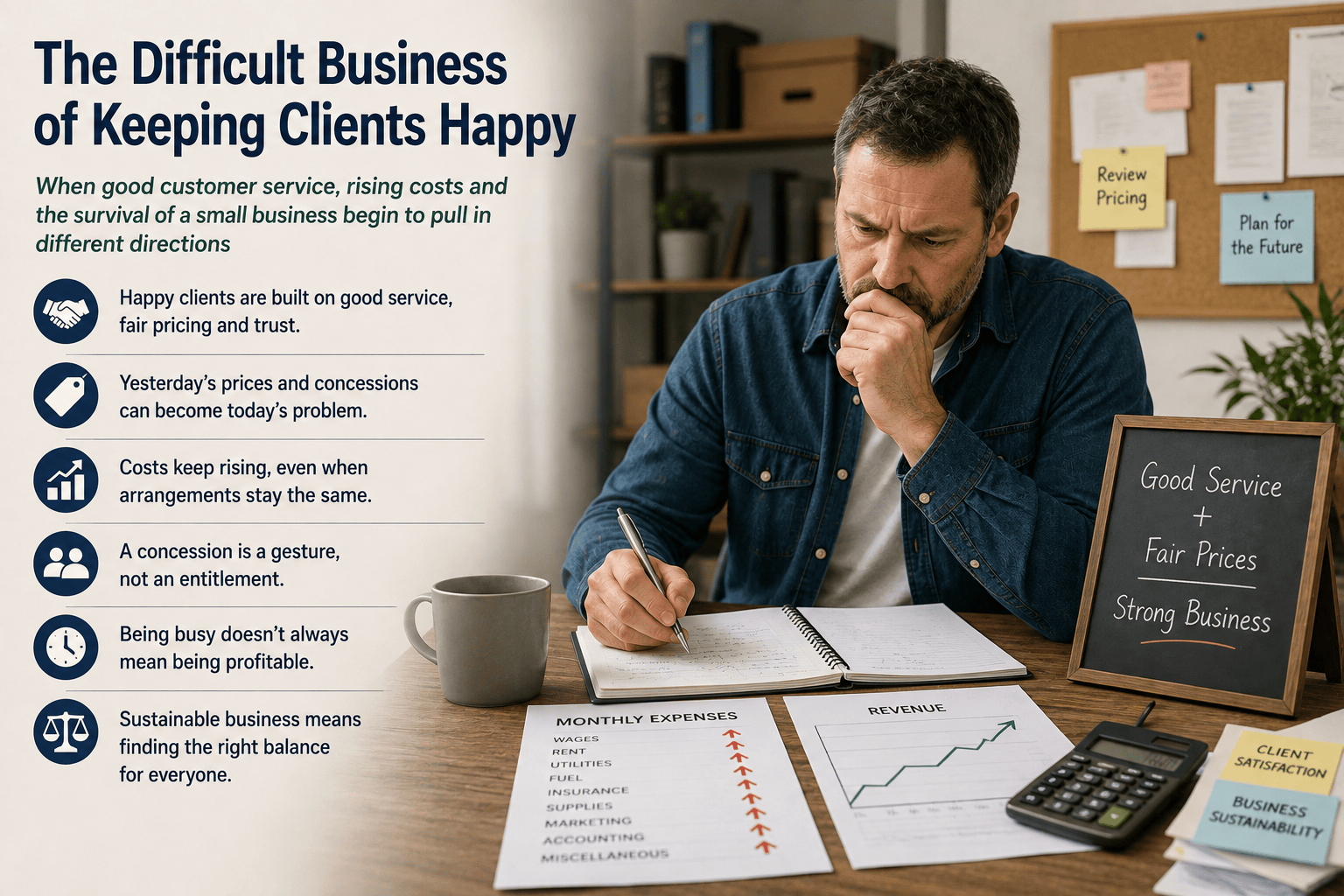
| When good customer service, rising costs and the survival of a small business begin to pull in different directions |
| Every small business wants happy clients. It sounds simple enough: look after people, provide a good service, charge fairly, deal with problems when they arise, and hopefully those clients stay with you for years. For many small businesses, particularly those providing personal services, those long-standing relationships are enormously important. The difficulty comes when keeping a client happy starts making it harder to keep the business itself healthy. It is an uncomfortable subject because no one running a good business wants to lose clients, particularly those they may have worked with for many years. Yet there comes a point when trying to preserve every old price, concession, and arrangement can begin to work against the very business that provides the service. When Good Service Isn’t the Problem There are really two ways a client can be happy. The first is with the service itself: did we turn up, did we do what we said we would do, was the work carried out properly, is the garden improving, and are we knowledgeable, careful and dependable? These are things that a business can largely control and should always strive to get right. The second is rather different. Is the client still receiving the same price, the same amount of time, the same concessions and the same little extras they have become accustomed to? A client can be extremely happy with the gardening but still be unhappy when the hourly rate increases. They can value their gardener enormously but dislike being told that a very short visit is no longer practical, or that a concession they have enjoyed for years needs to change. None of that necessarily means the service has become worse. More often, it means the economics surrounding that service have changed. The Problem With Yesterday’s Prices Small businesses often begin with arrangements that are perfectly reasonable at the time. An early client might receive a favourable rate, somebody elderly may be given a concession, a small job might be fitted between two larger ones, or green waste may be taken away without anyone giving much thought to what disposing of it actually costs. You help somebody out, then somebody else, and gradually these arrangements become part of the way the business operates. There is nothing inherently wrong with that. In many ways, those personal relationships and occasional acts of generosity are among the great strengths of a small business. The problem arises when temporary generosity gradually becomes a permanent business model: while the arrangement remains unchanged, almost everything around it keeps getting more expensive. Wages rise, fuel costs change, vehicles need maintenance, machinery wears out, and insurance, administration, and waste disposal all have to be paid for. Eventually, the amount charged several years ago cannot purchase what it once did. The client understandably remembers the price they used to pay; the business has to remember what it now costs to provide the service. When a Concession Becomes an Expectation There is also a subtle but important difference between a concession and an entitlement. A concession is something a business chooses to give: a lower rate for a longstanding client, a shorter visit than would normally be practical, or an occasional extra job carried out without charge. When something continues for long enough, however, it understandably begins to feel normal, and changing it can feel as though something is being taken away. That is why conversations about prices can become surprisingly difficult. A client may reasonably think, I’ve been with you for years, so why am I now paying more? The business may reasonably think, “You’ve been with us for years, which is why we’ve tried to protect you from the full increase for as long as possible.” Both perspectives can be genuine, and neither necessarily makes the other unreasonable. Loyalty matters, and long-term clients should be valued, but loyalty has to work in both directions. A business cannot demonstrate loyalty by indefinitely providing a service at a level that no longer covers its real cost. The Danger of Being Busy One of the stranger lessons of running a small business is discovering that being busy doesn’t necessarily mean being successful. A gardening company can have a full diary; every gardener can be working; the van can be travelling from one client to another all day; and the telephone can keep ringing. Yet, the business can still struggle to make enough money. Every working hour has a cost. If too many of those hours are being sold below the level required to support wages, vehicles, equipment, waste disposal, insurance and administration, being busier can mean working harder without building a stronger business. This is one of the most dangerous positions for a small company to find itself in: busy, but not sufficiently profitable. Eventually something has to give. Machinery isn’t replaced when it should be, wages struggle to remain competitive, more work has to be squeezed into each day, and the owner works increasingly long hours to compensate. Ironically, trying too hard to protect every client’s existing arrangement can eventually damage the quality of service received by all the other clients as well. Every Hour Has Another Possible Customer Service businesses also have something that cannot simply be manufactured when demand increases: time. There are only so many gardeners, workable hours and gardens that can physically be visited during a week. Once those hours are full, every hour allocated to one client is unavailable to someone else. This is where opportunity cost becomes important. Suppose a heavily discounted client occupies several hours each month. Those hours aren’t simply producing less income than they might otherwise produce; they are also unavailable to another client who may want longer, regular visits and be willing to pay the sustainable rate. When demand is strong, repeatedly accepting poorly priced work can therefore do more than reduce profit. It can actively prevent better work from entering the business. That leads to an uncomfortable expression which contains more truth than it might initially appear: sometimes you have to lose business to gain business. I don’t believe that means deliberately getting rid of customers. The objective should instead be to honestly establish the conditions under which the business can continue to provide a good service and allow clients to decide whether those conditions still work for them. Some will accept a price change, some may reduce the frequency of their visits, and others may reduce the amount of work they have done. Occasionally somebody will decide that the service no longer suits them and leave. Losing a longstanding client is never particularly pleasant, but it doesn’t automatically mean the business has made the wrong decision. Not Every Client Will Be Happy One of the hardest things for anybody running a small business to accept is that you cannot make everybody happy. There will always be somebody who remembers what something used to cost, somebody who dislikes a minimum visit, somebody who thinks waste disposal should be included, or somebody who doesn’t understand why travelling to a property for a very short job may no longer be economical. Trying to prevent every one of those clients from leaving can itself become extraordinarily expensive. Price is also only one measure of value. Reliability, knowledge, proper equipment, insurance, experienced staff and knowing that somebody will actually deal with a problem when it arises all have value. A professional gardening business cannot indefinitely compete with someone whose only competitive advantage is charging less, nor should it necessarily try to. That doesn’t mean dismissing concerns about affordability—quite the opposite. Where possible, a good business should look for alternatives: perhaps fewer visits, different priorities within the garden or a different way of organising the work. The important distinction is between finding a sensible solution for a client and subsidising an arrangement that is no longer sustainable. The Garden Is Changing Too For gardening businesses, another pressure isn’t simply financial: the gardens themselves are changing. Long dry periods can leave ground extremely difficult to work, sudden heavy rainfall can produce explosive growth, mild winters can extend growing seasons, and plants can experience stresses that might once have occurred only occasionally. This means a garden that historically required a certain number of hours may increasingly need more intervention to maintain the same standard. Postponing work doesn’t necessarily save money either. A hedge left too long becomes a bigger job, weeds allowed to establish become more expensive to remove, and shrubs neglected beyond a certain point can move from routine maintenance into recovery work. Sometimes advising a client to spend a little more now is therefore an attempt to prevent them spending considerably more later. That can be difficult to explain because the additional cost is visible today, whereas the higher cost being avoided may never be seen. When a Small Business Grows Up There is also a point at which a small business fundamentally changes. Initially, an owner is selling their own time. If I choose to give somebody an additional half-hour or charge a longstanding client slightly less, I am personally absorbing much of that difference. Once a business employs people, however, the equation changes. Wages have to be paid, vehicles maintained, equipment purchased and replaced, administration completed, and all the other infrastructure required to put a gardener outside somebody’s front door has to be funded. Pricing can no longer be based on what the owner is personally prepared to work for. The question changes from What am I prepared to charge for my time? to What does this business need to charge to continue employing people and providing the service properly? That is a very different calculation, and it is one that every growing service business eventually has to make. The Clients We Want to Keep None of this means longstanding clients become less important. In fact, a good long-term client is enormously valuable. We get to know their garden; they get to know us; trust develops, and decisions become easier because there is history behind the relationship. Those relationships are worth protecting, and where it remains sensible, there may still be room for concessions. The important point is that a concession must remain something the business can afford to give. It cannot become an arrangement that threatens the viability of providing the service in the first place. There is little benefit in keeping somebody’s gardening bill artificially low if doing so eventually leaves their gardener unable to provide the service at all. This may mean we need a broader definition of client care. Keeping clients happy doesn’t necessarily mean never increasing prices, saying yes to every request, or preserving every historic arrangement indefinitely. Nor does it mean absorbing every additional cost because we are afraid someone might leave. Good client care means being reliable, honest and fair. It means doing good work, explaining changes properly and trying to find alternatives when someone’s budget is under pressure. It also sometimes means being prepared to explain that an arrangement that worked several years ago no longer works. Some clients will leave. Others will stay, and new clients will arrive. Hopefully, those who remain are people who value what the business provides rather than simply what it used to cost. Perhaps, then, the old expression isn’t quite right. You don’t have to lose business to gain business, but sometimes you have to be willing to lose business to build a better one. For a small business, that can be one of the hardest lessons of all. The aim, after all, isn’t simply to keep every client at any cost. It is to build a business strong enough to continue looking after its clients for many years to come. |
| About our writing & imagery Most articles reflect our real gardening experience and reflection. Some use AI in drafting or research, but never for voice or authority. Featured images may show our photographs, original AI-generated artwork, or, where stated, credited images shared by others. All content is shaped and edited by Earthly Comforts, expressing our own views. |

