
| Series One Episode Two The Garden Before Gardens |
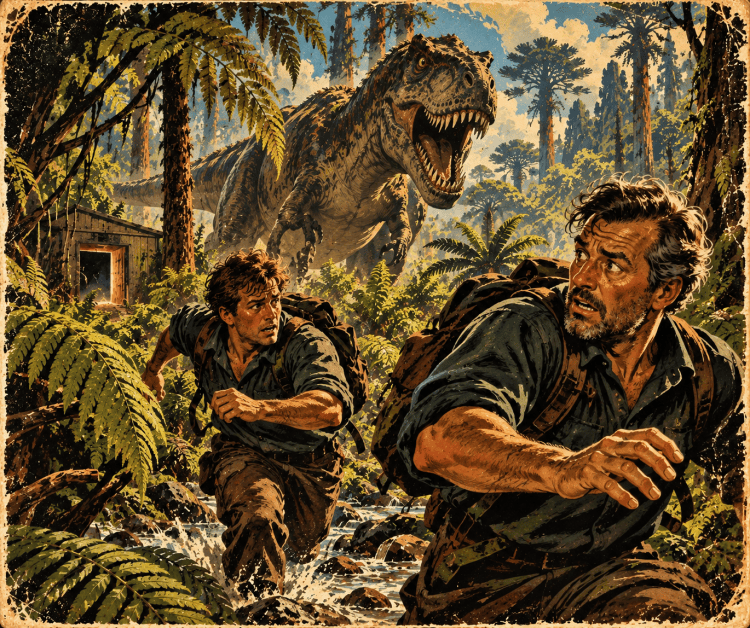
| There are occasions when being a gardener gives you a useful advantage. You learn to notice things. You become reasonably good at looking at soil, plants, weather and water and working out what is happening before somebody has to explain it to you. You also spend enough time outdoors to know when an environment feels wrong. Only moments earlier I’d been clearing a garden shed on an ordinary September day in Kent. Now I was standing on damp soil among enormous ferns in warm, humid air that felt positively tropical. I was fairly confident something was wrong. John was still looking at me through the hole I’d made when I fell backwards with the box. From his side I could see shelves, pots and the dim interior of the shed behind him. From mine there was damp earth beneath my boots, dense vegetation ahead and sunlight coming through a canopy that absolutely could not have fitted between the shed and the boundary fence. “Can you get back?” he asked. I told him probably, which didn’t appear to reassure him. “You’ve just fallen through the back of a shed, Rory,” I assured him; I was aware of that. The drop hadn’t been enormous, perhaps a couple of feet from the opening to the ground, and nothing appeared damaged apart from my dignity. What concerned me rather more was the complete absence of the shed itself on my side. I had expected to turn around and see its timber back wall, perhaps with a hole where the box and I had somehow broken through. Instead, the opening appeared in a low earth bank among roots and vegetation. Through it I could see John kneeling on the shed floor, but around it there was no timber wall, no roof and certainly no client’s garden. I looked around again. The plant beside me resembled a fern but was taller than I was, and beyond it were more fern-like plants, cycads, and unfamiliar forms, all mixed among trunks disappearing into the canopy. The ground was dark and damp beneath a thick layer of fallen vegetation. I crouched and rubbed a little of the soil between my fingers, which prompted John to ask whether I was seriously examining the soil after falling through an impossible hole in somebody’s shed. I pointed out that it might tell us something. When he asked what, I had to admit I didn’t yet know. The air was alive with noise. Insects buzzed and clicked around the vegetation, leaves moved somewhere high above me and from much farther away came a deep, resonant call unlike anything I recognised. It wasn’t frightening so much as unfamiliar, although there was something about the depth of it that suggested whatever had made it was substantially larger than a blackbird. I looked back at John and suggested he move a little more of the clutter so I could get back through without knocking over half the shelving. He shifted another box and pulled away a section of old netting, widening the gap enough for me to climb up. I put one hand against the bank and was about to haul myself towards the opening when something moved among the vegetation behind me. It wasn’t close, and I couldn’t see what had caused it, but several large fronds bent aside before slowly springing back into place. John had seen it too. “What was that?” “No idea.” “Big?” “Bigger than I’d like.” He looked past me for a few seconds and then reached behind him for his rucksack. Mine was still on the shed floor beside it. “I’m coming down.” That wasn’t quite the response I’d expected. I suggested that one of us being on the wrong side of the shed was probably enough. Still, John pointed out that if I managed to fall over, get bitten, stung or otherwise incapacitate myself, shouting instructions through a hole wasn’t going to be particularly useful. He had a point. He passed my rucksack down first, then his own, before turning around and lowering himself feet-first through the opening. I guided one of his boots onto the bank, and he dropped the remaining distance beside me. Neither of us was planning an expedition. The bags came with us simply because they contained our water, phones, lunches and most of the useful equipment we’d brought to work that morning, and leaving them sitting unattended in a half-cleared shed while we worked out what was happening seemed pointless. We had folding saws, secateurs, trowels, knives, gloves, twine, antiseptic, insect spray, food, drinks and all the other bits and pieces that accumulate in working bags. Perfectly sensible equipment for two gardeners. Rather less impressive if the nearest garden centre happened to be several million years away. John stood beside me and looked around. “Well,” he said after a while, “that’s definitely not behind the shed.” It was difficult to disagree. We stayed close to the opening at first. Neither of us had any intention of losing sight of it, and there was plenty to examine without going far. The temperature was considerably warmer than the September afternoon we’d just left, with humidity that sat heavily against the skin. Everything smelled of wet earth, vegetation and decay, not unpleasantly but richly, as though growth and decomposition were happening around us at extraordinary speed. The plants were what interested me most. There were ferns at scales that made familiar garden varieties look ornamental, cycads and conifer-like trees, along with other forms I recognised only vaguely. More striking was what I wasn’t seeing. There were no obvious flowering plants, grasses or familiar broad-leaved weeds. No brambles, nettles, docks, plantains or any of the ordinary vegetation that makes even an unfamiliar modern landscape feel recognisable. John suggested it might simply be the wrong season. That was possible, but the whole structure of the place felt different. We could hear running water somewhere below us, and from where we stood I could see occasional flashes of reflected light through the foliage. It wasn’t far away. More importantly, the opening remained clearly visible behind us. We agreed to go no farther than the water, have a look and come straight back. John suggested five minutes. I suggested ten. We settled on five, which probably tells you how seriously either of us regarded the agreement. The ground dropped gently through the vegetation until we reached a shallow stream perhaps twenty or thirty yards from the opening. Clear water ran between stones and fallen branches, crowded on both sides by dense growth. I crouched to look at it, prompting John to remind me not to drink anything. I hadn’t intended to; our own bottles were full, and there was no sensible reason to discover what microorganisms might inhabit water in a place we couldn’t even locate on a map. What interested me was the ground around it. Fallen fronds, dead branches, bark and decaying timber lay everywhere, with new growth pushing straight through the remains. Nothing had ever been swept, cut back, pruned or tidied. Nobody had cleared deadwood, improved the drainage or decided that a particular plant was getting rather too large for the space. This wasn’t an abandoned garden. It was something much older: vegetation simply doing what vegetation had done before anybody invented borders, lawns, or the expression “low maintenance”. “It could do with a tidy,” John said. “We’d need more bags.” That was the first time either of us laughed properly. Then something moved on the opposite side of the stream. Several large fronds bent aside and slowly returned to position. Whatever was responsible remained hidden, but the movement was substantial enough to stop us both talking. John suggested a deer. I said perhaps. He pointed out that it hadn’t looked much like the movement of a deer, so I offered a large deer instead. Neither of us found that especially convincing. We waited, but nothing appeared. Whatever had been moving seemed to be heading away from us, and after another minute the vegetation settled. That was enough exploring. We had seen more than enough to establish that whatever lay behind the shed was impossible, and staying any longer increased the chance of discovering something we’d rather not meet. We turned back towards the opening. It was still there, visible through the vegetation exactly where we’d left it. From this distance it looked like a dark rectangle cut into the bank, and through it I could make out the lighter interior of the shed beyond. That little patch of Kent suddenly looked remarkably inviting. We had covered half the distance when something stepped from the vegetation to our right. At first I couldn’t make sense of it. My brain tried to fit the animal into something familiar because that’s what brains do when presented with something unexpected. The horse was approximately the right animal, but the proportions were completely wrong. It stood primarily on powerful hind legs, balanced by a long tail, with a smaller upper body held above the surrounding vegetation. It wasn’t enormous, which somehow made the situation more convincing. A huge shape in the distance can be mistaken for almost anything. This was close enough for both of us to see properly. It was a dinosaur. For several seconds neither John nor I said anything. The animal looked towards us but did not attempt to approach. Then it lowered its head and began pulling at the vegetation. That was reassuring enough for me to point out that it appeared to be a herbivore. John reminded me that bears occasionally ate plants as well and suggested that I refrain from using diet as a complete risk assessment. We stood still and watched. Once the initial shock had settled into something approaching disbelief, I found myself becoming fascinated by what it was eating. The animal ignored the tougher fern fronds and repeatedly selected softer growth around a low cycad. Whether it was choosing younger foliage because it was easier to digest or preferred the taste, I had no idea. Still, I was trying to work it out when John nudged me and reminded me that there was an open garden shed behind us and perhaps this wasn’t the moment to conduct a feeding study. He was right. The dinosaur appeared uninterested in us, so we began moving slowly towards the opening again. It raised its head once, watched us for a few seconds and returned to feeding. Another ten yards and we’d be beneath the low bank. From there we’d only have to climb the couple of feet back into the shed, pull our rucksacks through and decide how on earth we were going to explain any of this to the client. We were almost there when something called from the vegetation farther to our left. The feeding dinosaur reacted before we did. Its head snapped up, and its entire posture changed. For a moment it stood completely still, listening. Then it turned and ran. That worried me considerably more than seeing it in the first place. It crashed through the vegetation with surprising speed and disappeared among the ferns and cycads, leaving branches moving in its wake. John and I looked towards the place where the call had come from. Another sounded a few seconds later. Closer. We didn’t need to discuss what to do. We quickly covered the remaining distance to the bank. John reached it first and scrambled up towards the opening, which was still a couple of feet above ground level. He took off his rucksack and tried to push it into the shed before hauling himself after it, but one of the shoulder straps caught on a piece of timber protruding from the other side. He pulled it back and tried again while I started climbing behind him. Then we saw the head. It appeared above the lower vegetation perhaps thirty yards away and disappeared almost immediately, but we’d seen enough. I had no idea what species it was and no desire whatsoever to get close enough to improve my identification. It was considerably larger than the animal that had just run away, and the shape of its jaws contained rather more teeth than I felt comfortable with. John gave the rucksack another shove. The strap caught again. He swore, pulled it back and tried to free it while I looked over my shoulder. The vegetation was moving towards us now, not away, and whatever was coming had enough mass to push through plants that had slowed us considerably. “Leave the bag.” “It’s got my lunch in it.” “And your saw. I know.” He looked at me. “Bring it. We’re not getting through there now.” The larger animal emerged into clearer ground. There are moments when you stop behaving like a professional gardener and start behaving like an animal that would very much prefer not to be eaten. This was one of them. John yanked his rucksack back onto his shoulder and slid down the bank. The opening was still only a few feet above us, close enough that I could see the old shelving inside the shed. Home was right there. Unfortunately, so was something considerably faster and larger than either of us. We ran. The only clear route was back towards the stream. Roots caught at our boots, fronds slapped across our faces, and the rucksacks bounced against our shoulders as we pushed through vegetation that hadn’t been designed with escaping gardeners in mind. Behind us came the unmistakable crashing of something much larger having considerably less difficulty with the terrain. We reached the stream and crossed without bothering to look for the shallowest point. Water came over the tops of my boots, and John nearly went down on a submerged stone, but we made the opposite bank and pushed into denser growth. The vegetation there slowed us immediately, but that worked both ways. Anything substantially larger would have to force its way through. The crashing behind us stopped. That was almost worse. We kept moving until the stream and the place we’d crossed it disappeared behind the vegetation. Eventually we reached a fallen trunk large enough to give us some cover and crouched behind it, both breathing rather harder than either of us would have admitted during an ordinary day’s work. Nothing followed. We waited for several minutes, listening. Insects gradually resumed their clicking and buzzing. Something called far away, but there was no sound of heavy movement nearby. John looked at me and asked whether I still thought the place needed a tidy. I told him it definitely did, but we might have difficulty providing a quote for it. Once we’d recovered, we tried to work out exactly where we’d come from. The stream was easy enough to find, but the crossing point wasn’t. Running away from a dinosaur does not encourage careful observation of landmarks, and both banks looked frustratingly similar. Eventually I recognised a broken trunk lying partly across the water. From there we crossed again and found the low cycad where the first animal had been feeding. Torn foliage and several deep footprints in the damp soil confirmed that at least that part hadn’t been imagined. The shed opening should have been just beyond it. We moved carefully through the vegetation until we could see the bank. The opening was still there. So was the dinosaur. Not the herbivore. The larger one. We saw part of its tail first, then the body moving slowly among the vegetation immediately between us and the bank. Whether it was investigating the strange opening, searching for us or simply occupying the same piece of ground didn’t particularly matter. There was no way we could get past it without being seen, and we couldn’t identify any other approach to the opening. John and I backed away. Somewhere behind that animal was a twelve-by-eight garden shed in Kent. Beyond it were our sorted piles of pots and rubbish, two mugs on a patio, a client presumably wondering why her gardeners had gone remarkably quiet, and an ordinary September afternoon continuing without us. We were thirty yards from home. We might as well have been on another planet. We waited, hoping the animal would move on. It didn’t. If anything, it settled more firmly into the area around the opening. Neither of us knew whether it had seen us disappear there and was waiting for us to return, but I wasn’t prepared to experiment. We decided it was time we took stock properly. We had our rucksacks, water bottles, lunches and snacks. Between us were folding saws, secateurs, trowels, knives, gloves, twine, antiseptic, insect spray and the usual collection of things that made perfect sense at the beginning of a gardening day. Our phones had no signal. Their batteries would eventually run out anyway. Food would disappear. Water would become a problem if we couldn’t find a safe way of replacing what we drank. The shed was still there, but we couldn’t reach it. That was the point at which our situation stopped being an extraordinary interruption to a day’s work and became something rather more serious. John adjusted the straps of his rucksack and looked back towards the vegetation stretching away behind us. “So what do we do, boss?” There was only one direction the dinosaur wasn’t occupying. We turned away from the shed and began walking. For the first time since I’d fallen through the back of that bloody box, we weren’t exploring. We were trying to find another way home. |
| About our writing & imagery Most articles reflect our real gardening experience and reflection. Some use AI in drafting or research, but never for voice or authority. Featured images may show our photos, original AI-generated visuals, or, where stated, images credited to others. All content is shaped and edited by Earthly Comforts, expressing our own views. |


This is a great story. I enjoyed it, Rory.
LikeLiked by 1 person
Pleasure, thank you Eugenia.
LikeLiked by 1 person
Most welcome, Rory.
LikeLiked by 1 person
A I have read a story like this one when I was in school. Very interesting writing Rory
LikeLiked by 1 person
Thank you Sadje, it was inspired by the what if series and also stories l used to read when young 🙂
LikeLiked by 1 person
Perhaps we read the same book?
LikeLiked by 1 person
I don’t know, what was your book called? 🙂
LikeLiked by 1 person
I don’t remember, besides it was an urdu translation of an English book. The premise was that a large piece of land was separated from the neighboring area and dinosaurs survived there. It was a very interesting story.
LikeLiked by 1 person