| Episode Two — A Working Proposition: The Soil Hub Schematic Subject to Change |
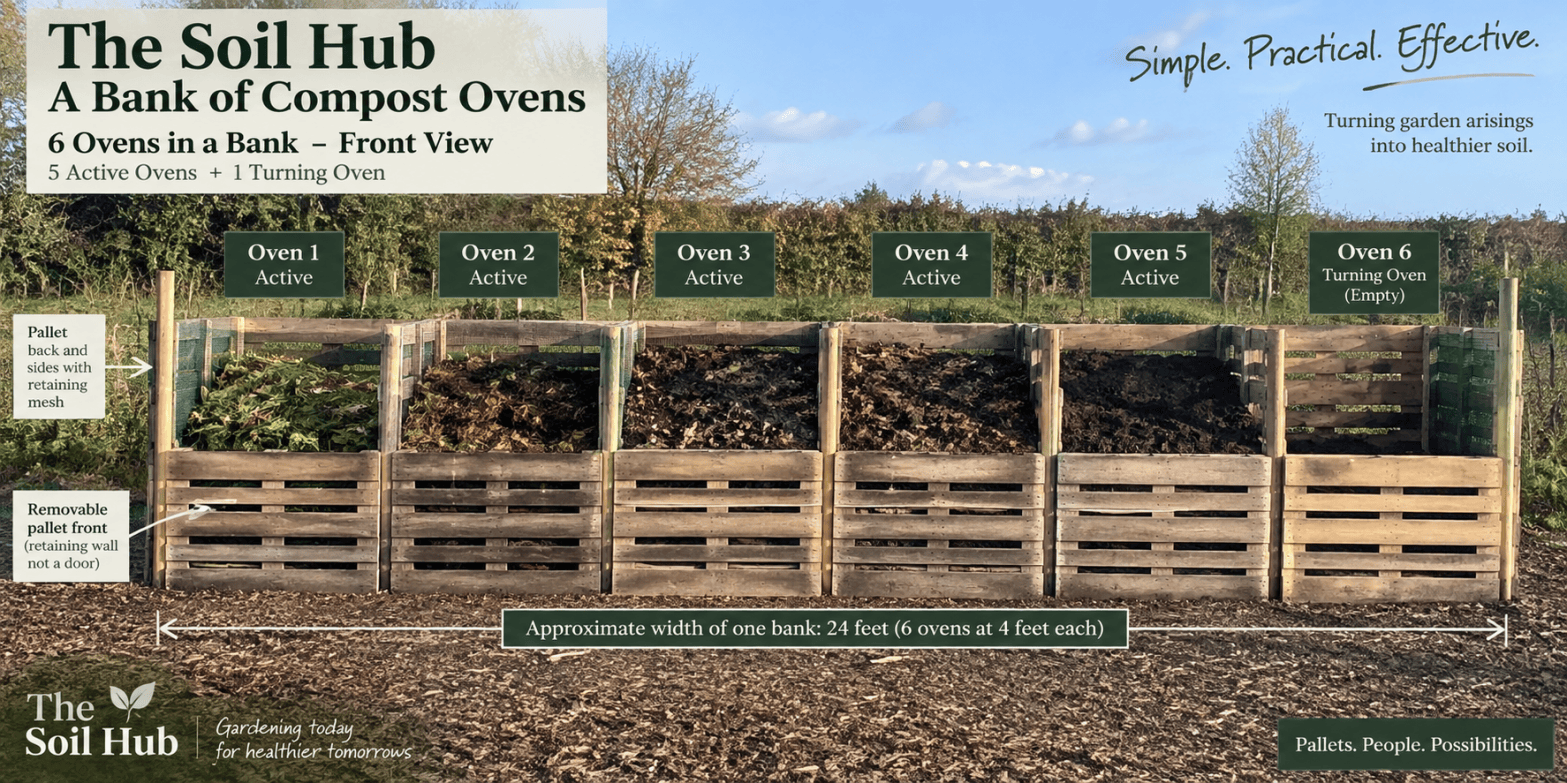
| One thing I am beginning to understand about the Soil Hub is that drawing a plan and building a system are two entirely different things. We have been thinking about this project in one form or another since 2023, and during that time we have had diagrams, calculations, compost ovens, worm farms, storage areas, and several versions of what the finished Hub might eventually look like. Some ideas have survived, and others have already been discarded. Now that we actually have a field outside Sandwich and the accumulated garden material has arrived, theory is rapidly giving way to practicalities. The schematic is changing again, and that isn’t a failure of the original plan. It is precisely what this first year is supposed to discover. The Soil Hub is now being approached as a twelve-month experimental project, running from September 2026 to September 2027. We are not producing bags of compost for sale, marketing a finished product, or assuming this will ultimately become a commercial operation. I am a gardener trying to answer a fairly straightforward question: can we take some of the plant material generated through our gardening work and turn it into genuinely useful material for improving soil? If the answer after twelve months is no, we will have learnt something. If the answer is yes — if the idea really does have teeth — then we can begin asking what comes next. The White Bags Have Changed the Plan The most immediate challenge is already sitting in the field. We have roughly 120 large white bulk bags containing accumulated garden arisings. I have loosely described this as 20 tonnes, though that remains a working estimate. Until we start opening and sorting the bags, we don’t really know their true weight or, more importantly for composting, their useful volume. What we do know is that leaving everything indefinitely in white sacks isn’t what the Soil Hub is for. Once we start opening them, what currently looks like one enormous quantity of green material should begin separating into several different resources. Soft grass and herbaceous material can enter the composting system, fallen leaves can go into dedicated leaf-mould kraals, and woody stems, bamboo, branches and pieces of trunk can be separated for appropriate reuse or removal. Anything unsuitable can be removed from the system altogether. That sorting process is probably when we will first discover what the Soil Hub actually has to deal with. From Three Oven Banks to a Minimum of Four This is one of the most significant changes to the working schematic. Our previous idea was to start with three banks of six compost ovens, for eighteen ovens total. We have now increased that. The minimum starting system will be four banks, and I expect it to grow to eight banks over the next few months if the experiment develops as expected. Each bank consists of six 4 ft × 4 ft × 4 ft pallet composting ovens. Five are working compost ovens and the sixth is deliberately left available as a turning bay. Four banks therefore give us 24 ovens in total — 20 active composting ovens and four turning ovens. Each active oven has a nominal capacity of around 1,812 litres, giving those first twenty working ovens approximately 36,000 litres of composting capacity. If we eventually reach eight banks, the experimental system would contain 48 ovens — 40 active and eight turning — with approximately 72,500 litres of nominal active capacity. That is quite a change from where the schematic stood only a short time ago, but we are not going to build forty working ovens simply because a drawing says we should. We start with four banks, fill them, watch them and learn. We can then add banks five through eight progressively if the material, workload, and results justify them. Small Groups Rather Than One Great Wall We also don’t want forty-eight compost ovens joined together into one enormous structure. Each group of six will stand independently, with approximately ten feet of working space between the banks. This is practical because we need room to work, remove pallet fronts, and turn material from one oven into another, but it also offers another advantage. A series of relatively small composting stations feels much more appropriate to an experimental working garden than one enormous wall of material. The spaces also allow us to treat individual banks as experiments in their own right. Eventually we could have Banks A through H, with ovens A1–A6, B1–B6 and so on. We can compare different mixtures and record different behaviour. If one batch performs particularly well, we can begin asking why. The Hub starts becoming a laboratory without ever needing to look like one. The Ovens Have Become Simpler The ovens themselves have also been stripped back. Earlier ideas involved more complicated fronts and structures, but we no longer think they are necessary. The current oven is a pallet cube with shared walls between neighbouring ovens, while the front is another pallet acting as a removable retaining wall. The first oven in a six-oven bank requires four pallets. Each additional oven shares one wall with its neighbour and therefore requires only three more, meaning a complete six-oven bank uses 19 pallets. Four banks require 76 pallets, while eight would eventually require 152. Given that our reclaimed pallets cost only £1.50 each, this remains an extraordinarily inexpensive way to create substantial composting capacity. The structures can be tied, staked, and braced as necessary, with green retaining mesh used where it helps contain loose vegetation without sealing the ovens off from air. Nothing is intended to be permanent, and that is becoming another principle of the Soil Hub: if the experiment doesn’t work, we should be able to take it apart. Two Receiving Kraals The receiving area has changed too. Rather than one receiving kraal, we now intend to construct two. Each will have a hard pallet back four pallets long, two-pallet-deep sides and a softer staked-and-wired front, requiring eight pallets per kraal. The first gives us somewhere to work through the existing accumulated material. At the same time, the second becomes the receiving area for loose garden material arriving in future rather than simply adding it to the existing stock. Together they add another sixteen pallets to the initial build. Four oven banks and two receiving kraals therefore require approximately 92 pallets, which means we are already remarkably close to having the pallet stock required for the first complete layout. Leaves Get Their Own System Leaves will increasingly be treated separately. There seems little point in filling valuable compost-oven capacity with material that can follow its own slower decomposition process. The leaf-mould kraals will therefore be simpler than the receiving structures, consisting of stakes driven into the ground with double wire or mesh retaining the leaves. No pallets are necessary, and the kraals can expand as autumn progresses. Their contents can largely be allowed to break down slowly into leaf mould and mulch. This is another departure from the idea that the Soil Hub must somehow force every piece of vegetation through the same process. It doesn’t. The Hub should sort first, then process. Paper and Cardboard Become Ingredients Another experiment is emerging around ordinary paper and corrugated cardboard. We encounter plenty of both — old bills, plain paper, and delivery boxes — and anything used at the Hub will be cleaned of unwanted packaging and shredded first. It then becomes a dry, carbon-rich ingredient rather than simply another material to dispose of. If we open a bulk bag containing wet, compacted grass, we can mix shredded cardboard or paper through it. A much drier batch containing coarse stems may need very little. Again, the numbered ovens allow us to test rather than assume. Perhaps an oven containing a particular proportion of shredded cardboard heats more evenly or remains better aerated. Perhaps it doesn’t. We will find out. The Turning Regime Has Changed Our original thinking was extremely slow composting: fill an oven, leave it for perhaps three months, turn it and then leave it again. We have now modified that. The current working proposition is to turn each active oven approximately once every eight weeks, giving a batch around six scheduled turns during twelve months. This isn’t meant to be an inflexible calendar. We will monitor every oven, and if a batch becomes too wet, compacted, or starts behaving as though it needs more air, we can turn it earlier. Temperature, moisture, smell and appearance all become part of the decision. We will also pay greater attention to the early active phase, when fresh material has the greatest biological energy and capacity to generate heat. Towards the end of the cycle, turning can become more intensive as we remix the material and work towards a mature, consistent product suitable for screening. The process is therefore no longer fill, wait, turn and wait. It is becoming sort, mix, fill, monitor, turn, mature, finish and sieve. Records Become Part of the Experiment We will number every oven and record every batch. We will note when it was filled, broadly what went into it, temperature observations, moisture and physical condition, when it was turned, how it responded and eventually how much finished material came out. This isn’t about making the project look impressive. Twelve months from now I don’t want to be saying, “I think that batch worked rather well.” I want to know how many bulk bags filled an oven, how much 1,800 litres of fresh material shrank, how quickly it heated, whether grass-heavy mixtures behaved differently from mixed herbaceous material, whether shredded cardboard helped, whether eight-weekly turning proved sufficient, how long the material took to mature and, perhaps most importantly, how much genuinely useful material we actually produced. Those answers will determine whether the Soil Hub goes any further. A Site That Explains Itself A visual principle is also emerging from these changes. At the moment, a line of large white sacks in a field can look like exactly that: a line of waste sacks. As the Hub develops, those sacks should progressively disappear. In their place will be recognisable composting bays, receiving kraals, leaf-mould areas, sorted woody material and eventually areas where the resulting material can be tested. We aren’t trying to hide what we’re doing—quite the opposite. I want someone looking across the field to understand that gardeners are running an organised environmental experiment. The structures are inexpensive, nothing particularly valuable needs to be left there, and there are no elaborate buildings or permanent installations. Pallets, stakes, wire, vegetation, leaves, woodchip and soil are really all we need. If the experiment has to disappear one day, most of it can disappear with surprisingly little trace. And the Worms? The outdoor worm-farm idea hasn’t disappeared; it has simply moved further down the experimental sequence. First we need to learn whether we can reliably produce good mature compost. Once we have that material in our hands, we can start experimenting with what happens when some of it becomes the basis of outdoor worm habitats and whether the resulting material behaves differently in the soil. For now, the compost ovens are the engine of the first year. The worms can wait until we have something worth giving them. A Working Proposition — Nothing More The most important words attached to the current schematic are subject to change. We now expect a minimum of four oven banks; a short while ago it was three. We expect four could become eight. The oven construction has become simpler, the turning regime has changed, we have added a second receiving kraal, leaves have increasingly moved into their own system, shredded paper and cardboard have entered the experiment, and worms have moved further towards the research end of the project. There will almost certainly be more changes, and that is precisely why we are giving ourselves twelve months. By September 2027 we should have something considerably more valuable than another drawing of what a Soil Hub might do. We should have a field full of evidence showing us what it actually does. Then we can answer the question that has sat behind this project from the beginning: does the Soil Hub really have teeth? If it does, then an entirely different conversation can begin. |
| About our writing & imagery Most articles reflect our real gardening experience and reflection. Some use AI in drafting or research, but never for voice or authority. Featured images may show our photos, original AI-generated visuals, or, where stated, images credited to others. All content is shaped and edited by Earthly Comforts, expressing our own views. |

