
| Case File 03 Bigfoot — The World’s Most Famous Unknown Animal |
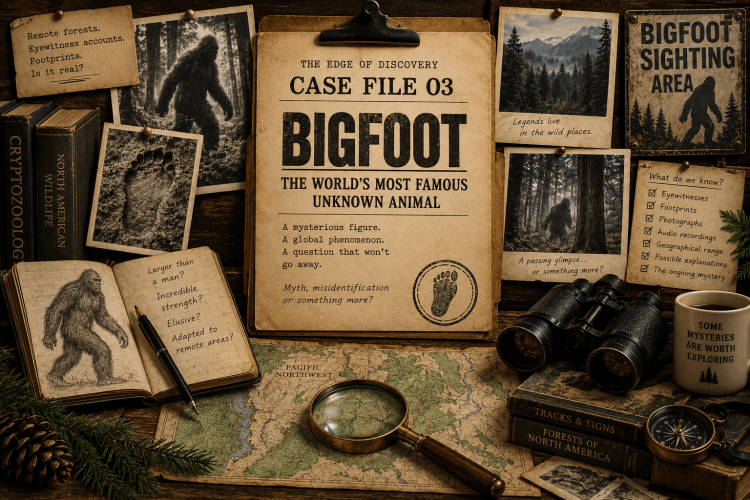
| Some cryptids require an introduction, and then there is Bigfoot. Even people with no particular interest in cryptozoology know roughly what Bigfoot is supposed to look like: enormous, upright, covered in dark hair and usually disappearing between trees just as somebody reaches for a camera. The creature has become so thoroughly absorbed into popular culture that it appears on road signs, coffee mugs, television programmes, films and T-shirts. Somewhere along the way, one of the strangest zoological claims of the modern era became a celebrity. That familiarity creates a problem. Bigfoot has become so famous that it is surprisingly difficult to investigate seriously. Believers can become determined to make every broken branch, strange call and oversized footprint fit the creature. At the same time, sceptics can be equally quick to dismiss the entire subject as men in furry suits, misidentified bears and wishful thinking. Neither approach interests me very much. Between those two positions lies the far more intriguing question: is there anything within the Bigfoot story that genuinely deserves investigation? After more than half a century of searching, that question should be easier to answer than it is. Before Bigfoot Had a Name The modern term “Bigfoot” is relatively young. Its rise to prominence is usually traced to northern California in 1958, when enormous human-like footprints appeared around a construction site near Bluff Creek. A local newspaper reported the mystery; the name captured the public imagination, and an American legend acquired one of the most successful pieces of branding in cryptozoological history. Some of those tracks were subsequently associated with logger Ray Wallace, whose family claimed after his death that he had used carved wooden feet to create Bigfoot prints. It is an important part of the story because hoaxing became entangled with Bigfoot almost from the moment the modern phenomenon acquired its name. It would be tempting to stop there and declare the entire thing solved. Unfortunately—or fortunately, depending upon your disposition—the history is nowhere near that tidy. Stories concerning large, wild or human-like beings in parts of North America existed long before 1958. Indigenous peoples of the Pacific Northwest have their own traditions concerning beings associated with forests and wilderness, though considerable care is warranted. These traditions belong to different peoples, languages and cultures and should not simply be gathered together and relabelled as ancient Bigfoot sightings. Similarities may be interesting, but folklore is not zoological evidence, and Indigenous traditions should not be treated as convenient supporting material for a modern cryptid. What they do establish is that the broader human idea of mysterious beings inhabiting the wilderness did not begin when an American newspaper printed the word “Bigfoot”. The modern phenomenon inherited a landscape already rich with stories. By the late 1950s, those older ideas, contemporary sightings, newspaper coverage, and popular imagination had begun to combine into something new. Then, less than a decade later, somebody brought a camera. Bluff Creek, 1967 On 20 October 1967, Roger Patterson and Bob Gimlin were travelling through the Bluff Creek area of northern California when they reported encountering a large, hair-covered figure. Patterson managed to film it. The resulting footage lasts only seconds, yet those seconds have probably been examined more obsessively than almost any other piece of film associated with cryptozoology. A dark, apparently upright figure walks across an open area, turns towards the camera and continues towards the trees. If you have seen what you think of as the classic photograph of Bigfoot, there is a good chance you have actually seen a frame taken from this film. The figure eventually acquired the nickname Patty, and more than half a century later arguments continue over what Patty actually was. Sceptics see a human being wearing a costume. Supporters point to the apparent gait, proportions, movement, and hints of musculature beneath the hair. Attempts have been made to calculate height, stride length and body proportions. At the same time, improvements in film processing have encouraged successive generations to examine the same handful of seconds in increasingly minute detail. I find the Patterson-Gimlin film interesting, but not entirely for the reason Bigfoot enthusiasts might hope. It demonstrates wonderfully how ambiguous evidence behaves. Strong evidence usually narrows possibilities: DNA identifies an organism, a carcass provides anatomy, a clear sequence of photographs allows features to be compared and measured. Ambiguous evidence frequently does the opposite. The more people examine it, the more interpretations appear. More than fifty years of analysis have not produced universal agreement that the film depicts an unknown primate, but the film has not disappeared from the discussion either. And Bigfoot has accumulated an enormous amount of ambiguous evidence. Footprints in the Forest If Bigfoot consisted only of fleeting visual encounters, the phenomenon might have disappeared decades ago. Instead, alleged footprints became one of the foundations of the modern case. Some are obvious fakes. Others are so poorly preserved that identifying their producers is almost impossible. Bears can produce confusing tracks, particularly where front and hind prints overlap, while soft ground, melting snow and erosion can enlarge or distort otherwise ordinary impressions. Certain tracks, however, have attracted more serious attention because investigators believe they contain anatomical details that would be difficult for casual hoaxers to reproduce. One of the academics most closely associated with this evidence was the late American anthropologist Grover Krantz. Krantz examined footprint casts and became convinced that at least some represented a genuine unknown primate. His willingness to investigate Bigfoot publicly drew criticism from within academia, but that did not prevent him from continuing to study the subject. Whether Krantz was correct is another matter. What I find valuable is the principle behind examining the evidence rather than deciding what it must represent beforehand. A footprint can be measured. Its depth, stride, shape and relationship with surrounding tracks can be studied. If the evidence eventually suggests a bear, human being or deliberate fabrication, then that is where the investigation should lead. “I don’t know what made this” is a legitimate conclusion. It is also very different from saying, “I don’t know what made this, therefore Bigfoot did.” Where Is the Animal? Now we reach the part of the Bigfoot story that causes me the greatest difficulty. Suppose, for a moment, that Bigfoot exists. We are not proposing a ghost, spirit or supernatural entity. The conventional cryptozoological hypothesis is that we are dealing with a large terrestrial primate inhabiting North America. That animal would therefore have to obey essentially the same biological rules as every other large mammal. It would need to eat, sleep and reproduce. It would defecate, shed hair and skin cells, disturb vegetation and leave footprints. It might become injured or ill. Eventually, like every other animal, it would die. Nor could there realistically be only one Bigfoot wandering endlessly through the forests. For the creature to represent a surviving species, there would need to be a breeding population occupying the landscape over generations, likely with enough individuals to maintain genetic viability. This is where my own experience working with animals makes me cautious. Large mammals are messy. They interact constantly with their surroundings, and they rarely cooperate with the tidy picture we create of them in our heads. They break vegetation, disturb the ground, and leave scent, hair, food remains, faeces, and tracks. They make noise. They reproduce, fight, become injured and die. An animal can certainly remain hidden from human eyes for considerable periods, particularly in difficult terrain, but remaining hidden from an entire ecosystem is something altogether different. That does not make Bigfoot impossible. It does, however, make the evidential requirement considerably higher. Hair, DNA and the FBI There is a wonderful chapter in Bigfoot history that sounds almost too good to be true: the FBI really did become involved. Unfortunately for anyone imagining federal agents creeping through Oregon forests with revolvers and plaster-casting kits, the reality was rather less dramatic. During the 1970s, Bigfoot researcher Peter Byrne corresponded with the FBI concerning alleged hairs connected with the creature. Surviving FBI documents show that hair samples were eventually examined, with the conclusion that they belonged to the deer family rather than an unknown primate. That result sounds disappointing, but it represents exactly what cryptozoological investigation should look like. Somebody had something potentially testable. It was submitted for examination. A result was obtained. The hairs were not Bigfoot. End of that particular piece of evidence. A negative result is still a useful result because every ordinary explanation eliminated or confirmed makes the remaining mystery clearer. Cryptozoology sometimes lets itself down by treating failed evidence as though science has somehow failed the mystery. If mysterious hair turns out to belong to a deer, bear or dog, science has done precisely what we asked it to do. The mystery has become slightly smaller. Repeat that process often enough and eventually either nothing extraordinary remains—or something extraordinary does. Modern DNA analysis should make this process even more powerful. Biological material from a genuinely unknown North American primate would be an extraordinary discovery. Yet despite numerous claims involving hair, tissue and other samples, no generally accepted genetic evidence has established Bigfoot as a previously unidentified primate. For an animal supposedly encountered so often, that absence matters. Could North America Hide Bigfoot? There is no question that parts of North America contain enormous wilderness areas. The Pacific Northwest, in particular, offers dense forests, mountainous terrain, abundant water, substantial vegetation, and populations of large mammals. An intelligent animal actively avoiding humans could certainly be difficult to observe, particularly if its population density were low and its behaviour predominantly nocturnal or crepuscular. But difficult to observe and undetectable are not the same thing. Black bears inhabit many of these landscapes and are photographed, struck by vehicles, hunted, caught on trail cameras and encountered by people. Cougars can be remarkably secretive, yet their tracks, kills, DNA, and bodies establish their presence even when nobody sees the animal itself. Wolves, lynx and wolverines may occur at low densities across vast territories, but modern wildlife science still finds ways to detect them. Bigfoot would therefore need to have achieved something remarkable. It would have remained zoologically undocumented while simultaneously becoming one of the most frequently reported mystery animals on the planet. The more eyewitness reports accumulate, the harder it becomes to ignore that contradiction. If thousands of encounters are occurring, why does physical evidence remain so poor? That question does not close the case. But it deserves considerably more attention than it sometimes receives. Could Bigfoot Be Gigantopithecus? One explanation frequently proposed involves Gigantopithecus, an enormous extinct ape known largely from fossil teeth and jaws discovered in Asia. Gigantopithecus blacki certainly existed, and its immense size makes it irresistible whenever people discuss unknown giant primates. Unfortunately, connecting it directly with Bigfoot requires a considerable series of assumptions. We would need some population of Gigantopithecus, or a descendant, to have survived long after its known disappearance from the fossil record. It would then need to have reached North America and adapted to very different ecological conditions. Perhaps most importantly, the fossils do not currently provide evidence for the habitual upright, human-like creature described by many Bigfoot witnesses. Current evolutionary research places Gigantopithecus closer to the orangutan lineage than to the human lineage. Could another unknown primate have followed an entirely different evolutionary route? Certainly, natural history contains enough surprises to prevent me from declaring such things absolutely impossible. But possibility is only the beginning of an investigation. “Could have” and “did” remain two very different standards. Then There Are the Witnesses This is the part of Bigfoot that I find most difficult to dismiss casually. Not because eyewitness testimony proves that Bigfoot exists—it does not—but because dismissing every witness as foolish, dishonest or intoxicated is equally lazy. People genuinely see things they cannot explain, and sometimes they remain absolutely convinced that what they saw was neither a bear nor another human being. I know from my own life how quickly an animal seen unexpectedly can confuse the brain. Distance, poor light, movement, unfamiliar behaviour and expectation can transform something ordinary into something extraordinary within seconds. Peripheral vision is particularly good at alerting us that something is there and considerably less reliable at telling us precisely what that something is. By the time we turn our heads, the brain has already begun interpreting incomplete information. But that does not mean every unusual observation is automatically worthless. There have been occasions in my own experience when I have looked again and remained uncertain about what I had seen. The sensible response to that uncertainty is neither to invent an explanation nor to allow somebody else to provide one merely because uncertainty makes us uncomfortable. A witness can be completely sincere and completely mistaken. Equally, a witness can be completely sincere and have encountered something genuinely unusual. Those possibilities can coexist. Bigfoot reports have come from hunters, forestry workers, motorists, hikers, police officers and families. Some involve nothing more than a dark silhouette crossing a road. Others describe close encounters with an upright, hair-covered creature. Reports sometimes include strong odours, vocalisations, unusual behaviour or footprints. Individually, most establish very little. Collectively, they create one of the most persistent unexplained-animal traditions of modern times. But a thousand uncertain observations do not automatically become one certain animal. The Camera Problem There was once an excellent explanation for the shortage of clear Bigfoot photographs: most people did not carry cameras. An unexpected encounter lasting a few seconds could easily end before somebody retrieved a camera from a bag, assuming they had one at all. That explanation has become considerably harder to maintain. Millions of people now carry high-resolution cameras in their pockets. Hunters and wildlife researchers deploy huge numbers of remote cameras capable of operating day and night. Thermal equipment, drones, acoustic monitoring, and increasingly sophisticated environmental DNA techniques are changing how wildlife is detected. We now document animals that earlier generations could study only through tracks and occasional sightings. Yet the definitive Bigfoot image remains stubbornly absent. This does not prove non-existence. Anyone who has tried photographing wildlife knows how quickly an animal can vanish, and an unexpected encounter is very different from sitting quietly with a camera already prepared. A frightened or astonished witness may also be more interested in understanding what is standing in front of them than filming it for YouTube. Nevertheless, after decades of searching, the failure of the evidence to improve must count for something. It certainly cannot count for nothing. Bigfoot’s Other Problem: Bigfoot Hunters Bigfoot has another enemy besides scepticism: some of its own enthusiasts. The subject has attracted hoaxes almost from the beginning. Fake footprints, costumes, fabricated photographs, dubious recordings, and carefully edited internet videos have contaminated an already difficult pool of evidence. The arrival of social media has made the problem worse because an extraordinary claim can reach millions of people before anyone has established where the footage came from, whether it has been altered or even whether the supposed creature was known to the person filming it. This is one reason sensationalism frustrates me so much within cryptozoology. A spectacular fake may generate a million views today and damage serious investigation for twenty years afterwards. Every successful hoax makes the next sincere witness easier to ridicule and every potentially interesting photograph easier to dismiss. If Bigfoot exists, fabricated evidence does it no favours whatsoever. The investigators most interested in establishing the creature’s existence should therefore also be among the most enthusiastic about exposing hoaxes. Removing bad evidence does not weaken a good case. It reveals whether there is a good case underneath it. So, Do I Believe in Bigfoot? That is not quite the question I want to answer. The better question is whether the possibility warrants investigation, and my answer is yes. Does the evidence currently prove that a large unknown primate inhabits North America? No. Those two positions sit perfectly comfortably beside one another. I find certain eyewitness accounts intriguing. Some footprint evidence deserves examination. The extraordinary persistence and geographical spread of the phenomenon deserves study in its own right, whether its ultimate explanation proves zoological, psychological, cultural or—quite possibly—a complicated mixture of all three. I also think there is something intellectually unhealthy about declaring a question ridiculous simply because its proposed answer appears improbable. At the same time, the absence of a body, uncontested DNA, unequivocal photographs or other repeatable physical evidence remains a formidable problem. We are no longer discussing a mystery that began last Tuesday. Bigfoot has been actively searched for across generations, during a period in which our ability to detect wildlife has improved beyond anything early investigators could have imagined. That brings me to what is the most important point in this entire Case File. If Bigfoot exists, eventually it must stop being a story. It must become an animal. An animal can be measured. Its biology can be studied. Its DNA can be sequenced. Its relationship with other species can be established. We could learn what it eats, how it communicates, where it sleeps, how long it lives and how it evolved. Bigfoot would cease to belong primarily to cryptozoology and become something far more interesting: zoology. That would be a wonderful outcome. The Case Remains Open Perhaps Bigfoot has survived while so many other mysteries have disappeared because it occupies an unusually uncomfortable territory between the plausible and the improbable. North America contains wild places large enough to make us wonder. Human perception is fallible enough to explain many encounters. Bears provide a plausible source for at least some reports. Hoaxers have been active enough to contaminate the evidence, while folklore and popular culture continually reinforce the image we expect Bigfoot to have. Yet the reports continue. Somewhere within all of that lies the truth. It may ultimately involve a previously unknown primate, although the physical evidence currently gives us little reason to conclude that it does. It may involve bears, shadows, expectation, folklore, misidentification, deliberate deception and extraordinarily successful storytelling. I suspect that if Bigfoot is eventually explained without the discovery of an unknown animal, there will be no single answer at all. There will be many. But I would never close the file simply because the creature sounds improbable. Case File 02 reminded us why natural history deserves a little humility. Nor would I declare Bigfoot real simply because thousands of people believe they have seen one. Curiosity and scepticism are not opposing forces. Used properly, they keep one another under control. That is exactly where I want The Edge of Discovery to sit. Listen. Investigate. Reach your own conclusion. For now, somewhere beyond the roads and towns, the forests continue exactly as they always have. Bears move between the trees, deer leave tracks in the mud, branches break where nobody is watching, and occasionally somebody emerges from the wilderness convinced that they have seen something for which they have no explanation. Whether Bigfoot is among those things remains unknown. Case File 03 remains open. |
| Case Assessment Status: UNRESOLVED Bigfoot remains unsupported by the physical evidence required to establish the existence of a new large North American primate. Eyewitness testimony, disputed footprints, and the Patterson-Gimlin film keep the subject worthy of investigation, but none constitutes universally accepted zoological proof. The continuing absence of an authenticated body, diagnostic DNA, or unequivocal modern imagery weighs heavily against the hypothesis. That does not make investigation pointless. Quite the opposite. A good investigation should be capable of examining an extraordinary claim without embracing it because we want it to be true or ridiculing it because we expect it to be false. |
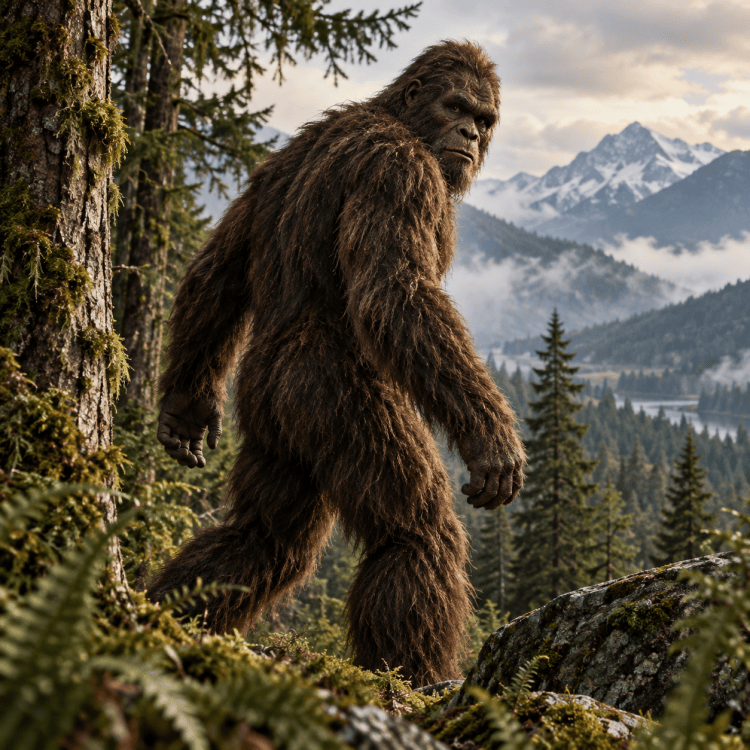
| Companion Box — Further Exploration For anyone who wants to dig more deeply after reading the Case File, the Smithsonian’s examination of Bigfoot’s history and enduring appeal provides useful background to the Bluff Creek era and the phenomenon that followed. The Smithsonian also has an interesting account of anthropologist Grover Krantz and his controversial scientific interest in Bigfoot. Something rather different can be found in the FBI’s own Bigfoot archive, where the surviving correspondence surrounding alleged Bigfoot hairs can be viewed directly. For the genuine prehistoric ape so often drawn into Bigfoot discussions, the Smithsonian’s exploration of Gigantopithecus and its extinction is a useful counterweight to some of the more imaginative claims found online. |
| Companion Box — When Bigfoot Became a Movie Star Long before social media filled our screens with questionable Bigfoot videos, cinema had already turned the creature into something of a celebrity. The Legend of Boggy Creek arrived in 1972, combining purported eyewitness experiences with dramatic reconstruction in a documentary-like format centred on Arkansas’s Fouke Monster. By the 1980s, Bigfoot had undergone an extraordinary transformation. Harry and the Hendersons (released in the UK as Bigfoot and the Hendersons) presented us not with a terrifying forest monster but with Harry: intelligent, gentle, funny and remarkably human. The film even won an Academy Award for its Bigfoot makeup. (Encyclopedia of Arkansas) Since then, Bigfoot has appeared in horror, comedy, animation, documentaries and television, sometimes as a monster and sometimes as a sympathetic creature hiding from the far more troublesome species—us. (Wikipedia) But there is an intriguing consequence to all this. The more frequently we see Bigfoot represented on screen, the more clearly defined our collective image of the creature becomes: towering height, broad shoulders, dark hair, long arms and a particular lumbering stride. That raises a question worth keeping in mind whenever we examine modern eyewitness testimony. When somebody reports seeing Bigfoot today, how much of the creature they describe comes from what they actually saw—and how much might have been supplied unconsciously by fifty years of films, television and photographs? That doesn’t invalidate eyewitness testimony. It simply reminds us that none of us observes the world with a completely blank mind. Sometimes culture may influence the mystery, and the mystery may influence culture. For further exploration: Harry and the Hendersons — Amblin’s official film page · The Legend of Boggy Creek — Encyclopedia of Arkansas |
| About our writing & imagery Most articles reflect our real gardening experience and reflection. Some use AI in drafting or research, but never for voice or authority. Featured images may show our photographs, original AI-generated artwork, or, where stated, credited images shared by others. All content is shaped and edited by Earthly Comforts, expressing our own views |

