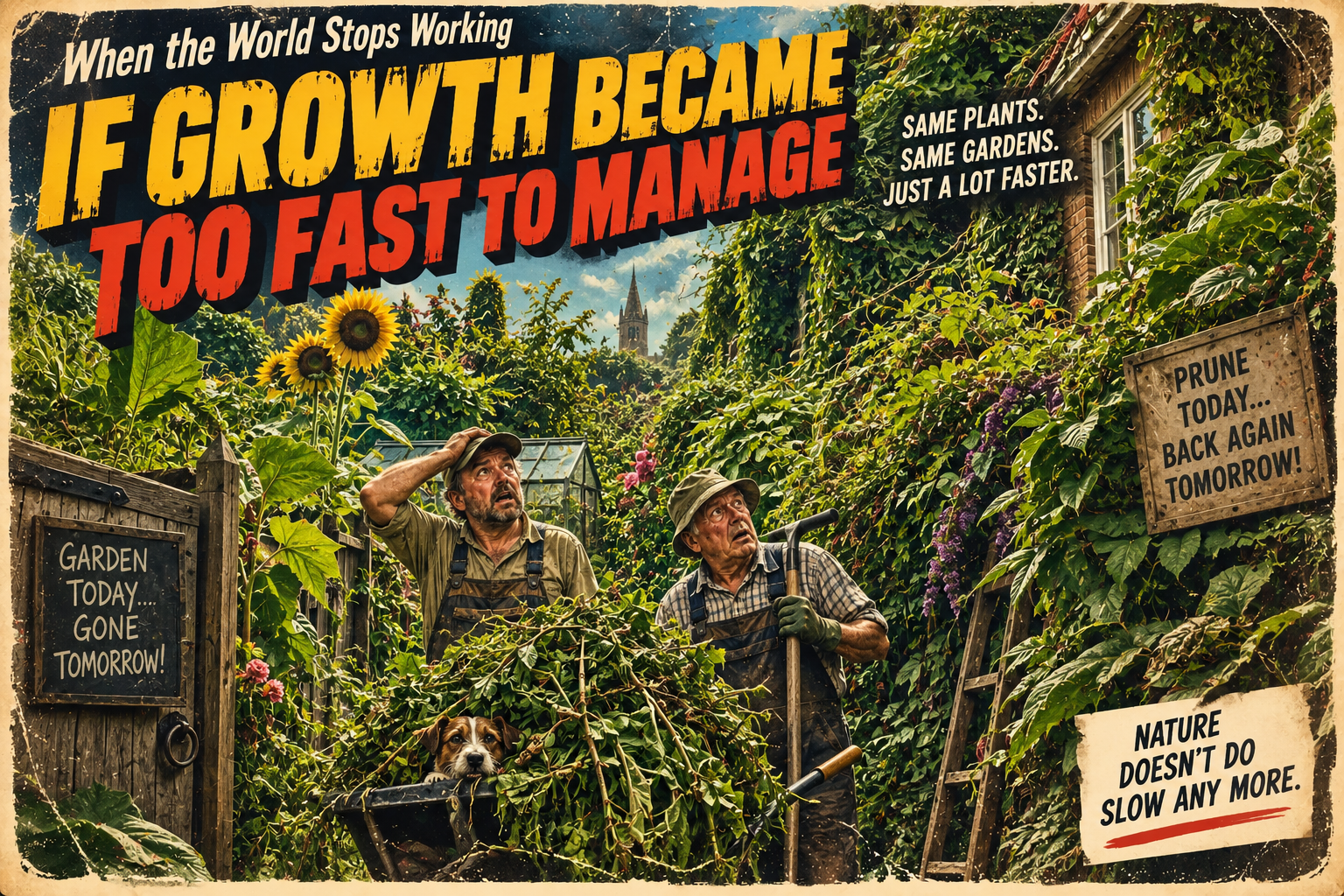
| There is a particular moment in the gardening year when you realise the garden has stopped waiting for you. In winter, we are largely in charge. We decide what gets cut back, what gets moved, what gets planted, and which jobs can safely wait until next week. Even in early spring, we usually have time to think. Buds are opening, bulbs are appearing, and lawns are beginning to wake up, but everything still feels reasonably civilised. Then somewhere around late spring, particularly after a spell of warm weather and rain, the balance changes. You finish a garden on Tuesday, return the following week and wonder whether somebody has secretly fertilised the entire place while you were away. Professional gardeners know this feeling particularly well because we see the difference from week to week. A homeowner looking out of the kitchen window every morning may not notice a shrub putting on several inches of growth. Still, when you maintain dozens of gardens on a rotation, the change can be remarkable. Lawns suddenly need cutting, not tidying. Hedges lose their clean lines. Climbers make exploratory journeys into gutters. Weeds appear in spaces you distinctly remember clearing. Everything seems to decide, simultaneously, that now would be an excellent time to grow. Normally, we catch up. But what if one year we couldn’t? Nothing particularly dramatic happens—no mysterious meteor, laboratory accident, or announcement on the six o’clock news. Plants haven’t become aggressive, intelligent or supernatural. They begin growing perhaps twice as quickly as they normally would. At first, I suspect gardeners would be delighted. The lawn you reseeded has germinated beautifully. The hedge that looked thin after renovation has filled out. Newly planted shrubs are establishing at extraordinary speed. Bare patches disappear. Climbers cover fences. Vegetable growers begin posting photographs of courgettes with expressions usually reserved for lottery winners. Garden centres sell plants faster because customers suddenly have confidence that everything they put into the ground will actually do something. For perhaps three weeks, gardening has never looked better. Then somebody notices the hedges. A hedge that normally needs two or three cuts through the growing season suddenly needs attention every fortnight. By the time you’ve worked through the gardens at one end of the round, those at the other end are ready again. Privet becomes particularly enthusiastic. Laurel starts advancing across paths. Leylandii, never an especially restrained plant to begin with, behaves as though it has been given a deadline. The lawns follow. In warm, wet conditions, grass can grow quickly enough to turn a weekly maintenance schedule into a negotiation. Double that growth and the neat lawn you cut seven days ago is no longer merely ready for another cut; it looks as though you’ve been neglecting it. Miss a week because of rain and the mower begins facing something closer to haymaking. That is when the phone starts ringing. “Hello, Rory. I know you were only here last Thursday, but the garden seems to have gone mad.” Yes. We’d noticed. The problem wouldn’t simply be that plants were growing faster. Everything involved in controlling that growth would still be operating at normal speed. Gardeners would not suddenly acquire twice as many hours in the day. Hedge cutters wouldn’t become faster. Mowers wouldn’t develop wider decks. Green-waste collections wouldn’t double automatically. Vehicles would carry the same amount. Compost heaps would occupy the same space. And there are only so many gardeners. That is where our hypothetical gardening boom would begin turning into a systems problem. A maintenance round is essentially a time calculation. A lawn takes time to cut, a hedge takes time to trim, borders take time to weed, and the waste takes time to clear. Clients rarely think about gardens in those terms, nor should they, but every gardening business does. If a two-hour garden suddenly requires three or four hours to leave it at the same standard, something else has to give. You could work longer for a while. Then you run out of daylight, energy or both. You could employ more people, assuming you could find them. You could buy more equipment, assuming it was available. You could visit clients more frequently, except that doing so means visiting somebody else less frequently. Very quickly, the question would stop being How do we keep every garden exactly as it was? and become Which things actually need controlling? That would be a surprisingly difficult adjustment. Modern gardening has created expectations about tidiness that nature has never agreed to. We like hedges with straight sides, lawns at a consistent height, paths without weeds and shrubs that remain conveniently within the dimensions printed on a label several years earlier. Faster growth would expose how much continuous work is required to maintain that appearance. We would begin prioritising. Paths first, because people need to walk along them. Growth around windows, doors and entrances would need controlling. Branches obstructing roads or pavements couldn’t simply be left. Plants covering signs, lights, drains and gutters would become practical problems rather than aesthetic ones. Anything threatening buildings or neighbouring property would move up the list. The perfect lawn might move down it. So might the slightly untidy shrub. And suddenly gardens would begin looking different. Not abandoned. Just less controlled. This would probably have an unexpected ecological consequence. More vegetation means more shelter, more flowers where plants can reach the flowering stage, more seed, more leaf material, and potentially more habitat. Insects would exploit it. Birds would follow them. Small mammals would discover increasingly dense boundaries between gardens. Some wildlife might benefit enormously. Other things wouldn’t. Dense growth can shade out smaller plants. Vigorous species can overwhelm slower ones. Climbers can smother shrubs. Weeds that reproduce rapidly would hardly sit politely on the sidelines while our ornamental plants enjoyed themselves. Bindweed growing twice as quickly doesn’t bear thinking about, and ground elder would probably regard the entire situation as the opportunity it had been waiting centuries for. Then there is ivy. I like ivy. Wildlife likes ivy. Buildings occasionally have more complicated opinions. At twice its normal rate of progress, somebody would have to keep an eye on it. Vegetable gardens would present another contradiction. Faster growth sounds wonderful if you’re growing food, and it might be at first. Lettuce reaches harvest sooner. Beans climb rapidly. Courgettes become even more determined to produce more courgettes than any household could reasonably consume. But faster plant growth doesn’t automatically mean better crops. Plants require water and nutrients to build all that additional material. If growth accelerated without a corresponding increase in available resources, deficiencies could appear quickly. Soil moisture might disappear faster. Containers would dry out astonishingly quickly. Hungry plants would become hungrier. A gardener accustomed to watering twice a week might find the same plant needs attention almost daily. The weather would matter enormously. Rapid growth during a wet spell could produce soft, lush vegetation vulnerable to disease or physical damage. A sudden dry period following that growth could leave plants with large amounts of foliage they could no longer support. Strong winds could tear through plants that had grown too quickly to strengthen properly. The garden would be producing biomass faster, but not necessarily resilience. Trees would become a much more serious concern. A season of unusually strong extension growth is one thing; sustained accelerated growth over several years would change the relationship between trees and the spaces in which we plant them. Trees selected for small gardens might stop being suitable much sooner than expected. Roots would expand. Canopies would close. Shade patterns would change. Pruning cycles would shorten. And unlike cutting grass, managing a large tree isn’t something you squeeze into the end of a Friday afternoon. Green waste might eventually become one of the biggest problems of all. Every cut hedge has to go somewhere. Every lawn produces clippings. Every pruning job creates branches. Every border clearance produces vegetation. If gardens were generating twice as much material, council collections and commercial disposal sites would face the same problem gardeners did: the biological system would be moving faster than the human system built around it. At Earthly Comforts, I suspect we’d become extremely interested in composting and more so than we already are! Not because we’d suddenly developed a philosophical objection to moving green waste, but because transporting ever-increasing quantities of plant material from one place to another would become increasingly ridiculous. If growth were going to produce enormous amounts of organic material, the sensible question would be how much of it could remain within a useful cycle rather than becoming something we needed to get rid of. Grass clippings become compost. Leaves become leaf mould. Suitable woody material becomes chips. Prunings can become habitat where appropriate. Suddenly what looks like a waste problem begins looking suspiciously like a resource. That doesn’t solve everything, but it changes the thinking. And I suspect that would happen throughout gardening. After the first frantic year of trying to keep gardens looking exactly as they had before, people would begin adapting. Some hedges would be replaced with slower-growing species. Lawns would become smaller. Areas previously clipped, strimmed and controlled every week might be allowed to become more natural. Plant choices would shift toward species that could look after themselves without constantly trying to annex the neighbour’s driveway. Garden design itself would probably change. The fashionable question would no longer be: How quickly will this fill the space? It would be: How often am I going to have to cut it? Nurseries would discover a sudden commercial advantage in anything described as compact, slow-growing or restrained. Dwarf varieties would become extremely popular. Garden designers would leave more room between plants rather than creating instant fullness. The familiar instruction to plant for a shrub’s eventual size would finally be taken seriously, possibly for the first time in horticultural history. Professional gardening would change too. We couldn’t promise permanent neatness because permanent neatness would have become economically absurd. Maintenance would become more selective, more seasonal and probably more ecological. Instead of continually suppressing every sign of growth, we’d concentrate our effort where it mattered. There is something slightly ironic about that. Gardeners spend much of their lives trying to make things grow. We improve soil, add compost, feed plants, water them, prune them to encourage new shoots and spend considerable amounts of money replacing things that have stubbornly refused to grow at all. If growth suddenly became abundant beyond anything we’d previously experienced, we’d quickly discover that growth itself isn’t necessarily the goal. The goal is healthy growth in the right place, at a rate the surrounding system can support. And that is where this particular What If? begins edging uncomfortably towards reality. We already see periods when growth arrives in extraordinary bursts. Warmth, moisture and longer growing seasons can combine to produce weeks when gardens seem to accelerate. Professional gardeners already experience the spring rush when suddenly everybody’s garden needs attention at the same time. Some vigorous plants already require constant management, while changing weather patterns can alter when growth starts and how long it continues. Our imaginary world removes the quieter periods that let us catch up. Perhaps after several years nobody would remember gardens looking particularly different. Hedges would be broader. Lawns might be smaller. Wilder areas would be common. Composting would be normal. People would stop expecting every plant to remain precisely where it had been placed. Gardens would still be beautiful. They would look more alive. And somewhere on a Monday morning, John and I would finish a garden that had taken us considerably longer than it used to. We’d load the tools, clear the last of the cuttings and stand for a moment looking at the newly trimmed hedge. “Looks good,” John would say. “It does.” We’d come back the following week. The hedge would already need cutting again. John would look at it. I’d look at John. And without either of us saying anything, we’d get the bloody hedge cutter back out of the van. |
| About our writing & imagery Most articles are grounded in our real gardening experience, observations and reflections. AI may assist with research, drafting and editing, but the experiences, opinions and editorial direction are our own. Featured images may include our photography, original AI-generated visuals or, where stated, images credited to others. All published content is reviewed and shaped by Earthly Comforts before publication. |


That happens here in spring and early summer
LikeLiked by 1 person
Morning Sadje, oh yes this article isn’t that far removed from the truth for many countries already, the UK which the recent weather changes has discovered it as well 🙂
LikeLiked by 1 person
Good morning Rory. Yes, the climate change has now changed the growth patterns in uk too
LikeLiked by 1 person
Indeed it has Sadje, it’s the start of the end of the typical British summer as once known.
LikeLiked by 1 person
Yes, same here but attribute it to the monsoon season.
LikeLiked by 1 person
Yes, when l lived in Malaysia in the 60’s l remember all too well the monsoon season. Some things stay etched on your mind for a long time.
LikeLiked by 1 person
Yes, they probably have a similar weather pattern.
LikeLiked by 1 person
We’ve had a crazy summer here with a lot of sunshine, and a lot of rain. The landscapers here have their work cut out for them, indeed. Even our spider plants seem to grow faster.
LikeLiked by 1 person
Is that what they call gardeners there Eugenia, landscapers for commercial property gardening – here we call them commercial garden maintenance.
LikeLiked by 1 person
Yes, they’re mostly called landscapers, lawn services, landscaping services, etc.
LikeLiked by 1 person
That phrase about climbers making exploratory journeys into gutters gave me a good chuckle. There really is that sudden shift where the balance changes, and what felt civilised in early spring turns into a full sprint. You describe that shock of coming back after a week so well. Seeing lawns suddenly need cutting instead of just tidying must be quite daunting when you have a whole rotation of gardens waiting for you. It must take a lot of patience not to feel overwhelmed when a spell of warm weather and rain undoes a week of hard work in a matter of days. A lovely piece of writing.
LikeLike
Thank you. You get used to it, but at times the growth seems to be at a different pace from your own.
LikeLike