| Episode 3 The Eurasian Skylark: The Song Above the Fields |
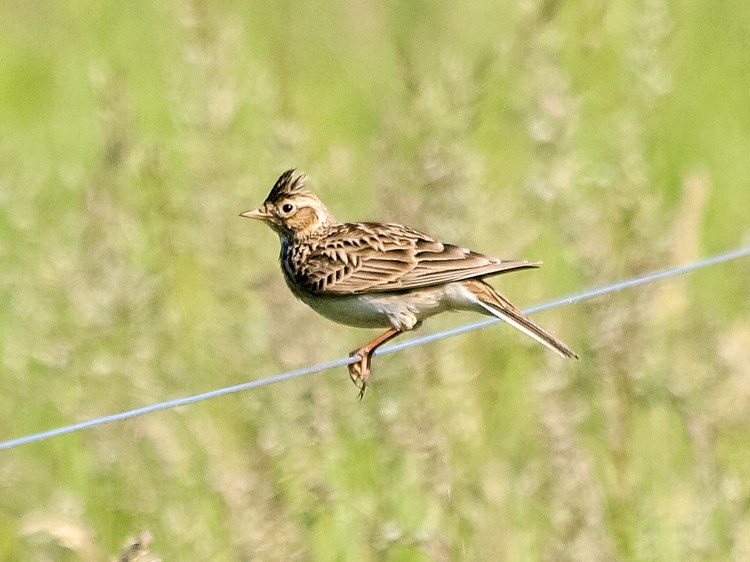
| Eurasian Skylark by Kathy_Büscher |
| Days are spent working outside when you become aware of a sound without immediately knowing where it is coming from. You stop what you are doing, straighten your back—which after several hours of gardening is sometimes an achievement in itself—and look towards the nearest tree or hedge. Nothing. The sound continues. You look again, this time further away, until eventually you realise you have been looking in entirely the wrong direction. The bird is above you. Very far above you. The Eurasian Skylark (Alauda arvensis) has one of those peculiar abilities to make itself simultaneously conspicuous and almost impossible to find. Its song pours down from the sky in a continuous stream of whistles, trills and rapidly changing phrases, yet the bird producing it may be little more than a speck against the blue. Sometimes you can follow it upwards as it climbs. At other times your eyes lose it altogether while the song continues, apparently being produced by the sky itself. It is one of the great sounds of the British countryside, although “sound” hardly seems adequate. A Skylark doesn’t simply sing a few notes and stop. The male can remain high above its territory delivering a sustained performance while hovering and circling, pouring extraordinary energy into making itself known. When eventually it descends, the song comes back towards earth with it. There is something wonderfully excessive about the whole business. For a bird that looks comparatively modest when standing on the ground, the Skylark behaves as though someone has handed it the entire sky for a stage. A Bird That Belongs to Open Space Seeing a Skylark properly for the first time can be slightly surprising. After such a performance, you should expect something more flamboyant. Instead, you find a streaked brown bird, larger than a sparrow but hardly spectacularly coloured, with a small crest that can be raised when the mood requires it. On the ground, that understated appearance makes perfect sense. Skylarks are birds of open country. They live amongst fields, grasslands, coastal marshes, heathland and other relatively treeless landscapes where being brightly coloured would be an excellent way to attract precisely the wrong sort of attention. Their plumage allows them to disappear remarkably well against soil and vegetation. They also nest on the ground. That single fact explains a great deal about the Skylark’s life and many of the problems it faces. There is no nest tucked safely into a hedge or hidden amongst branches. Instead, the female creates a small hollow amongst vegetation, lining it with grasses and leaves. Eggs and chicks spend their earliest days only centimetres above the soil. To us, a field is an enormous space. To a Skylark, it is home. And this is where the bird begins to challenge one of the assumptions we often make about wildlife. We tend to notice habitats that look obviously wild. Woodland looks like habitat. A reedbed looks like habitat. A flower-rich meadow certainly looks like habitat. An ordinary agricultural field can appear to be little more than the space between more interesting places. But wildlife doesn’t classify landscapes according to how attractive they look from a footpath. Sometimes the least dramatic-looking patch of countryside is doing far more than we realise. The Problem With Being on the Ground Gardening teaches you fairly quickly that anything living at ground level occupies a dangerous neighbourhood. We discover frogs beneath pots, beetles beneath logs, hedgehogs travelling along boundaries and occasionally nests in places where no sensible creature would have put one if it had first consulted the gardener. Of course, wildlife was there before our work schedule arrived. The difficulty for Skylarks is that agricultural land is not merely their habitat; it is also a working environment. Fields are cultivated, drilled, sprayed, cut and harvested according to the requirements of food production. None of this is inherently unreasonable—we need farming—but it creates an unavoidable tension between the rhythms of agriculture and the rhythms of a ground-nesting bird. Modern cropping patterns have added another complication. Skylarks traditionally benefited greatly from spring-sown cereals. Crops planted in spring provided suitable vegetation during the breeding season, allowing birds access to the ground while giving nests enough cover. The shift towards greater use of autumn-sown cereals changed that balance. By the time Skylarks are trying to raise later broods, crops can have become too tall and dense for them to use easily. One response has been wonderfully simple: deliberately leave small unsown patches within cereal fields. They are known as Skylark plots. There is something rather pleasing about this idea. Conservation sometimes brings to mind expensive equipment, complicated management plans and large restoration projects. Yet here, one useful intervention consists largely of not planting a small piece of a field. Occasionally the most productive thing we can do for wildlife is leave something alone. Gardeners may recognise the principle. The Myth of the Perfectly Managed Landscape We have inherited a peculiar fondness for neatness. Straight edges, clipped hedges, evenly mown lawns and weed-free beds suggest that somebody is taking care of things. Leave a patch of grass untouched and, sooner or later, somebody may wonder whether the mower has broken. I understand the attraction. I spend much of my working life making gardens look cared for. But cared for and completely controlled are not the same thing. A garden can have structure and still contain long grass. A hedge can be maintained without being cut at the worst possible time for nesting birds. Seed heads can remain standing through winter without the garden becoming abandoned. Fallen leaves can stay beneath shrubs where they feed the soil and shelter countless small creatures. The Skylark lives beyond most garden boundaries, but the principle it represents belongs inside them too. Diversity frequently appears wherever our desire for control becomes slightly less absolute. There is a practical distinction here that matters. Simply allowing everything to become overgrown is not necessarily good habitat. Vigorous species can dominate, scrub can overwhelm grassland, and some environments require active management to remain valuable. Nature conservation is not synonymous with doing nothing. But neither is good management synonymous with doing everything. Knowing when not to interfere may be one of the more difficult gardening skills to learn. A Familiar Bird Becoming Less Familiar There is a sadness attached to the Skylark because its voice once belonged even more widely to Britain’s farmland than it does today. The species remains widespread, and in the right place its song can still seem wonderfully abundant. Yet the long-term decline in the UK has been substantial. Changes in farming practices, cropping patterns and the availability of suitable nesting and feeding habitat have all played a part. This is where statistics can sometimes fail us emotionally. Being told that a bird population has declined by a certain percentage is important, but numbers alone struggle to convey what has actually changed. A decline in birds is also a sound decline. It means a walk across a field where three birds once sang and perhaps only one does now. It means children growing up with a slightly different soundtrack to the countryside than their grandparents knew. Eventually, if the change happens slowly enough, each generation accepts its own version of the landscape as normal. That phenomenon reaches far beyond birds. As gardeners, we constantly see smaller examples. People become accustomed to fewer butterflies because they cannot remember how many there once were. A garden containing very few insects may still seem perfectly healthy if that is what we have come to expect. Even the number of moths around an outside light can change almost unnoticed because nobody was counting them in the first place. Memory is imperfect. But absence has a way of accumulating. More Than a Beautiful Song It would be easy to turn the Skylark entirely into a story of decline, and I don’t think that would do the bird justice. There are still mornings across Britain when Skylarks rise from fields and sing above them. There are farmers managing land with wildlife in mind, conservation schemes creating nesting opportunities, and landscapes where the bird remains part of everyday spring and summer. And when you hear one, the statistics temporarily become irrelevant. You stand beneath an enormous sky trying to locate a bird the size of a small handful of feathers while it produces enough sound to fill the entire landscape. There is a lesson in scale there somewhere. We are naturally attracted to the spectacular parts of nature: great trees, dramatic coastlines, mountains, large animals and rare species. Yet the Skylark reminds us that wonder can be produced by something small, brown and extraordinarily determined. It also reminds us to look differently at the spaces between the obvious wildlife habitats. The field beyond the hedge is not empty. The rough strip beside the path is not necessarily wasted. The uncut corner is not automatically neglected. Sometimes these apparently ordinary places contain entire lives that remain invisible until something gives them away. In the case of the Skylark, that something is song. Perhaps this is why hearing one still has the power to stop us. We may have machinery running nearby, traffic somewhere in the distance and a day’s work waiting to be finished, but above all of it comes this continuous cascade of sound from a bird we can barely see. Eventually, you find the speck. You watch it hanging impossibly high over the field. And for a few minutes, an ordinary patch of British countryside becomes somewhere quite extraordinary. Watching For… Skylarks can be encountered throughout much of Britain in the open countryside, particularly in farmland, grassland, heathland, coastal marshes, and dunes. Spring and early summer are the easiest times to become familiar with them because displaying males make themselves unmistakable through their prolonged aerial song. If you hear one, don’t immediately search the hedges. Look upwards into the open sky and give your eyes time to adjust. Finding the bird can take surprisingly long, particularly on a bright day. Watch for a tiny hovering shape high overhead, sometimes climbing until it almost disappears from view. And if your neck begins to complain before you find it, you are probably doing it properly. |
| About our writing & imagery Most articles reflect our real gardening experience and reflection. Some use AI in drafting or research, but never for voice or authority. Featured images may show our photos, original AI-generated visuals or, where stated, credited images shared by others. All content is shaped and edited by Earthly Comforts, expressing our own views. |

