
| Series One Episode Four The Garden That Hadn’t Happened Yet |
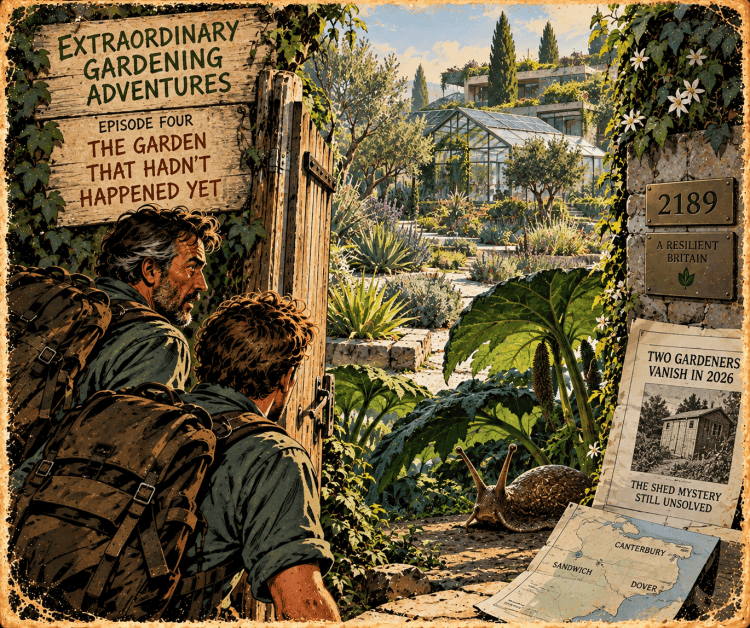
| The door opened onto a garden, and for one wonderful second it looked completely ordinary. A path, clipped shrubs, trees, and what appeared to be a greenhouse stood beyond a low wall. After everything we’d seen since falling through the back of a client’s shed, the sight of something recognisably maintained was almost overwhelming. Somebody had cut things. Somebody had planted things deliberately. Somebody, somewhere, presumably owned a pair of secateurs. Then I noticed what was growing beside the path, and the relief began to fade. John was still standing behind me on the ruined terrace of the abandoned garden. “Well?” he asked. I told him it was definitely a garden, which he considered a remarkably unhelpful observation given that he could see it perfectly well himself. What I meant was that this wasn’t another wilderness masquerading as one. There were borders, paths and planted areas, and although the style was unfamiliar, everything suggested active management. I stepped through first, and John followed. There was no flash of light or mysterious sensation; one boot was on weathered paving in the ruined garden, and the next was on pale gravel somewhere else. We immediately checked the door. It remained open, with the abandoned garden clearly visible through it, so John wedged a substantial stone beneath it. If whatever controlled these places wanted the door closed, I doubted a lump of masonry would stop it, but it helped psychologically. My first impression of the new garden was Mediterranean. Silver foliage, aromatic shrubs, succulents, grasses and drought-tolerant perennials dominated the borders, while small trees with leathery leaves provided patches of shade. Gravel covered much of the planted ground and what I’d initially mistaken for lawn was actually a dense mixture of low-growing plants spreading between stepping stones. John suggested Spain, then Portugal, while I crouched beside the path and looked more closely. There were salvias, lavenders, grasses and familiar-looking euphorbias among plants I couldn’t immediately identify, but it was the way everything had been arranged that interested me. Plants with similar water requirements were grouped, shallow channels directed rainfall towards their roots, and several trees stood in slight depressions where water could collect. Whoever had designed this place wasn’t trying to force a traditional temperate garden to survive in difficult conditions. They had accepted the conditions and gardened accordingly. The structure we’d taken for a greenhouse made that clearer. Although partly glazed, large sections were permanently open and vines grew through the framework, suggesting it was intended as much for shade and airflow as warmth. Substantial tanks collected water from the roof, and pipes disappeared beneath the surrounding beds. Beyond it stood a low house with shaded windows, vegetation across much of the roof and solar panels incorporated into several structures. There were no flying cars, robots or anything else to suggest we’d stumbled into the future. It simply looked like a house and garden designed for a climate warmer and drier than the September afternoon we’d left behind. Nobody answered when we called out, but around the side of the house we found a work area with benches, propagation trays, hand tools, and storage racks. Some of the equipment was unfamiliar, but the purpose wasn’t. “Potting shed,” I said. John looked around at the immaculate benches and decided it was rather fancy. More importantly, there was a sink. After our experience with the prehistoric stream, we were cautious, but the water was clear, odourless and apparently ordinary, so we refilled our increasingly empty bottles. At that moment a functioning tap seemed more impressive than anything else the future might have invented. While John dealt with the water, I examined the propagation bench. The labels carried plant names, some familiar and others not, but they were written in English. Nearby, a map fixed beside a board of planting notes provided the next clue. The coastline had changed slightly in places, but the shape was unmistakable: Britain. London was there, as were Canterbury and Dover, and when we found Sandwich marked in its familiar corner of Kent, neither of us said anything for several seconds. After a prehistoric forest and an abandoned garden that seemed to belong nowhere, seeing the name of a town we knew should have been reassuring. Instead, it made the situation stranger. “We’re home,” John said. “Somewhere near it.” “That’s Kent.” “I know.” “So what’s wrong?” I looked around the unfamiliar potting area, then back toward the drought-adapted garden. “I think that might be the least of our problems.” We found out almost immediately. An ordinary maintenance sheet was clipped beside the map, recording irrigation checks, pruning, pest observations and replacement planting. I was halfway down it before glancing at the heading. I read the date once, then again, before handing the sheet to John. He stared at it and said, “No,” as though refusing might cause the numbers to rearrange themselves. The year was 2189. There are discoveries so extraordinary that you expect them to arrive with some fanfare. This one appeared above a note about irrigation maintenance. John eventually noticed we were late, and when I worked out it was by roughly a hundred and sixty-three years, he said the client was going to be annoyed. We laughed considerably longer than the joke deserved, partly because we’d had very little sleep and partly because thinking too carefully about the alternative—that the September afternoon we’d left was now more than a century in the past—was considerably harder. Once we’d accepted the date, the garden made much more sense. This wasn’t southern Europe but apparently southern Britain under different climatic conditions. Water was captured and directed carefully, shade had become something deliberately designed into the landscape, and plants were chosen for heat and drought tolerance. Much of what might once have been lawn had become ground cover, gravel or more resilient mixed planting. What struck me was that it didn’t look like a garden struggling to survive. It simply looked like gardening had adapted. Gardeners have always worked with whatever weather, soil and location allow, even if we occasionally spend ridiculous amounts of effort trying to persuade plants otherwise. Whoever tended this place hadn’t defeated the climate; they’d changed what they expected a British garden to be. Beyond the house, mature trees shaded paths and seating areas, fruit trees grew beneath open structures that could support temporary covers, and vegetable beds mixed annual crops with flowers and perennial plants. Bees worked among flowering herbs, butterflies crossed the warmer areas and small lizards disappeared between stones as we approached. Whatever environmental changes had occurred between our September and this one, nature hadn’t simply vanished. Some things had undoubtedly changed, perhaps profoundly, but life and gardening had changed with them. We might have spent considerably longer looking around if John hadn’t found the plaque. It stood beneath an old tree near the edge of the property and gave a brief history of the site: former boundaries, restoration work and changes of ownership. Most of it meant nothing to us until we reached a sentence near the bottom. Local tradition, it said, recorded the unexplained disappearance of two gardeners from the area during the early twenty-first century. John read it twice before deciding it couldn’t possibly mean us. I asked how many pairs of gardeners he imagined disappeared around Sandwich under mysterious circumstances, and he admitted he’d never researched the subject. According to the plaque, two men had vanished while working at a private property, leaving tools and belongings behind. No explanation ever emerged, and over the following decades the story picked up the usual embellishments. One version claimed they’d walked into woodland that didn’t exist; another involved strange lights in the sky. More interestingly, several accounts mentioned an old garden shed. “So we don’t get back,” John said. “That isn’t what it says. It says we disappeared.” “For a hundred and sixty-three years.” “From their point of view.” He considered that and decided he didn’t particularly like their point of view. Neither did I, but the plaque wasn’t necessarily telling us our future. From the perspective of 2189, two gardeners had disappeared in 2026 and never been seen again. We were still alive and standing beside the plaque describing that disappearance, which suggested time had become about as reliable as the shed’s dimensions. There was another important detail. The shed itself had apparently remained on the property for decades before eventually being removed during redevelopment. That meant it hadn’t vanished when we’d been forced away from the opening in the prehistoric world. If stories about the structure had survived for more than a century, perhaps somebody had eventually investigated it. The decayed rucksack we’d found in the abandoned garden also took on a different significance. Somebody else appeared to have travelled through these places, and perhaps they’d been trying to do exactly what we were doing: find a way home. Back in the potting area, John discovered an archive screen built into the wall. After several minutes of pressing things with increasing irritation, we managed to persuade it to display local records. Technology had advanced enormously without considering the needs of two gardeners from 2026. Searching for the property produced little, but searching for the shed brought up an entry titled The Sandwich Garden Disappearances: Folklore, Hoax or Unexplained Event? The details had changed in the telling. One version suggested we’d deliberately vanished, another involved unidentified aircraft, and several seemed to have invented people who’d never been there. Then we found a photograph. Even faded and reproduced from an older source, there was no mistaking the roofline, doors and utterly ordinary appearance of the client’s shed. Below it, a caption explained that the structure had survived for decades after the disappearance. During its eventual demolition, workers had reportedly discovered something unusual behind the rear wall. The original report was missing, but a summary remained. A narrow void had been discovered where no structural space should have existed. That changed things. Whatever we’d fallen through might not have depended entirely on the shed. Perhaps the building had concealed something rather than created it. Historical maps showed where the original property had stood, several miles from our present location. The surrounding area had changed considerably by 2189, but the old garden appeared to survive as part of a larger managed landscape. For the first time since the dinosaur had forced us away from the original opening, we had an actual destination rather than merely a direction. We refilled our bottles before leaving. Food sat in the work area, and the equipment was far better suited to our situation than some of what we carried in our rucksacks, but we left everything alone. Being stranded one hundred and sixty-three years in the future probably gave us a reasonable moral argument for borrowing a sandwich, but stealing from another gardener’s potting shed still felt wrong. John pointed out that anybody attempting to prosecute us would have an interesting identity problem to resolve, although he didn’t take anything either. The old wooden door remained where we’d left it, still wedged open with the stone. Through it lay the abandoned garden and, somewhere beyond that, the route toward the prehistoric world. Retracing our steps might eventually bring us back to the original opening if the predator had moved on. Going forward meant trying to reach the place where the shed had stood more than a century after it had been demolished. Neither choice was particularly sensible, but before we could make it, we heard voices approaching from beyond the house. They were unmistakably human, and after everything we’d been through that should have been the most welcome sound imaginable. Instead, John and I immediately realised the difficulty. Two filthy gardeners had appeared in a private garden carrying equipment manufactured in 2026, wearing clothes more than a century out of date and apparently matching a local legend about two men who’d disappeared from almost the same area. Even if the people approaching were friendly, explaining ourselves was likely to take some time. We moved away from the potting area, intending only to stay out of sight until we’d decided what to say. A path curved behind tall grasses and shrubs before descending towards another part of the garden, so we followed it while the voices drew closer. Halfway down, John stopped so abruptly that I nearly walked into him. At first I thought the enormous leaf beside the path belonged to one of the large-leaved plants that seemed perfectly plausible in this warmer version of Kent. Then I realised just how large it was. The blade was broad enough for both of us to shelter beneath, while the stem supporting it was thicker than my arm. Beyond it rose more enormous foliage, some carried on stems approaching the dimensions of young trees. What I’d initially taken for saplings farther down the slope wasn’t a group of trees at all. John stared upwards and asked me to tell him it wasn’t what he thought it was. I couldn’t, because I wasn’t entirely sure what I thought it was. Whatever route we’d been following appeared to have changed again, although this time neither of us had consciously passed through a doorway. Somewhere among the planting, the transition had happened so gradually that we’d crossed it without noticing. Behind us, the human voices continued approaching. Ahead, the vegetation became larger with every yard until the future garden began disappearing behind leaves that should never have reached those dimensions. Then something moved slowly across the path. It was a slug, or at least anatomically it appeared to be one. The difficulty was that it was roughly the size of a wheelbarrow. John watched it complete its leisurely crossing and disappear beneath an enormous leaf, then looked back toward the approaching voices and then at me. “We’re going that way, aren’t we?” There wasn’t much of a choice. We adjusted our rucksacks and moved beneath the enormous leaves, leaving the garden of 2189 behind us. By that point, I was beginning to suspect getting home would take longer than we’d originally planned. |
| About our writing & imagery Most articles reflect our real gardening experience and reflection. Some use AI in drafting or research, but never for voice or authority. Featured images may show our photos, original AI-generated visuals, or, where stated, images credited to others. All content is shaped and edited by Earthly Comforts, expressing our own views. |

