| Part Two |
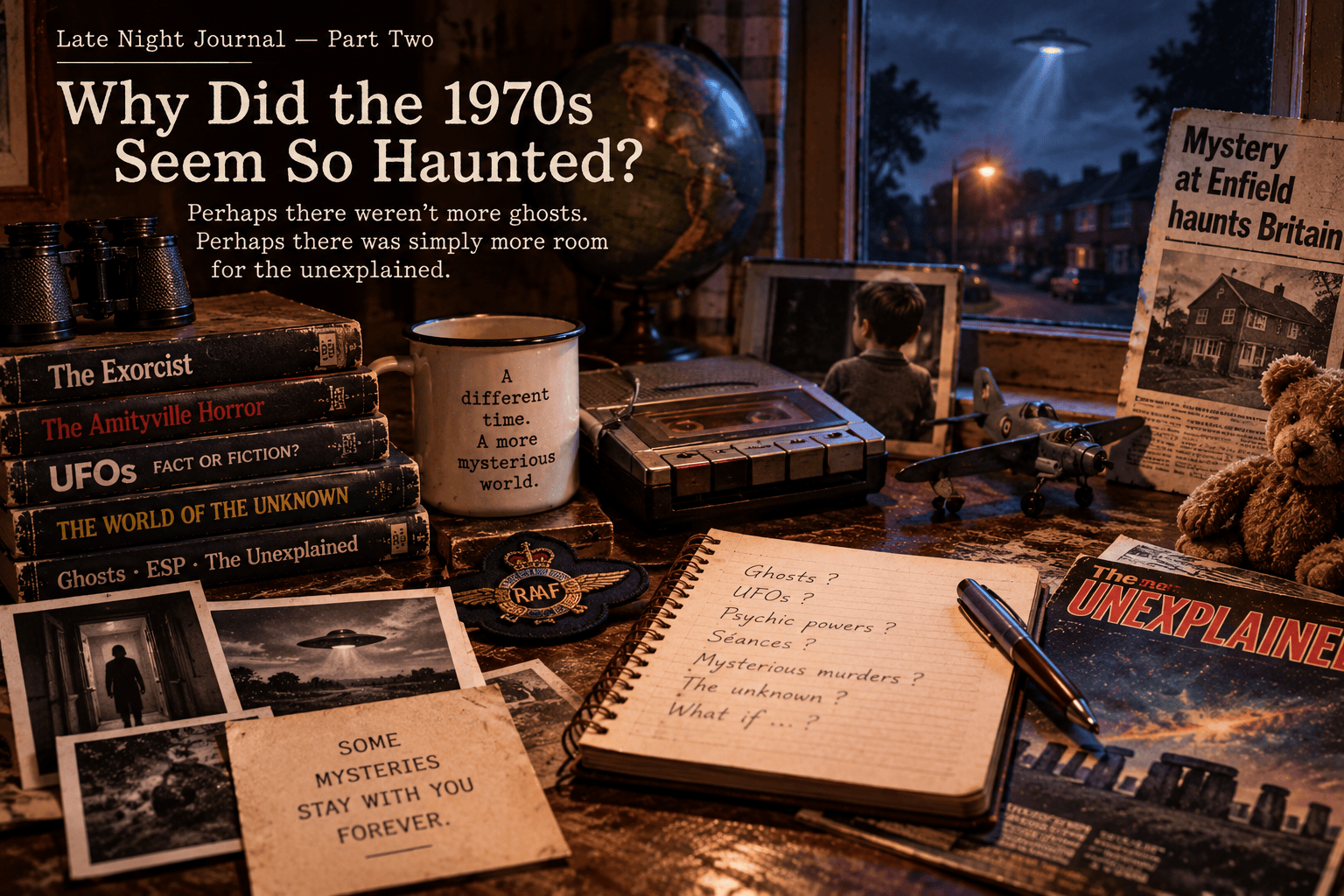
| Perhaps there weren’t more ghosts. Perhaps there was more room for the unexplained. In the first part of this Late Night Journal, I wrote about spending part of my teenage years looking for ghosts and the rather strange fact that, decades later, a horror film managed to frighten me in a way those supposedly haunted places rarely did. That left me thinking about something else. When I look back at the period in which my fascination with the supernatural developed, the 1970s seem extraordinarily crowded with unexplained things. Ghosts and poltergeists, UFOs, séances, psychic phenomena, possession stories, strange creatures, and mysterious disappearances. Some became famous internationally; others existed as stories passed between families, friends and schoolchildren. Looking back from a world in which almost any claim can be searched within seconds, it is tempting to conclude that people were more gullible then. I don’t think it was that simple. The world I remember wasn’t necessarily more supernatural. It was naturally more mysterious. |
| Growing Up Between Belief and Disbelief My parents were an interesting combination when it came to anything supernatural. My mother had been a Salvation Army girl and possessed quite firm beliefs about what she would and wouldn’t accept. As a couple, my parents’ official position on ghosts and the supernatural was generally that it was nonsense. Privately, however, things weren’t quite so straightforward. My mother would tell me about ghosts and unusual happenings, and subjects like séances and tarot cards entered conversation, even though boundaries still existed around what was considered acceptable. My father came from almost the opposite direction. He was raised Catholic, and his parents wanted him to become a priest. He rebelled against that upbringing and became agnostic, and my impression was that he subsequently closed his mind to almost anything that smacked of religion or the supernatural. Yet his life had hardly been sheltered. He had been a Metropolitan Police officer in England before we emigrated to Australia as £10 Poms, served with the RAAF Military Police in Malaysia and Australia, and later worked in security after we returned to Britain. By his own admission, he encountered strange things, but he refused to interpret them as supernatural. He would also talk about famous murders from around the world, and UFOs were certainly a subject of conversation during the 1970s. So I grew up between two rather contradictory positions. My mother could officially dismiss ghosts and then tell me about one; my father could admit that he had encountered something strange while simultaneously refusing to believe there was anything strange about it. Perhaps without realising it, they left a gap between belief and disbelief, and I became interested in whatever lived inside that gap. Things I Couldn’t Explain Another part of this is much harder to describe because it concerns my own experiences as a child. Before we returned to Britain in 1977, I sometimes saw what I would then have described as figures, shadows, or impressions of people. Sometimes I saw people who apparently weren’t there. Other times I saw nothing but felt an extraordinarily strong sense that I wasn’t alone. There could be apparent temperature changes or the impression of movement around me. Sometimes the sensation seemed to arrive before I had consciously decided anything unusual was happening. My mother would tell me that I was sensitive to these things, which naturally gave a child one possible explanation for experiences he didn’t understand. I am much more cautious about them today. I don’t claim that I was seeing ghosts, because I don’t know what I was seeing. Human perception is complicated, childhood memory is imperfect, and our brains are extraordinarily good at finding people and movement in incomplete information. A shadow glimpsed out of the corner of the eye can become something very different when we turn toward it. But I don’t feel the need to rewrite my childhood and pretend the experiences didn’t happen. They happened to me in the sense that I genuinely experienced them. What caused them is another question entirely, and after half a century, I am perfectly comfortable answering it with: I don’t know. That uncertainty helped feed the fascination. Instead of becoming frightened by these experiences, I wanted to understand them. Learning to Look at What Wasn’t There By my late teens, when casual ghost hunting had become paranormal investigation, I had learned to focus on what I thought I was sensing. I became attentive to small movements, changes in temperature, shadows, noises and that peculiar impression that somebody else was occupying a space even when there appeared to be nobody there. At the time, I thought of it almost as training myself to focus on what wasn’t there. Looking back, that phrase fascinates me. I was becoming a better observer, noticing tiny environmental changes that other people ignored. Perhaps expectation was training my brain to give greater significance to ambiguous sights and sensations. Most likely there were occasions when perfectly ordinary things felt extraordinary simply because of the surroundings in which they happened. Ghost hunting itself taught me that lesson again and again. Strange noises could be traced to buildings, cold areas to draughts or environmental conditions, and apparently mysterious movement to perfectly ordinary causes. Frightened people could also unintentionally amplify an experience, while other people occasionally made things up. The older members of the investigation club weren’t interested in accepting every creak as evidence of the dead. They were open-minded, which to me meant being prepared to consider possibilities while also looking for ordinary explanations. That remains close to my position today. Unexplained doesn’t mean supernatural. It means unexplained. Mystery Didn’t Arrive Through the Television It would make a convenient story if I said that television and shelves of paranormal books filled my childhood with ghosts. The truth is almost the opposite. Books that encouraged that sort of imagination weren’t particularly welcome in our house, and I don’t remember Australian television during the 1970s feeding my interest in the way one might expect. Some of the stories came from much earlier. During our years in Malaysia in the late 1960s, the amahs would talk about strange happenings. Those stories existed alongside my mother’s accounts of unusual events, my father’s murder stories and discussions about UFOs, and my own experiences that I couldn’t explain. The fascination therefore developed piecemeal rather than arriving through one particular book or television programme. Only later, particularly after returning to Britain, did I begin building my own private bookshelf. By the late 1970s and early 1980s, ghosts, unexplained phenomena, UFOs and other mysteries had become a serious personal interest. I wasn’t particularly selective. If something was strange, unexplained or sitting somewhere on the edge of accepted knowledge, I wanted to know about it. Then, in 1977, I arrived back in Britain just as one particular ghost story was becoming very difficult to avoid. Everybody Was Talking About Enfield The Enfield poltergeist began in 1977 and developed into one of Britain’s most famous alleged paranormal cases. For me, though, the important memory isn’t an investigator’s report or something I saw on television. It is school. Enfield was hotly debated there. That tells us something about how stories travelled then. There was no social media, no YouTube analysis appearing hours after an event, no online archive through which a schoolchild could instantly investigate every claim. Newspapers reported extraordinary events, adults discussed them, children overheard the conversations and then carried the stories into school. One child had heard one version, somebody else had been told something different, and another was certain that his version was true. By lunchtime, a paranormal event happening somewhere else in Britain could become an argument among children who had never been anywhere near the house in question. The Enfield case remains controversial. Some incidents were regarded as compelling by investigators and witnesses, while others involved children who were caught or admitted to producing phenomena themselves. That mixture of testimony, apparent evidence, acknowledged trickery, and disputed details is precisely what made cases like Enfield so durable. There was enough uncertainty for both believers and sceptics to find something that supported their position. For a curious teenager, that uncertainty was irresistible. When Horror Borrowed Reality Around this period I also began encountering supernatural horror through books. I read William Peter Blatty’s The Exorcist in 1978. Interestingly, my own chronology doesn’t match the neat history of 1970s horror that we tend to construct today. I don’t remember The Exorcist or The Omen dominating my childhood because they were famous films. In fact, I don’t think I watched the original Omen until the late 1990s, probably on video. That distinction matters because memory rarely follows cultural timelines as neatly as retrospective documentaries suggest. Something can become a defining film of a decade without being part of one particular child’s experience of that decade. Amityville entered my world differently again. I vaguely remember my parents discussing the DeFeo murders while we were living in Australia and I was around ten. Still, it was later, through a book by paranormal investigator Hans Holzer around 1980, that I really discovered the murders and the supernatural story that had grown around them. I bought the book out of curiosity, and by then, curiosity had become a fairly substantial bookshelf. Amityville fascinated me because it combined something undeniably real with something far harder to establish. Six members of the DeFeo family had actually been murdered inside the house in 1974. The Lutz family subsequently lived there and made extraordinary claims about what happened during their short stay. Those supernatural claims have been challenged, disputed and argued over ever since. That distinction matters. A real murder does not make a subsequent ghost story real. A real person reporting a paranormal experience does not establish a paranormal cause. Yet attaching a supernatural story to a genuine tragedy gives it a foothold in reality that pure fiction doesn’t possess. The house is real, the people are real, and the terrible event really happened. Imagination only has to cross the much smaller distance between what happened and what if this happened too? The Decade of the Unexplained Amityville wasn’t alone. The 1970s produced or popularised an extraordinary collection of stories involving poltergeists, possession, psychic abilities, UFOs and supposedly haunted places. The case that would later inspire The Entity emerged from reports made by Doris Bither in California, while investigators and self-proclaimed paranormal specialists became increasingly visible. Astrology, séances, tarot, ESP, mysterious disappearances and unidentified flying objects all occupied parts of the same broad cultural territory. That doesn’t mean the decade experienced an outbreak of the supernatural. What interests me is why so many of these stories found such receptive audiences. Part of the answer may lie in technology. The 1970s had enough technology to record mysteries but not always enough to resolve them. Cameras could produce photographs of supposed apparitions. Tape recorders could capture strange voices and unexplained sounds. Television could take a local story and place it in millions of homes, while newspapers could transform an ordinary house into a nationally known haunted location. Yet the evidence was often tantalisingly poor. A blurred photograph remained blurred. A strange noise on a cassette remained open to interpretation. No smartphone was in everybody’s pocket recording the same event from six different angles, and no internet let thousands of people inspect the evidence before breakfast. A mystery could remain a mystery for a very long time. Before Everything Had an Answer That is what I mean when I say the world was naturally mysterious. We shouldn’t romanticise the past. The absence of readily available information also allowed nonsense, hoaxes and misinformation to survive far longer than they might today. People weren’t wiser because they lacked Google, nor are we necessarily wiser because we have it. But there was unquestionably more space between encountering something strange and finding an explanation. If somebody told you about an unexplained light in the sky, you couldn’t immediately check aircraft movements, satellite tracks and astronomical events from the device in your hand. If you heard about a haunted house, you couldn’t instantly find fifty sceptical investigations, the building’s history, previous owners and somebody’s video tour of the attic. Often you had the story, perhaps a newspaper photograph, and whatever somebody else had heard. Then imagination occupied the remaining space. That environment suited somebody like me perfectly. As a child, I had already experienced things I couldn’t explain. My mother had suggested I was sensitive to them. My father discussed UFOs while refusing to accept supernatural explanations for the strange things he’d encountered himself. The amahs in Malaysia had their stories. Britain gave me Enfield, my own growing bookshelf and eventually paranormal investigation. There was always another door to open. Perhaps the 1970s Weren’t More Haunted. Looking back now, I don’t think the 1970s were necessarily more haunted than any other decade. I certainly don’t think a collection of unexplained experiences constitutes evidence that ghosts were wandering around Britain in unusually large numbers. What the decade possessed was uncertainty. Mass communication let an extraordinary story travel around the world, technology provided something that looked like evidence, and gaps in knowledge and verification kept that evidence unresolved. Add our natural attraction to frightening stories, genuine tragedies such as Amityville, controversial cases such as Enfield and a culture fascinated by UFOs, psychic phenomena and the occult, and perhaps the 1970s didn’t need any additional ghosts. It simply provided extraordinarily good conditions for believing there might be one. And perhaps my generation encountered one of the last versions of childhood in which a mystery could remain unanswered. You heard something strange, saw something you couldn’t explain or were told a story by an adult, and sometimes nobody could produce a definitive answer. You carried the question around with you. I still carry a few. I don’t regard that as proof of anything supernatural. After all my years of interest and investigation, I remain far more comfortable saying I don’t know than filling an unexplained space with a ghost. But perhaps we have lost something interesting in our determination to explain everything immediately. Mystery used to have time to breathe. A strange story could sit in your imagination for years, sometimes becoming more elaborate, sometimes eventually collapsing when a perfectly ordinary explanation appeared. And occasionally it never did. The world wasn’t necessarily more haunted when I was growing up. It just had more dark corners. In the next Late Night Journal, I want to follow what happened when those dark corners moved into our homes and eventually onto our screens. From Amityville and the classic haunted house to The Blair Witch Project, Hill House and the strange power of the words “based on actual events,” horror learned how to make us question where fiction ended and reality began. And somewhere in there, unfortunately, there is still a mirror I’m not prepared to stand in front of. |
| Part Three: When the Haunted House Followed Us Home |
| About our writing & imagery Most articles are grounded in our real gardening experience, observations and reflections. AI may assist with research, drafting and editing, but the experiences, opinions and editorial direction are our own. Featured images may include our photography, original AI-generated visuals or, where stated, images credited to others. All published content is reviewed and shaped by Earthly Comforts before publication. |

