| A 5-Part Series |
| A curated exploration of North America’s most iconic, curious, and ecologically important insects |
| Part Two Butterflies & Moths: Migration Written in the Air |
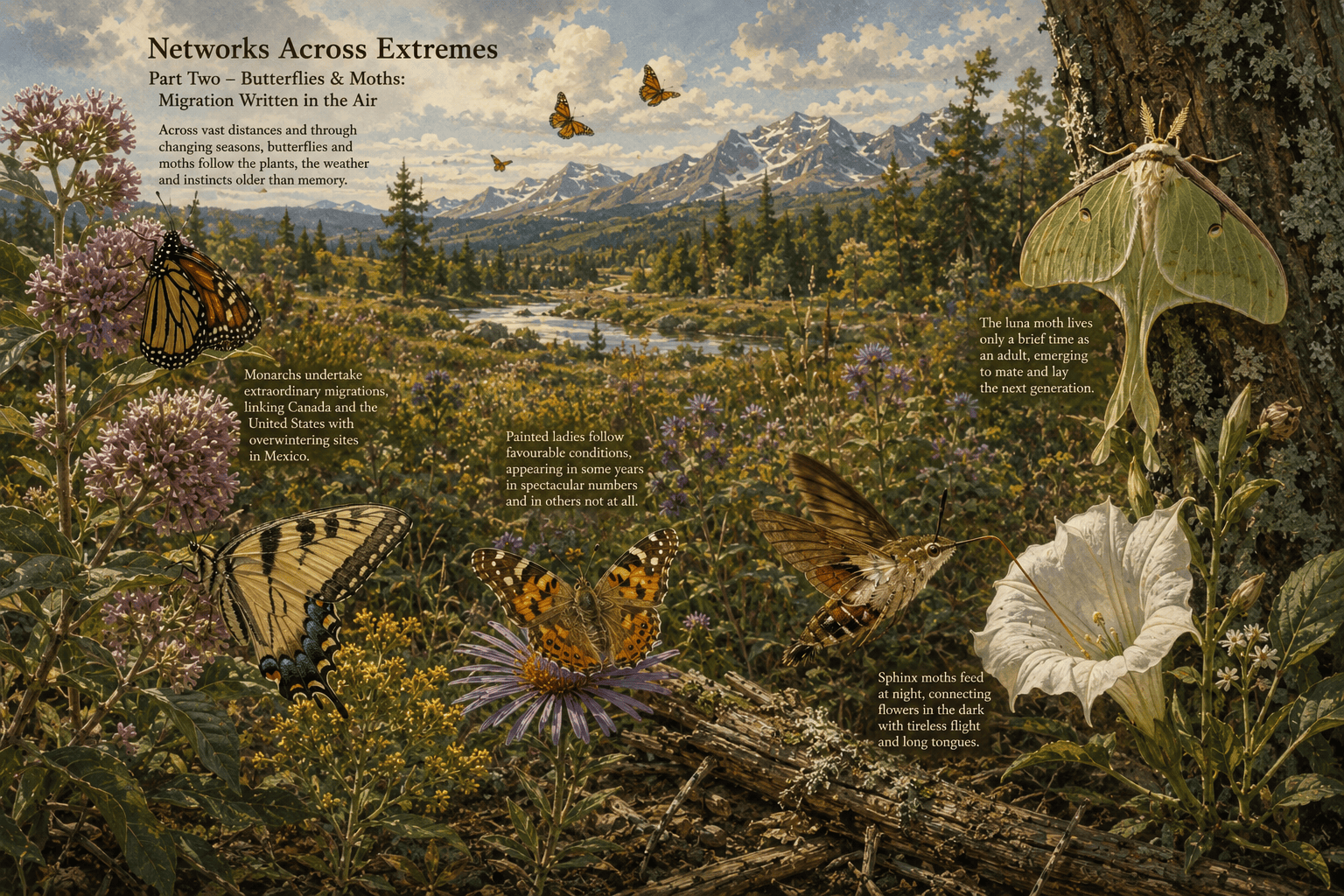
| There is something slightly misleading about the apparent delicacy of a butterfly. We see thin wings, slender bodies and a creature that seems capable of being pushed from its course by the slightest breeze. Yet across North America, butterflies and moths undertake journeys that would be impressive for animals many times their size. This is a continent where movement matters. From Canada to Mexico, landscapes are separated by enormous distances, mountain ranges, deserts, forests, farmland and expanding towns and cities. Seasons can change sharply, and the availability of food may shift hundreds or even thousands of kilometres during the course of a year. For many insects, remaining in one place is not an option. Butterflies and moths respond by moving with the landscape. Some travel vast distances, while others shift locally between habitats as conditions change. Rainfall, temperature, wind and the emergence of particular plants all influence where they appear and how long they remain. What looks to us like a butterfly wandering casually across a garden may be one small part of a much larger journey. Monarchs and a journey shared between generations The monarch butterfly has become almost inseparable from the story of North American insect migration. Its journey links large areas of Canada and the United States with overwintering sites in Mexico, creating one of the most remarkable recurring movements in the insect world. What makes the migration especially extraordinary is that it is not simply a return journey undertaken by the same individuals. Several generations participate as monarchs move northwards, breeding along the way. Later in the year, a longer-lived generation undertakes the great southward migration towards Mexico. No single butterfly experiences the entire annual cycle from beginning to end, yet the route continues. There is something difficult to comprehend about this. We usually associate navigation with experience: an animal learns a route and remembers where it has travelled. Monarchs demonstrate something very different. Much of the information required for the journey is inherited rather than taught. Their success also depends upon far more than the ability to fly. Monarch caterpillars require milkweeds, while adults depend upon nectar-rich flowers throughout their migration. A route thousands of kilometres long is therefore only useful if suitable habitat continues to exist along it. This is where the scale of insect conservation becomes clearer. Protecting a butterfly cannot always be achieved by preserving a single reserve or by planting a single garden. A migratory species needs a chain of opportunities across an entire landscape. A garden containing milkweeds or late-flowering nectar plants may seem insignificant when viewed against the size of a continent. To a migrating insect searching for somewhere to feed or reproduce, however, it can form another small link in a much longer chain. Swallowtails and the advantage of strength North America is home to numerous swallowtail butterflies, and they bring a very different style of movement to the landscape. Large, powerful and immediately recognisable, they are considerably stronger fliers than their elegant appearance might suggest. Their ability to travel between scattered habitats provides an important advantage in fragmented landscapes. Woodland edges, gardens, meadows and river corridors may contain suitable host plants, but these habitats are not always connected. A butterfly capable of crossing open ground has more options than one confined to a narrow ecological niche. Swallowtails also remind us that adaptability does not necessarily mean being able to live anywhere. Different species still depend upon particular larval food plants and suitable conditions. Their strong flight enables them to search more widely for those resources. Gardeners often concentrate on the flowers adult butterflies visit, which is understandable because that is the stage we see. Yet a butterfly garden cannot really be considered successful if it provides nectar but nowhere for caterpillars to live. The adult is only the most visible part of the lifecycle. Sometimes the plant with chewed leaves is doing more ecological work than the immaculate specimen beside it. Painted ladies and the unpredictability of abundance Painted ladies tell another migration story altogether. They can appear suddenly and sometimes in extraordinary numbers, creating the impression that an entire population has materialised almost overnight. Their movements are less tied to a simple annual timetable than those of monarchs. Rainfall, vegetation growth and favourable weather can trigger large movements as successive generations exploit temporary abundance. This makes painted lady years difficult to predict precisely. One summer they may seem to be everywhere; another year sightings may be comparatively sparse. It is tempting to interpret these changes locally. If butterflies are abundant in a garden, we may assume something nearby has improved. If they are scarce, we may wonder what has gone wrong. Migratory insects remind us that the explanation may lie far beyond the garden boundary. Rain hundreds of kilometres away can create vegetation that supports a new generation. Wind systems can assist movement across enormous distances. Drought elsewhere can alter migration routes entirely. A butterfly arriving on a flower may therefore be carrying evidence of weather conditions in a landscape we have never seen. This is one reason insects are such useful indicators of environmental change. Their movements connect places that we tend to think of separately. The brief appearance of the luna moth Not every remarkable journey involves crossing a continent. The luna moth represents another kind of precision: the ability to compress the visible adult stage into an extraordinarily short period. With its pale green wings and long trailing tails, it is one of North America’s most distinctive moths. Yet an adult luna moth has no functional mouthparts and does not feed. All the energy required for its adult life was accumulated earlier, as a caterpillar. Once it emerges, the task is straightforward and urgent: find a mate and reproduce. The adult may survive for only about a week. This seems almost brief when compared with our own understanding of a lifespan. Yet there is no evolutionary requirement for adulthood to be long. The caterpillar fed, the pupa transformed, and the moth exists just long enough to complete the next stage of the cycle. Its beauty is therefore strangely temporary even by insect standards. A gardener fortunate enough to encounter one is seeing something that occupies only a tiny window of the year. The moth has not suddenly appeared from nowhere; most of its life has happened beyond our notice. Sphinx moths and flowers after dark Sphinx moths bring power back into the story. Their rapid wingbeats and ability to hover in front of flowers can make them resemble hummingbirds, particularly in the half-light of evening. Their flight is purposeful and energy-intensive. Long proboscises allow many species to feed from deep flowers while remaining airborne, moving quickly between nectar sources. Some plants are particularly suited to nocturnal pollination. Pale flowers remain visible in low light, while strong evening fragrance helps guide insects towards them. Sphinx moths become part of a relationship that most gardeners rarely witness, as it peaks after we have gone indoors. A garden does not stop functioning at sunset. Pollination continues, predators emerge, and a different collection of insects takes over from those active during the day. Moths form a substantial part of that night shift. This is easily forgotten because butterflies receive so much more attention. We plant “butterfly-friendly” borders and talk enthusiastically about daytime pollinators, while the insects working those same flowers after dark can remain almost invisible to us. Leaving some evening-flowering and night-scented plants within a garden extends its usefulness beyond daylight hours. It also reminds us that wildlife gardening should accommodate different schedules, not merely different species. Movement requires somewhere to arrive. Migration can create the impression that butterflies and moths are free from the limitations affecting less mobile insects. If conditions deteriorate, surely they can fly somewhere else. The reality is much less forgiving. Flight only helps when another suitable habitat exists within reach. A monarch still requires milkweed for its caterpillars. A swallowtail must locate the appropriate host plant. A sphinx moth needs nectar, while its larvae require plants of their own. Even the strongest flyer eventually needs somewhere to land. Fragmentation therefore matters. One isolated garden cannot replace a functioning landscape, but gardens, parks, roadside vegetation, field margins and wild areas can collectively create corridors and stepping stones. The value lies in connection rather than any single perfect habitat. This is one of the more useful lessons butterflies offer gardeners. We sometimes become preoccupied with making our individual patch ideal. Wildlife sees things differently. Our gardens are parts of larger landscapes, and insects move between them without recognising property boundaries. What matters is whether the next opportunity remains reachable. Migration written in the air North America’s butterflies and moths live within a landscape that rarely remains still. Seasons advance and retreat across enormous distances. Rain creates temporary abundance. Drought removes it. Plants flower, set seed and disappear again. Wind systems change, temperatures fall, and another generation begins moving. Monarchs turn this into a continental relay. Swallowtails use powerful flight to cross fragmented landscapes. Painted ladies follow favourable conditions with a flexibility that makes their arrival difficult to predict. Luna moths compress adulthood into a few extraordinary days, while sphinx moths connect flowers through the darkness. Their strategies differ, but each depends upon timing. Perhaps that is why butterflies and moths can tell us so much about the landscapes around them. Their movements reveal where conditions have become favourable and where connections remain intact. Their disappearance can tell us something too. We tend to notice the insect itself — the flash of orange from a monarch, the sweep of a swallowtail or the improbable green of a luna moth. What we do not see is the geography that it carries. Every travelling butterfly represents a series of successful connections: the plant upon which it began life, the weather that allowed it to emerge, the flowers that provided fuel and the pieces of habitat that remained close enough for it to continue. Across North America, those connections stretch for extraordinary distances. The migration may be written in the air, but its survival is rooted firmly in the ground below. |
| About our writing & imagery Most articles reflect our real gardening experience and reflection. Some use AI in drafting or research, but never for voice or authority. Featured images may show our photos, original AI-generated visuals, or, where stated, images credited to others. All content is shaped and edited by Earthly Comforts, expressing our own views. |

