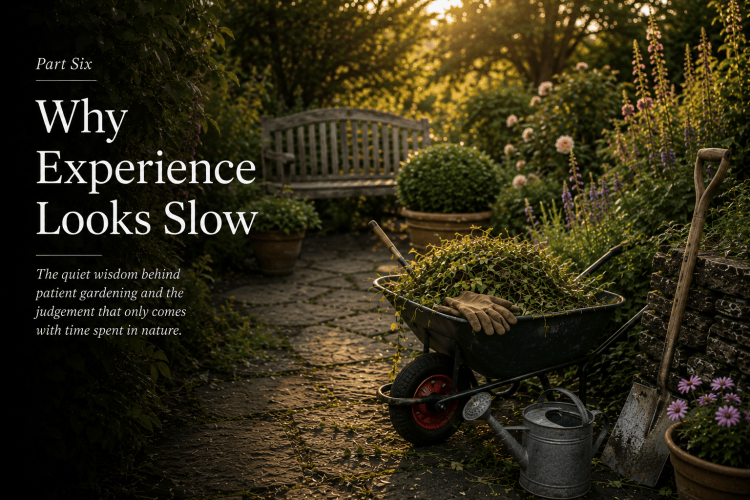
| Part Six Why Experience Looks Slow |
| There is a question I have been asked more than once over the years, although it is not always spoken aloud. Why does an experienced gardener sometimes appear to work more slowly than someone with far less experience? At first glance, it seems a perfectly reasonable observation. The younger gardener is already halfway across the lawn with a strimmer, while the older one is still standing beside the trailer, looking quietly around the garden as though searching for something that isn’t immediately obvious. The funny thing is that they usually are. Experience has a curious habit of slowing the body while speeding up the mind. Before a tool is lifted, a dozen small decisions have already been made. Which job should come first? Where will the green waste naturally accumulate? Which borders are still damp from yesterday’s rain? Has anything flowered since the last visit that deserves to be enjoyed for another week before being cut back? Is there a blackbird nesting in the hedge that looked empty last month? None of these questions delays the work. They shape it. When I first began gardening professionally, I suspect I measured a good day’s work by how tired I felt when I climbed back into the van. If I had spent hours digging, lifting and cutting, then I assumed I had worked well. There is certainly satisfaction in honest physical labour, and gardening provides plenty of it. Still, over time I began to realise that effort and judgement are not quite the same thing. Some of the most valuable decisions a gardener makes are almost invisible. Choosing not to prune a shrub because it is carrying late flowers for bees. Deciding to leave the lawn until the dew has lifted rather than risk marking it with heavy machinery. Cutting one branch instead of five because removing the others would disturb the natural shape of the tree. Walking an extra twenty yards to fetch the correct tool rather than forcing the wrong one to do the job. None of these moments looks especially impressive, yet together they define the quality of the finished work. That may be why gardening reminds me less of a race than a game of chess. The best move is not always the quickest one. It is the one that quietly makes all the subsequent moves easier. One of the great misconceptions about experience is that it is measured by the number of years someone has worked. Time certainly helps, but only if it is accompanied by curiosity. Gardens have an unfortunate habit of humbling anyone who believes they have seen everything. When you think you’ve understood a particular plant, an unusually wet spring or a prolonged summer drought reminds you that nature has no obligation to repeat last year’s performance. The longer I garden, the more comfortable I have become with not knowing everything. Oddly enough, that feels rather liberating. Instead of trying to master every garden, I have learnt to listen to them. One garden wants restraint. Another asks for confidence. One rewards bold pruning, while another responds far better to patience. They may contain the same plants growing only a few miles apart, yet each has its own character, shaped by soil, aspect, weather and the people who care for it. Experience, I’ve come to believe, is not the accumulation of answers. It is the ability to ask better questions. That applies just as much to people as it does to plants. Clients sometimes apologise because they think they are asking too many questions, but I rather enjoy those conversations. They tell me how someone uses their garden, what matters to them, and which corners hold memories invisible to anyone visiting for the first time. Understanding those things often influences the work far more than any gardening book ever could. The wildlife has been teaching me similar lessons all along. A robin hopping confidently behind the spade is not interested in how efficiently I finish the border. A hedgehog sheltering beneath an untidy pile of leaves has no opinion on whether the lawn stripes are perfectly straight. Bees continue visiting the flowers whether I admire them or not. They all serve as gentle reminders that gardens exist for far more than our own satisfaction. That may be why I have become less interested in perfection with every passing year. Perfection often demands control. Good gardening asks for understanding. There is an important difference. A perfectly clipped shrub can still look uncomfortable if it has been forced into a shape that doesn’t suit it. A slightly uneven border may feel entirely right because it reflects the gentle rhythm of the rest of the garden. Nature has never shown much enthusiasm for rulers or spirit levels, and I suspect that is part of its enduring charm. Looking back over this series, I realise that every part has really been describing the same thing from a different direction. Learning to see. Understanding why edges matter. Knowing what to remove and what to leave behind. Recognising that the smallest finishing touches often leave the strongest impression. Discovering that a tidy-up is as much about people as it is about plants. None of those lessons appeared overnight. They arrived one garden at a time. One mistake at a time. One quiet observation at a time. If experience appears slow, perhaps it is because it has already learnt that gardens are in no hurry. An oak does not become magnificent in a single season. A newly planted hedge does not provide privacy by next summer. Even the finest compost asks for patience before it is ready to nourish another generation of growth. Gardens have always measured time differently from the rest of us. That may be their greatest gift. They gently encourage us to do the same. When I first picked up a pair of secateurs, I thought gardening was mostly about learning what to do. Now, after years spent in other people’s gardens, I suspect it is far more about learning what not to do, when to wait, when to trust nature, and when a gentle nudge is all that is needed. That is not slower gardening. It is quieter gardening. And perhaps that has been the hidden craft all along. |
| About our writing & imagery Most articles reflect our real gardening experience and reflection. Some use AI in drafting or research, but never for voice or authority. Featured images may show our photos, original AI-generated visuals, or, where stated, images credited to others. All content is shaped and edited by Earthly Comforts, expressing our own views. |


Nice post, Rory. Patience is beneficial in most anything we do.
LikeLike