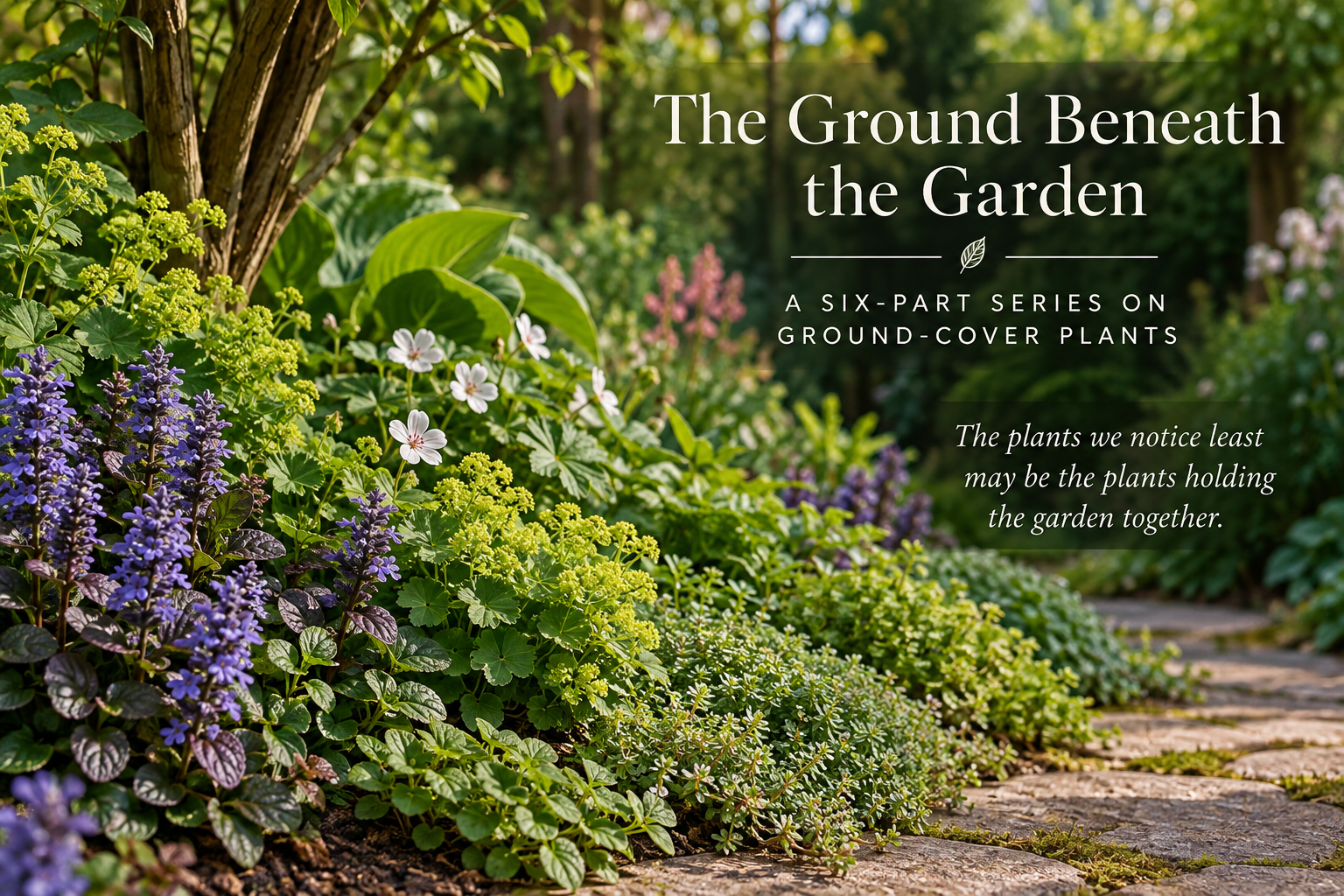
| Episode 1 “Why Bare Soil Is Rarely the Finished Garden.” |
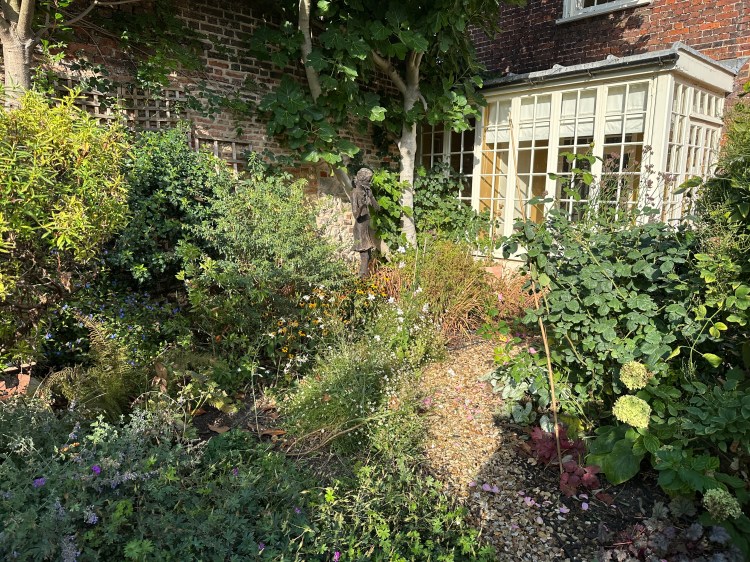
| A border beginning to knit together. Low-growing plants occupy the spaces beneath and between larger shrubs and perennials, leaving little bare soil and creating the living layer that helps hold the planting together. |
| There is something rather satisfying about a freshly weeded border. The soil is dark, cultivated, and clean; the plants stand individually where we intended them to stand; and for a brief period, everything looks remarkably organised. It is also one of those moments in gardening that rarely lasts very long. Leave that soil alone, and the garden immediately begins attempting to fill it. We usually describe what happens next as a weed problem, but there is another way of looking at it. Bare ground is an opportunity, and plants are remarkably good at exploiting opportunities. Seeds arrive on the wind, drop from plants already in the garden, are carried by birds or are disturbed from the soil itself. Perennial weeds move in from the edges or emerge from roots and rhizomes below. Before long, that beautifully cleared patch of earth is green again, although not necessarily with the plants we would have chosen. Much of gardening is really an attempt to influence this process. We decide which plants are allowed to occupy the ground and which are not. We weed, mulch, cultivate, and plant, but underneath it all is a fairly simple ecological principle: if there is suitable space, something will eventually try to grow in it. Ground-cover planting takes advantage of that rather than constantly fighting against it. The space between the plants When people first plan a border, attention naturally goes towards the plants that will be noticed. A rose, hydrangea, peony, ornamental grass or beautifully shaped shrub tends to be the reason we buy the plant in the first place. Smaller plants are often fitted around them afterwards, almost as decoration. Yet after maintaining gardens for long enough, you begin to notice that the spaces between those larger plants matter just as much. A border containing good plants but too much exposed ground can look unfinished. Each plant sits in its own little territory rather than belonging to a larger planting. Gaps let weeds establish, soil dries quickly in summer, rain hits the surface directly, and every empty patch becomes another small maintenance job. Put the right plants into that lower layer and something changes. The border begins to join together. This does not mean covering every centimetre of soil with one sprawling plant. Nor does it mean creating a thick green carpet through which everything else has to struggle. Good ground cover is more subtle than that. It fills the spaces larger plants don’t need while letting those plants remain part of the composition. In some gardens this might be a low-growing geranium gradually forming a loose colony around shrubs. Elsewhere it could be Alchemilla mollis softening the front of a border, an Epimedium spreading beneath deciduous shrubs, or thyme working its way through a hot, dry edge where many other plants would struggle. They are doing different jobs, but the principle is the same. The soil has become planted rather than merely exposed. Nature doesn’t leave many gaps. One reason ground-cover planting works is that it borrows from natural plant communities. Walk through woodland, and there is usually more happening beneath the trees than we first notice. Shrubs, ferns, grasses, mosses, bulbs, and low herbaceous plants may occupy different layers. In a meadow or grassland, plants overlap and intermingle. Even apparently sparse habitats often contain species specifically adapted to exploiting the difficult spaces between larger vegetation. Gardens are obviously not natural ecosystems. We select the plants, alter the soil, irrigate when necessary, prune things into shapes they would never encounter in the wild and remove anything we have decided is a weed. There is little point pretending otherwise. But we can still learn from the way plants occupy space. One of the peculiarities of the traditional cultivated border is the amount of bare earth we sometimes expect to maintain between plants. We clear it, rake it and then spend the following months preventing nature from filling it again. Mulching has become one answer, and a good organic mulch remains one of the most useful things we can put onto many garden soils. It suppresses annual weeds, reduces evaporation, adds organic matter as it breaks down and protects the soil surface. But mulch and plants need not compete. A newly planted border may benefit enormously from mulch while the plants establish. As those plants mature and begin meeting one another, living vegetation can increasingly perform some of the protective role that previously depended upon an exposed layer of compost, bark or other material. The result is not a garden in which soil disappears completely. It is a garden in which bare soil becomes less of a permanent design feature. What happens beneath the leaves The benefits are not purely visual. A layer of foliage close to the ground changes the conditions immediately beneath it. Less sunlight reaches the soil surface. Wind movement is lower. Evaporation can be slowed, and fluctuations in soil temperature may be moderated. Fallen leaves and plant debris become caught amongst the vegetation rather than always blowing away. For the soil organisms beneath, this can create a very different environment from an exposed, repeatedly cultivated surface. Roots also have a physical effect. Ground-cover plants are not simply leaves spread across the soil surface. Beneath them is a living network that occupies different depths, interacts with fungi and microorganisms, takes up water and nutrients, and contributes organic material as roots grow and die. This is where the phrase living mulch begins to make sense, although, as we will explore later in this series, it needs to be used carefully. Plants consume water and conserve it. They compete for nutrients and protect soil. Put vigorous ground cover around a newly planted shrub, and it may not be helping nearly as much as we imagine. Gardening rarely rewards absolute rules. The important question is not simply whether ground cover is good, but whether this particular plant is useful in this particular place. A weed is looking for the same opportunity. Weeds are the most obvious reason for thinking about the lower layer of a border. Ground-cover plants cannot make weeds disappear. I wish they could. A well-established planting can still acquire dandelions, willowherb, bindweed, couch grass, creeping buttercup and all the other plants capable of finding their way into places where they were not invited. Good ground cover can make establishment harder for some of them. A weed seed landing on open, recently disturbed soil has found rather favourable circumstances. A seed landing beneath dense foliage, where light is restricted, and roots already occupy much of the available space, faces a rather different proposition. This is particularly noticeable once a border has matured. The first year or two after planting can require just as much attention as before because the ground-cover plants themselves are still establishing. In fact, this is when weeding matters most. Let perennial weeds become entangled among spreading ground cover, and you can create a much more irritating problem for yourself. But once suitable plants have knitted together, the character of the maintenance begins to change. Instead of repeatedly clearing large areas of exposed soil, we are increasingly removing occasional weeds from amongst plants we actually want. That is not a maintenance-free garden. It is a different kind of maintenance. The danger of being too successful However, there is an obvious trap. If our objective is to find plants that can spread across the ground and compete with weeds, we are deliberately selecting plants with a certain amount of ambition. Sometimes they have rather more ambition than we anticipated. I have seen plenty of plants recommended as ground cover that perform the task magnificently, right up until the gardener decides they would like them to stop. A plant capable of suppressing weaker vegetation does not necessarily understand that the expensive perennial planted beside it is exempt. This is where the distinction between useful ground cover and what I call the beautiful bullies becomes important. Some plants spread slowly enough that you can easily manage their progress. Others run through the soil, root as they travel, seed themselves enthusiastically or form such dense colonies that removing them becomes a project in itself. In a difficult bank, beneath established trees or across a large informal area, that vigour may be exactly what is required. In a small mixed border containing delicate perennials, the same behaviour can be disastrous. We will meet some of those plants later in the series because they are not necessarily bad plants. Often they are very good plants being asked to behave in the wrong place. That distinction matters. Looking down rather than across The biggest change that comes from thinking about ground cover is simply learning to look at a border differently. Instead of seeing a collection of shrubs and perennials separated by soil, we begin to see layers. There are the taller structural plants, the seasonal performers, bulbs appearing and disappearing, and beneath all of them another community occupying the ground itself. Suddenly the rather insignificant plant spreading beneath a shrub does not seem quite so insignificant. It may never be the plant somebody notices when they first walk into the garden. Nobody is likely to stand admiring how its roots protect the soil or congratulate it for making life slightly harder for a germinating weed. It may spend most of the year being overshadowed by something taller and more spectacular. Yet remove that lower layer, and the difference can be immediate. The border opens up. Soil appears. Plants that once seemed connected become isolated again. Maintenance increases and the whole planting can feel less settled. That is why ground cover deserves rather more attention than it normally receives. Over the next few episodes, we are going to look at what works in sun, what thrives in shade, what happens when useful plants become too successful, whether living plants can genuinely reduce our dependence on conventional mulching and weeding, and eventually how this lower layer can be deliberately built into a border rather than added as an afterthought. A successful garden is not made only of the plants that catch our eye. Sometimes the plants we notice least are the ones holding the garden together. |
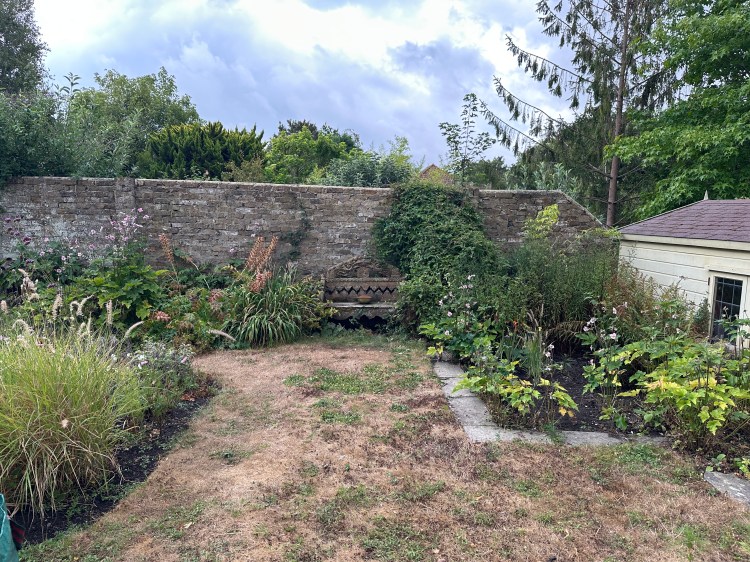
| Where plants have yet to close the gaps, bare soil remains an opportunity. As this border develops, the lower layer can gradually occupy those spaces, reducing exposed ground and changing the way the border needs to be maintained. |
| About our writing & imagery Most articles reflect our real gardening experience and reflection. Some use AI in drafting or research, but never for voice or authority. Featured images may show our photographs, original AI-generated artwork, or, where stated, credited images shared by others. All content is shaped and edited by Earthly Comforts, expressing our own views. |

