| Part Three |
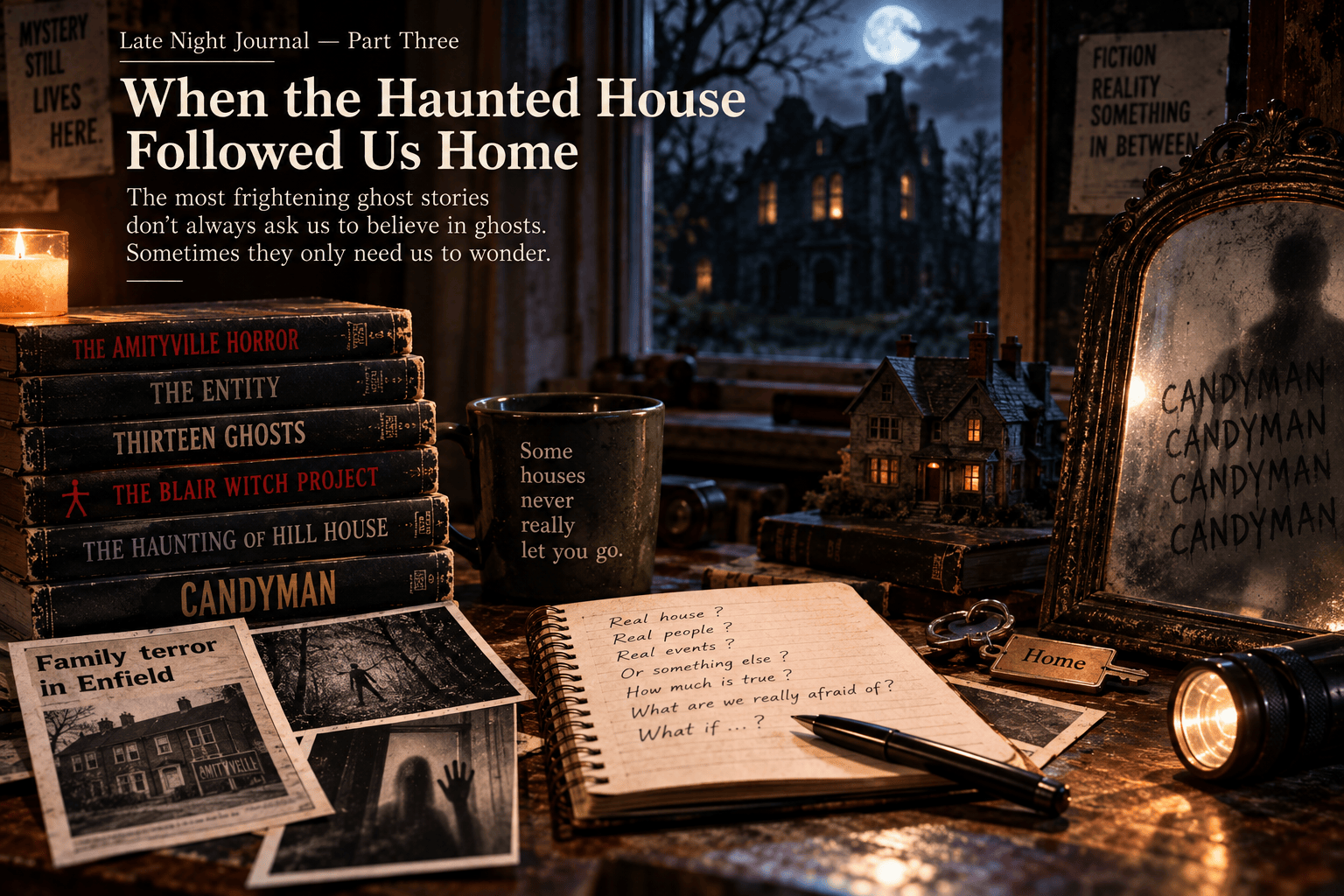
| The most frightening ghost stories don’t always ask us to believe in ghosts. Sometimes they only need us to wonder. Over the previous two episodes, I have somehow travelled from wandering around graveyards as a teenager to the Enfield poltergeist, Amityville, UFOs, paranormal investigation and my eventual discovery that, despite all those years of curiosity, I could still be frightened by a horror film. It has left me thinking about the haunted house itself, since houses have recurred throughout this story. There were the supposedly haunted buildings I deliberately entered as a teenager, the house at Amityville, the ordinary council house at the centre of the Enfield case and, much later, Hill House and Bly Manor. Even when horror takes us somewhere else, it has an irritating habit of eventually bringing the danger home. Perhaps that is because the haunted house reverses one of our oldest ideas about safety. Outside is where danger is supposed to live. Home is where we close the door against it. A haunted house tells us that closing the door won’t help because the thing we’re frightened of is already inside. For reasons I explored in Part One, I have a slightly complicated relationship with that idea. Home wasn’t always the safest place for me when I was young, and the supposedly frightening places I explored could actually offer an escape. Nevertheless, the idea of home as sanctuary is deeply embedded in us. Bedrooms, kitchens, staircases and sitting rooms are ordinary places where we lower our guard, which may be precisely why horror filmmakers enjoy putting something at the end of the corridor. |
| When a Real House Becomes a Horror Story The Amityville Horror is probably one of the clearest examples of reality and storytelling becoming entangled. The house was real. The DeFeo family was real, and six members of that family were murdered there in November 1974. Ronald DeFeo Jr. was convicted of those murders. The supernatural story came afterwards. George and Kathy Lutz and their children moved into the house in December 1975 and left twenty-eight days later. They subsequently described extraordinary experiences during their short time there, and those claims became the foundation for books, films and decades of argument. The haunting claims have been heavily disputed, and later occupants did not report the same extraordinary experiences. None of that changes what makes Amityville psychologically powerful. The supernatural part doesn’t have to be established as true because the story begins with something we know was horrifyingly real. Once reality has opened the door, imagination only has to take another step through it. That little step is the territory in which the phrase “based on actual events” has become one of horror’s most useful tools. It doesn’t mean everything we are about to see happened. Sometimes very little of what appears on screen resembles the original events by the time writers, directors and marketing departments have finished with them. But those four words encourage us to watch differently. Instead of asking only, ” What happens next?, another question begins hovering somewhere behind it: how much of this actually happened? When Leaving the House Doesn’t Work The Entity disturbed me for a related reason. The film draws on experiences Doris Bither reported in California during the 1970s. She described violent attacks by unseen entities, and people associated with paranormal research investigated aspects of the case. That establishes that a woman made extraordinary claims and that people investigated them; it does not establish that supernatural beings were responsible. But the story contains an idea that makes it particularly disturbing. The threat isn’t necessarily the building. It is attached to the person. That changes one of the basic rules of the haunted-house story. If a house is haunted, theoretically you can leave it. Sell it, abandon it, burn the estate agent’s particulars and never go back. But what happens if whatever is frightening you comes too? Horror becomes much harder to contain once it crosses the front door. Perhaps that is why some supernatural stories linger while others disappear almost as soon as the credits roll. They don’t merely show us a monster. They interfere with ordinary things: mirrors, bedrooms, children’s toys, photographs, telephones, televisions and the dark space at the top of the stairs. Once the film finishes, all those things are still in our houses. Seeing What Isn’t There This connects rather neatly with Thirteen Ghosts, which frightened me not because its ghosts were especially convincing but because of the way they were seen. The characters could see them only under particular circumstances, using special glasses. Without the glasses, the room looked empty. I find that much more unsettling than a creature standing plainly in front of me. Something visible has a position. You can watch it, run from it, or at least know which direction not to walk in. An invisible threat removes that certainty and hands the space over to the imagination. It also reminds me of something I described in Part Two. As a teenager involved in paranormal investigation, I learned to pay attention to what seemed not to be there: small movements, temperature changes, shadows, sounds and that peculiar sensation that another person was occupying a space even though nobody was visible. I am far more cautious about interpreting those experiences today. But horror understands exactly how to exploit the same instinct. Show us an empty doorway for long enough and eventually we begin looking for the thing that isn’t standing in it. Then Horror Discovered the Internet Years later, The Blair Witch Project found another way of doing this to me. I believed it. Not forever, thankfully, but long enough for the film to achieve exactly what its makers wanted. I thought I was watching recovered footage belonging to three people who had genuinely disappeared. I can laugh about that now, but it is worth remembering what the internet was like in 1999. It was developed enough for information to spread rapidly but still young enough that many of us hadn’t acquired the instinct to verify everything we encountered online. The film’s marketing exploited that beautifully. The actors were presented as missing people, the footage was treated as recovered material, and an invented mythology was allowed to circulate. The film itself helped enormously because it didn’t look like a conventional horror movie. No famous actors wandered around beautifully lit sets, and there was little of the polished visual language that tells us we are safely watching fiction. Shaky footage, frightened voices, noises outside a tent, and people who increasingly seemed unsure where they were filled the screen. If you believed, even temporarily, that the footage might be genuine, you weren’t simply wondering what would happen to the characters. You thought you might be watching what had happened to real people. By the time I discovered that it wasn’t real, the trick had already worked. In some respects, Blair Witch was doing with the early internet what paranormal stories had done with newspapers, books and fuzzy photographs during the 1970s. It created uncertainty, then let the audience’s imagination fill the space. The technology had changed. The psychology hadn’t. The House Isn’t Always the Ghost Which brings me back to The Haunting of Hill House, where this whole Late Night Journal began. When I first watched the series in 2020, I found it uncomfortable. Watching it again recently with Suze was completely different. Neither of us was particularly concerned with being frightened by the ghosts. We were much more interested in the family. That may be because Hill House understands something that the best haunted-house stories have probably always understood. A ghost doesn’t necessarily have to be the most frightening thing in the building. The Crain family physically leaves Hill House, but each member carries something away from it. Childhood memories, grief, guilt, addiction, anger and unanswered questions follow them into adulthood. The house becomes both a supernatural place and a container for everything that happened to the family inside it. That idea resonates with me rather differently now than it would have done when I was fourteen watching Hammer Horror. A house can contain memories as effectively as it contains furniture. People can leave a place without completely escaping what happened there. That doesn’t require ghosts. It only requires memory. Perhaps that is why Bly Manor didn’t particularly frighten me either. Beneath its supernatural story is something recognisably human: love, loss, memory and the impossibility of keeping people forever. The ghosts give the story a language to explore those things. This may be one reason my relationship with horror has changed. When I was young, I wanted to know whether the ghost was real. Now I am more interested in what the ghost represents. What Are We Actually Afraid Of? Writing these three Late Night Journals has made me realise that the supernatural has occupied very different places in my life. As a child, I experienced things I couldn’t explain and was told by my mother that I was sensitive to them. As a teenager, I went looking for answers and discovered that many supposedly paranormal events had perfectly ordinary explanations. As an adult, I became increasingly sceptical about ghosts while remaining fascinated by unexplained phenomena. Then, in 2015, Annabelle frightened me at half past ten on a bright sunny morning. That may be the strangest part of the whole story. Horror didn’t frighten me most when I believed in ghosts. It frightened me after I had largely stopped believing in them. That suggests belief may not be particularly important. We don’t jump during a horror film because we have carefully evaluated the available evidence and concluded that the monster probably exists. We jump because another, older part of the brain has detected something resembling danger before our rational mind has finished objecting. Music can do it. Silence can do it. An empty doorway can do it. Something moving at the edge of vision can do it. So can being told that what we are watching really happened. Horror doesn’t always need us to believe. Sometimes it only needs us to hesitate. And Then There Is the Mirror Unfortunately, after three articles exploring psychology, perception, paranormal investigation, cultural history and the difference between evidence and belief, I am still left with one embarrassing problem. Candyman. As I said in Part One, the film itself didn’t particularly frighten me. The mirror ritual did. Stand in front of a mirror, say Candyman five times, and supposedly something terrible happens. I know it won’t. There is no evidential basis for believing that repeating the name of a fictional character can summon him. I understand suggestion, conditioning and the psychology of fear considerably better at sixty-three than I did as a teenager. I spent years entering supposedly haunted buildings and learned repeatedly that unexplained things often become ordinary once somebody investigates them properly. So I have an extremely simple experiment. Stand in front of a mirror. Say Candyman five times. Observe that nothing happens. Experiment concluded. Except I’m not doing it. And perhaps, after everything I’ve written in these three Late Night Journals, that is the most honest conclusion I can offer. The boy who went looking for ghosts became the man who largely stopped believing in them. Yet, somewhere between reason and imagination, a tiny part of the mind still whispers the same question that kept me interested in the supernatural all those years ago. What if? Logically, I know the answer. But I’m still not saying it five times. |
| About our writing & imagery Most articles are grounded in our real gardening experience, observations and reflections. AI may assist with research, drafting and editing, but the experiences, opinions and editorial direction are our own. Featured images may include our photography, original AI-generated visuals or, where stated, images credited to others. All published content is reviewed and shaped by Earthly Comforts before publication. |

