
| Series One Episode Seven The Way Back |
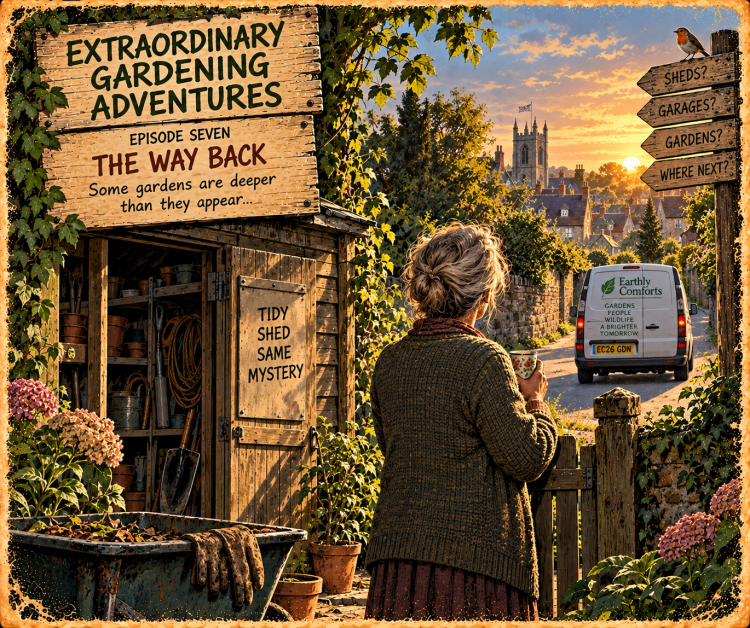
| The gap was narrower than it had looked from the path, and for several seconds all I could see was hedge on one side, timber fencing on the other and John’s rucksack immediately in front of me. Then he stopped so suddenly that I walked straight into him. “John.” He didn’t move. “Look.” I squeezed past far enough to see over his shoulder, and there it was. We were standing behind the client’s shed. Not something resembling it, not another version surrounded by plants from three different worlds, but the actual shed. The fence was where it should have been, the neighbouring roof was visible beyond it, and the narrow strip of ground along the back contained exactly the collection of weeds I’d noticed earlier that afternoon. Somewhere beyond the house, a car passed along the road. John turned towards me. “Are we back?” I told him I thought so, which earned the entirely reasonable reply that I’d said that before. We moved around the side of the shed cautiously, which must have looked ridiculous had anyone been watching. After dinosaurs, giant insects and gardens separated by millions of years, we were treating a perfectly ordinary Kent garden as though it might attack us. Nothing did. The piles we’d sorted during the clearance were still where we’d left them: pots and trays in one group, rubbish in another, useful materials set aside and a smaller collection awaiting the client’s decision. On the patio stood the two mugs we’d abandoned when the shed clearance became considerably more complicated than expected. I picked mine up. The tea was still warm. John immediately checked his phone, stared at the screen, then showed it to me. According to the time, we’d been gone for less than half an hour. That took some absorbing. We’d walked for hours through a prehistoric landscape, spent a night beneath trees listening to things moving in the darkness, crossed an abandoned garden, stood in Kent in 2189 and wandered beneath plants large enough to shelter under. We’d eaten most of the food from our rucksacks, refilled our water bottles in the future and accumulated enough scratches, mud and general dishevelment to suggest we’d been missing for considerably longer than twenty-odd minutes. John looked at his clothes, then at the phone again. “I’m not explaining this on the timesheet.” I laughed, partly because it was funny and partly because the sound of a car passing outside the garden had suddenly become one of the nicest things I’d ever heard. The client appeared at the back door a moment later and looked at us, then at the shed, then back at us. Her expression wasn’t one of alarm at discovering that her gardeners had somehow become filthy and exhausted during a relatively straightforward clearance. If anything, she looked mildly concerned in the way someone might if we’d been caught in a sudden shower. “Oh dear,” she said. “It swallowed you as well, didn’t it?” John and I looked at one another. “What do you mean, as well?” he asked. She seemed to realise she’d said slightly more than intended and suggested that perhaps we’d better have another cup of tea. There are times when you demand immediate answers. There are other times when a dinosaur has recently chased you, and somebody offers you tea. We chose tea. We sat at the patio table while she made a fresh pot. For a while neither John nor I knew where to begin. How do you ask somebody why their garden shed contains access to prehistoric ecosystems and the twenty-second century without sounding unreasonable? Eventually I started with the simplest question. “You knew.” She considered that while pouring the tea and said she knew it could happen. When John asked whether that meant she’d knowingly sent us into a shed we could fall through, she pointed out that she hadn’t known it would happen specifically to us. John didn’t appear to find the distinction particularly comforting. What followed wasn’t the explanation I’d expected, largely because she didn’t have one. She didn’t know why the shed did what it did, who or what had created the passages or why some journeys apparently crossed enormous distances in time. Over the years, she’d developed theories and abandoned most of them. What she did know was that once somebody had travelled through and returned, things seemed to become slightly easier. John stared at her. “Easier? A dinosaur chased us.” She calmly took a sip of tea. “I didn’t say safer.” She told us she’d once been a gardener herself. Many years earlier, long before she owned the house, she’d encountered the shed and discovered its peculiarities much as we had: accidentally. Her first journey had taken her somewhere she couldn’t properly identify, and getting back had been considerably harder than getting there. She’d travelled again over the years, although she wouldn’t tell us how often. When I asked why she’d eventually bought the house, she looked towards the shed. “Some people buy a house for the kitchen.” John stared at her. “You bought it for the shed?” She smiled. “I liked the garden too.” Then I remembered the ruined garden. I told her we’d found something there: the remains of a rucksack, most of the fabric rotted away, with an old metal bottle and folding knife nearby. For the first time since we’d returned, her expression genuinely changed. She stopped stirring her tea and asked whether the knife had a dark handle. As far as I could remember, it had. “I wondered where I’d left that.” John slowly lowered his mug and asked whether she was serious. She was. That one answer rearranged much of what we’d seen. The old path, the worked posts, the arrows and the belongings beneath the ruined wall hadn’t been evidence of some anonymous traveller. At least some of them belonged to the woman sitting opposite us drinking tea. When I asked about the arrows, she admitted that some were hers. “Some?” I repeated. She smiled. “You’re not the first people to travel, Rory.” I could have asked questions for the rest of the afternoon, but something about her manner made it clear that answers wouldn’t necessarily make the shed more understandable. She knew considerably more than we did, but she didn’t understand everything either. The places changed, routes appeared and disappeared, and time behaved according to rules she’d never managed to establish. There was one thing she seemed reasonably confident about: once someone had travelled, these places appeared to recognise them. John frowned. “The shed recognises us?” She shrugged. “That’s as good an explanation as I’ve ever found.” John looked towards it. “We’re never going in there again.” “Of course not,” she said. I knew immediately that she didn’t believe him. Neither, if I’m truthful, did I. There remained the slightly ridiculous matter of why we’d been there in the first place. The shed still needed clearing. After dinosaurs, future Britain and a slug the size of a wheelbarrow, returning to stacks of old pots and broken trays felt strangely therapeutic, so we finished the job. John refused to work at the back until I’d checked it, but the impossible gap had gone. Behind the shelving was a perfectly ordinary timber wall. I measured the interior because I couldn’t help myself and found that it corresponded almost exactly with the outside dimensions: twelve by eight, give or take the thickness of the walls. Whatever additional space we’d encountered earlier had disappeared. We carried the remaining rubbish outside, swept the floor and stacked everything the client wanted to keep. By the time we’d finished, the shed looked like a shed again. There was room to move, the shelves were accessible, and nothing suggested that two gardeners had recently fallen through its back wall and spent what felt like days trying to return. When the client came out to inspect it, she looked around approvingly and said, “Oh, that’s much better.” John stared at her in disbelief before asking whether there was anything else she’d like doing. She considered the question for just long enough to worry him, then smiled. “No, dear. I think you’ve done quite enough for one afternoon.” Before closing the shed, I looked once more at the back wall. There was nothing unusual about it. No opening, no unexplained depth and no glimpse of vegetation belonging to millions of years in the past. Just timber, shelves and several neatly stacked pots. I closed the doors and joined John at the van. The client stood at the gate as we packed away. John had already made it clear that if she ever telephoned asking for another shed clearance, somebody else could have the job. I was inclined to agree, although I couldn’t stop thinking about the places we’d seen and, more importantly, the places we hadn’t. The client apparently noticed. “You’ll wonder about it,” she said. I asked what she meant. “Where it might go next.” From beside the van, John called, “He won’t.” She smiled at me, and I didn’t answer. We drove away with the rucksacks behind the seats, the tools where they belonged, and an afternoon’s gardening job somehow completed. Neither John nor I saw the client remain at the gate after the van disappeared around the corner. We didn’t see her glance back towards the now tidy and completely ordinary-looking shed, nor did we hear her speak quietly to herself. “Perhaps I should have told them. It isn’t only sheds.” There were garages in Sandwich that behaved strangely too, old ones mostly, although age didn’t seem to be the important part. There were garden gates that occasionally opened somewhere other than where they should, and at least two gardens where a person taking the wrong path at the right moment might find that the other end was considerably farther away than expected. She knew about some of them; others, she suspected, were still waiting to be discovered. She looked once more at the shed, went back into the house and closed the door. Across Sandwich, behind garden walls, garage doors and weathered timber gates, everything looked perfectly ordinary. Which, as John and Rory had recently discovered, meant absolutely nothing. |
| End of Series One The Shed That Swallowed Things |
| About our writing & imagery Most articles reflect our real gardening experience and reflection. Some use AI in drafting or research, but never for voice or authority. Featured images may show our photos, original AI-generated visuals, or, where stated, images credited to others. All content is shaped and edited by Earthly Comforts, expressing our own views. |


Great storytelling, Rory! Does this mean Sandwich is haunted?
LikeLiked by 1 person
Well in truth, l think that many places might have interesting areas, l have certainly encountered a few strange places during my gardening moments 🙂
LikeLiked by 1 person
😊
LikeLiked by 1 person