| A 5-Part Series |
| A curated exploration of North America’s most iconic, curious, and ecologically important insects |
| Part Three Beetles & Ground Insects: Stability Below the Surface |
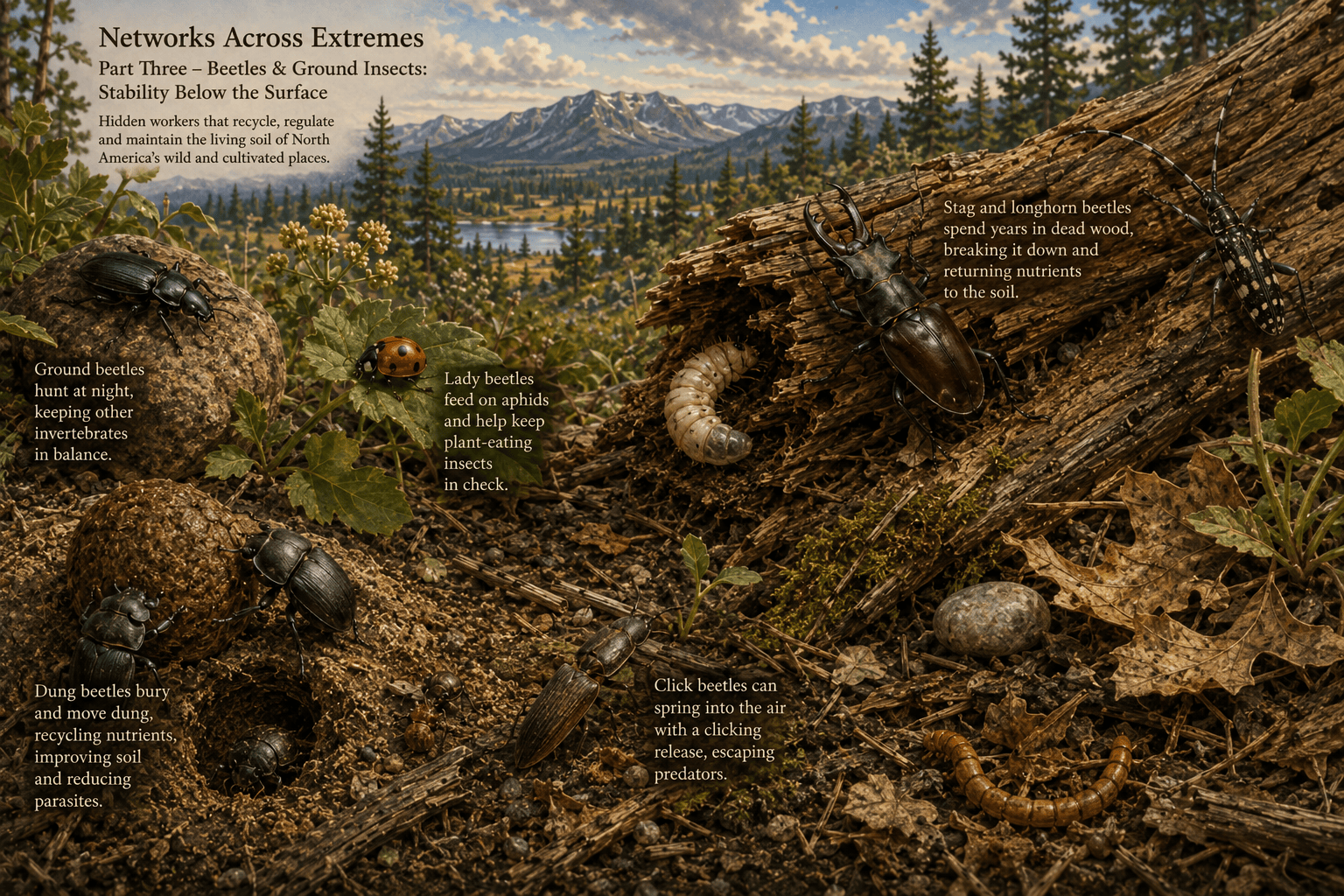
| It is easy to think of an ecosystem in terms of what we can see. Trees change colour, flowers open, grasses grow, and insects move through the air. Seasons announce themselves above ground so clearly that we can forget how much of the landscape’s real continuity lies much closer to the soil. North America’s beetles are particularly good examples. Many spend their lives beneath vegetation, inside dead wood, under stones or moving across the soil after dark. They rarely provide the spectacle of a monarch migration or the obvious activity of a bee working through flowers, yet their influence is enormous. They hunt, recycle, bury, tunnel and dismantle material that would otherwise accumulate. This is quieter ecological work. It does not depend on being seen, and much of it continues even as the landscape above changes dramatically. Forests lose their leaves, grasslands dry out, snow covers the ground, and storms bring down trees, but decomposition and nutrient cycling continue. For a gardener, this world is particularly relevant. Turn over an old log, lift a pot that has stood undisturbed or look carefully across damp soil after dark, and another community becomes visible. It was there all along. We were not looking at the right level. Ground beetles and the night shift Ground beetles are among the most persistent hunters operating at soil level. Many species spend daylight hours concealed beneath stones, logs, leaf litter or dense vegetation before emerging after dark to search for prey. Their diet varies among species, but many feed on other invertebrates, including caterpillars, insect larvae, and other small creatures moving across the soil. Some also consume seeds. Collectively, they help regulate populations and prevent any one group from operating entirely without opposition. This matters in gardens as much as it does in forests and grasslands. A gardener seeing damaged leaves may naturally focus on the animal responsible, but beneath those same plants predators may already be hunting it. Ground beetles seldom receive the recognition given to ladybirds because much of their work takes place when we are indoors. Their presence can also tell us something about the ground itself. Many species benefit from relatively stable soil conditions, shelter and reduced chemical disturbance. A garden containing leaf litter, stones, low vegetation and undisturbed margins offers more opportunities than one where every surface is repeatedly cleared. That does not mean a garden must be abandoned to become ecologically useful. There is a considerable difference between neglect and allowing habitat to remain. A few protected areas beneath shrubs or behind borders can provide exactly the conditions these insects require without changing the character of the whole garden. Sometimes wildlife gardening is less about creating something new than deciding what does not need removing. Lady beetles and the danger of simple reputations. North Americans commonly call them lady beetles or ladybugs; in Britain, we know them as ladybirds. Whatever the name, they are among the few beetles that most people welcome immediately. Their reputation rests largely on aphids. Both adults and larvae of many species consume considerable numbers of them, making lady beetles familiar allies in gardens and agriculture. That reputation is deserved, but the story is more complicated than the familiar image of a red beetle neatly removing pests from a rose. North America supports many species of lady beetle, and not all share the same habits. Their populations also depend upon prey being available. If every aphid is removed at the first sight of one, the predators that depend upon them lose a food source. This is one of the awkward balances involved in gardening with wildlife. We want the predator without necessarily wanting the prey. Yet the two cannot be separated. A small aphid population may support lady beetles, hoverflies, lacewings and other predators without causing meaningful damage to a mature plant. Intervention becomes useful when genuine harm is occurring, but treating every insect feeding on a plant as an emergency can interrupt the very biological control we hope will eventually arrive. Gardening teaches patience rather reluctantly sometimes. Dead wood and lives measured in years Stag beetles and longhorn beetles take us into another part of the landscape altogether: dead and decaying timber. Many beetle larvae spend long periods developing within wood or beneath the soil around old roots and stumps. Some remain there for several years before emerging as adults. During that time, they help dismantle material that a human observer might describe as dead. Ecologically, dead wood is anything but empty. A fallen tree represents stored nutrients, moisture and physical habitat. Fungi begin breaking down its structure, while beetles and other invertebrates open galleries through it. Moisture penetrates, microorganisms spread, and the timber gradually loses the solidity it once possessed. Eventually, what was a tree becomes soil again. In forests shaped by storms, fire, age and disease, this process is essential. Without decomposition, woody material would keep accumulating, and many of the nutrients it contains would remain unavailable for future growth. Gardeners have historically been rather efficient at interrupting this process. Dead branches are removed, stumps are ground away, and fallen timber is carried off because a tidy garden has often been defined as one from which decay has disappeared. We now understand the ecological cost of doing that everywhere. There are perfectly good reasons to remove unsafe timber, diseased material, or wood that interferes with how a garden is used. But a log pile behind a shrub, a stump allowed to soften naturally or part of a fallen branch left in a quiet corner can support years of insect activity. Dead wood is not a decoration added for wildlife. It is habitat in its own right. Dung beetles and disappearing waste Dung beetles perform work that is less aesthetically appealing but no less important. Across North American grasslands, rangelands, and grazing areas, dung represents a substantial nutrient flow. Left entirely on the surface, it can persist, smother vegetation and provide breeding habitat for flies and parasites. Dung beetles intervene by moving some of that material underground. Different species approach the task in different ways. Some tunnel beneath dung and bury portions directly below it, while others move material away before burying it. The familiar image of a beetle rolling a perfectly formed ball represents only one of several strategies. The ecological effect is significant. Nutrients are transferred into the soil, organic matter becomes available to microorganisms and plant roots, and tunnels can improve water movement and aeration. Removing dung from the surface also interrupts the lifecycle of some parasites and flies. It is an extraordinary amount of environmental housekeeping carried out without machinery, fuel or anyone organising the rota. For a gardener accustomed to adding compost or manure to improve soil, the principle is immediately recognisable. Organic matter becomes particularly useful when soil organisms can incorporate it into the soil. Dung beetles start the process themselves. Click beetles and an ingenious escape. Click beetles introduce something quite different to the story. When one finds itself stranded on its back or threatened, it can flex a specialised structure between parts of its body and release it suddenly, producing the characteristic click that gives the group its name. The movement can throw the beetle into the air. It is not graceful, and the beetle has little control over precisely where it lands, but elegance is not really the point. The sudden movement may startle a predator and give the beetle another chance to escape or regain its footing. This is a wonderfully simple example of survival through mechanics rather than strength. Click beetles also demonstrate why it is dangerous to judge an insect group solely by one stage of its lifecycle. Their larvae, commonly called wireworms, live in soil or decaying material. Some species feed on plant roots and can become agricultural pests, while others occupy different ecological roles. Once again, the label of “useful” or “harmful” depends on species, numbers, and context. A beetle can be ecologically interesting and occasionally inconvenient at the same time. What happens when we stop clearing everything away A practical thread connects most of these insects: they benefit from ground-level structure. Leaf litter provides shelter. Deadwood provides food and nesting habitat. Stones create cool spaces beneath them. Undisturbed soil allows larvae to develop. Vegetation moderates temperature and moisture close to the ground. None of this requires turning a garden into wilderness. A border does not fail because a few leaves remain beneath shrubs. A log does not have to be displayed prominently to provide habitat. Even relatively formal gardens can accommodate small areas where decomposition is allowed to proceed naturally. The difficulty is partly cultural. For generations, good gardening was associated with removal. Leaves were cleared, dead stems cut down, timber taken away, and bare soil cultivated until it looked clean. Some of those practices remain useful. Thick, diseased leaf litter beneath susceptible plants may need to be removed, and accumulated material can create practical problems. But clearing everything simply because it is dead removes much of the habitat used by the insects doing the recycling. A functioning garden needs both growth and decay. One cannot continue indefinitely without the other. Stability below the surface North America’s beetles reveal an ecological system that operates at a different pace from the insects travelling overhead. Ground beetles patrol after dark, quietly regulating other invertebrates. Lady beetles follow aphid populations through vegetation. Stag and longhorn beetle larvae may spend years reducing solid timber to increasingly fragile material. Dung beetles take nutrients from the surface and return them to the ground, while click beetles carry a small piece of mechanical ingenuity within their bodies. Individually, none appears responsible for maintaining a continent. Together, their work becomes fundamental. They prevent material from remaining locked away, move nutrients through the soil, and provide countless links between plants, fungi, microorganisms, and larger animals. Birds and mammals feed upon beetles; beetles consume other organisms; their larvae alter wood and soil; and eventually the beetles themselves return to the same system. This may be why the world at ground level deserves more attention from gardeners. We spend so much time looking at what grows upwards that we can overlook what is happening beneath it. The flowers, trees and grasses we admire are supported by processes taking place among roots, litter, decaying timber and soil. Much of that work is performed by organisms we rarely see. Above ground, North America’s seasons can be dramatic. Heat follows snow, forests change colour, storms arrive, and grasslands shift between abundance and dormancy. Closer to the soil, another rhythm continues. It is slower, darker and considerably less spectacular. But without it, very little above would remain stable for long. |
| About our writing & imagery Most articles reflect our real gardening experience and reflection. Some use AI in drafting or research, but never for voice or authority. Featured images may show our photos, original AI-generated visuals, or, where stated, images credited to others. All content is shaped and edited by Earthly Comforts, expressing our own views. |

