| Introduction Part One The Films Were Already Waiting: 1963–1967 |
| I was born in 1963, which gives me a convenient place to begin a journey through more than sixty years of cinema. Not because I remember going to see The Great Escape, The Birds or The Pink Panther when they first appeared — I was a baby — but because the films were already beginning to accumulate around me. I have loved films for most of my life, although I have never regarded myself as a film critic and I have never really reviewed them. I know what I like and what I don’t. I was certainly watching films by the age of twelve, but I think my real obsession with them began in 1977. I was fourteen, had returned to Britain after living in Australia, was reading enormous amounts and increasingly watching films as an interest in their own right. By then, of course, fourteen years of cinema had already appeared during my lifetime, waiting for me to discover it. Looking back now, I think I have always been something of a visual collector. I collect actors, faces, performances, scenes, memorable lines and strange pieces of information that attach themselves to films. An actor in one film leads me into another; a film leads me to a book; a familiar face sends me looking through somebody’s earlier work. Much later, that collecting instinct became quite literal, with a DVD collection running into the thousands. Still, the habit of making connections between films and the people in them began long before I had shelves full of them. Why These Films? We could consider hundreds of films across any five years, so it is worth explaining how this series works. It is a collaboration. Rather than beginning with films I already know and love, I use AI to help research and assemble a broad working selection from each year. The aim is to include a mixture of major commercial successes, recognised classics, influential productions, enduring popular favourites and significant examples from different genres. I then provide what AI cannot: which films I have actually seen, what I remember about them, which actors I followed, what I loved or disliked, and the sometimes rather obscure connections that have remained in my head over the years. These working selections are not intended to be definitive lists of the ‘best’ films ever made. Cinema is far too subjective for that, and another perfectly reasonable selection could contain completely different titles. The starting list gives me something independent to react to, rather than letting me fill every year with favourites I chose in advance. For this first look at 1963–1967, we began with forty films, eight from each year. I had seen thirty-three of them. Considering I was between newborn and four years old when they were released, that says far more about the films’ longevity than about any precocious film-watching ability on my part. Most came to me much later, particularly as my interest in cinema grew. |
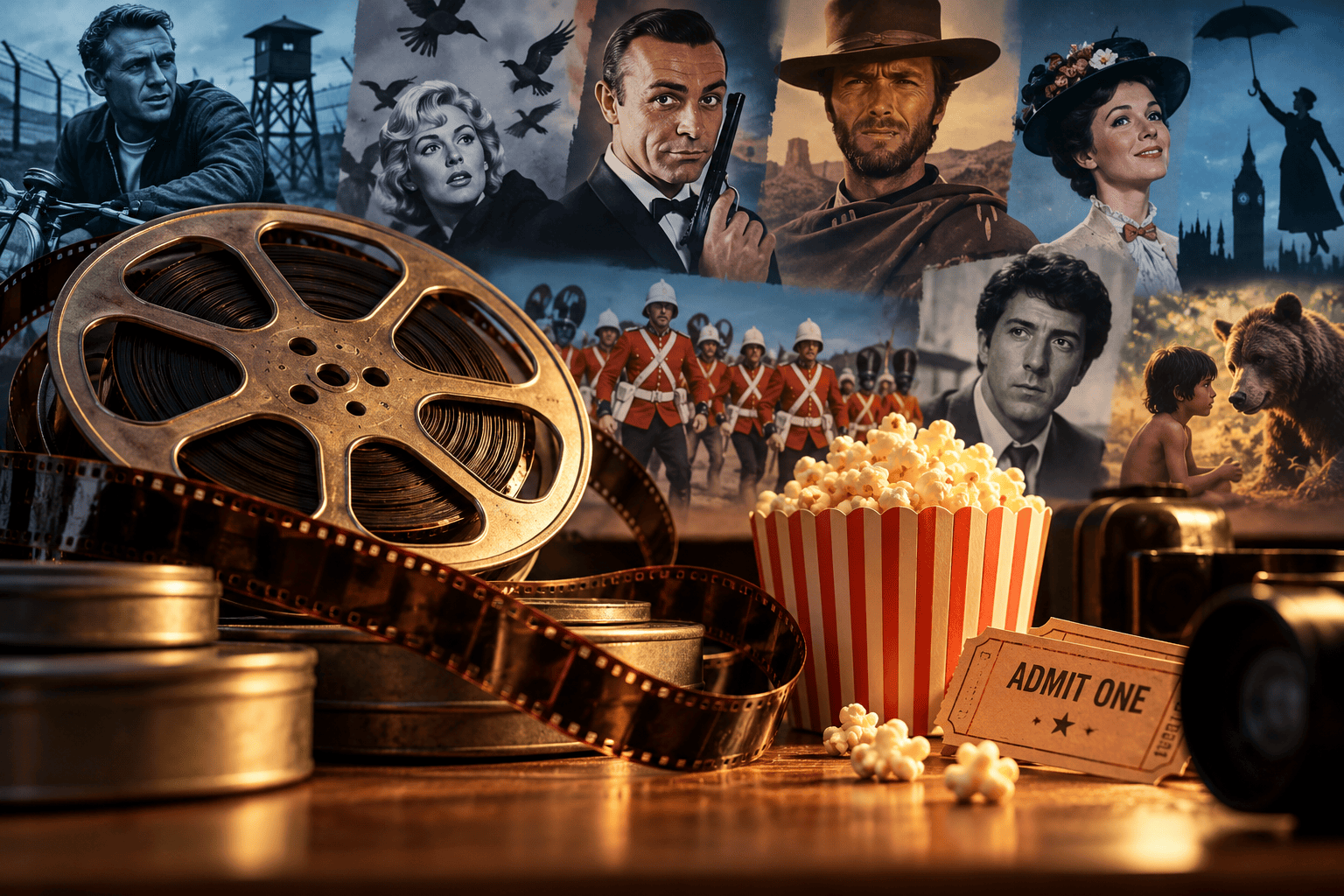
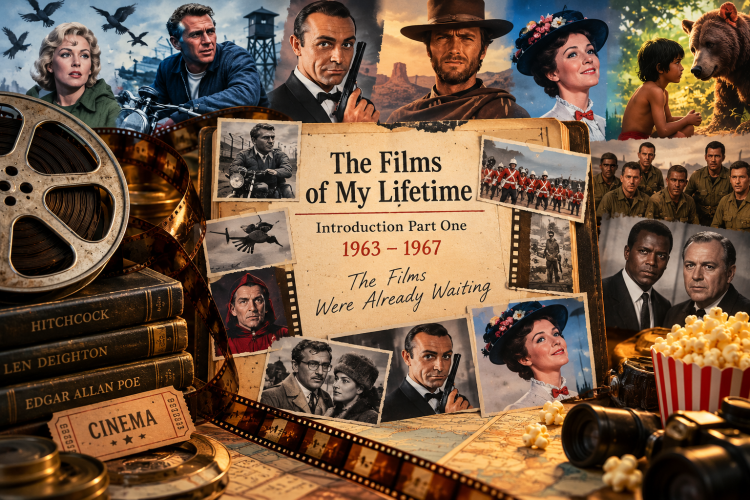
| 1963 — The Year I Arrived Some remarkable films share my birth year. The Great Escape, The Birds, From Russia with Love, The Pink Panther, Cleopatra, The Haunting and Jason and the Argonauts are all films I eventually watched. Other 1963 films that became favourites included Move Over, Darling and The Nutty Professor, which immediately demonstrates why the original working selection is only a starting point. Once I remember a year, other films inevitably wander back into the conversation. The Great Escape became particularly important because I was a huge Steve McQueen fan. That introduces something that I suspect will recur throughout this series: sometimes my affection for a film is inseparable from the people in it. Move Over, Darling had Doris Day and James Garner, both favourites of mine, while The Pink Panther gave me Peter Sellers and David Niven. Jerry Lewis is one reason I still prefer the original The Nutty Professor to the enormously successful 1996 Eddie Murphy remake. Then there is Hitchcock. I read a great deal about Hitchcock and his films, which gave The Birds another connection beyond simply watching it. This relationship between what I read and what I watched will crop up repeatedly as we move through the years. If I had to pick five films from 1963 that stand out for me, they would be The Great Escape, Move Over, Darling, The Nutty Professor, The Pink Panther and The Birds. They may not be the five a film critic would choose, but that’s the point. 1964 — Zulu The following year produced another extraordinary collection. Goldfinger, Dr Strangelove, Mary Poppins, My Fair Lady, A Hard Day’s Night, Zulu, A Fistful of Dollars and The Masque of the Red Death formed our initial selection, and I had seen every one of them. Seeing a film and loving it are two different things. Mary Poppins and My Fair Lady were films I loved watching. At the same time, A Fistful of Dollars became a particular favourite during the 1980s, when I developed a real taste for gritty Westerns and enjoyed that whole series of films. The Masque of the Red Death brought several interests together because I loved Edgar Allan Poe and was also a great admirer of Vincent Price and Jane Asher. Once again, the film, the writing and the performers became interconnected. Bond is slightly different. I watched the films, but I don’t think I properly learned to appreciate the Bond series until the 1980s. That is another distinction worth making as we work through my lifetime: the year I first saw a film isn’t necessarily the period when I came to appreciate it. Then there is Zulu. Of all the films from these first few years, it stands apart as one of my all-time favourites. From the first time I watched it, it stayed with me, and I have probably seen it around eight times. Michael Caine would also become one of those actors whose work kept appearing throughout my film watching, which brings us rather neatly into the following year. 1965 — Actors, Books and Great Casts The Ipcress File brought Michael Caine and Nigel Green together again after Zulu, this time in a wonderful telling of Len Deighton’s novel. It is another example of books, actors and films crossing paths in my memory. For a Few Dollars More fed that later enthusiasm for gritty Westerns, while Those Magnificent Men in Their Flying Machines is another film I remember as much for its tremendous cast as anything else. Then there was Doctor Zhivago, an excellent film with an extraordinary line-up. I became a huge admirer of Rod Steiger during the 1980s. Still, Doctor Zhivago represents something broader that I particularly enjoy about films from this period: productions that could assemble an astonishing collection of first-rate actors in one place. Those large ensemble casts made a film feel like an event, and I find myself noticing them again and again as we work through these years. The Flight of the Phoenix gives us another interesting comparison. I loved the original, but I actually prefer the 2004 remake, although I think both casts were superb. There will be no automatic assumption in this series that an original must be better simply because it came first. At the other extreme sits The Sound of Music. I hated it as a child and, despite its enormous reputation and enduring popularity, I still don’t like it. That belongs in the story just as much as the favourites do. A lifetime at the movies would be rather dishonest if every recognised classic suddenly became wonderful simply because everybody tells us it is. 1966 — Watching Once Can Be Enough By 1966, the gritty Western had reached The Good, the Bad and the Ugly, which was very much my sort of film. Michael Caine appeared again in Alfie. Jude Law performed well in the later remake, but between the two, Caine wins hands down for me. Fantastic Voyage was another excellent film for its time, with Raquel Welch and Donald Pleasence among the performers who stayed in my memory. Who’s Afraid of Virginia Woolf? is different. I recognise it as a great film, but I have never been a huge fan, and that distinction matters. I can recognise that something is very good without necessarily wanting to watch it repeatedly or count it among my favourites. Then there is Born Free. The film itself, like Joy Adamson’s original book, essentially leaves us with a happy ending, but knowing what happened afterwards changes its emotional weight. Elsa died, something explored further in Living Free; the cubs did not simply disappear into the perfect future we might imagine. The later lives of both Joy and George Adamson contained tragedy. Born Free therefore belongs to a very particular group of films for me. I am glad I watched it, and it affected me, but I don’t need to watch it again. Gorillas in the Mist and The Killing Fields would later have a similar effect. Some films stay with you precisely because they are difficult, and repeat viewing isn’t necessarily the measure of how highly you regard them. 1967 — Childhood Begins to Meet the Films By 1967 we reach The Graduate, a coming-of-age film with terrific performances from Dustin Hoffman, Anne Bancroft and Katharine Ross. I became a big Hoffman fan over the years, with films such as Rain Man and Tootsie, and much later the Fockers films, although liking an actor has never meant automatically liking everything they did. Kramer vs Kramer, for example, is one I disliked and still dislike. Bonnie and Clyde gave me another tremendous cast. Warren Beatty particularly made the film for me alongside Faye Dunaway, and there too is Gene Wilder, years before many of us would forever associate him with Willy Wonka. The Dirty Dozen was another great film with one of those extraordinary ensemble casts I keep noticing, while In the Heat of the Night brought Sidney Poitier and Rod Steiger together in two tremendous central performances. Paul Newman was an actor I liked, yet Cool Hand Luke wasn’t a film I particularly liked, another reminder that the actor alone was never enough. Perhaps the most revealing film from 1967, though, is much simpler: The Jungle Book. I remember seeing it as a youngster in the later 1960s, and it was always a favourite. That makes it different from many of the films in these first five years, which became mine retrospectively as I encountered them as a teenager or adult. The Jungle Book belongs to childhood itself. |
| What Am I Actually Collecting? Even after only five years of films, a few possible patterns are beginning to appear, although it is far too early to decide what they mean. Actors clearly matter enormously to me. Steve McQueen, Doris Day, James Garner, Peter Sellers, David Niven, Vincent Price, Jane Asher, Michael Caine, Nigel Green, Rod Steiger, Dustin Hoffman, Warren Beatty and Sidney Poitier have already appeared in the story, and often one actor leads directly into another film. Books and films overlap repeatedly. Large ensemble casts attract me. Gritty Westerns keep appearing. I can admire a film without particularly liking it, prefer a remake to an original, dislike an acknowledged classic and love a film without feeling the slightest need to watch it every year. There are also a very small number of films that I can watch repeatedly, although we have not really reached the most obvious example yet. Perhaps most importantly, I am beginning to realise that simply describing myself as a movie buff doesn’t quite explain it. I have never been somebody who wants to sit down and formally review every film I watch. Films are much more visual than that for me. I collect the people, images, dialogue, stories and bits of information surrounding them. Sometimes the film itself is almost the doorway into everything else. That is what I want to explore as this series develops. Not simply which films were supposedly the best in a particular year, but which ones I saw, what stayed behind afterwards and why certain actors, scenes and stories followed me through the decades while others provided a couple of enjoyable hours and disappeared. This isn’t really a history of the greatest films ever made. It is a journey through the films that were made during my lifetime — and the ones that eventually found me. In 1963, the films were already waiting. I just hadn’t started looking for them yet. |
| Next: Introduction Part Two — 1968–1972 The films and childhood begin to move closer together, while actors, books, memorable lines, and an increasing appetite for visual entertainment start to reveal how I would eventually consume and collect cinema. |
| About our writing & imagery Most articles are grounded in our real gardening experience, observations and reflections. AI may assist with research, drafting and editing, but the experiences, opinions and editorial direction are our own. Featured images may include our photography, original AI-generated visuals or, where stated, images credited to others. All published content is reviewed and shaped by Earthly Comforts before publication. |


You mentioned some great films, and great actors, Rory. I like the older films more than ones that have come out in the last 10 years.
LikeLiked by 1 person
That is so true of many things Eugenia, it’s not that there haven’t been any good films, but there has been a lot of crud.
LikeLiked by 1 person
😊
LikeLiked by 1 person
Oh, I think I may have just discovered another interest we have in common! 😂
I was also born in 1963, so reading this feels a little like taking a trip through the cinema of my own lifetime, even though, like you, I obviously wasn’t sitting in a cinema watching The Great Escape when I was a baby. 🤣
What I really enjoyed about this isn’t simply the list of films, though. It’s the way you describe remembering films through the people in them, the scenes, the dialogue and the connections they created to other films, books and memories.
I’m very much like that with things. One thing leads to another, and suddenly I’m down some completely unexpected rabbit hole. 😂
And I love that you don’t seem to feel obliged to love a film simply because it’s considered a classic. You can recognise that a film is good without actually enjoying it, love an actor without loving everything they’ve done, prefer a remake to the original, or watch something once and decide that once was quite enough. I completely agree with that.
I also had to smile at The Sound of Music. 😂 There are certain films that everybody seems to adore and I sit there thinking, “Really?” 🤣
Zulu, The Great Escape, The Pink Panther, The Birds and The Jungle Book all brought back memories for me too, although some of my own film memories are probably mixed up with the decades when I actually discovered them rather than when they were released.
And I particularly liked your description of yourself as a “visual collector.” I think that makes perfect sense. You’re not simply collecting films; you’re collecting the people, faces, stories, images and little pieces of information that become attached to them over time.
Perhaps that’s why this caught my attention. I’m a photographer, and I think I do something similar with photographs. I don’t just remember the photograph itself. I remember where I was, what caught my eye, what was happening around me and sometimes the completely unexpected things that the photograph leads me to think about afterwards.
So I suspect I’m going to enjoy following this series as it moves through the years. 😊
And now I have one very important question:
If we’re both 1963 babies, does that mean we are allowed to complain about how much better some things were “back in our day”? 😂🤣
LikeLiked by 1 person
Yes very much so, l think we are at the stage where we are not ‘specifically’ looking through rose tinted glasses but actually seeing the difference between yesterday and today. Yesterday we were allowed to voice our opinions, and yet today sadly apparently we are not. The Sound of Music l first ever saw when l was around 14, so ’77 and l remember sitting there and thinking ‘ l would rather watch 10 back to back screenings of The King and I [the original] than any more of this nonsense! ” 🙂
LikeLiked by 1 person
😂 Well, now you’ve made me curious about The King and I, because I have actually never seen it! Although if it’s a choice between watching that or Mary Poppins ten times, I think I already know where I’ll be sitting. 🤣
As for The Sound of Music, I honestly can’t even give you a proper opinion because I remember watching it, but I can’t remember much of the film at all apart from the singing! 😂 So clearly it didn’t make quite the impression on me that it made on some people. I certainly don’t have the “oh, it’s one of the greatest films ever made!” reaction to it.
Mary Poppins, on the other hand, is a completely different story. That one I could watch over and over again. 😊 And Beetlejuice has to be right up there with it as one of my all-time favourites. I suppose my taste in films is perhaps a little eclectic! 😂
And Casanova is another perfect example. I’ve watched it because so many people rave about it, but I sat there afterwards thinking, “Okay… what exactly am I supposed to be going gaga over here?” 🤣
I think that’s what makes talking about films — and people in general — so interesting though. We don’t all have to love the same things. We can watch exactly the same film and come away with completely different feelings about it, and that’s perfectly okay.
In fact, I think I’d find life rather boring if we all liked the same things. Imagine everyone agreeing about everything! 😱😂
So yes, I think we have definitely earned the right to complain about some of the things that were better “back in our day” — but I’ll happily leave The Sound of Music in your yesterday while I go and watch Mary Poppins again. 🤣❤️
LikeLike