
| Case File 04 The Yeti — Ghost of the Himalayas |
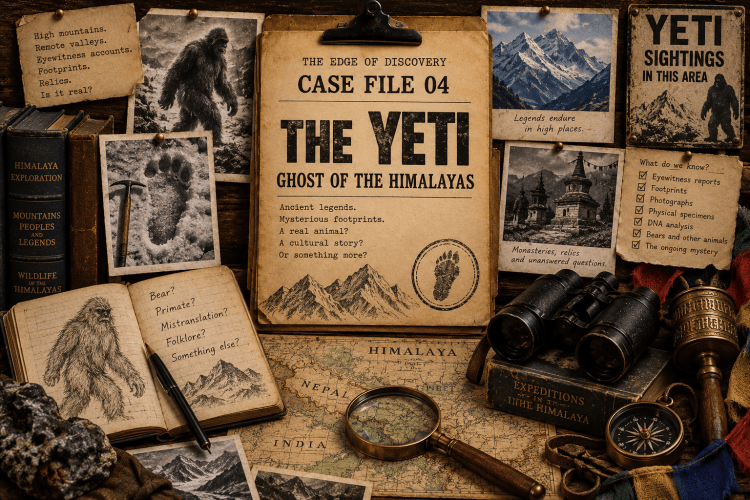
| Few landscapes on Earth are better suited to creating legends than the Himalayas. Mountains disappear into clouds, valleys lie separated by ridges that can take days to cross, snow can erase tracks within hours, and above everything rise some of the highest places on the planet. Human beings are visitors here. The mountains decide where we can travel, when we can travel and occasionally whether we return at all. Somewhere within this immense landscape lives—or is said to live—one of the oldest and most famous creatures in cryptozoology: the Yeti. In the West, we transformed it into the Abominable Snowman, a huge shaggy creature wandering eternally across glaciers. It appears in films, cartoons, children’s books and advertising and has become almost as instantly recognisable as Bigfoot. Yet when we begin opening the historical file, something interesting happens: the creature we think we know starts to disappear. The original Yeti is far more complicated than the monster Western popular culture created, and its story reaches into Himalayan traditions, religious beliefs, local wildlife, exploration history, and the extraordinary psychology of people trying to interpret fleeting observations in one of the most hostile environments imaginable. Before we go searching for a mysterious ape in the snow, we should establish what we are actually looking for. Before the Abominable Snowman Stories concerning unusual human-like or animal-like beings existed among Himalayan communities long before Western mountaineers began searching for them. The difficulty is that no single, universally recognised creature corresponds neatly to our modern Yeti. Different communities had different names, descriptions, and traditions, and outsiders later translated, simplified, and sometimes combined them. When an explorer hears a local account, translates it through an interpreter, records it in a diary, another person publishes it, and a newspaper eventually turns it into a headline, the story that reaches the public may not be the same as the one that began. Even the word Yeti has a complicated linguistic history. It is generally associated with Tibetan terms often interpreted as referring to a bear associated with rocky places, although transliterations and interpretations differ. This matters because the Western assumption that Himalayan people described an undiscovered ape may itself have distorted the evidence. Some traditions may indeed have concerned mysterious human-like beings, but others may have referred to animals already known perfectly well to the people who lived alongside them. One particular animal will follow us throughout this investigation: the bear. Before the bear could become a serious explanation, however, the creature needed a name that the Western world would remember. It received a spectacular one. The Birth of the “Abominable Snowman” In 1921, a British reconnaissance expedition travelled into the Everest region under Lieutenant-Colonel Charles Howard-Bury. Members of the expedition encountered unusual tracks at high altitude. Howard-Bury thought the prints probably belonged to a wolf whose tracks had become distorted in the snow. Still, the local interpretations proved far more interesting to journalists. When accounts of the expedition reached India, journalist Henry Newman interviewed members of the party, and somewhere in the translation and reporting process emerged the phrase that would transform the story: the Abominable Snowman. The translation has been questionable, but accuracy had little chance against such a magnificent name. Western explorers were already fascinated by Everest and the great Himalayan ranges, places associated with danger, isolation and enormous areas that outsiders knew comparatively little about. Add the possibility of an unknown human-like creature wandering somewhere above the tree line and the story became irresistible. The Yeti had begun its transformation from a complex collection of regional traditions into an international cryptid, and from that point onwards Western imagination would increasingly influence the creature we thought we were searching for. That transformation accelerated dramatically three decades later when somebody photographed a footprint. Footprints at 6,000 Metres In 1951, British mountaineer Eric Shipton was leading an Everest reconnaissance expedition when members of the party encountered a series of unusual tracks on the Menlung Glacier, close to the Nepal-Tibet border. Shipton photographed one impression with an ice axe beside it for scale. The resulting photograph became one of the most famous images in cryptozoology and did more than almost anything else to place the Yeti permanently into modern popular consciousness. It is easy to understand why. The print appears broad and strangely human-like, with what look remarkably like toes. To somebody already wondering whether a large unknown primate inhabited the Himalayas, the photograph could appear extraordinarily persuasive. Newspapers reproduced it, investigators studied it, and the Yeti suddenly seemed to have moved from folklore towards physical evidence. Here, apparently preserved in Himalayan snow, was something that could be measured. Unfortunately, snow is a dreadful archivist. A footprint does not necessarily retain the shape of the foot that created it. Sunlight, temperature changes, wind, melting and refreezing can enlarge or distort impressions, while tracks from different feet can overlap. A bear placing a hind foot partly over the impression of a front foot can create a surprisingly elongated or human-like track, and continued melting can exaggerate the effect further. Shipton undoubtedly photographed an unusual impression, but identifying what originally produced it is considerably more difficult than recognising what the finished print resembles. This distinction is fundamental to the way I want us to approach The Edge of Discovery. The photograph demonstrates that something made a track. It does not demonstrate that the something was a Yeti. Nevertheless, I understand completely why the image has fascinated people for more than seventy years. Had I been standing beside Shipton on that glacier in 1951, looking at those tracks before anybody had offered me an explanation, I would have wanted to follow them too. Curiosity is not the problem; deciding upon the answer before following the evidence is. Hillary Goes Looking The Yeti attracted investigators who could hardly be dismissed as inexperienced adventurers. Among the most famous was Sir Edmund Hillary, who, with Tenzing Norgay, became one of the first two climbers confirmed to have reached the summit of Everest in 1953. Hillary took the Yeti question seriously enough to investigate it during the 1960–61 Himalayan Scientific and Mountaineering Expedition, examining supposed evidence and several objects preserved locally as Yeti relics. One of the best-known was a scalp kept at Khumjung monastery in Nepal. The object certainly looked extraordinary: dome-shaped and covered with coarse reddish-brown hair, it was precisely the sort of thing somebody might hope to discover when searching for an unknown Himalayan primate. Scientific examination, however, revealed no mysterious ape. The material was considered consistent with the hide of a serow, a goat-like ungulate found in Asia, and the object itself appeared to have been manufactured rather than representing the preserved scalp of an unknown animal. I don’t find results like this disappointing. They represent exactly what an investigation is supposed to achieve. An extraordinary object existed, people associated it with the Yeti, somebody examined it, and the evidence pointed towards a known animal. That part of the mystery shrank. The interesting thing is that the wider Yeti tradition did not disappear with it. Reinhold Messner and the Bear One of the most intriguing figures in the story was legendary mountaineer Reinhold Messner. During a journey through Tibet in 1986, Messner reported encountering a large, dark, hairy animal that puzzled him at first. Rather than immediately announcing that he had discovered the Yeti, he spent years investigating the traditions and wildlife associated with the mystery. His eventual conclusion was considerably less sensational than the headlines might have hoped: Messner became convinced that much of the Yeti tradition was associated with bears. That explanation becomes increasingly interesting the closer we look. Brown bears occur within parts of the greater Himalayan region, as do Asian black bears, and both are substantial animals. Bears can stand upright, and although they do not normally stroll around mountains on two legs, a brief, unexpected upright posture can create an extraordinary impression. Their footprints can be equally confusing, especially when hind and front tracks overlap or when snow begins to alter the original impression. Imagine encountering one in difficult conditions. You are exhausted, perhaps suffering from altitude, visibility is poor, and a large dark animal suddenly rises onto its hind legs before disappearing into vegetation or behind rocks. You have only seconds in which to understand what you are seeing. The resulting account might be entirely sincere, yet bear surprisingly little resemblance to the animal that produced it. This is where zoology and folklore begin interacting in fascinating ways. A real animal does not necessarily destroy a legend. Sometimes a real animal helps create one. When DNA Entered the Mountains Modern genetics has allowed alleged Yeti evidence to be examined in ways that Shipton, Hillary and the early explorers could scarcely have imagined. Hair, bone, teeth and preserved tissue attributed to mysterious Himalayan creatures have been subjected to genetic analysis, and the results have repeatedly pointed towards known animals. An important study of purported Yeti material held in museums and private collections found that most specimens came from bears, including Himalayan and Tibetan brown bears and Asian black bears. One sample came from a dog. It would be wrong to say that DNA has therefore “disproved the Yeti”. Science rarely gives us such wonderfully convenient endings. What genetics tells us is that when several physical specimens presented as Yeti remains have actually been tested, they have failed to establish the existence of an unknown primate. Instead, bears keep appearing. That does not explain every footprint, story or eyewitness account ever recorded across the Himalayas, but it certainly changes the balance of probability. We encountered the same problem when investigating Bigfoot. Eyewitness accounts can be sincere but mistaken, photographs can remain ambiguous, and footprints can be distorted or fabricated. Biological material is different because it can identify the animal that produced it. If somebody tomorrow recovered fresh hair from an alleged Yeti resting site and several independent laboratories demonstrated that its DNA belonged to a previously unidentified primate lineage, we would suddenly have a very different investigation. Old photographs would deserve re-examination, historical accounts might acquire new significance, and researchers would have a genuine biological signature to search for. That has not happened. So far, when genetics enters the Yeti story, the mysterious primate retreats and known Himalayan wildlife takes its place. But Are the Himalayas Completely Explored? Here we arrive at the same question we considered when investigating Bigfoot, although the landscape makes it even more interesting. Have humans explored every Himalayan valley, forest, and mountainside thoroughly enough to know every large animal living there? I don’t think we can reasonably claim that we have. Satellite imagery lets us map terrain with extraordinary precision, but mapping a mountain range is not remotely the same as conducting a complete biological survey beneath forest canopies, across inaccessible valleys, and through remote mountain habitats. The Himalayas and associated ranges span an enormous geographical area with exceptionally difficult terrain. Some locations are visited rarely, others only seasonally, and animal populations can occur at low densities across very large territories. It is therefore entirely reasonable to say that an unknown animal could remain undiscovered somewhere within the wider Himalayan region. Science continues to describe previously unrecognised species around the world, and the idea that humanity has catalogued every living creature simply because we possess satellites and smartphones is plainly wrong. The difficulty begins when we move from hiding an animal to hiding a species. A large primate would require food, shelter and suitable breeding habitat. Individuals would reproduce, travel, become injured and eventually die. They would leave hair, faeces, bones, feeding remains, footprints and traces of DNA within their environment. A viable population would need to persist across generations. If the Yeti existed across anything resembling the enormous geographical range suggested by historical reports, we might reasonably expect considerably more physical evidence than we currently possess. There may still be places in the Himalayas where a large animal could avoid being seen for years. Explaining how an entire breeding population of large primates could remain biologically undetected for generations is considerably harder. A Creature of Snow That Probably Wouldn’t Live in Snow Popular culture has created another problem for the Yeti because we tend to place it permanently among glaciers. It makes wonderful artwork: an enormous white or grey creature moving across an endless snowfield beneath towering Himalayan peaks. Biologically, however, the image makes considerably less sense. A large primate would require a substantial and reliable supply of calories, together with shelter and sufficient resources to support reproduction. Permanent snowfields and the highest Himalayan elevations provide precious little food for a population of enormous mammals. If something resembling the traditional Yeti genuinely existed, its primary habitat would far more plausibly lie lower down, among forests, valleys and mountain environments where food and shelter are available. An animal might cross higher ground occasionally or leave tracks above the tree line while travelling between suitable habitats. Still, the romantic idea of a giant ape spending its life wandering across barren glaciers would create an ecological problem before we ever considered the lack of physical evidence. This issue appears repeatedly in cryptozoology. We become so attached to the iconic image of a mysterious creature that we forget to ask whether the animal depicted could actually survive where we have placed it. If the Yeti exists, ecology gets a vote, and ecology is unlikely to choose the summit of Everest. What Did Himalayan Communities Actually Believe? Western accounts have often spoken rather casually about “Sherpa belief in the Yeti”, as though everyone living throughout the Himalayas shared one tradition and one interpretation. Reality is considerably more complicated. Stories vary between communities, regions, and generations, while cultural traditions can include practical observations of wildlife alongside spiritual, symbolic, and folkloric elements. Those things do not have to be mutually exclusive. This matters because local and Indigenous knowledge deserves considerably more respect than being treated as supporting evidence whenever it suits a cryptozoological argument. People who live within an environment can possess extraordinarily detailed knowledge of its animals, seasons, tracks and behaviour. At the same time, a cultural story does not automatically become a literal zoological description merely because somebody from outside the culture wishes it to be one. My own childhood in Malaysia taught me this indirectly. The stories I heard about the Orang Mawas existed within their own cultural setting. I was a small boy, and they fascinated me, even if my amahs sometimes used them to persuade an adventurous child to behave himself. Decades later, it would be very easy to reinterpret those memories through everything I subsequently learnt about Bigfoot and cryptozoology, but doing so risks changing the original stories into something they may never have been intended to represent. Sometimes an investigator’s first responsibility is not to explain. It is to listen properly. The Yeti We Created Another creature wanders through this Case File, and unlike the Himalayan bears, we know exactly who created it: us. The Western Yeti is generally enormous, white or grey, heavily furred and permanently associated with snow. Sometimes it resembles an ape; sometimes it looks suspiciously like Bigfoot after somebody changed the weather. Cinema, television, advertising, books, toys, and animation have repeated this image so successfully that many of us would recognise a Yeti instantly, despite having no agreed biological animal to compare it to. Historical descriptions are considerably less uniform. Some describe dark animals, others smaller creatures, and still others beings whose characteristics are difficult to separate from bears or local folklore. Once popular culture establishes what a mysterious creature is supposed to look like, however, an interesting psychological process can begin. Later witnesses encounter the world carrying that image with them. Human perception does not operate independently of expectation. If somebody has spent a lifetime being told that a large hairy creature inhabits a particular mountain range and then glimpses something large moving upright for a few seconds, their brain already possesses a possible interpretation. That does not make the person dishonest, foolish or unreliable. It simply means that none of us observes the world with an entirely blank mind. The legend can influence the sighting, and the sighting can then reinforce the legend. After enough generations, separating one from the other becomes extraordinarily difficult. So What Is the Yeti? If I had to place my money somewhere based solely upon the evidence currently available, I would place considerably more of it on bears, folklore and human interpretation than on an undiscovered giant primate. Genetic testing strongly supports bears as the source of at least some supposed Yeti material. Bear tracks can become remarkably strange when distorted by snow, historical Himalayan terminology contains associations with bears, and experienced mountaineers, including Reinhold Messner, have independently reached similar conclusions after investigating the phenomenon. I would nevertheless hesitate before declaring that every Yeti report across every Himalayan culture and every historical period has one identical explanation. That would replace one form of overconfidence with another. Some accounts may involve brown bears or Asian black bears; others could involve langurs, people, distorted footprints, folklore, mistranslation or deliberate invention. Certain historical observations may remain unexplained because insufficient information survives for anyone to determine what actually happened. That may be where the Yeti becomes more interesting, not less. We began searching for a monster and instead encountered a complicated relationship between people, bears, mountains, culture, language, perception and fear. If that eventually proves to be the explanation for the Yeti tradition, I don’t regard it as disappointing—quite the opposite. Understanding how a real animal can become intertwined with centuries of human storytelling may ultimately tell us more than discovering another large ape ever could. The Ghost of the Himalayas There is something wonderfully appropriate about the Yeti remaining uncertain. Bigfoot inhabits forests that feel mysterious because trees conceal what lies fifty metres ahead. The Yeti occupies a landscape where mystery works differently: the scale itself overwhelms us. Mountains disappear behind other mountains, valleys vanish beneath cloud, and snow can cover evidence almost as quickly as it creates it. Somewhere within that landscape, bears still move across remote slopes largely unseen by human beings. Their footprints enlarge in melting snow, a distant shape occasionally moves between rocks, and somebody returns from the mountains convinced that they encountered something they cannot explain. Perhaps that is all the Yeti has ever been: different animals, observations and traditions gradually woven together into one extraordinary creature. Perhaps somewhere within those immense ranges there remains an animal we have not yet properly recognised. At present, the evidence strongly favours the first explanation, but evidence, not certainty, matters. The Himalayas remain enormous; there are still places exceptionally difficult to reach, and there will undoubtedly be wildlife discoveries there in the future. That is enough reason to keep asking questions without pretending we already know the answer. Listen. Investigate. Reach your own conclusion. For now, the Ghost of the Himalayas remains where it has always been: somewhere between animal, folklore and the enormous white spaces of human imagination. Case File 04 remains open. |
| Case Assessment |
| Status: UNRESOLVED WITH A STRONG NATURAL EXPLANATION No accepted biological evidence currently establishes the Yeti as an unknown Himalayan primate. Genetic examination of purported Yeti material has repeatedly identified known animals, particularly Himalayan and Tibetan brown bears and Asian black bears. Distorted footprints, difficult viewing conditions and bear behaviour provide plausible explanations for a significant proportion of the evidence. Reducing centuries of Yeti traditions to “people mistaking bears for monsters”, however, would oversimplify a much richer story involving Himalayan wildlife, language, culture and folklore. The Yeti may ultimately prove most interesting not as a single undiscovered animal but as a meeting point between the natural world and the human need to explain what we cannot immediately understand. |

| The Footprint That Changed Everything |
| Eric Shipton’s 1951 photograph of an unusual footprint on the Menlung Glacier remains one of the most recognisable images in cryptozoology. The impression appears remarkably human-like, and its apparent toes and unusual proportions helped propel the Yeti from Himalayan tradition into international popular culture. Snow, however, is a changing surface rather than a permanent plaster cast. Melting, refreezing and wind can dramatically alter tracks, while overlapping prints can create shapes very different from the foot that originally made them. Shipton’s photograph demonstrates that his expedition encountered an unusual track; identifying the animal responsible from the photograph alone is considerably more difficult. It is the perfect Yeti photograph: compelling enough to make us look twice, but incomplete enough to prevent certainty. |
| When the Yeti Became the Abominable Snowman |
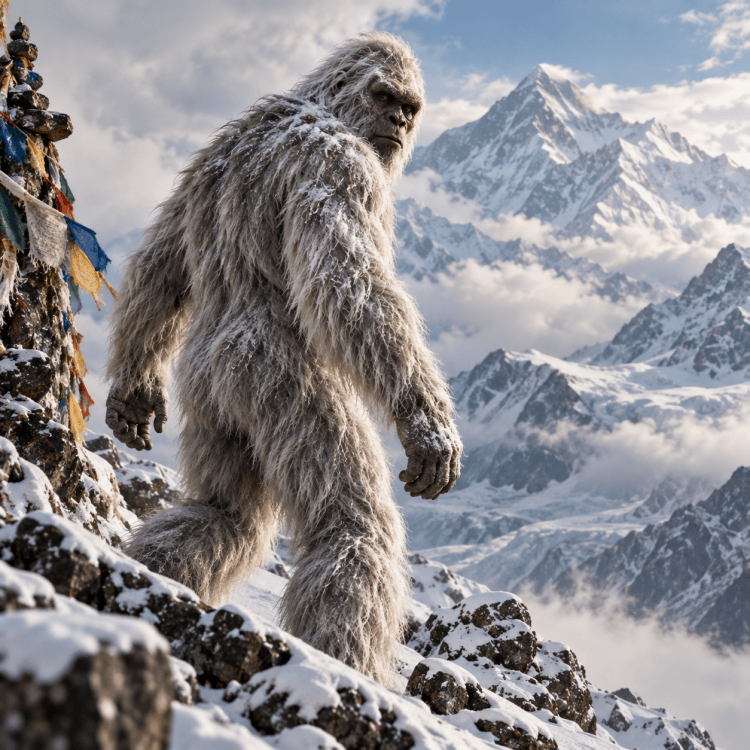
| The name “Abominable Snowman” is itself part of the mystery. It emerged after the 1921 British Everest reconnaissance expedition, when accounts of unusual tracks and local terminology passed through translation and into newspaper reporting. The wonderfully dramatic phrase captured Western imagination and proved considerably more durable than whatever linguistic accuracy originally accompanied it. From that point onwards, Western culture increasingly created its own version of the Yeti: enormous, shaggy, frequently white and permanently associated with snow. Books, films, comics, advertising and later animation reinforced the image until the creature became internationally recognisable. This leaves us with an intriguing question whenever we investigate later reports: are witnesses describing something they encountered in the Himalayas, or has the creature the rest of the world taught them to expect influenced what they believe they saw? |
| Further Exploration |
| For readers who want to go beyond the Case File, genetic research into alleged Yeti specimens is particularly valuable because it examines physical material rather than relying upon interpretation of photographs or eyewitness testimony. The published genetic work found the tested Himalayan samples overwhelmingly associated with known animals, especially bears, rather than an unidentified primate. The scientific investigation of Yeti material is worth exploring alongside the historical accounts because it demonstrates exactly what happens when a cryptozoological claim becomes testable. A mystery does not become less interesting because evidence points towards an ordinary animal; instead, we begin discovering how that ordinary animal may have contributed to an extraordinary legend. |
| About our writing & imagery Most articles reflect our real gardening experience and reflection. Some use AI in drafting or research, but never for voice or authority. Featured images may show our photographs, original AI-generated artwork, or, where stated, credited images shared by others. All content is shaped and edited by Earthly Comforts, expressing our own views |


Oh, I really enjoyed this one!
I have to admit, the Yeti is one of those subjects that has always fascinated me, although I’m probably much more interested in the mystery and the stories around it than in deciding whether there really is a giant hairy creature wandering around the Himalayas. 😂
What I particularly enjoyed about your approach is that you didn’t seem to start with a conclusion and then look for evidence to support it. You followed the evidence and allowed the conclusion to remain somewhat open.
This sentence really stood out to me:
“Curiosity is not the problem; deciding upon the answer before following the evidence is.”
I think there is a lot of truth in that, not only with things like cryptozoology but with people and life in general. We can become so attached to an explanation that we stop being curious about what else might be possible.
I also really liked your point about how different things can become woven together over time — local stories, translations, folklore, actual animals, photographs, eyewitness accounts and eventually popular culture. By the time the story reaches us, it can be very difficult to know which parts belonged to the original story and which parts we have added ourselves.
And your discussion about perception made me think of photography. A photograph can show us something very clearly, but it can also leave out an enormous amount of context. We see one frame, from one position, at one particular moment. What happened immediately before or afterwards isn’t in the photograph.
Which brings me to the Shipton photograph. I can completely understand why people found that footprint fascinating, but I also love the distinction you made between “something made this track” and “this proves it was a Yeti.” Those are two very different statements.
I think that’s what makes this sort of mystery enjoyable. We don’t necessarily have to believe the most exciting explanation, but we don’t have to stop being curious just because the most likely explanation might be something rather less dramatic either. 😂
And I have to admit, I rather like your conclusion that the Yeti may be somewhere between animal, folklore and human imagination.
Perhaps that’s actually more interesting than finding out tomorrow that there really is a giant hairy Himalayan man wandering around looking for somewhere to hide from tourists. 🤣
I’m definitely going to have to explore some more of your Case Files. I have a feeling I’ve just found another blog that is going to make me ask far too many questions. 😊
LikeLiked by 1 person
You and l share an interest in photography but also we allow our minds to see past the thing in front of us, we want to know everything about what we can’t see, Whilst l no longer have the time to concentrate upon my earlier fondness for photography, l have found that whilst we take working ‘transformation’ photos of the work we do. I sometimes say to clients and others that l prefer to believe in the photo as that sees the image before in more detail – still images capture beautifully the moment and taken right, at the right time allows us to see more than our mind’s eye saw at exactly the same moment. But that is the beauty of photography, we capture moments in time, that many a time our eyes don’t see clearly.
LikeLiked by 1 person
Yes, I think you’ve described that beautifully, and I completely agree with you about photography. 😊 Sometimes I look at a photograph afterwards and realise that the camera saw something that I simply didn’t notice with my own eyes at the time. Perhaps that is one of the reasons I love photography so much. We think we are capturing what we see, but sometimes we are actually capturing far more than we realised.
I also really like what you said about allowing our minds to see past the thing in front of us. I think that is exactly what curiosity is about. We don’t necessarily need to have an answer; sometimes it is the wondering that makes something fascinating.
Perhaps that is why I still like leaving a little bit of room for magic and mystery. 😊 Not necessarily believing every strange story or photograph, but being willing to look at it and think, “Hmm… but what if?” 😂
I think life would be rather dull if we decided that everything had to have an immediate explanation and there was nothing left to wonder about.
And yes, I think photographs do something rather special. They freeze a tiny fraction of a second that our eyes and minds experienced only fleetingly. When we look at it afterwards, we can examine that moment in a way we simply couldn’t while it was happening.
That’s probably what I love most about photographing little things in nature. A spider, a frog, a flower, a tiny movement in the garden — I’m there for the moment, but the photograph lets me come back and look again. And sometimes I see something completely different the second time around.
So yes… I think you and I may both be guilty of looking at something ordinary and immediately wondering what might be hiding just beyond it. 😂
And I’m perfectly happy to keep doing that. There is still far too much magic, mystery and curiosity in this world to stop looking. ❤️
I must admit, when you say that you no longer have as much time to concentrate on your earlier love of photography, I do feel a little sorry about that, because I can tell how much you enjoyed those walks and looking for things to photograph. But having read more about Earthly Comforts, I can also understand why. 😊 It sounds as though the business has grown considerably and that there is a lot more to your work now than simply looking after gardens.
Perhaps photography hasn’t really disappeared from your life after all; it has just taken on a different role. Your camera may now often be documenting the work you do rather than being taken out simply because you want to see what you can find, but that way of looking at the world is obviously still there.
And I think that’s rather lovely. Once you’ve learned to really look through a camera, I don’t think you ever completely lose that way of seeing. Even when you’re taking a “working” photograph, you’re still noticing things that someone else might simply walk past. 😊
Of course, if you ever do get a free day to go wandering with a camera again, I hope there will be a few spiders, frogs or other little creatures waiting patiently for you to discover them. 😂🕷️
LikeLike