| Episode 5 The Yellowhammer: A Flash of Gold Along the Hedgerow |
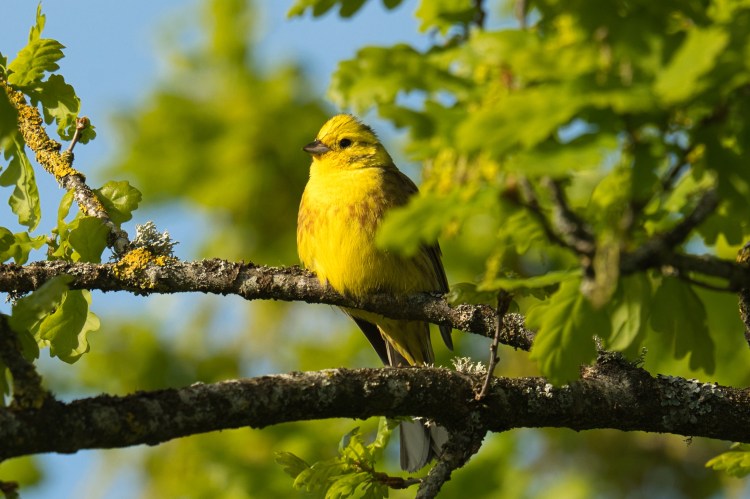
| Some colours in a garden seem perfectly reasonable until sunlight catches them. A yellow flower sitting quietly amongst foliage can suddenly become almost luminous, and after several hours working amongst greens and browns, your eye is inevitably drawn towards it. The same thing happens in the countryside. You can be looking across a perfectly ordinary field edge, seeing little more than hedge, grass and soil, when something yellow appears on top of a bush. For a moment it looks almost too bright to belong there. Then it moves, and you realise you are looking at a Yellowhammer. The male Yellowhammer (Emberiza citrinella) is one of those British birds that seems designed to undermine the idea that our native wildlife is rather restrained in its colouring. Its head and underparts can be a glorious yellow, contrasting with warm brown, chestnut and heavily streaked plumage. Females and younger birds are generally less flamboyant, but even they carry hints of the colour that gives the species its name. Against a winter hedge the bird can disappear surprisingly well; put an adult male on top of that same hedge in summer sunshine, and subtlety rather goes out of the window. Yet for all that colour, many people probably know the Yellowhammer better by its voice. Its song is simple enough to recognise once somebody points it out, traditionally remembered by the phrase “a little bit of bread and no cheese.” Birdsong mnemonics can occasionally feel as though somebody heard a bird and then spent an unnecessarily long afternoon trying to turn the noise into English, but this one genuinely works. Once learned, that drawn-out final note becomes remarkably difficult not to hear as the missing cheese. It is a sound associated with open farmland, scrub, hedgerows and field edges, and on a warm summer day it can seem completely at home there. That seemingly uncomplicated setting, however, hides a more interesting relationship between the bird and how we manage land. The Hedge Is Only Half the Story When we see a bird sitting in a hedge, it is easy to conclude that the hedge is its habitat. Certainly, Yellowhammers need hedges, bushes and scrub for nesting and shelter, but that is only part of what keeps them there. The surrounding ground matters just as much. They feed extensively on seeds, particularly outside the breeding season, while insects become important when chicks are being raised. A useful Yellowhammer landscape therefore needs several things happening at once: somewhere to nest, somewhere to feed and enough insect life to support the demands of breeding. That sounds obvious on paper, yet it highlights a problem with how we sometimes think about wildlife gardening and conservation. We focus on objects. Put up a nest box. Plant a tree. Dig a pond. Grow a wildflower patch. Each can be worthwhile, but animals do not experience landscapes as collections of individual features. They need functioning systems that connect food, shelter, breeding sites, and safe movement through the landscape. A hedge can look magnificent to us and still be surrounded by land offering relatively little food. Equally, a seed-rich margin may be of limited value if suitable nesting cover has disappeared. The Yellowhammer needs the pieces to remain connected. Gardens work the same way. A bird feeder may attract birds, but the hedge beside it provides escape cover. The shrubs contain insects. The lawn may produce worms. The tree offers a lookout point. Water is available somewhere nearby. Remove enough of those supporting elements and the garden becomes less useful even though the feeder itself remains full. It is one reason I have become increasingly suspicious of the phrase “wildlife feature”. Wildlife does not particularly need features. It needs habitat. The Trouble With Tidiness Hedgerows occupy an interesting position in the British landscape because they are both natural habitats and human creations. They have been planted, laid, cut, removed, replanted and managed for centuries, marking boundaries while also becoming extraordinary corridors for wildlife. A mature hedge can contain shrubs, trees, climbers, grasses, wildflowers, dead wood, leaf litter and countless insects, all compressed into a relatively narrow strip of land. To the gardener’s eye, however, a hedge also presents an irresistible temptation. It can be trimmed. There is something deeply satisfying about stepping back from a newly cut hedge and seeing a clean line where twenty minutes earlier there was an untidy collection of shoots pointing in every conceivable direction. I make my living partly by doing exactly that, so I am hardly going to argue that hedges should never be cut. But the Yellowhammer reminds us that timing and intensity matter. Birds need nesting cover during the breeding season, while flowers, berries and insects associated with hedges depend upon allowing plants to go through enough of their natural cycle. Cutting everything hard and frequently may produce a very neat boundary, but neatness is not necessarily the same thing as health. The same principle applies beneath the hedge. One of the easiest ways to make a garden look cared for is to remove every fallen leaf, dead stem and patch of rough vegetation. Unfortunately, these are precisely the places where many invertebrates shelter and where seeds accumulate. A perfectly vacuumed garden may satisfy us aesthetically while leaving surprisingly little behind for anything else. This does not mean gardens must become tangled wildernesses. I have never been convinced that wildlife gardening requires us to stop gardening. Good habitat can be designed, maintained and attractive. The useful compromise is often variation: some closely managed areas, some looser planting, a hedge allowed a little depth, grasses left longer in selected places and corners where every last seed head is not removed the moment flowering finishes. Nature is remarkably good at using the spaces we stop trying to perfect. Seeds, Insects and an Agricultural Bird The Yellowhammer’s diet reveals another interesting seasonal shift. During autumn and winter, seeds are extremely important. Grasses, cereals and other plants provide food when insects are scarce. During the breeding season, however, insects become particularly valuable because growing chicks need protein. That means the bird depends upon both the botanical and insect life of the countryside. This offers a lesson for gardens, because we sometimes separate plants from wildlife as though they were different subjects. We choose plants for flowers, shape or colour and then perhaps add something specifically “for wildlife”. In reality, the planting itself is habitat. A diverse collection of grasses, shrubs, herbaceous plants and trees supports insects in different ways and at different times. Some provide nectar, some foliage for larvae, some seeds, some shelter and some simply structure. Even dead plants remain useful. Seed heads left standing into autumn can feed birds and provide hiding places for insects. Hollow stems become overwintering sites. Fallen material breaks down into soil. By spring, much of what looked untidy in November has either disappeared naturally or can be cleared once it has served another purpose. It is one of gardening’s more useful changes of perspective: instead of asking whether something has finished flowering, ask whether it has finished being useful. Quite often, it hasn’t. When Common Birds Stop Being Common The Yellowhammer also carries a less comfortable story. It remains a familiar bird in suitable parts of Britain, but its population has fallen substantially over the long term, particularly as agricultural practices changed during the later twentieth century. Reduced availability of winter seed, changes in cropping, loss or alteration of hedgerows and changes affecting insect abundance have all formed part of a complicated picture. This is where the decline of familiar birds can be particularly deceptive. If you visit somewhere that still has Yellowhammers, you may see several and wonder what all the concern is about. Wildlife decline rarely means that every individual disappears evenly across the country. Populations contract, densities change, and strongholds remain. A species can still appear locally common while becoming much less common overall. Gardeners encounter something similar with plants. A plant may flourish magnificently in one corner while failing everywhere else, and looking only at the successful patch tells you very little about the whole garden. There is another difficulty too. We tend to notice rarity more readily than declining abundance. If something disappears completely, we recognise the change. If there are simply fewer of them each year, the shift is much easier to miss. Five birds become three, three become two, and eventually the sight that was once routine becomes something worth mentioning when you get home. No dramatic moment marks the transition. The countryside becomes incrementally different. A Bird of Edges Perhaps the most interesting thing about the Yellowhammer is that it is fundamentally a bird of edges. It uses the places where one kind of landscape meets another: hedge and field, scrub and grass, track and farmland. These boundaries can be disproportionately rich because they contain elements of both habitats. Gardens are full of edges too. The bottom of a hedge, the side of a pond, the transition between lawn and border, the strip behind a shed and the place where shrubs meet taller trees can all contain more diversity than a large uniform area. It is one reason I am wary of gardens being simplified into broad expanses of a single surface. Uniformity may be easy to maintain, but nature tends to find complexity more useful. A gardener can encourage that complexity without turning the place upside down. A hedge can be allowed to thicken slightly. A narrow strip of grass can be left longer. Plants can overlap instead of standing like isolated specimens surrounded by bare soil. Seed-bearing plants can remain through autumn. A few leaves beneath shrubs can be regarded as mulch rather than evidence of poor housekeeping. None of this guarantees a Yellowhammer will arrive. For many gardens, particularly urban ones, it probably never will. But that is not the only measure of success. A garden supporting moths, beetles, caterpillars and seed-eating birds contributes to the same ecological fabric that species such as the Yellowhammer ultimately depend on. Gardens are not islands, even when fences make them look that way. They sit inside streets, which sit inside towns and villages, which connect to farmland, woods, rivers and coast. Wildlife does not recognise property boundaries nearly as enthusiastically as we do. The Yellow Bird on the Hedge There is something particularly uplifting about seeing a male Yellowhammer in good light. Perhaps it is simply the colour. Britain does grey extremely well, and a vivid yellow bird sitting above a country lane can feel like a small act of defiance against the weather. But I think there is something else. The Yellowhammer belongs to the ordinary countryside. It does not require a mountain expedition, a boat trip or specialist equipment to appreciate. It can appear beside a footpath, along a farm track or on a hedge you have driven past dozens of times without giving it much thought. Like the Skylark, it demonstrates how much wildlife exists in places we describe as unremarkable. The difficulty is that ordinary landscapes are often the easiest to take for granted. We notice when ancient woodland is threatened because we understand instinctively that it is special. We recognise the value of a dramatic wetland or a spectacular coastline. A hedge beside a cereal field can seem rather less important. Yet for the Yellowhammer, that hedge and the rough ground beside it may contain everything it needs to live. Perhaps that is what this bird adds to our growing collection of quiet lives. The Barn Owl taught us about the value of rough grassland. The Cuckoo connected birds to insects and distant continents. The Skylark asked us to reconsider apparently empty fields, and the Swallow made us look at the landscape above our heads. The Yellowhammer brings our attention back to the boundary. To the hedge we drive past. To the seeds we clear away. To the slightly rough margin somebody has not quite got around to tidying. And occasionally, sitting on top of all that apparent ordinariness, a little flash of gold sings about bread and its disappointing lack of cheese. Watching For… Yellowhammers are birds of open countryside, particularly farmland with hedgerows, scrub, field margins and areas where seed remains available. Spring and summer are excellent times to learn the male’s distinctive song, and once you have connected that drawn-out final note with the traditional “little bit of bread and no cheese”, it becomes surprisingly easy to recognise. Rather than concentrating only on the field itself, watch the tops of hedges, isolated bushes, fence lines and overhead wires where males may choose an exposed singing perch. In winter you may encounter Yellowhammers feeding in groups on farmland alongside other seed-eating birds, when their colours can appear rather more subdued. Then spring returns, the light improves, and a male lands on a hedge. Suddenly, nothing about him is subdued. |
| About our writing & imagery Most articles reflect our real gardening experience and reflection. Some use AI in drafting or research, but never for voice or authority. Featured images may show our photos, original AI-generated visuals, or, where stated, credited images shared by others. All content is shaped and edited by Earthly Comforts, expressing our own views. |


The Yellowhammer is a beautiful bird, Rory. Thank you for the education.
LikeLiked by 1 person
Thank you Eugenia, Yellowhammers are a real treat to see in a garden.
LikeLiked by 1 person
You’re welcome, Rory.
LikeLiked by 1 person