| Episode One Where Better to Begin? |
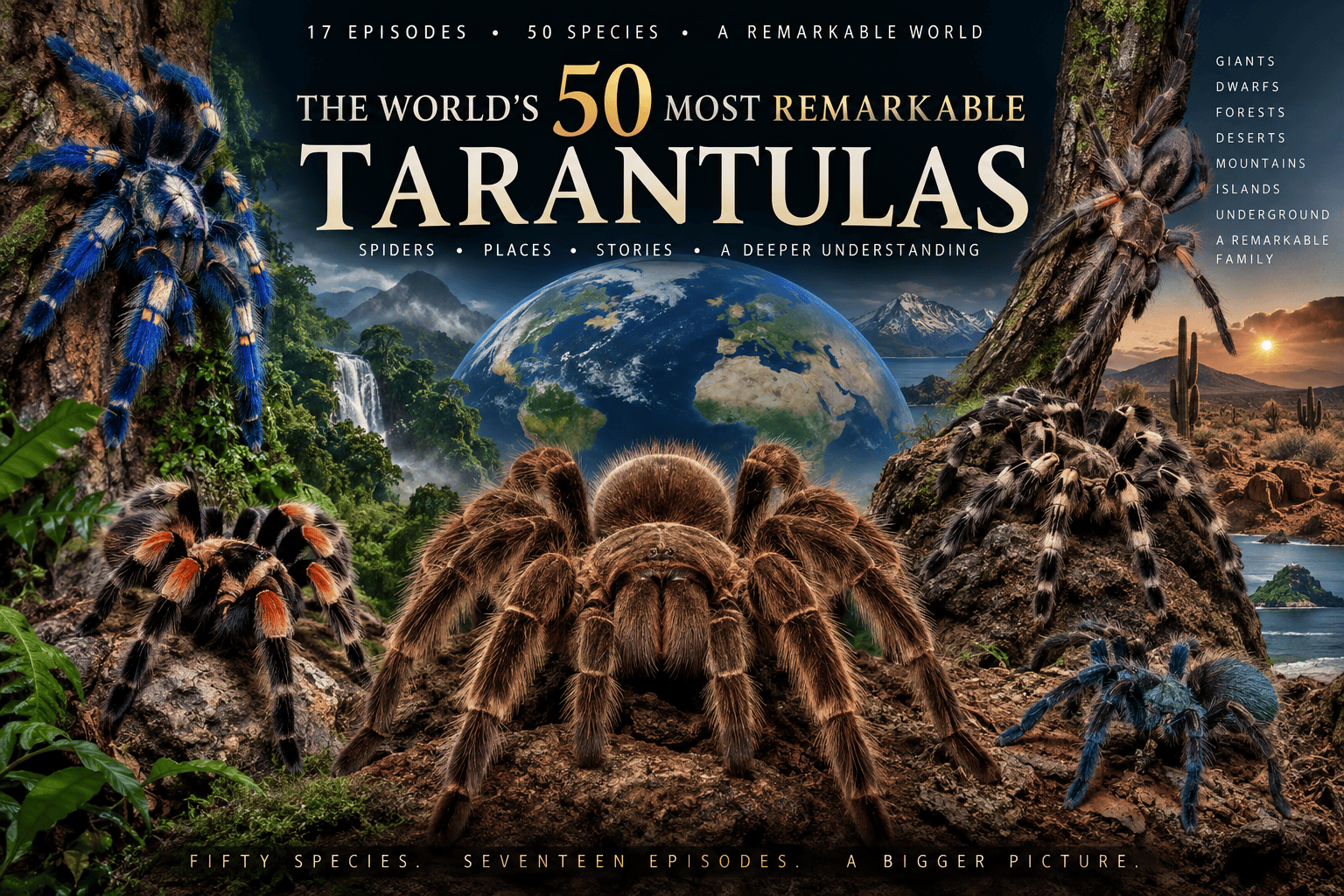
| Having decided to choose fifty of the world’s most remarkable tarantulas, there was an obvious problem: where on earth do you start? We could begin with the biggest, the most colourful, the rarest, or perhaps the one with the most formidable reputation, but that would undermine the purpose of this series before we had properly begun. No single characteristic makes a tarantula remarkable, and there isn’t a sensible scientific scale to measure one against another. So instead, our first three take us to very different parts of the world and introduce three very different ways of being a large spider. We begin in the forests of northern South America with an animal whose name has become almost synonymous with enormous spiders. From there, we travel to India and into the trees to meet a tarantula so extraordinarily blue that photographs can sometimes look artificially enhanced. Finally, we cross to the island of Socotra, where geographical isolation has produced a tarantula with a rather different story to tell. If anyone still thinks all tarantulas are basically variations on a large brown hairy spider, these three aren’t a bad place to start. |
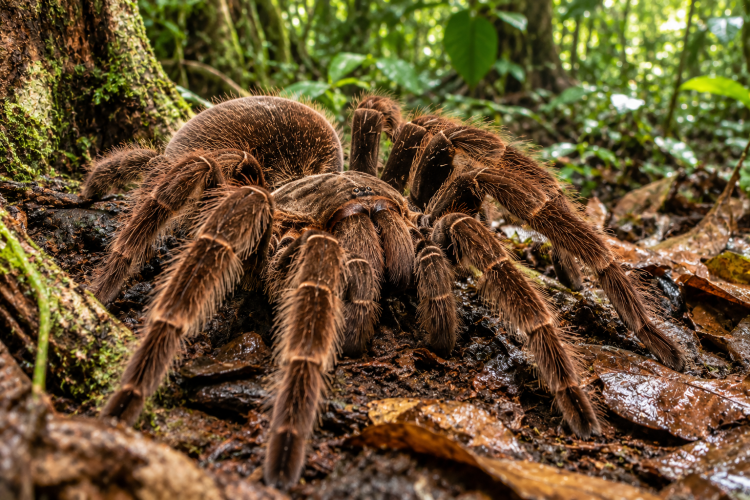
| The Goliath Birdeater Theraphosa blondi There was probably no realistic way of writing a series about remarkable tarantulas without eventually arriving at Theraphosa blondi, so we may as well meet it first. The Goliath birdeater has occupied an extraordinary place in the popular imagination for generations, helped considerably by a common name containing both “Goliath” and “birdeater”. It sounds like something a Victorian naturalist designed to ensure nobody overlooked his discovery. The spider itself needs very little exaggeration. Theraphosa blondi is a genuinely enormous, heavy-bodied tarantula, predominantly reddish to dark brown and covered in dense hairs. Adult females can reach extraordinary proportions, and the species belongs among the heaviest spiders known. That last distinction is worth making because spider size is surprisingly difficult to discuss sensibly. Body length, leg span, and weight are different measurements; exceptional individuals are often presented online as though they were typical, and figures tend to increase with each retelling. A Goliath birdeater is impressive enough without adding another centimetre every time the story is told. Its natural distribution lies in northern South America, including parts of Guyana, Venezuela and Brazil, where it inhabits humid tropical forest. Despite the enormous spider we tend to picture striding dramatically through the jungle, it is essentially a terrestrial animal strongly associated with burrows and the forest floor. Soil, leaf litter, roots, and available retreats make up its world far more than the open spaces where photographers understandably prefer to show it. The “birdeater” part of the name has a longer history. Early European accounts and illustrations helped establish the idea of enormous tropical spiders capturing birds, and variations of “bird-eating spider” became attached to several large tarantulas. A spider the size of Theraphosa certainly possesses the physical ability to overpower surprisingly substantial prey, and small vertebrates may occasionally be taken. That does not mean birds form the ordinary basis of its diet, however. It is better understood as an opportunistic predator taking suitable prey when the opportunity arises, with large invertebrates making considerably more sense as regular meals than an endless procession of unfortunate birds. What interests me more than the name is how well defended such a large animal still needs to be. Like many New World tarantulas, T. blondi has specialised urticating hairs it can release from its abdomen when seriously disturbed. These can cause considerable irritation, particularly if they reach sensitive tissues. The species can also produce warning sounds by stridulation, rubbing specialised structures together, and behind all of this sits the final physical defence of a very large spider equipped with substantial fangs. It would be easy to turn those characteristics into the usual monster story, but biologically they tell us almost the opposite. Here is one of the world’s largest spiders carrying several layers of defence because being large does not make an animal invulnerable. A Goliath birdeater still has predators, still benefits from concealment and still needs to avoid unnecessary physical confrontation. For a slow-growing animal, an injury that prevents it from hunting or leaves it vulnerable during a moult can matter enormously. Threatening appearance and defensive capability are therefore not evidence of an animal looking for a fight; quite often they are ways of avoiding one. T. blondi is also pleasingly understated. We will meet tarantulas during this series coloured brilliant blue, orange, yellow and violet, but the Goliath is largely dressed for the earth around it. Its browns and reddish tones belong among soil, dead leaves, roots and shadow, while its extraordinary bulk is the feature that catches our attention. That is why it belongs among our fifty, but not simply because somebody once measured a very large specimen. The Goliath birdeater gives us our first useful lesson in looking beyond the obvious. The record-book giant becomes considerably more interesting once we stop treating it as a record. |
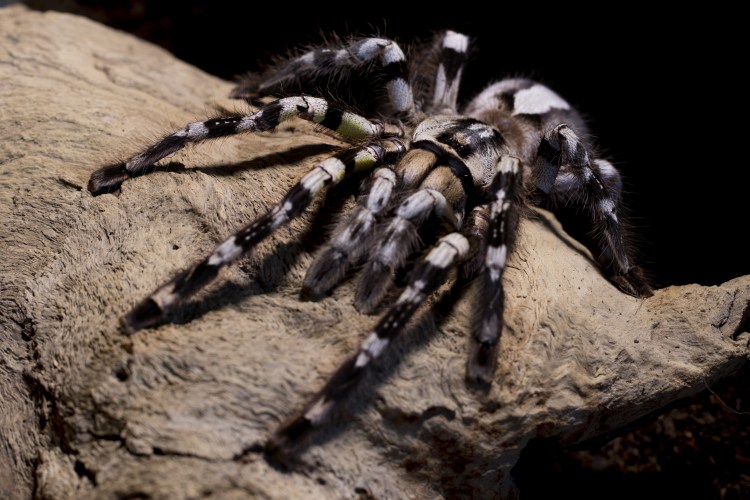
| The Gooty Sapphire Ornamental Poecilotheria metallica If our first tarantula looks as though it belongs to the earth, Poecilotheria metallica can look as though somebody has made a mistake with the colours. The Gooty sapphire ornamental can display an extraordinary metallic blue across much of its body and legs, broken by intricate pale patterning and contrasting yellow markings. Even in a family with some spectacularly coloured animals, it is difficult to confuse an adult P. metallica with anything else. Colour, however, is only the doorway into the story. This is an Indian arboreal tarantula and therefore an animal built around a rather different existence from the heavy terrestrial Goliath we have just left behind. Rather than occupying the forest floor, P. metallica is associated with trees, using hollows, crevices and other protected spaces as retreats. Moving vertically across bark and through branches creates different challenges from travelling across soil, and members of Poecilotheria are correspondingly agile animals capable of moving with remarkable speed when they need to. Its defensive biology also immediately shows us why talking about “the tarantula” as though all species operate in much the same way quickly becomes misleading. P. metallica is an Old World species and lacks the urticating hairs used defensively by many tarantulas from the Americas. Concealment and rapid retreat consequently become particularly important, while threat displays and biting remain available when escape or hiding fails. Two species into our fifty, and we already have substantially different solutions to avoiding predators. Another reason Poecilotheria metallica deserves our attention is less comfortable than admiring its colour. The species has an extremely restricted natural distribution in Andhra Pradesh and has been assessed as Critically Endangered. Habitat degradation is a serious concern, while its extraordinary appearance has inevitably drawn considerable attention from the international tarantula trade. International commercial movement of Poecilotheria is now controlled through CITES, reflecting wider concerns surrounding these distinctive Indian and Sri Lankan tarantulas. This is one place where my own history inevitably changes how I see the animal. I spent many years working professionally within the exotic livestock trade, and this entire series grew from a Top 50 tarantula list I was once asked to compile for an importer. At the time, the trade viewed an extraordinary species partly through the lens of availability, rarity, and demand. Revisiting the idea years later from a natural history perspective turns the question around. With P. metallica, what interests me now isn’t how desirable an animal might be in a collection, but why such an extraordinary species evolved where it did, how it actually lives there and what will allow wild populations to remain there. That distinction becomes even more interesting when we consider how much remains to be learned. Dedicated conservation fieldwork in Andhra Pradesh is still trying to improve knowledge of the species’ distribution, habitat use, population status and the pressures facing it. There is something rather revealing about an animal being instantly recognisable to tarantula enthusiasts around the world while important aspects of its natural life remain incompletely understood. Perhaps that is one consequence of our fascination with spectacular wildlife. We can become extremely familiar with what an animal looks like without necessarily knowing the animal particularly well. Photographs travel much more easily than ecological understanding, and a vivid blue spider naturally attracts attention in a way that a study of habitat requirements may not. Poecilotheria metallica earns its place among our fifty because it brings so many strands of this series together: extraordinary adaptation, geographical restriction, human fascination, wildlife trade and conservation. Its blue colour may be what first makes us stop and look, but the more important story begins after we have stopped looking only at the blue. |
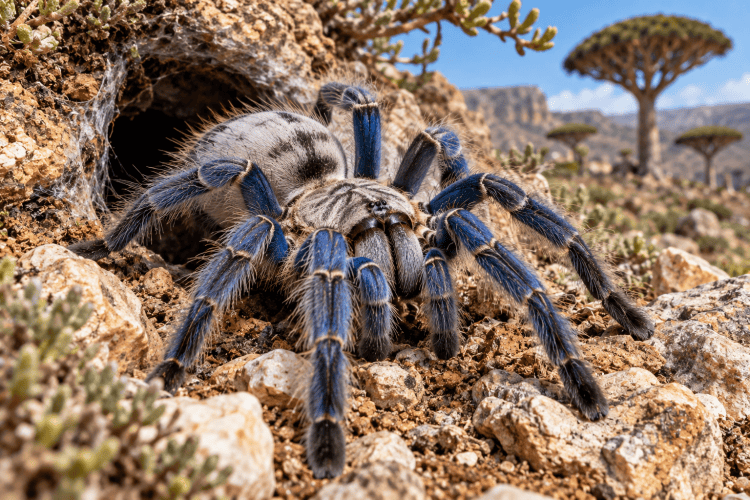
| The Socotra Island Blue Tarantula Monocentropus balfouri Our third tarantula takes us away from both South America and mainland Asia to somewhere remarkable before we have even found the spider. Socotra lies in the Arabian Sea and is part of Yemen, but its long geographical isolation has produced an extraordinary assemblage of plants and animals found nowhere else. The famous dragon’s blood trees may provide the postcard image. Still, the same broad evolutionary principle runs throughout the island’s wildlife: isolation can create opportunities for populations to follow their own paths. Among Socotra’s endemic animals is Monocentropus balfouri, usually known as the Socotra Island blue tarantula. Its colouring differs greatly from the metallic brilliance of Poecilotheria metallica. Pale body tones contrast with darker blue-grey legs, giving the animal a distinctive appearance without the almost jewel-like intensity of our previous species. Put the two side by side, and even the simple description “blue tarantula” begins to lose much of its usefulness. What makes M. balfouri particularly interesting to me, however, is its geography and lifestyle. This fossorial species lives in burrows and builds substantial webs, and recent fieldwork describes it as inhabiting rocky montane grassland with scattered shrubs and small trees. We have therefore moved from the humid South American forest floor to an Indian arboreal specialist and then to a burrowing spider inhabiting the very different landscapes of Socotra. Three species have already taken us into three quite separate versions of the tarantula world. Socotra’s isolation also gives the animal an evolutionary context that is easy to overlook when concentrating upon its appearance. Island species can exist within restricted geographical boundaries for very long periods, separated from related populations elsewhere and exposed to their own combinations of climate, prey, predators and habitat. That does not automatically make every island animal bizarre, but it can produce lineages whose histories cannot be understood without understanding the places in which they evolved. Even the scientific classification of M. balfouri reminds us that our understanding is continuing to change. Recent taxonomic work has examined Monocentropus and its relatives in detail, confirming M. balfouri while moving another species formerly placed within the genus elsewhere. Tarantula taxonomy has changed considerably over the years and will undoubtedly change again as morphological study is increasingly combined with genetic evidence. Names that once seemed settled can turn out to conceal relationships rather more complicated than anyone realised. Another aspect of M. balfouri has made it particularly famous among tarantula keepers. In captivity, individuals have repeatedly been maintained together with a degree of tolerance unusual enough to give the species a reputation as a “communal” tarantula. Groups may occupy elaborate systems of webbing and retreats, and observations of adults and young together have understandably encouraged people to wonder whether something more complicated is happening than the solitary lifestyle we usually associate with these spiders. This is where we need to resist turning an intriguing observation into a convenient fact. Much of what is repeated about the communal behaviour of M. balfouri comes from captive experience, and tolerating members of the same species under particular conditions is not the same thing as possessing the organised social structure we see in ants, termites or honeybees. The really interesting question is what happens naturally beneath the stones, webs and burrows of Socotra. How frequently do individuals encounter one another? Under what circumstances do they tolerate each other, and how closely do behaviours seen in captivity reflect life in the wild? We do not yet have complete answers, and I rather like that. Natural history would be terribly dull if every species arrived with a completed instruction manual. Sometimes an uncertainty is more valuable than a neat answer because it shows us where observation and research still have something to discover. That is ultimately why Monocentropus balfouri completes our opening three. It doesn’t need to compete with the Goliath birdeater for size or with the Gooty sapphire ornamental for colour. Its story lies in island evolution, geographical isolation, a burrowing existence and behaviour that raises questions we have not yet fully answered. Sometimes an animal becomes remarkable not because we know everything about it, but because what we do know makes us want to know considerably more. |
| Three Spiders, Three Different Stories For our first episode, we travelled farther than I suspect most people would expect from an article about three tarantulas. In northern South America, Theraphosa blondi showed us what happens when a terrestrial tarantula becomes genuinely enormous, and why enormous animals still need sophisticated ways to avoid trouble. In India, Poecilotheria metallica took us into the trees and introduced the more uncomfortable relationship between extraordinary wildlife, rarity and human desire. On Socotra, Monocentropus balfouri returned us underground but into an entirely different landscape, where geographical isolation, evolving taxonomy and intriguing behaviour remind us how much remains unknown. None of these animals is more remarkable than the others; they are remarkable for different reasons, and that distinction is really the point of our fifty. Tarantulas have not been successful because evolution discovered one perfect large-spider design and then repeated it around the world. Different lineages have found different ways to solve the same fundamental problems: finding somewhere to live, getting food, avoiding becoming food themselves, coping with their environment, and producing the next generation. We have met only three species, yet already the familiar image of “a tarantula” has begun to fragment into something much more interesting. We have a forest-floor heavyweight, an extraordinarily coloured Indian tree specialist and a Socotran burrower whose natural behaviour still leaves us with unanswered questions. If three animals can produce that much variation, the remaining forty-seven should take us into some very interesting territory indeed. And that is really where I hoped this series would take us, not toward a collection of records, rarities, and impressive photographs, but toward an understanding of just how diverse, resilient, and adaptable these animals have become. |
| Next: Episode Two — Giants and Heavyweights Theraphosa apophysis · Lasiodora parahybana · Pamphobeteus antinous |
| About our writing & imagery Most articles reflect our real gardening experience and reflection. Some use AI in drafting or research, but never for voice or authority. Featured images may show our photos, original AI-generated visuals, or, where stated, images credited to others. All content is shaped and edited by Earthly Comforts, expressing our own views. |


Oh my goodness, I absolutely LOVE this series already! 🕷️❤️
And starting with the Goliath birdeater was probably the quickest way possible to get my attention. 😂 I adore tarantulas. Actually, I adore spiders in general, but the birdeater has always been my absolute favourite.
I would honestly love to be in that jungle with a camera, quietly stalking these beautiful creatures and photographing them all day. Although I suspect there would be at least one moment when I would look at a particularly magnificent tarantula and think, “I wonder if you would let me give you a little hug?” 🤣🤣🤣
Fortunately for the tarantula, I would probably settle for photographs. 😂
What I really appreciate about this post, though, is that you aren’t simply presenting these animals as impressive “record breakers”. You’re looking at how they actually live, what makes them different and what we still don’t know about them.
Your discussion of the Goliath’s defensive behaviour particularly interested me. Something that looks frightening to us isn’t necessarily an animal looking for a fight. Sometimes all those impressive defences are simply a way of saying, “Please leave me alone.” And I think that’s something we humans forget rather easily.
The section about the Gooty Sapphire Ornamental also really struck a chord with me. I absolutely hate the idea of wild animals being taken from their natural habitats simply because people want to own something rare or beautiful.
My philosophy with wildlife is probably very simple: take photographs and leave careful footprints. 📷🌿
Watch them. Learn about them. Appreciate them. Photograph them. But let them remain where they belong.
I have no problem with responsible captive breeding when it contributes to learning and understanding these animals, and I can understand why people become fascinated by them. But there is something very different about breeding and learning from animals in captivity and stripping wild populations out of their natural environment because there is a market for them.
And I really loved your point that photographs can travel much more easily than ecological understanding. As a photographer, that made me stop and think. A photograph can make somebody fall in love with an animal, but hopefully it can also make them curious enough to learn about the animal behind the photograph.
So yes, you have definitely found one reader who is going to be following this series very closely. 😂
The Goliath has already won me over, and now I’m rather curious about the other 47.
Although I feel I should warn you in advance: if you eventually write about a tarantula that is particularly adorable, I reserve the right to become completely ridiculous about it. 🤣🕷️❤️
LikeLiked by 1 person
Of course – many spiders are adorable if people give them the time, so many people are terrified of spiders which always confuses me – don’t get me wrong, there are spiders that can cause harm, but it baffles me why so many people are frightened of them.
LikeLiked by 1 person
Absolutely! I feel exactly the same way. 😊 I can understand that some people are genuinely frightened of spiders, and I do feel sorry for them because they are missing out on some incredibly fascinating little creatures.
I’m quite the opposite though — I absolutely adore them! 😂 I could happily sit and watch a spider going about its business for ages, especially when I have my camera with me. I think once you take the time to actually look at them, rather than immediately seeing “spider” and thinking “kill it!”, you start noticing just how beautiful, interesting and sometimes downright adorable they can be.
And I completely agree with you that there are spiders that need to be treated with respect, but most of them really aren’t interested in us at all. They have their own little lives to get on with, and if we leave them alone, they generally leave us alone.
We actually have quite a few brown button spiders around the house. They stay tucked away in their little dark corners during the day and come out at night to do their thing and catch insects. We leave them in peace and they leave us in peace — although my youngest son, Rudi has even been known to provide the occasional fly for the two living near his bed light! 😂
I think that’s what I love most about nature photography — you slow down enough to actually notice the little lives happening all around you. There is always something fascinating going on if you take the time to look and I must truly say, I am so, so glad I found your blog. It’s just awesome! I am still doing my best to try and catch up, but will get there. LOL! 🕷️❤️
LikeLiked by 1 person
Oh Sonel thank you, that comment of yours has inspired me somewhat ‘but most of them really aren’t interested in us at all. They have their own little lives to get on with, and if we leave them alone, they generally leave us alone.’ We always look from our perspective, what is we looked from theirs? I am going to create a small series called ‘The Other Side of the Flowerbed’
LikeLiked by 1 person
Oh, I absolutely love the sound of this! ❤️🕷️🌿 “The Other Side of the Flowerbed” is a wonderful title, and I’m really looking forward to seeing the garden from their perspective. What a fascinating idea! 😊 Can’t wait to start reading it. 🤗🙌
LikeLiked by 1 person
I think you’ll like it, it starts October 11.
LikeLiked by 1 person