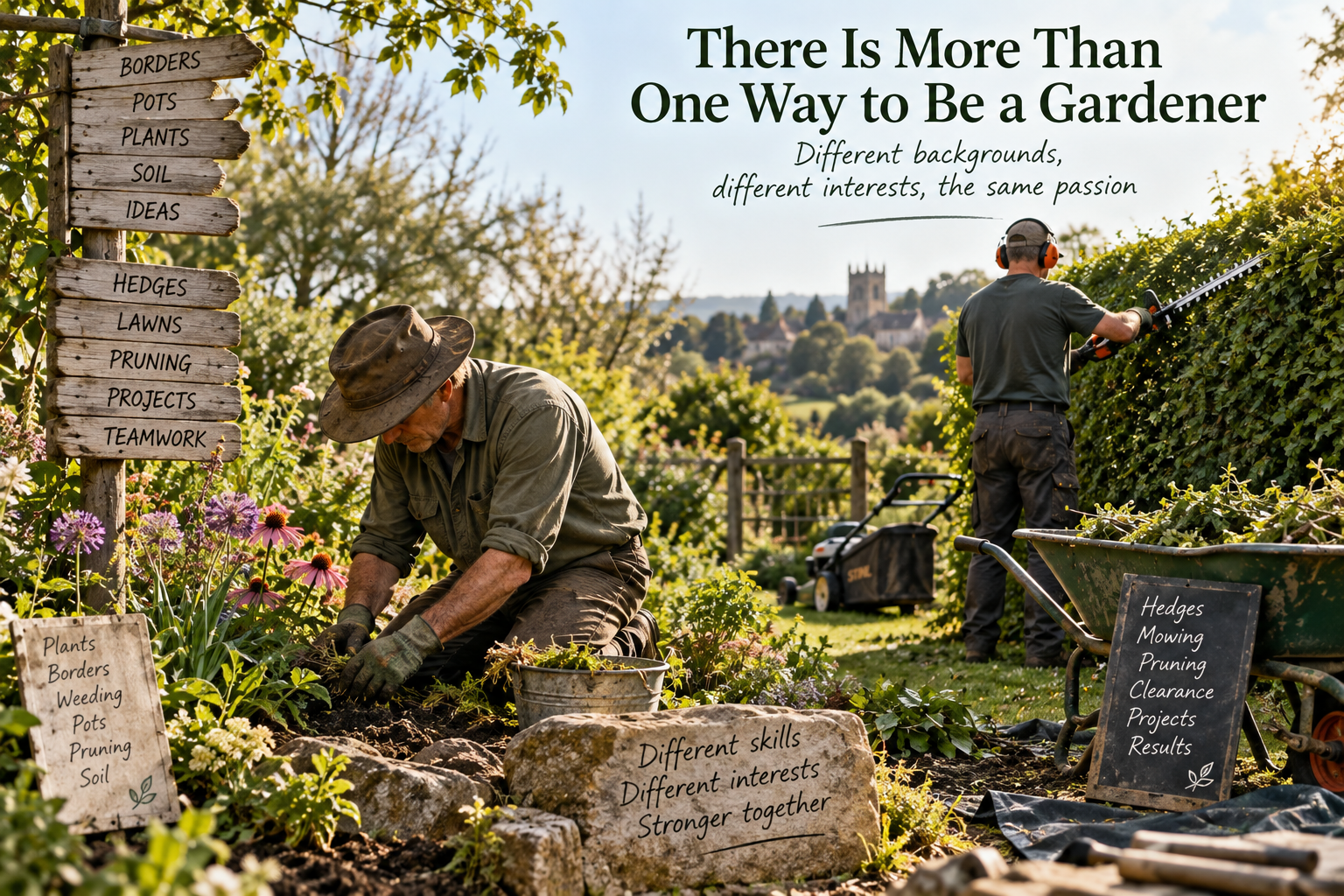
| Different backgrounds, different interests and different ways of doing the same job |
| I was talking to a trainee gardener recently when she told me that she spends much of her spare time visiting gardens. She explained it very simply: “I am passionate about gardening and get inspired by visiting gardens and looking at planting.” I understood exactly what she meant, but it also made me realise how differently people can express the same enthusiasm. Visiting gardens in my spare time doesn’t particularly appeal to me. That isn’t because I don’t love gardening. I spend most of my working week in gardens, looking at plants, borders, soil, weeds, trees and everything else that comes with maintaining them. When I finish work, I don’t necessarily feel an urge to go and look at another garden. Allow me to see behind the scenes of a composting operation or waste-recycling facility, however, and I’d be fascinated. These aren’t generally places you can turn up and wander around, unfortunately, but if I could, I’d happily wallow in them. Composting and the recycling of waste are two of my real passions. I love gardening and seem to have taken to it very naturally, but soil was my first true love. That conversation made me wonder whether we sometimes have too narrow an idea of what a gardener is supposed to be. |
| Gardeners Don’t Come Out of the Same Mould There is a conventional route into professional horticulture, and there’s absolutely nothing wrong with it. People study horticulture, gain RHS qualifications, train under experienced gardeners and build their careers from there. A trainee gardener visiting established gardens and studying planting is doing something enormously useful. She’s seeing combinations, observing mature plants, discovering ideas, and building a mental library she can draw on later. But not every gardener arrives that way. John and I certainly didn’t. Neither of us is an RHS-trained gardener, and professional gardening wasn’t the career either of us began with. We’ve come into it from very different backgrounds and brought a lifetime of other experience. John has, at different times, worked as a lorry driver and in waste management. My own working life travelled through completely different territory before I eventually became a professional gardener. Perhaps that’s partly why neither of us feels that being a gardener requires us to behave like gardeners every waking hour. We love the work and take it seriously, but gardening doesn’t have to become the only thing we’re interested in. We Don’t Even Garden in the Same Way John and I have noticeably different working styles. Given the choice, I naturally gravitate towards beds and borders. I like working amongst the plants, weeding, selectively pruning, looking after pots, tidying planting and noticing the small things that determine whether a border looks cared for or merely maintained. This sometimes gets described as lighter maintenance, although I’m not convinced that’s a particularly good description. It may be lighter in terms of machinery and brute force, but good border work requires constant decisions. What is this plant? Should it be cut now? Is that a weed or something worth keeping? Is one plant beginning to overwhelm another? Does something need moving, supporting, dividing or feeding? Is that bare patch deliberate or has something disappeared? You can spend hours in a border without doing anything particularly dramatic, yet the difference afterwards can be considerable. John tends to prefer the heavier end of maintenance. Hedging, mowing, larger pruning and more project-based work suit him. It often involves more machinery and a greater physical transformation. Something is high, long, overgrown or needs tackling, and John enjoys getting into it. Neither approach makes one of us more of a gardener than the other. They’re simply different ways of working. Put Us Together, and It Makes Sense Those differences become particularly useful when we’re working as a team. John can concentrate on the hedge, the mower or the heavier pruning while I work through the beds, borders and pots. He may be making the most immediately obvious transformation while I’m working on the detail underneath it. Eventually the two meet and the whole garden has moved forward. We’re not rigid about it. If something needs doing, it needs doing. I mow lawns, cut hedges and tackle heavier jobs; John weeds, prunes and works in borders. But when a garden has enough work for both of us, we naturally drift toward the areas we prefer. There’s another practical difference too. John doesn’t walk between gardens; I often do. That changes the way you work because a van can carry an extraordinary amount of equipment, whereas a walking gardener has to decide what genuinely deserves to travel with him. You learn to make tools earn their place and to work with what you’ve brought rather than having an entire mobile tool shed parked outside. Over time, circumstances like these help shape the gardener as much as personal preference does. What Does Passion Actually Look Like? The conversation with the trainee gardener stayed with me because of that word, passionate. I don’t doubt for a moment that she is passionate about gardening. Spending her free time visiting gardens and studying planting is her way of expressing it and, particularly while training, I can see enormous value in doing so. But passion doesn’t have a uniform. You don’t have to visit famous gardens every weekend, know every Latin plant name, watch every gardening programme, subscribe to every magazine or arrange your holidays around gardens you’ve always wanted to see. Some gardeners genuinely love doing all those things. Others don’t. John might quite happily spend his day off visiting a stately home. I’d probably get much more animated if somebody offered to show me how tonnes of green waste are processed into useful material. Put me beside an enormous composting system, and I’ll want to know what went into it, how it is being managed, how hot it becomes, how frequently it’s turned, what machinery is involved, what happens to contamination, how long the process takes and what eventually comes out the other end. Apparently that’s my idea of a good day out. Soil Came Before Gardening My fascination with soil probably explains quite a lot about the kind of gardener I’ve become. Plants are what most people see. Soil is largely hidden, but everything above it depends upon what is happening underneath. Organic matter breaks down, worms and microorganisms work through it, nutrients move, water is held or lost, and yesterday’s waste can eventually become tomorrow’s growing material. That cycle fascinates me. It means that when I look at a pile of garden waste, I don’t necessarily see rubbish. I see material that hasn’t finished its journey yet. What’s cut from one garden can eventually contribute to another piece of ground. Leaves, clippings and plant material can become compost; compost can improve soil; improved soil supports plants; plants grow and eventually produce more material. Gardening sits somewhere in the middle of that cycle rather than at the beginning or the end. Perhaps someone else falls in love with flowers first. Someone else loves trees. Another gardener becomes obsessed with lawns, propagation, vegetables or garden design. That’s the point. There is more than one way into gardening because there is more than one thing within gardening to fall in love with. We Came From a Working Generation John and I share something else that has very little to do with horticulture. We both came up through our younger working lives in the 1980s. Our backgrounds were different, but the work ethic we brought with us is remarkably similar. We work. That sounds almost ridiculously obvious on paper, but I mean something quite specific by it. When we arrive at a garden, we’re there to move the garden forward. We prefer some jobs and enjoy others less, but the work still needs doing. Sometimes it’s interesting, sometimes satisfying, sometimes physically exhausting and sometimes repetitive. You get on with it. Perhaps that’s one reason John and I work well together despite having different gardening styles. Neither of us needs the other person to love the same things. If he’s tackling something heavy while I’m buried in a border, we’re both doing what needs doing. If circumstances change, we change with them. The garden doesn’t particularly care which one of us prefers what. It just needs looking after. What Else Does a Gardener Bring With Them? This has also started to influence how I think about the gardeners we bring into Earthly Comforts. We are increasingly looking at trainees and part-trained gardeners, including people coming through routes such as RHS qualifications or WRAGS placements. That horticultural training is valuable, and there are areas where somebody with formal plant knowledge may know considerably more than I do. But I’m becoming equally interested in another question: what else have they learned in life? A gardener doesn’t arrive at the gate carrying only horticultural knowledge. They bring everything they’ve done before. Someone may have worked in construction and understand materials and practical problem-solving. Another may have worked with animals and developed patience and powers of observation. Someone from hospitality may be particularly good with clients. A former driver may understand machinery, logistics and working independently. An office background can bring organisation and record-keeping. Caring for children or relatives can build patience, responsibility, and the ability to adapt when plans suddenly change. None of these things appears on an RHS certificate, but all of them can become useful in a gardening business. John and I are good examples. Neither of us came through formal horticultural training, and our earlier working lives were very different, but we didn’t arrive in gardening empty-handed. We brought decades of working experience with us. John’s background included driving lorries and working in waste management; mine took me through completely different industries. Those experiences shape how we approach problems, work with people, organise ourselves and, perhaps most importantly, our attitude towards work itself. That means that when we recruit somebody now, I’m not simply interested in whether they can identify plants or whether they’ve completed a particular qualification. Those things matter, particularly as we build a team containing different levels of horticultural knowledge. But I also want to know what else they can bring to the garden. What have they done? What have they learned? What are they naturally good at? What interests them beyond gardening? Perhaps that’s ultimately what I’d like Earthly Comforts to become: not a collection of gardeners who all know and do the same things, but a team whose skills overlap while their individual strengths are different. One person may bring stronger formal horticultural knowledge, another machinery experience, another an instinct for borders, another practical construction skills, another knowledge of wildlife or soil. We can teach each other, cover one another’s weaker areas and become more capable collectively than we would be if we recruited several versions of the same gardener. RHS and WRAGS can help teach someone horticulture. Life teaches them an awful lot of other things. A good gardening team probably needs both. There Isn’t a Correct Way to Be a Gardener The longer I do this work, the less convinced I am that there is a standard model of a gardener. Some arrive through horticultural college. Some learn through years of practical experience. Some have gardened since childhood. Others discover much later in life that they have an instinct for it. Some adore plants and planting design, some love machinery and physical transformation, some want immaculate lawns, and some would rather spend all day in a border. And some apparently want to stand beside an industrial-sized heap of decomposing vegetation and ask questions about it. Professionally, what matters is whether you know what you’re doing, recognise what you don’t know, keep learning, and care about the work you leave behind. John and I aren’t trained from the same horticultural mould, and we don’t have identical interests or working styles. But perhaps that is precisely why the combination works. We don’t need to garden in the same way. We need to garden well. And when the day’s gardening is finished, we’re perfectly entitled to be interested in something else. |
| About our writing & imagery Most articles are grounded in our real gardening experience, observations and reflections. AI may assist with research, drafting and editing, but the experiences, opinions and editorial direction are our own. Featured images may include our photography, original AI-generated visuals or, where stated, images credited to others. All published content is reviewed and shaped by Earthly Comforts before publication. |

