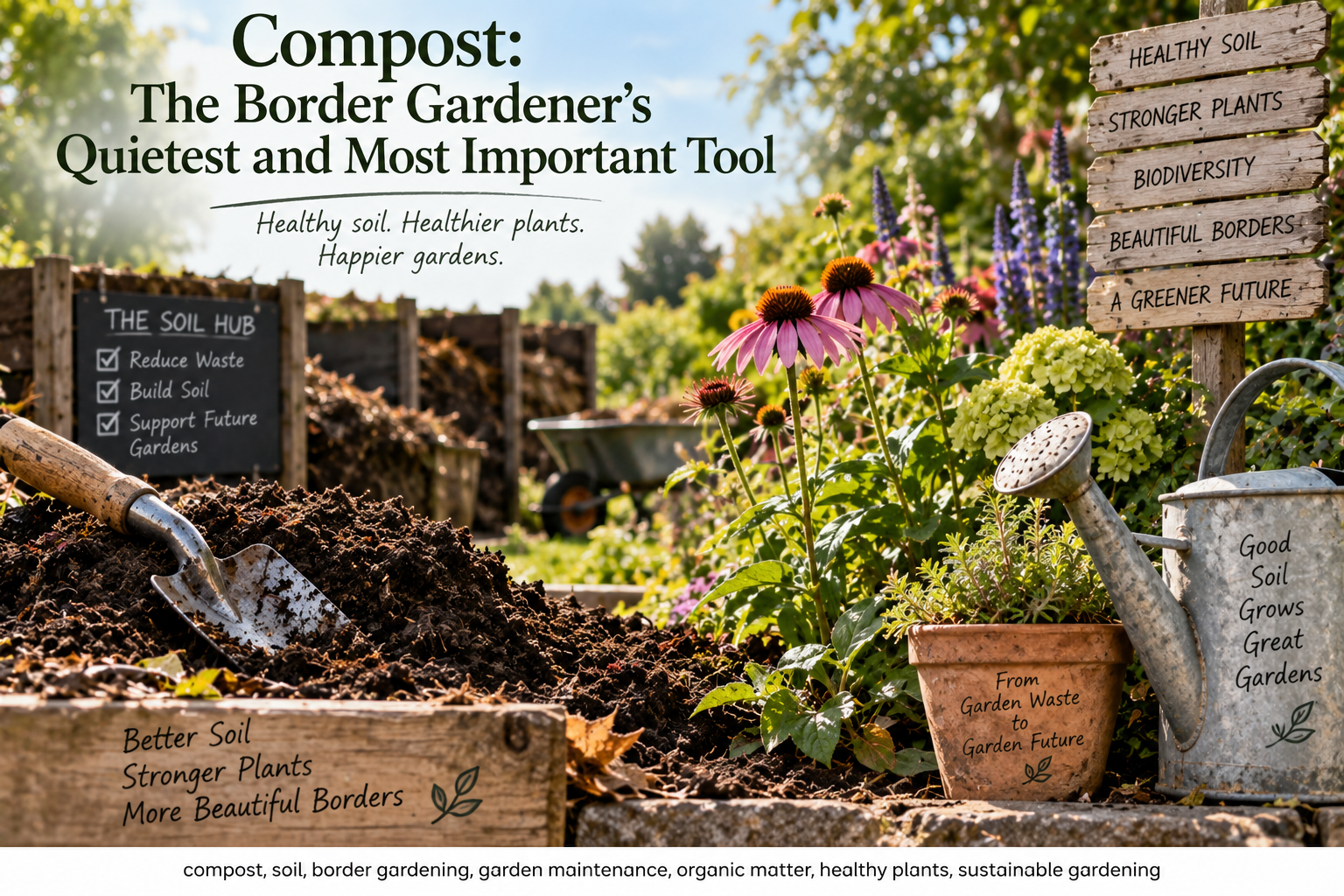
| Beautiful borders begin with plants, but successful borders begin with soil. |
| When people look at a good garden border, they naturally look at the plants. They notice the flowers, colours, shapes and heights, perhaps a particularly good combination or a plant they haven’t seen before. The gardener working in that border has to look at all of those things too, but I think a good border gardener eventually learns to look in the opposite direction as well. Downwards. Because however beautiful the planting plan might be, everything growing above the surface ultimately depends upon what is happening underneath it. A border gardener who understands plants can create something attractive. A border gardener who begins to understand soil has a much better chance of keeping it that way. That’s where compost becomes far more important than the brown stuff we occasionally tip out of a bag or wheelbarrow. |
| A Border Is Really Two Gardens There is the garden everybody sees and the garden almost nobody sees. Above ground we have stems, leaves, flowers, shrubs, grasses and all the combinations that give a border its character. Below ground is an extraordinarily busy environment of roots, soil particles, water, air, fungi, microorganisms and invertebrates. The health of the first garden depends enormously upon the condition of the second. That changes how I think about border maintenance. Weeding, pruning, deadheading and cutting back are all important. Still, if we spend year after year concentrating entirely on what is above the ground while giving little thought to the soil beneath it, we’re maintaining only half the border. Soil isn’t simply something that holds plants upright. It has structure. It holds and releases water. It contains and retains nutrients. It provides air spaces around roots and supports a living community that helps organic material continue its journey through decomposition. The RHS describes organic matter as important to soil structure and fertility, and notes its ability to help soil hold moisture and retain nutrients rather than letting them wash away. (RHS) For a border gardener, that’s fairly fundamental. Compost Isn’t Just Plant Food I think one of the easiest mistakes is to think of compost primarily as something that feeds plants. It can certainly contribute nutrients, but that undersells what good garden compost does. Adding organic matter can improve the soil’s physical condition. In lighter, fast-draining soils, it can improve moisture retention; in heavier soils, it can help structure and drainage. Compost also supports soil organisms and, when used as a surface mulch, can reduce evaporation and suppress weeds. (RHS) That matters because borders rarely contain one plant growing under controlled conditions. They contain communities of plants competing for water, nutrients, light and physical space. Some are shallow-rooted, some send roots much deeper, some establish quickly, and others take years. The border gardener is constantly managing that competition. Good soil gives us a better starting point. It doesn’t mean every plant will thrive. The wrong plant in the wrong place remains the wrong plant, no matter how much compost we give it. Compost also doesn’t magically correct every soil problem. But improving the soil’s organic matter gives the plants growing there a better environment to do what they are naturally capable of. The Border Gardener Needs to Learn to Read Soil This is where border gardening becomes much more interesting to me than simply knowing plant names. Plant knowledge matters enormously. You need to recognise what you’re working around, understand how it grows, and know when and how to maintain it. Eventually, you start noticing why the same plant behaves differently just a few metres away. Why is that plant thriving while this one struggles? Why does this section dry out first? Why does water sit here? Why is the soil beautifully workable in one part of the bed and horrible twenty feet further along? Why are roots struggling through one area but spreading freely through another? Sometimes the answer is the plant. Sometimes it is light, exposure, competition or water. And sometimes the answer is underneath your boots. A border gardener therefore needs to become something of a soil observer. You don’t need a laboratory every time you put a trowel into the ground. You can learn an enormous amount by handling soil, watching what happens after rain, seeing how quickly it dries, noticing compaction, looking at root growth and observing the life within it. Over time, the soil starts telling you things. Compost Connects Maintenance With Improvement Another reason I think compost belongs at the heart of border gardening is this. Much garden maintenance is necessarily subtractive. We cut things back. We prune. We weed. We mow. We remove leaves from places where they cannot remain. We take out annual growth and clear plants that have finished. A professional gardening business can therefore remove a remarkable amount of organic material from gardens each year. But all that material came from somewhere. The plants took water and nutrients from the soil, used sunlight to grow, and produced the leaves, stems, and other material we’re now carrying away. If everything continually travels in one direction — out of the garden — we’re interrupting a natural cycle. Composting allows us to close part of it. Material that has finished one job can begin another. Green waste can decompose, stabilise and eventually become useful organic matter. Returned appropriately to soil, it can contribute to the conditions that allow another generation of plants to grow. That’s one reason composting fascinates me. I don’t really see a heap of garden waste as the end of something. I see material halfway through a journey. A Good Border Gardener Should Understand That Journey Someone who wants to become particularly good at border gardening can learn an enormous amount by understanding compost. Not simply how to spread it, but what it actually is. What happens while plant material decomposes? Why does a heap become hot? Why does it need air? What happens if it becomes too wet or too dry? Why do different materials break down at different rates? Why does mature compost look, smell and behave so differently from the vegetation that went into it? Once you become interested in those questions, the connection between the compost heap and the flower border becomes much clearer. The border produces organic material. The gardener removes some of it. Decomposition transforms it. The resulting material can eventually return to soil. Garden to compost. Compost to soil. Soil to plants. Plants back to garden. It is a wonderfully ordinary cycle, and yet much of gardening depends upon it. It Doesn’t Mean Digging Everything In Our understanding of soil care has also changed. Improving soil doesn’t necessarily mean turning it over repeatedly. Organic matter can be incorporated when appropriate, particularly when creating or substantially renovating a border, but established beds can also benefit from compost applied at the surface as a mulch. Worms and other soil organisms gradually work within that material while the soil itself is disturbed less. The RHS now includes ornamental beds and borders among the places where this kind of reduced-cultivation or no-dig approach can be used. (RHS) For the border gardener, that makes sense. Once a border is established, digging around perennial root systems to incorporate material can do more harm than good. Sometimes the best soil improvement happens quietly from above. This Is Where the Soil Hub Ultimately Leads It also explains what we’re developing in our Soil Hub. Right now, the Hub is an experiment. We are taking the green waste produced through our gardening work and testing whether we can process it in an orderly, controlled and useful way. Phase One is deliberately about learning rather than selling anything. We need to understand our material, our composting system, turning, moisture, temperatures, maturation and eventually what sort of finished product we can reliably produce. But the ultimate purpose has always been bigger than simply finding somewhere to put green waste. I want to know whether material leaving the gardens we maintain can eventually become finished compost and vermicast that can improve soil again. That’s the circle I’m interested in. A gardener arrives at a client’s property and removes material as part of maintaining the garden. Instead of regarding that material simply as waste requiring disposal, we ask whether at least some of it can be processed responsibly, allowed to decompose properly and ultimately become a resource for soil improvement. Perhaps it will eventually support our own growing areas and pollinator planting. Perhaps, as the experiment develops, it can return to suitable client gardens as soil improver. Commercial possibilities can wait until we know whether the system actually works. For now, the important thing is proving the principle. Can we take what gardens give us and turn some of it into something gardens need? Soil Was My First Love I’ve said elsewhere that I love gardening, and apparently I’ve taken to it rather naturally. But soil was my first true love. The longer I garden professionally, the more convinced I become that the two interests were always going to meet. Plants are fascinating, but I’m increasingly interested in what makes their success possible. Composting sits right at that meeting point between plants, waste, decomposition and soil. Perhaps that’s also why I think anyone aspiring to become a really good border gardener should become curious about compost. Learn your plants, certainly. Visit gardens. Study planting combinations. Learn pruning, propagation, pests and diseases. Understand how borders change through the seasons. But now and then, set the flowers aside and pick up a handful of soil. Look at it. Feel it. Smell it. Notice what is living in it and how easily roots can move through it. Ask what has happened to that soil over the years and what you’re doing today that might leave it better than you found it. Because eventually every beautiful border comes back to the same place. The plants may be what we garden above ground. The soil is what makes the garden possible. |
| About our writing & imagery Most articles are grounded in our real gardening experience, observations and reflections. AI may assist with research, drafting and editing, but the experiences, opinions and editorial direction are our own. Featured images may include our photography, original AI-generated visuals or, where stated, images credited to others. All published content is reviewed and shaped by Earthly Comforts before publication. |

