| Episode 6 The Corn Bunting: The Ordinary Bird We Forgot to Notice |
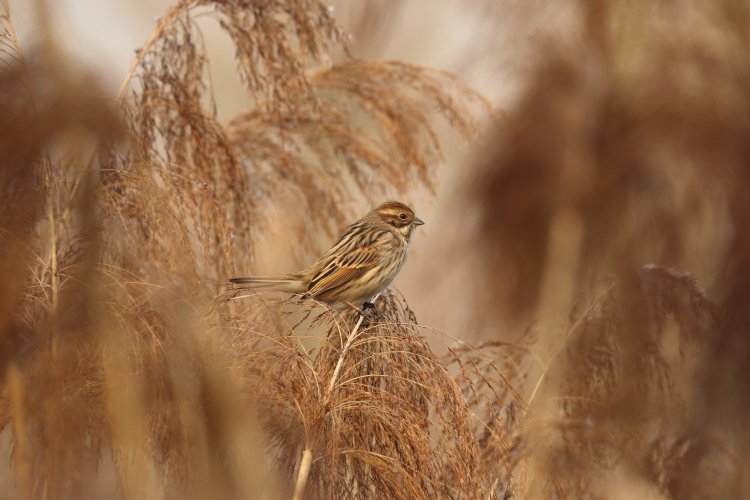
| Some garden plants receive almost no attention until they disappear. They are not the roses somebody remembers planting for an anniversary, nor the enormous hydrangea that dominates a border every summer. They are the quieter plants filling the spaces between everything else, doing nothing particularly spectacular but somehow making the whole garden feel complete. Remove one, and you may not immediately identify what has changed. You stand there thinking that the border looks slightly emptier than it did before. The British countryside has birds like that too, and the Corn Bunting is perhaps one of the best examples. Nobody could reasonably accuse the Corn Bunting (Emberiza calandra) of excessive flamboyance. It is a chunky, heavily streaked brown bird, rather more substantial than a sparrow, without the Yellowhammer’s glorious yellow head or the Skylark’s spectacular aerial performance. Even its song sounds slightly mechanical, traditionally compared with the jangling of a bunch of keys. Yet put a Corn Bunting on a fence post beside a summer field, singing into the warm air while insects move through the grasses beneath it, and suddenly the bird seems exactly where it ought to be. It belongs to that landscape so completely that its very familiarity can make it invisible. That may have been part of the problem. We are naturally drawn towards wildlife that demands our attention. Barn Owls floating over rough grass make us stop. Swallows slicing through the air are hard to ignore. A male Yellowhammer glowing from the top of a hedge practically advertises his presence. The Corn Bunting asks rather less of us. It sits on a wire, post or exposed branch, throws back its head and delivers its peculiar rattling song to anybody who happens to be listening. For generations, enough of them were doing precisely that for people to assume they always would. A Bird Built Around Farmland The Corn Bunting is very much a bird of open agricultural country. Unlike many familiar garden birds, it is not particularly dependent upon trees or dense woodland. It prefers broad, open landscapes containing cereal fields, grassland, field margins and scattered places from which males can sing. The relationship is so close that even its English name ties the bird directly to farming. That relationship involves food throughout the year. Seeds and grain are particularly important outside the breeding season, while insects become vital during summer when chicks need protein. Beetles, caterpillars, grasshoppers, and other invertebrates form part of a food supply that ultimately depends on how the surrounding land is managed. The bird may be the part we notice sitting on a fence, but beneath it lies an entire network of plants, insects, soil and agricultural decisions. This is where apparently simple wildlife stories become complicated. It would be convenient if we could identify one thing that Corn Buntings require, provide plenty of it and consider the problem solved. Nature rarely offers such tidy arrangements. A bird needs somewhere suitable to nest, enough food while breeding, enough food through winter and sufficient habitat connecting all those requirements. Improve one element while another disappears and the overall result may still be poor. Gardening is much the same. We occasionally become fixated on individual solutions: a bird box, an insect hotel, a wildflower seed packet. There is nothing wrong with any of them, but a garden becomes genuinely useful to wildlife when the pieces work together. Flowers support insects, insects support birds, shrubs provide shelter, leaf litter provides overwintering habitat, water supports still more life and the soil beneath everything quietly keeps the whole arrangement functioning. The Corn Bunting demonstrates this principle across fields rather than flower beds. Nesting: Where the Work Happens Like the Skylark, the Corn Bunting nests on or very close to the ground amongst vegetation. This immediately places its breeding life in the same space where agricultural work is taking place. Crops grow, grass is cut, and machinery moves through fields while, somewhere amongst all this activity, a bird may be trying to raise young. This matters because discussions about farmland wildlife can too easily become a simplistic story of farmers on one side and nature on the other. Real landscapes are considerably more complicated. Farmers produce food, run businesses, and respond to weather, markets, regulation, and the practical demands of managing land. Wildlife is trying to use that same land according to rhythms that evolved long before modern agricultural systems existed. Conservation therefore becomes less about choosing one side and more about finding ways in which both can continue to function. Measures such as retaining field margins, providing winter seed resources, managing some areas less intensively and considering the timing of operations can all contribute. None is particularly dramatic. Indeed, much useful conservation is remarkably unspectacular when viewed from a distance. A slightly wider field edge or an area left with seed through winter will never attract the attention given to a newly created nature reserve. Still, to a bird trying to survive February it may be considerably more relevant. The same is true in gardens. We like visible projects because they feel like action. Digging a pond produces a pond. Planting a hedge produces a hedge. Buying a nest box gives us something we can point to and say, “That’s for wildlife.” Leaving stems standing until spring or deciding not to clear every seed head is much less impressive, partly because it looks suspiciously like we haven’t finished the job. Wildlife, fortunately, is not particularly concerned with appearances. The Useful Things We Call Weeds The Corn Bunting’s dependence upon seeds raises another subject close to every gardener’s heart: weeds. Few words in gardening are quite so efficient at turning a perfectly innocent plant into an enemy. Once something has been designated a weed, its fate is usually decided. It is in the wrong place, we don’t want it there, and out it comes. In working gardens, of course, weeds genuinely do need managing. Leave vigorous species unchecked, and they compete with planting, spread through borders and quickly turn a manageable job into something considerably more entertaining. I have no intention of suggesting that bindweed should be welcomed into a herbaceous border in the interests of biodiversity. Even my tolerance has limits. But at landscape scale, the plants we casually group as weeds have enormous ecological value. Many produce seeds that farmland birds eat. Others support insects. Some flower at times when other food sources are scarce. Remove too much botanical diversity from agricultural land and the effects travel upwards through the food chain. This is one of the recurring lessons of gardening: usefulness depends upon context. A thistle in the middle of a formal border may be unwanted; a thistle flowering in a rough field margin can be an insect restaurant. Long grass across an entire small lawn may be impractical; a strip left along one edge can become habitat. Fallen leaves blocking a path need moving; fallen leaves beneath a hedge may be best left exactly where they are. Nature rarely divides the world neatly into useful and useless. We tend to do that for it. When Abundance Slips Away The Corn Bunting has declined sharply in Britain, particularly since the latter part of the twentieth century, and its distribution has contracted considerably. Changes in agricultural practice have played a major role, including reduced availability of seed-rich winter feeding habitat and changes affecting insects and nesting opportunities. The bird still survives in parts of the country, sometimes in locally healthy numbers, but its former abundance belongs to a different agricultural landscape. What interests me about declines like this is how difficult they are to perceive while they are happening. If a species vanished overnight, everyone would notice. Instead, populations usually diminish over decades. A field that once held several singing males holds two. Later there is one. Eventually there are none, but by then the people who remember the earlier abundance may themselves have moved away or grown older. The next generation inherits the quieter field and assumes that is what the countryside has always sounded like. Ecologists sometimes describe this wider problem as a shifting baseline: each generation tends to regard the natural world encountered in its own youth as normal. If butterflies were already less abundant when you were a child, that lower number becomes your point of comparison. If your parents grew up with more birds, their idea of abundance is different again. Over enough generations, enormous ecological change can occur while our definition of “normal” quietly follows it downwards. This is why personal observation matters, even when it is not scientific data. Gardeners spend years returning to the same places. We notice when a hedge flowers differently, when a tree begins struggling, when butterflies appear unusually late or when a bird that was once regularly present stops turning up. None of those observations alone proves very much, but they encourage the habit of paying attention. And paying attention is where conservation begins. Not Every Bird Needs to Be Beautiful The Corn Bunting gently challenges another assumption: that wildlife needs to be spectacular before it deserves our affection. Conservation inevitably uses charismatic species because they attract attention. An owl staring from a poster is likely to generate more interest than a streaky brown bird sitting on a wire. That is understandable. Human beings respond emotionally to beauty, rarity and drama, and there is little point pretending otherwise. But ecosystems are not assembled according to popularity. The ordinary species matter precisely because they are ordinary. They form the texture of a landscape: the birds in the hedges, insects over the grass, plants along the verge and creatures beneath the soil that nobody photographs. When those everyday populations begin thinning out, the countryside may still look green and pleasant from a car window while becoming biologically poorer underneath. Gardens can fool us in the same way. A garden can be beautifully landscaped and almost sterile. Perfect lawns, clipped shrubs and immaculate paving may create an impressive picture while providing surprisingly little food or shelter. Another garden may look slightly rougher around the edges yet be alive with bees, beetles, moths, birds and countless things we never see. The most attractive garden to us is not automatically the most useful garden to everything else. The interesting challenge is finding room for both. The Jangle From the Fence If you encounter a Corn Bunting today, the first thing you notice may still be its song. A male chooses an exposed perch—a fence post, bush or wire—and delivers that peculiar jangling sequence across the surrounding fields. Once somebody has described it as a bunch of keys being shaken, it becomes difficult to hear anything else. It is not particularly melodic. Compared with a Blackbird singing from a rooftop or a Skylark pouring music down from the sky, the Corn Bunting’s contribution can sound almost comically functional. Yet perhaps that is part of its charm. This is not a bird asking to be admired. It is simply occupying its place in the landscape, doing what Corn Buntings have done across British farmland for generations. The extraordinary thing is not that the bird is rare enough to deserve attention now. It is that something once sufficiently common to be overlooked could become much less common while most of us were busy looking elsewhere. In our previous episode, the Yellowhammer drew us towards the hedgerow with a flash of colour. The Corn Bunting asks us to look beyond the hedge into the field itself, especially at those seemingly insignificant margins where cultivated land becomes slightly less controlled. These are not dramatic places. They are strips of grass, seed-bearing plants, rough corners and field edges. Yet entire lives depend upon them. Perhaps there is a useful thought for gardeners in that. We spend a great deal of time deciding what the important parts of a garden are: the main border, the lawn, the specimen tree, the patio. Wildlife frequently reaches a different conclusion. The bottom of the hedge, the compost heap, the long grass behind the shed or the pile of leaves we haven’t quite got around to moving may be far more interesting. The Corn Bunting belongs to those overlooked spaces on a much larger scale. And maybe that is why it deserves to be noticed. Not because it is spectacular. Because it never needed to be. Watching For… Corn Buntings are now much more localised in Britain than they once were, so finding them usually means visiting suitable areas of open farmland where populations remain. Look for a fairly large, chunky, heavily streaked brown bird perched prominently on a fence post, wire, bush or other exposed position. During the breeding season, listening is often easier than looking: the male’s distinctive jangling song carries well across open country and is an excellent clue that a bird is nearby. If you do find one, spend a little time looking at the landscape around it rather than concentrating solely on the bird. Notice the field margins, the rough vegetation, the hedges or scrub, the crops and the places where seed and insects might persist. The Corn Bunting makes much more sense when viewed as part of that whole landscape. Which, when you think about it, is probably how we should look at most wildlife. |
| About our writing & imagery Most articles reflect our real gardening experience and reflection. Some use AI in drafting or research, but never for voice or authority. Featured images may show our photos, original AI-generated visuals, or, where stated, credited images shared by others. All content is shaped and edited by Earthly Comforts, expressing our own views. |

