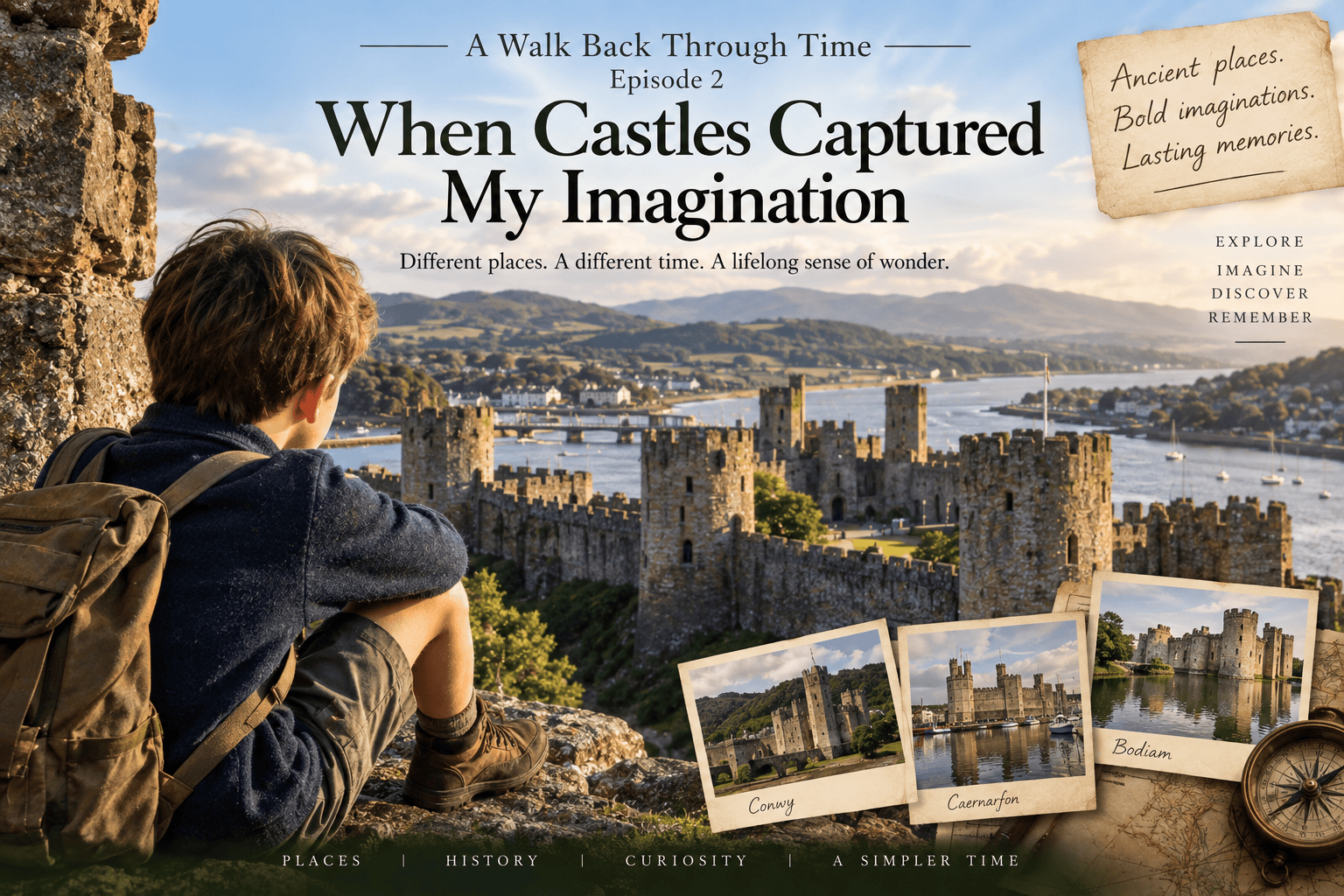
| A Walk Back Through Time Episode 2 |
| At the end of my last walk back through time, I wrote that model villages made me look down into another world, while castles made me look up. However, there was a difference between those two fascinations. My love of miniature worlds never completely disappeared. Castles came into my life suddenly, occupied an enormous amount of my imagination for several years, and then, sometime during my mid-teens, quietly began to loosen their grip. Perhaps the reason lies in where I grew up. I was born in Britain in 1963, but my family emigrated to Australia in 1965. In 1968, my father was stationed in Butterworth, Malaysia, where we lived until 1971, before returning to Australia. We remained there until 1977, when we came back to Britain permanently. So although I was British by birth, medieval Britain wasn’t the landscape of my early childhood. Then, in 1970, we took a three-month break from Malaysia and returned to Britain. It was my first time back since leaving in 1965, and I was about seven. Somewhere during that visit we went to North Wales. And there were castles. Real ones. Until then, the imaginary worlds of my toys had largely belonged to another period. Westerns were enormously popular, and I had forts, cowboys and the usual paraphernalia of the Wild West. North Wales changed the scenery. Suddenly there were immense stone walls, towers, battlements and gatehouses. These weren’t illustrations in a book or scenery in a film. You could walk through them, touch the stone and climb the stairs. I was captivated. I came away wanting castles, knights and everything medieval. Looking back, I wonder whether encountering castles in that way made them more powerful. Had I grown up in Britain surrounded by medieval churches, ruins and ancient buildings, perhaps I would have taken them for granted. Instead, after spending most of my remembered childhood on the other side of the world, I suddenly encountered a country that was visibly, physically old. North Wales was where it began. Conwy and Caernarfon are among the names I remember, along with Chirk. Later came Bamburgh Castle, Edinburgh Castle, the Tower of London, and Bodiam. Tintern Abbey also sits among those memories — not a castle, of course. Still, to a boy fascinated by ruins and the medieval past, it occupied much the same territory in my imagination. When we returned permanently to Britain in 1977, we spent about six months living in North Wales. By then I was fourteen, and seven years had passed since that first encounter. During those years, I had begun reading and learning about military history, so when we revisited several Welsh castles, I looked at them differently. A gatehouse now had a purpose. Arrow loops weren’t simply mysterious openings in walls. Battlements, towers and portcullises were parts of a defensive system. I wanted to understand how somebody attacked one of these places and how the people inside tried to stop them. Military history became a real passion of mine from around twelve until about twenty, ranging far beyond the medieval period, but castles fit perfectly into it. Strangely, it wasn’t necessarily the complete castles that fascinated me most. I preferred ruins. A complete castle tells you a great deal. A ruin asks something of you. You walk into a space and have to imagine the room that once occupied it. A line in the stone marks a vanished floor. A fireplace hangs halfway up a wall because everything around it has disappeared. Doorways lead nowhere, and stairs climb towards rooms that haven’t existed for centuries. By my teens I knew enough to begin rebuilding those missing places in my imagination. Roofs returned above the walls. Empty courtyards filled with horses, soldiers and servants. Fires burned again in fireplaces. A collection of weathered stones became a working place inhabited by real people. Perhaps that was where castles and model villages had something in common for me. Both required imagination to finish the world. I loved all the classic ingredients too: dungeons, sieges, secret passages, legends, ghosts, battlements and the darker stories attached to these places. Spiral staircases disappearing upwards were almost impossible to resist, and if a tower could be climbed, I wanted to climb it. Emerging from a dark stone staircase onto the battlements changed everything. Suddenly you could see the landscape around you and understand why the castle had been built there. The road, river, valley or coastline it controlled became obvious. Military history that seemed abstract on a page suddenly made physical sense. Castles occasionally affected me in another, stranger way. When I was young, I sometimes experienced powerful sensations of familiarity in old places, as though something about them was known to me when logically it couldn’t have been. My mother explained it as déjà vu. Perhaps she was right. I don’t feel any need, all these years later, to find another explanation. I remember those sensations, and they became part of the atmosphere of castles for me alongside the cold stone, echoing rooms, enormous fireplaces, narrow passages and dark corners where imagination could easily get ahead of reality. As I grew older, the fascination changed. The romantic world of knights and castles gradually gave way to wanting to understand how these places actually worked. How were they built? Why was a castle positioned where it was? How did people live inside one? Where did the water and food come from? How effective were the defences? The castle became not simply a dramatic backdrop but a piece of engineering, military technology and social history. Perhaps that was also the beginning of the end of my castle phase. By my mid-teens, the intense fascination was fading. Military history remained an interest for several more years, and my later tabletop wargaming concentrated much more heavily on the Napoleonic period. I didn’t spend my adult life travelling around Britain ticking castles off a list, and no particular castle today compels me to revisit. And I rather like that truth. Not every passion has to last forever to have mattered. For several important years of my childhood, castles gave me history, imagination, exploration, architecture, warfare, mystery and adventure all at once. More importantly, they arrived at exactly the right moment. A seven-year-old boy came back to the country where he had been born but barely remembered, having grown up in Australia and Malaysia. He discovered enormous stone fortresses standing in the landscape. The cowboy forts suddenly had competition. The knights won. Eventually I grew older, my interests moved elsewhere, and castles became places I could appreciate without needing to disappear into them. But somewhere behind everything I subsequently learned remains the memory of being seven years old in North Wales, looking upwards at walls and towers belonging to a world I had never encountered before. For a while, I wanted to know everything about that world. Perhaps that is what these walks back through time are beginning to show me. Our passions don’t necessarily arrive according to some grand plan. One catches our attention, leads us somewhere else and then quietly hands us on to the next fascination. Model villages made me look down. Castles made me look up. And eventually, something else made me look much further away. But that is another walk back through time. |
| About our writing & imagery Most articles reflect our real gardening experience and reflection. Some use AI in drafting or research, but never for voice or authority. Featured images may show our photos, original AI-generated visuals, or, where stated, images credited to others. All content is shaped and edited by Earthly Comforts, expressing our own views. |

