| Epimedium Gardening’s Quiet Investment |
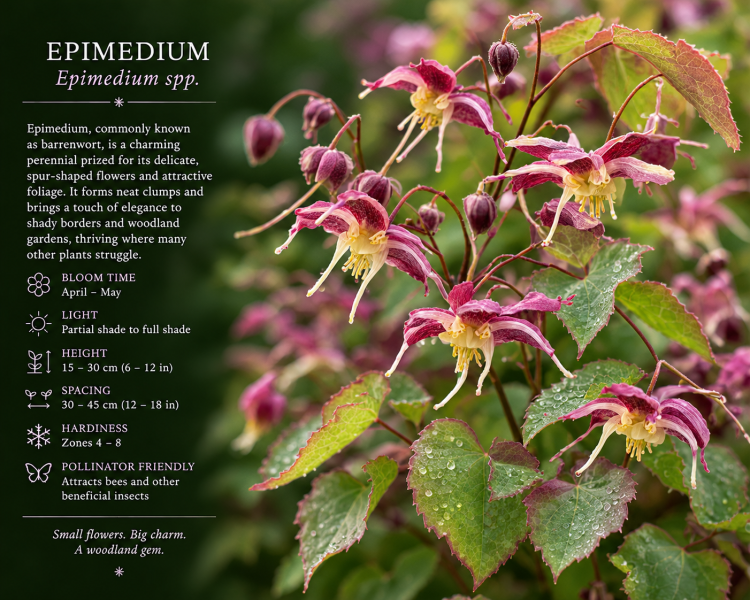
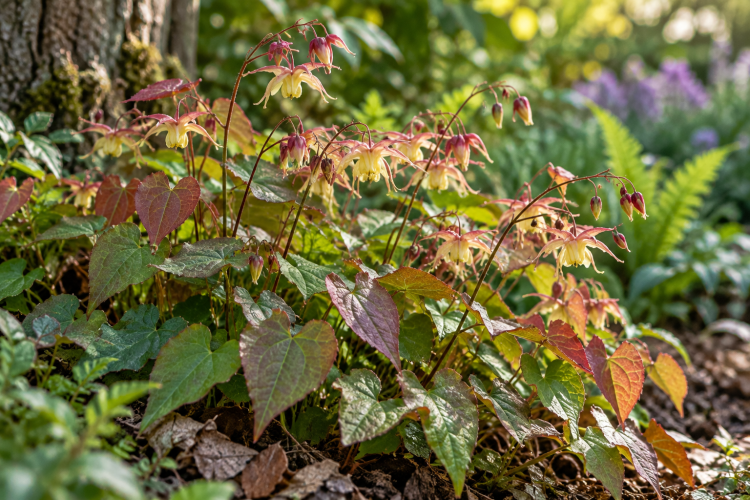
| There is something faintly disappointing about planting a new perennial and discovering that it has absolutely no intention of doing very much. You’ve prepared the soil, watered it in, stood back to admire your work and perhaps imagined how that particular corner of the garden will look in a couple of years. Then spring arrives, followed by summer, and the plant appears to have made very little progress. It hasn’t died, which is encouraging, but it hasn’t shown much enthusiasm for justifying the money spent on it. Epimedium can be rather like that. Known commonly as barrenwort or bishop’s hat, it is one of those woodland perennials that seldom attracts much attention in a garden centre. The flowers are small, sometimes almost impossibly delicate, and the foliage doesn’t necessarily suggest anything particularly remarkable when you’re looking at a young plant in a pot. There are no enormous blooms promising instant colour, no dramatic growth habit and certainly nothing suggesting that it intends to transform an awkward patch of ground before the weekend. Yet given time, Epimedium can become one of the most satisfying plants in a garden. Its greatest strength lies in its ability to occupy places where other plants struggle. Beneath deciduous shrubs, along shaded borders, and even under established trees, certain species and hybrids will gradually form attractive carpets of foliage. Some tolerate dry shade particularly well once established, although this shouldn’t be mistaken for an ability to survive without water while their roots are developing. Dry shade is difficult gardening territory, and even the toughest plants appreciate a little assistance while settling in. What makes Epimedium particularly interesting is how much it offers without relying upon extravagant flowers. The leaves are often heart-shaped or pointed, sometimes emerging with bronze, copper or reddish markings before settling into green. Some varieties remain evergreen, while others lose their foliage during winter. In spring, delicate flowers appear on slender stems, often hovering just above or amongst the new leaves. Look closely, and their shapes are extraordinary, with some resembling tiny spiders, miniature stars or elaborate little hats. You do have to look closely, though. That is part of the pleasure. We tend to expect spring flowers to announce themselves, particularly after several months of grey skies and wet ground. Daffodils make themselves impossible to ignore, tulips stand proudly above their neighbours, and flowering cherries appear determined to decorate entire streets. Epimedium takes a different approach. Its flowers can be so discreet that you might miss them entirely unless you happen to be working nearby, which seems a rather poor marketing strategy but a perfectly reasonable way for a woodland plant to behave. It also teaches a practical lesson: know when to leave it alone. Established evergreen clumps often benefit from having their old foliage removed in late winter, before the new flower stems emerge. This lets you appreciate the flowers and makes room for fresh growth. Leave the job too late, and you risk cutting off the very flowers you’ve been waiting to see. It is one of those gardening tasks where timing matters more than enthusiasm. The temptation, particularly with a newly planted Epimedium, is to expect immediate results. We have become accustomed to buying plants that provide immediate impact, filling borders with mature specimens and treating empty soil as something that needs correcting urgently. Yet some of the most rewarding garden plants refuse to work to our timetable. Their priority is establishing roots, adapting to their surroundings and gradually building the strength needed to spread. I sometimes think we underestimate the value of plants that take their time. A well-established clump of Epimedium can suppress weeds, protect the soil surface and provide dependable foliage for years with relatively little interference. It won’t necessarily spread quickly, and different varieties behave differently, but that gradual expansion is part of its appeal. Rather than racing across a border and demanding constant attention, it quietly claims its space, becoming more useful with each passing season. Something is reassuring about that kind of progress. Not every improvement in a garden needs to be immediately visible, and not every successful planting has to produce a spectacular photograph during its first summer. Sometimes the best decisions are the ones that only become apparent several years later, when you realise a once-troublesome patch beneath a shrub has become an attractive, settled piece of planting that rarely asks anything of you. Of course, patience has its limits. A plant that is genuinely struggling needs help, and there is little virtue in watching something deteriorate simply because you’ve decided to be philosophical about it. But learning to distinguish between slow establishment and genuine failure is an important part of gardening. Epimedium is particularly good at teaching that distinction. Perhaps that is why I find it such an appealing plant. It doesn’t promise instant gratification, and it certainly won’t transform a neglected corner overnight. Instead, it offers something more valuable: the possibility that a modest decision made today will quietly improve a garden for many years to come. And there is a particular satisfaction in returning to a garden several seasons later, looking beneath an established shrub and finding that the little plant you once wondered about has finally made itself at home. Not everything worthwhile happens quickly. |
| About our writing & imagery Most articles reflect our real gardening experience and reflection. Some use AI in drafting or research, but never for voice or authority. Featured images may show our photos, original AI-generated visuals, or, where stated, credited images shared by others. All content is shaped and edited by Earthly Comforts, expressing our own views. |

