| Episode 1 The Giants Have Returned! |
| Author’s Note The Other Side of the Flowerbed is an original work of humorous fiction. All characters, personalities, dialogue and events are fictional. Any similarity in character names to those appearing in existing literary works or other fictional creations is coincidental and does not imply any connection with, or endorsement by, their respective creators or rights holders. |
| Story inspired by Sonel of The Creative Soul |
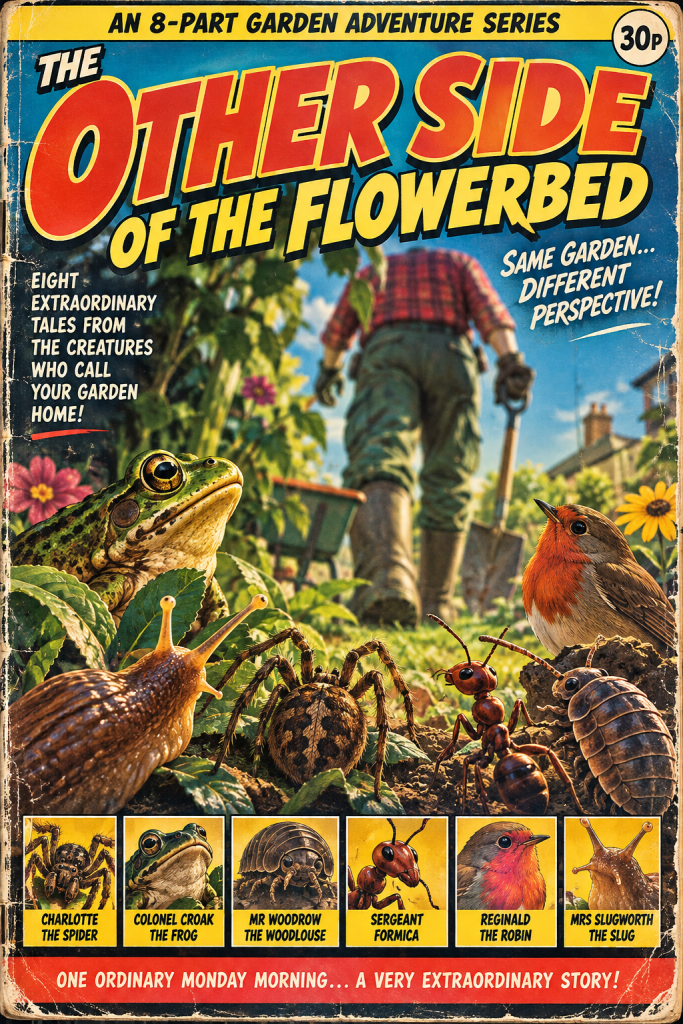
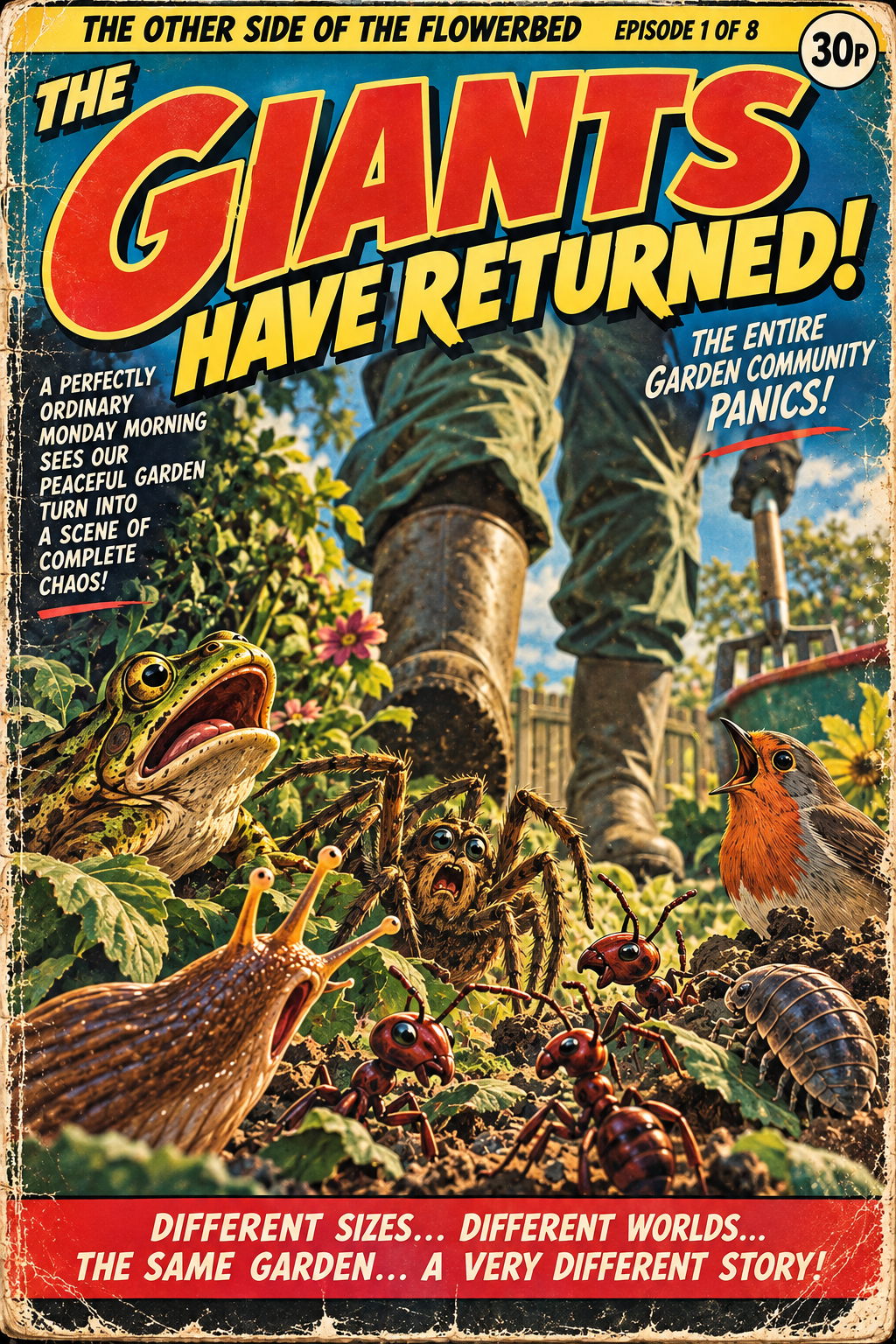
| One ordinary Monday morning. One perfectly respectable garden. Six unsuspecting residents. And three hours of impending chaos. Few places are as peaceful as a garden before a gardener arrives. To the casual observer, it might look like little more than an arrangement of shrubs, flowering plants, patches of lawn, and the occasional terracotta pot. A pleasant enough place, certainly, but hardly somewhere one might expect to find political disagreements, housing disputes, military preparations, territorial ambitions and a thriving underground transport network. Yet beneath the garden’s apparently tranquil surface lay a remarkably complicated society, populated by creatures whose daily concerns mattered as much to them as those of the enormous two-legged beings who occasionally wandered through their world. The garden itself was neither especially large nor particularly unusual. A narrow lawn stretched between two generously planted borders, an old apple tree provided shade towards the rear, and a collection of weathered flowerpots stood beside a small wooden shed. Hostas, hardy geraniums, lavender, several untidy shrubs, and a compost heap had become something of a residential district in its own right. The soil was rich, the vegetation offered abundant shelter, and years of accumulated leaf litter had created a comfortable environment for countless inhabitants who preferred their accommodation slightly damp and their neighbours reasonably edible. For most of these residents, life followed an established routine. They had territories to defend, meals to find, shelters to maintain, and the occasional unpleasant encounter with something with a larger mouth. Disagreements were common, particularly concerning ownership of the more desirable damp corners, but outright conflict was generally avoided unless somebody happened to be hungry. It was a functioning community, although few of its members would have described it as particularly well organised. On this particular morning, the garden was enjoying a period of unusual calm. Charlotte, a mature garden spider of considerable architectural ambition, was inspecting the eastern supports of her latest construction. Suspended between two shrubs, her web represented three nights of painstaking labour and an investment of silk that she considered entirely justified by its excellent position along a busy aerial route. Charlotte was a perfectionist, and although she had no formal qualifications in structural engineering, she regarded herself as considerably more competent than most creatures who attempted to build anything. Her principal irritation was the complete absence of respect shown by passing insects, particularly moths, whose inability to navigate around perfectly visible obstacles she considered evidence of a serious educational failure. One particularly large specimen had blundered through the western section the night before, leaving Charlotte with several hours of unnecessary repairs. “Honestly,” she muttered, examining a slightly uneven strand, “you spend half your life building something beautiful, and the first idiot with wings treats it like a public footpath.” She adjusted a supporting thread, tested the tension with one delicate leg and settled back to admire the results. It was, she decided, a magnificent achievement. With luck, it would remain undisturbed for several days, perhaps even a week. Charlotte was not, as events would shortly demonstrate, particularly fortunate. Some distance below her, beneath the broad overlapping leaves of a hosta, Colonel Croak was conducting his customary morning reconnaissance. The Colonel was an elderly frog with a mottled complexion, a permanently disapproving expression and an almost supernatural ability to detect trouble where none appeared to exist. He had survived several seasons in the garden, an achievement he attributed entirely to vigilance, tactical intelligence and a refusal to trust anything taller than himself. His military career was largely self-appointed, although he maintained that several encounters with lawnmowers, garden forks and an especially aggressive blackbird constituted more than sufficient combat experience. He regarded the garden as a network of defensive positions connected by dangerous open ground, and he had spent considerable time identifying escape routes between the hostas, the compost heap and a shallow pond near the rear fence. “Ground conditions satisfactory,” he murmured, surveying the damp earth before him. “Visibility acceptable. Western approach clear. No immediate signs of hostile activity.” A blackbird landed on the lawn, cocked its head and began searching for worms. The Colonel narrowed his eyes. “Bloody aerial reconnaissance. They’re getting bolder.” He withdrew slightly beneath his leaf and continued watching. In his opinion, peace was merely the period when the enemy decided what to do next. Not far away, beneath a substantial terracotta flowerpot, Mr Woodrow was presiding over a meeting of the Under-Pot Residents’ Association. Mr Woodrow was a woodlouse of impeccable administrative habits who believed civilisation depended on three essential principles: adequate moisture, secure accommodation, and properly conducted committee meetings. He had appointed himself chairman several seasons earlier, largely because nobody else had understood what a chairman was or why one might be necessary. The morning’s agenda concerned a small damp patch near the northern entrance. Several residents had suggested that dampness was rather the point of living beneath a flowerpot, but Mr Woodrow insisted that all environmental matters required proper consideration. “We cannot simply allow conditions to develop without oversight,” he explained to the assembled woodlice, several of whom were already attempting to leave. “But we like the damp,” replied a younger resident. “That is not the issue.” “Isn’t it?” “The issue,” Mr Woodrow continued patiently, “is whether the dampness is being distributed fairly throughout the property.” An elderly woodlouse near the rear observed that she had lived beneath the same pot for most of her life and had never previously encountered a moisture-distribution policy. Mr Woodrow made a mental note to establish a subcommittee. Meanwhile, beneath the lawn’s southern edge, Sergeant Formica was experiencing difficulties of an entirely different nature. The ant colony had established a remarkably efficient network of transport routes linking its underground headquarters with several promising food sources, and the Sergeant considered himself personally responsible for maintaining discipline throughout the workforce. Hundreds of ants were already moving along the main pathways, carrying fragments of vegetation, investigating unfamiliar scents, and exchanging information through the chemical signals their civilisation depended on. To an outsider, the activity might have appeared chaotic. To Sergeant Formica, it was a triumph of collective organisation, provided nobody examined Private Derek’s activities too closely. “Derek!” the Sergeant shouted, intercepting a worker carrying a piece of dried leaf in entirely the wrong direction. “Where, precisely, do you think you’re going?” “Back to headquarters, Sergeant.” “Headquarters is behind you.” “Is it?” “YES!” Derek paused, considered the situation and turned around. “Right you are, Sergeant. Thought the scenery looked familiar.” Sergeant Formica watched him depart with an expression of profound disappointment. He sometimes wondered whether the colony’s remarkable achievements came from its workers or despite them. Above this complicated little world, Reginald the robin sat comfortably upon a fence post, surveying the garden with the cheerful confidence of a creature who considered most of its inhabitants potential breakfast. Reginald was not especially interested in politics, engineering, military preparedness or the distribution of moisture beneath flowerpots. He preferred the simpler pleasures of life, particularly worms, small insects and the opportunity to sing loudly from prominent positions. He was also unusually tolerant of humans. Indeed, Reginald regarded the enormous two-legged creatures as rather useful members of the local ecosystem. They had an extraordinary habit of disturbing soil, exposing worms and occasionally leaving freshly turned earth unattended. Their methods were clumsy, certainly, and their appearance left much to be desired, but Reginald had long ago concluded that one should never criticise a creature capable of such excellent catering. Beneath another hosta, Mrs Slugworth was still asleep. She had enjoyed a particularly satisfying night, having consumed a generous portion of a young hosta leaf, investigated several promising seedlings and left an extensive silver trail across a nearby paving slab. Mrs Slugworth possessed a formidable appetite and an equally formidable sense of entitlement. She considered the garden a vast, privately maintained dining establishment whose owners had inexplicably failed to provide menus. Her favourite hosta was especially convenient, offering both excellent accommodation and an abundant food supply. She had never understood why certain creatures insisted upon travelling considerable distances in search of meals when perfectly acceptable vegetation was available immediately above their heads. In short, it was a perfectly ordinary morning. Then something changed. The first indication was a faint vibration travelling through the soil. It was barely noticeable at first, a distant trembling that passed beneath the roots and stones before disappearing into the surrounding earth. Most residents ignored it. Gardens were full of unexplained disturbances, and experience suggested that reacting to every minor vibration was an excellent way to accomplish absolutely nothing. Colonel Croak, however, became immediately alert. He raised his head, remained perfectly still and waited. A second vibration followed, stronger than the first. Somewhere beyond the garden boundary came a low mechanical rumbling, accompanied by a brief metallic rattle. The Colonel’s eyes widened. “Oh, no.” Above him, Charlotte paused mid-reinforcement on a supporting strand. She had felt the vibration through the shrub, and although she could not identify its source, she recognised the unpleasant sensation of something large moving nearby. “Not again,” she muttered. The rumbling grew louder. It was followed by the unmistakable sound of a vehicle coming to rest, a heavy door closing and something metallic being moved. Across the garden, an extraordinary transformation began. Sergeant Formica halted the morning transport operation and ordered an immediate assessment of the disturbance. Several workers reported unusual vibrations along the southern perimeter, while another claimed to have detected a gigantic underground predator. Derek suggested that the entire colony might be experiencing indigestion, an observation that did little to improve his standing within the organisation. Beneath the flowerpot, Mr Woodrow suspended proceedings and called for an emergency discussion concerning structural stability. The meeting quickly deteriorated when someone suggested the roof might be about to move. Mr Woodrow insisted that such an event was impossible without prior consultation. However, his confidence was undermined by the fact that nobody had ever consulted him about anything outside his own imagination. Colonel Croak emerged cautiously from beneath the hosta and looked towards the garden gate. He knew that sound. He knew it very well indeed. “The Giants,” he whispered. A passing beetle stopped. “What giants?” “The two-legged ones. The destroyers of cover. The movers of mountains. The wielders of the screaming machines.” The beetle considered this information. “Oh. Them.” “Precisely.” “Should I be worried?” The Colonel stared at him. “Only if you wish to remain alive.” The beetle hurried away, immediately informing a passing woodlouse that an enormous predator had arrived and was apparently intending to eat the entire garden. By the time this information reached the ant colony, the rumour had grown into a report that six giants were approaching to excavate the lawn and relocate the compost heap to another county. Reginald, meanwhile, had recognised the familiar sequence of noises and was becoming increasingly enthusiastic. “Oh, splendid!” he announced from his fence post. “They’re here!” Colonel Croak turned towards him, disbelief on his face. “Splendid? Have you completely lost your senses?” Reginald merely fluttered his wings. “Lovely morning for it. Ground’s a bit damp, too. Should be excellent.” “Excellent for WHAT?” “Worms, obviously.” The Colonel closed his eyes. There were moments when he seriously questioned the evolutionary wisdom of allowing birds to develop opinions. Then the garden gate opened. From the perspective of the smaller inhabitants, the figure that entered was an almost incomprehensible creature. It towered above the surrounding vegetation, supported by two enormous legs encased in muddy boots, and carried an assortment of implements whose purposes appeared uniformly threatening. Its upper body was covered in red-checked material, and its movements carried the casual, careless confidence of something entirely unaware that hundreds of lives might be affected by a single misplaced foot. The Giant paused just inside the gate and surveyed the garden. To him, it was simply another maintenance visit. Borders needed weeding, a few shrubs needed tidying, some pots needed moving, and several patches of soil needed attention. Three hours of straightforward gardening lay ahead, and he was already considering which task made the most sense to tackle first. To the residents, however, his arrival represented an event of potentially historic proportions. Charlotte watched from her web, horrified by the enormous figure standing dangerously close to her eastern supports. She had survived storms, heavy rain, careless moths and several encounters with birds, but the Giants were something else entirely. They moved without warning, interfered with perfectly respectable vegetation and displayed an astonishing disregard for private property. “Look at him,” she muttered. “Not even a moment’s consideration for the existing architecture.” Beneath the flowerpot, Mr Woodrow’s emergency meeting had descended into confusion. Several residents were attempting to evacuate, others were demanding reassurance, and one elderly woodlouse had begun complaining that conditions had been considerably more stable before the introduction of modern gardening practices. “Order!” shouted Mr Woodrow. “ORDER! We must not allow ourselves to descend into panic!” At that precise moment, a heavy boot landed nearby, sending a tremor through the soil. The entire association scattered. Sergeant Formica, meanwhile, had ordered all available workers to remain at their posts, an instruction complicated by the fact that several hundred ants had already abandoned theirs. He was attempting to restore discipline when Derek arrived carrying the same fragment of leaf. “Sergeant! There’s a giant!” “I AM AWARE OF THAT, DEREK!” “Should I put this down?” “YES!” “Where?” “ANYWHERE!” Derek carefully placed the leaf on the ground, stepped backwards and immediately tripped over it. Colonel Croak observed the unfolding situation from beneath his hosta with the grim satisfaction of someone whose worst predictions were being vindicated yet again. Every seven days, with an almost infuriating regularity, the Giant returned to interfere with the garden’s natural order, and every seven days the Colonel warned his fellow inhabitants of the dangers that lay ahead. He had spent countless mornings studying the creature’s movements, cataloguing its weapons and advocating the establishment of a properly organised defensive network. Yet despite the repeated disturbances, nobody seemed particularly interested in his recommendations. Some had even suggested that the Giant’s visits were simply an unavoidable part of garden life, an attitude the Colonel considered dangerously complacent. Now, as the enormous creature began unloading its equipment beside the flowerbed, he felt an almost irresistible urge to remind everyone that he had, once again, warned them precisely what would happen. Instead, he adopted a suitably commanding tone. “All residents remain under cover. Avoid open ground. Do not approach the Giant under any circumstances. And somebody tell that blasted robin to stop singing!” Reginald, already in a shrub overlooking the gardener’s equipment, was thoroughly enjoying himself. The Giant placed a green waste container beside the border, collected a garden fork and looked towards the lawn. Reginald recognised the implement immediately. He had witnessed its remarkable ability to expose buried delicacies on numerous previous occasions and considered it one of humanity’s more impressive inventions. “Morning!” he chirped brightly. The Giant glanced towards him. “Morning, little fella.” Reginald puffed out his chest, enormously pleased with the exchange. Colonel Croak, observing from a safe distance, regarded the conversation as an act of collaboration with the enemy. “He’s carrying a fork, you feathered imbecile,” the Colonel hissed. Reginald tilted his head and examined the implement with professional interest. “Yes,” he replied cheerfully. “That’s how he gets the worms out.” The Colonel could think of no suitable response. Mrs Slugworth, finally awakened by the growing disturbance, emerged from beneath her hosta leaf and surveyed the scene with profound irritation. She had been enjoying a perfectly satisfactory rest after an excellent night’s feeding, and she resented being disturbed by creatures who apparently understood nothing of the importance of uninterrupted digestion. “What,” she demanded, “is all this dreadful commotion?” “The Giants have returned,” whispered a passing woodlouse. Mrs Slugworth considered this information for several moments. “Have they?” “Yes!” “How tiresome.” She extended her eye stalks towards the enormous figure standing near the border, then glanced at the hosta leaf above her. “Well, they can do whatever they like, provided they leave my breakfast alone.” Unfortunately, the Giant had already noticed that several hosta leaves were looking rather ragged. He crouched beside the plant, examined the damage and shook his head. “Slugs again,” he murmured. Mrs Slugworth froze. Few experiences are quite so unsettling as hearing one’s entire species discussed in a tone of mild disapproval by a creature approximately a thousand times one’s size. She had no idea what the Giant had said, of course, but his expression suggested that he was not particularly impressed by her gardening contributions. “Rude,” she muttered, withdrawing beneath the leaf. By now the garden had entered a state of general alarm. Messages passed between shrubs, rumours spread beneath the leaf litter, and creatures who had spent the days ignoring one another suddenly shared an interest in the possibility of imminent destruction. The ants were reorganising their supply routes, the woodlice were debating emergency accommodation, Charlotte was inspecting her web for potential evacuation points, and Colonel Croak had begun drawing up a defensive strategy involving the pond, the compost heap and several routes that existed only in his imagination. Above them all, Reginald continued singing. The Giant, entirely unaware of the political and social crisis unfolding around his boots, stood for a moment considering the work ahead. He had three hours available and a reasonable amount to accomplish. The borders needed attention, a few overgrown plants needed cutting back, and several flowerpots had to be shifted to access the soil beneath them. He looked towards the shrubs supporting Charlotte’s web, then across to the hostas sheltering Colonel Croak and Mrs Slugworth. His gaze passed over the terracotta pot beneath which Mr Woodrow’s association was attempting to restore order. Finally, it settled upon the lawn where Sergeant Formica’s transport network was already suffering considerable disruption. “Right then,” he said pleasantly. “Let’s get this lot sorted.” The words meant nothing to the garden’s inhabitants. Still, the tone, accompanied by the movement of an enormous boot and the lifting of a pair of secateurs, was sufficiently ominous to require no translation. Charlotte tightened her grip upon the central strands of her web. Mr Woodrow abandoned all attempts to establish a quorum. Sergeant Formica ordered an immediate state of emergency. Mrs Slugworth retreated beneath the deepest part of her hosta. Colonel Croak slowly lowered himself into his defensive position and surveyed the approaching Giant with weary resignation. “I knew it,” he murmured. “The offensive has begun.” And somewhere above the gathering panic, Reginald gave a particularly cheerful burst of song. Because while the rest of the garden prepared for what might prove to be the most catastrophic morning in living memory, he had noticed something rather wonderful. The Giant had brought a spade. And breakfast, Reginald felt certain, was about to be served. |
| About our writing & imagery Most articles are grounded in our real gardening experience, observations and reflections. AI may assist with research, drafting and editing, but the experiences, opinions and editorial direction are our own. Featured images may include our photography, original AI-generated visuals or, where stated, images credited to others. All published content is reviewed and shaped by Earthly Comforts before publication. |
| To be continued in Episode 2 — Charlotte’s Property Dispute! |