| A 5-Part Series |
| A curated exploration of North America’s most iconic, curious, and ecologically important insects |
| Part Five Mantids, True Bugs & Predators: Precision in Motion |
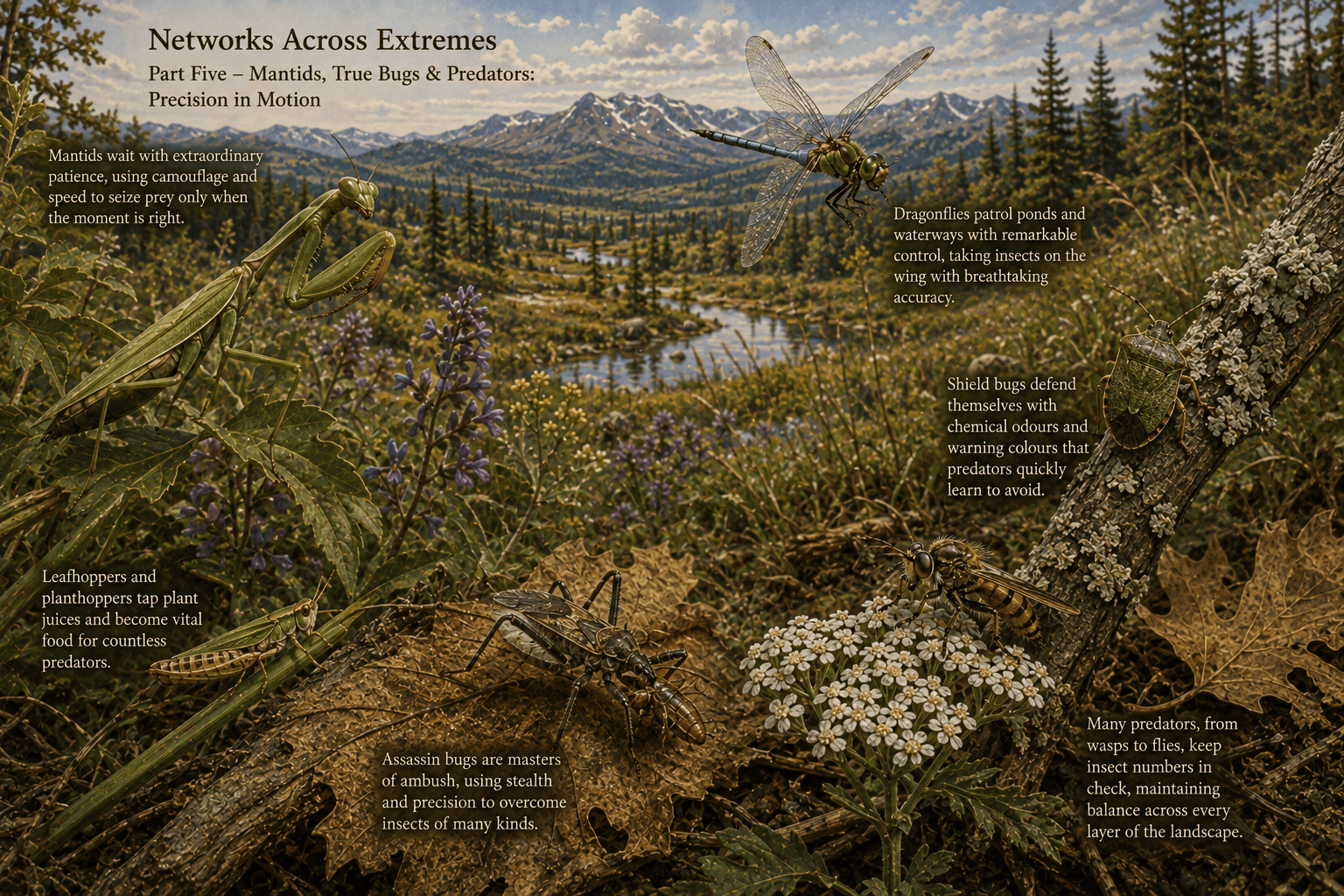
| Predation in the insect world is easily imagined as a matter of speed and aggression. There are certainly insects that pursue prey rapidly, but some of North America’s most effective hunters take a rather different approach. They wait, watch, disguise themselves or rely upon brief moments of extraordinary accuracy. Their success comes not from constantly chasing food, but from knowing when movement is worth the effort. Alongside them are insects that have developed equally sophisticated ways of avoiding becoming somebody else’s meal. Shield bugs use chemical deterrents, while leafhoppers and planthoppers rely upon sudden movement and sheer abundance. Around ponds and rivers, dragonflies take the opposite approach, pursuing prey through the air with remarkable control. These relationships create a continuous exchange between hunter and hunted, with every successful predator pressuring its prey and every successful defence forcing predators to adapt in return. For gardeners, much of this happens within surprisingly small spaces. A mantis can remain unnoticed among foliage, leafhoppers may occupy stems only inches away, and a dragonfly can turn a modest garden pond into hunting territory. What looks peaceful from a few metres away is actually filled with movement, avoidance and opportunity. Mantids and the usefulness of doing nothing Praying mantids are among the most recognisable insect predators. Their triangular heads, large eyes, and folded front legs create a distinctive appearance that seems almost designed to resemble hunters. Yet much of their success depends upon doing very little. A mantis may remain motionless among stems and foliage until another insect comes within reach, its camouflage reducing the chance of detection before its specialised front legs seize the prey with remarkable speed. This is an economical form of hunting. Pursuit consumes energy and exposes a predator to its own dangers, whereas waiting lets the mantis conserve resources while potential prey does most of the travelling. There is a temptation to describe mantids as beneficial garden insects because they eat other insects, but that is a little too convenient. A mantis does not distinguish between a caterpillar we dislike and a bee or butterfly we value. It takes suitable prey when the opportunity presents itself. That does not make the mantis harmful either; it simply makes it a predator. This is one of the recurring difficulties with dividing garden wildlife into friends and enemies. Nature rarely respects those categories, and the ecological value of predation lies in relationships between populations rather than whether every individual hunting decision suits the gardener. Shield bugs and defence without escape. Shield bugs solve the problem of survival in different ways. Their broad, distinctive bodies are familiar in gardens, woodlands and grasslands, where different species feed on plant sap, seeds or other insects. Rather than depending entirely on speed, many have chemical defences that produce a powerful, unpleasant odour when disturbed; hence the familiar name “stink bug” applied to some members of the group. The defence works partly through experience. A predator encountering an unpleasant-tasting or foul-smelling insect may become less willing to attack something similar in future, and distinctive colours can reinforce the message. Avoiding attack altogether is generally cheaper than surviving one, and chemical deterrence lets a relatively slow insect make itself an unattractive meal without a prolonged struggle. It is worth resisting another easy generalisation here. Not every shield bug occupies the same ecological role. Some feed on plants and can become troublesome when present in large numbers, while others are predators themselves. The broad label tells us considerably less than we might imagine. As with so many insects, species, numbers and circumstances matter more than reputation. Leafhoppers, planthoppers and small connections Leafhoppers and planthoppers are far less imposing. Many are tiny enough to go unnoticed unless a plant is examined closely, although touching the vegetation may reveal them as they suddenly spring away. Their ability to jump provides an immediate escape from predators, but their ecological importance extends well beyond that moment of disappearance. These insects feed primarily upon plant fluids, taking energy produced by vegetation and making it available to spiders, birds, assassin bugs and numerous other predators. They are small links within a much larger food chain. Some species can weaken plants or transmit plant diseases, particularly where populations become unusually large, and this can be a genuine concern in agriculture and occasionally in gardens. Yet removing them entirely would also deprive the organisms that depend on them of food. This sounds perfectly reasonable until the prey feeds on a plant we value. Then our ecological tolerance can become rather less philosophical. The useful question is not simply whether an insect is present, but whether its numbers are actually causing meaningful harm. A few leafhoppers in a healthy garden may represent little more than another layer of biodiversity; a severe infestation that affects plant health is quite different. Observation should come before judgement. Dragonflies: precision above the water If mantids represent stillness, dragonflies represent movement. Few insects appear more completely adapted to aerial hunting. Their four wings can operate with considerable independence, allowing rapid acceleration, hovering and abrupt changes of direction, while their enormous compound eyes help them track moving prey. Mosquitoes, midges, flies and other airborne insects can be intercepted with a degree of precision that makes the hunt appear almost effortless. The adult dragonfly, however, is only half the story. Much of its life is spent underwater as an aquatic nymph, already a predator long before it takes to the air. This makes dragonflies particularly interesting from a gardener’s perspective because a wildlife pond is not merely somewhere adults visit. Given suitable conditions, it can support an entire stage of their lifecycle. Aquatic vegetation provides structure, while water quality and the wider pond community influence which species can establish. We sometimes assume that dragonflies belong to lakes, rivers and wilderness, yet some species readily use relatively modest garden ponds. Creating even a small area of freshwater can therefore add an entirely new ecological dimension to a garden. Water attracts life remarkably quickly, and dragonflies are among the more spectacular demonstrations of how rapidly wildlife can discover a new opportunity. Assassin bugs and the art of ambush Assassin bugs possess one of the more dramatic names in entomology, although their hunting methods are often surprisingly restrained. Many rely upon stealth, approaching prey slowly or remaining still until another insect moves within range. Their piercing mouthparts are then used to subdue and feed upon the victim, making accuracy more important than prolonged pursuit. They prey on a wide variety of insects and can help regulate populations in gardens and agricultural landscapes. Describing them simply as biological pest control, however, risks making the same mistake we make with mantids. Assassin bugs hunt for themselves, not for us, and their importance lies in being one component of a much broader predator community. Wasps search through foliage, ground beetles patrol below, dragonflies hunt above, and assassin bugs operate at closer quarters among leaves and stems. No single predator maintains balance. The combination of many species applying pressure in different places and at different times makes the system resilient. Predators need habitat too. We often talk about supporting pollinators by providing flowers, but predators need habitat just as much. Mantids require vegetation in which they can conceal themselves, assassin bugs hunt among leaves and stems, and dragonflies need freshwater during their development. Other predators depend upon bark, stones, dead stems, leaf litter and undisturbed ground for shelter and overwintering. None of this requires turning a garden into wilderness. Dense planting in part of a border, some stems left standing through winter, a small pond, or a little deadwood beneath shrubs can provide considerable habitat without overwhelming the design. One of the more useful lessons from wildlife gardening is that habitat need not dominate a garden to function. It simply has to exist. Chemical use deserves similar consideration. Broad-spectrum insecticides rarely distinguish between the insect causing damage and the predator that might eventually help control it. Removing both can provide an immediate solution while weakening the relationships responsible for longer-term regulation. There are certainly occasions when intervention is justified, but ecological gardening is not about refusing to act. It is about acting proportionately and recognising what else may be affected. Precision rather than power North America’s predatory insects demonstrate how many solutions can evolve around the simple problem of obtaining food without becoming food yourself. Mantids disappear into vegetation and wait. Shield bugs discourage attack chemically. Leafhoppers and planthoppers transfer energy from plants into food webs while relying upon sudden escape. Dragonflies dominate the air through extraordinary flight control, while assassin bugs bring patience and accuracy to hunting at close range. None needs absolute dominance. Each occupies a particular place within the system, and that is one of the strongest ideas running through this entire North American series. Insects rarely succeed by controlling everything around them. They succeed by fitting into opportunities created by climate, plants, soil, water and other organisms. Ants work beneath the ground. Bees connect flowers. Butterflies and moths follow seasons across enormous distances. Beetles dismantle what has died. Grasshoppers respond to abundance, flies recycle it, and predators follow the emerging populations. The system is neither neat nor particularly peaceful, but it is connected. For a gardener, recognising that complexity is useful. We do not need to manage every interaction occurring within a garden, nor could we. Much of the work happens without our involvement. Sometimes the most valuable thing we can do is provide enough variety for those relationships to continue: water, shelter, flowers across the seasons, reasonably undisturbed soil and places where insects can hunt, hide, reproduce and overwinter. Then we watch. Whether it is the sudden strike of a mantis, a dragonfly turning above a pond, or a tiny leafhopper vanishing from a stem, precision happens around us constantly. We have to notice it. |
| About our writing & imagery Most articles reflect our real gardening experience and reflection. Some use AI in drafting or research, but never for voice or authority. Featured images may show our photos, original AI-generated visuals, or, where stated, images credited to others. All content is shaped and edited by Earthly Comforts, expressing our own views. |


I absolutely love the way you look at the little world around us Rory! ❤️🌿 I’ve always believed that there are no bad bugs in nature. Every little creature has its place, even those whose behaviour we might find difficult to watch. I must admit, though, that the thought of an assassin bug laying its eggs in one of my beloved spiders makes me want to look away! 😅 But that’s nature, and who am I to argue with Mother Earth? But I do agree with you on the fact that predators need habitat as well.
I’m especially fond of mantids and their adorable little alien faces. 🤗 Those curious eyes get me every time! Shield bugs in all their beautiful colours, tiny leafhoppers, and those majestic dragonflies that always remind me of fairies — there’s so much to discover when we take the time to look closely.
What I appreciate most about your writing is that you don’t simply show us what’s living in your garden; you help us understand and appreciate it. Your love for gardening and your concern for conservation shine through, and I wish more people would learn to observe before judging or reaching for pesticides. These little creatures aren’t intruders in our gardens. They’re part of the wonderful world we’re fortunate enough to share.
Thank you for opening our eyes to your little corner of the natural world my dear blog friend. I always come away from your posts having learnt something new and appreciating these tiny wonders even more. ❤️🕷️🪲🌿
LikeLiked by 1 person