
| Ophiopogon planiscapus – ‘Nigrescens’ The Remarkable Plant That Refuses to Be Green |
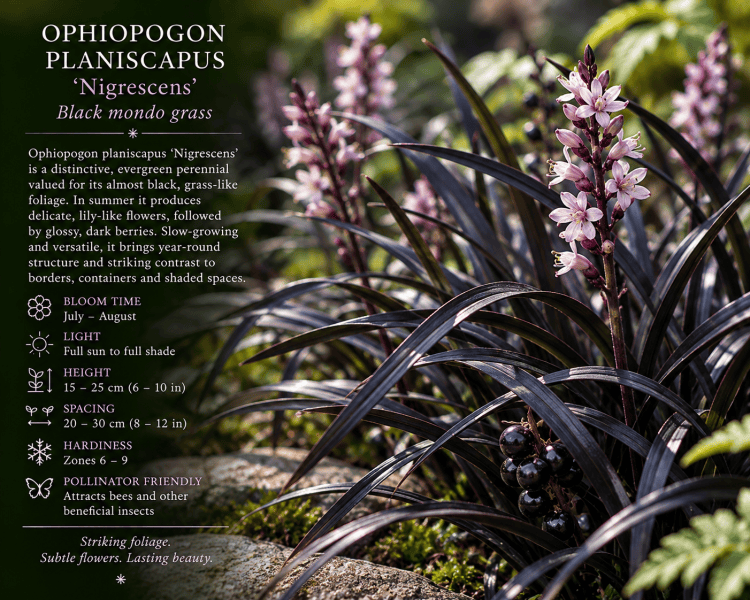
| There is something rather satisfying about finding a plant that refuses to behave as expected. Most of us grow accustomed to certain gardening rules. Leaves are green, flowers provide the colour, and anything resembling grass generally belongs somewhere near a lawn. Occasionally, however, a plant comes along that mocks those assumptions, leaving us wondering whether we’ve been paying enough attention to what we’re growing. Black mondo grass is one of those plants. At first glance, Ophiopogon planiscapus ‘Nigrescens’ looks like a small tuft of ornamental grass someone accidentally painted black. Its narrow, arching leaves emerge greenish before gradually darkening to a remarkable purplish-black, a colour so unusual in the garden that it can appear almost artificial. Against pale gravel, silver foliage or the fresh greens of spring, the contrast is extraordinary. Yet despite its appearance and common name, it isn’t a true grass. Botanically, Ophiopogon belongs to the asparagus family, Asparagaceae, alongside plants that might seem rather unlikely relatives. Its name comes from Greek words for a serpent and a beard, a wonderfully imaginative description that presumably made more sense to the botanists who coined it than to the average gardener standing in front of a clump. The genus is native to eastern Asia, and the dark-leaved form has long been associated with Japanese horticultural traditions, where the appreciation of foliage, texture and restrained contrast has an established place. The remarkable colouring deserves a closer look. Most plants appear green because chlorophyll, essential for photosynthesis, dominates the colour we see. Black mondo grass still contains chlorophyll, but its foliage accumulates high concentrations of anthocyanins, pigments responsible for many of the reds, purples and blues found throughout the plant kingdom. These pigments absorb and alter the light reflected from the leaves, creating that extraordinary near-black appearance. The plant hasn’t abandoned photosynthesis; it has simply found a rather unconventional way of dressing for the occasion. What makes this particularly interesting is that black foliage behaves differently within a planting scheme. Bright flowers draw attention towards themselves, whereas dark foliage can make neighbouring colours appear more vivid. A golden-leaved heuchera, a silver-leaved perennial or even the ordinary fresh green of a fern can suddenly look quite different beside Ophiopogon. It creates contrast without requiring flowers, which is useful when developing a border that stays interesting beyond its main flowering season. And black mondo grass does flower, though you could be forgiven for overlooking it entirely. In summer, small bell-shaped flowers appear among the foliage, usually in shades of pale pink, lilac, or whitish purple. When conditions allow, glossy dark fruits follow, adding another unexpected detail. Neither display is particularly conspicuous, especially when the flowers remain partly hidden beneath the arching leaves. It seems appropriate that a plant already making such an unusual statement through its foliage should regard flowering as a secondary consideration. In British gardens, Ophiopogon is generally accommodating provided the soil drains reasonably well. It prefers fertile, moisture-retentive ground without prolonged winter waterlogging and will grow in sun or partial shade. Its dark colouring is often strongest with good light, although some protection from intense exposure can be beneficial. Once established, it is relatively undemanding, and occasionally removing damaged leaves is usually enough to keep it looking respectable. Its one noticeable shortcoming, if we can call it that, is speed. Black mondo grass is not a plant in any particular hurry. Although frequently recommended as ground cover, it spreads gradually through short underground stems, forming slowly expanding clumps rather than racing across bare soil. Anyone expecting a newly planted handful to carpet a border by the following summer may be disappointed. For quicker coverage, you’ll need several plants, and even then patience remains part of the arrangement. You can divide established clumps, preferably in spring when growth is becoming active. Each division needs a healthy portion of roots and growing shoots, and the resulting plants should be watered carefully while they settle. This is a useful way to increase stock without repeatedly buying new plants, although smaller divisions may take time to regain their former appearance. Perhaps that gradual development is part of the attraction. We often expect garden plants to grow quickly, flower generously and fill every available space. Yet, there is considerable value in something that remains compact, dependable and visually distinctive without constantly demanding attention. Ophiopogon reminds us that foliage can be every bit as interesting as flowers, that botanical appearances can be deceptive, and that a plant needn’t grow rapidly to earn its place. Sometimes the most remarkable thing in a garden is a small clump of leaves quietly refusing to be green. |
| About our writing & imagery Most articles reflect our real gardening experience and reflection. Some use AI in drafting or research, but never for voice or authority. Featured images may show our photos, original AI-generated visuals, or, where stated, credited images shared by others. All content is shaped and edited by Earthly Comforts, expressing our own views. |

