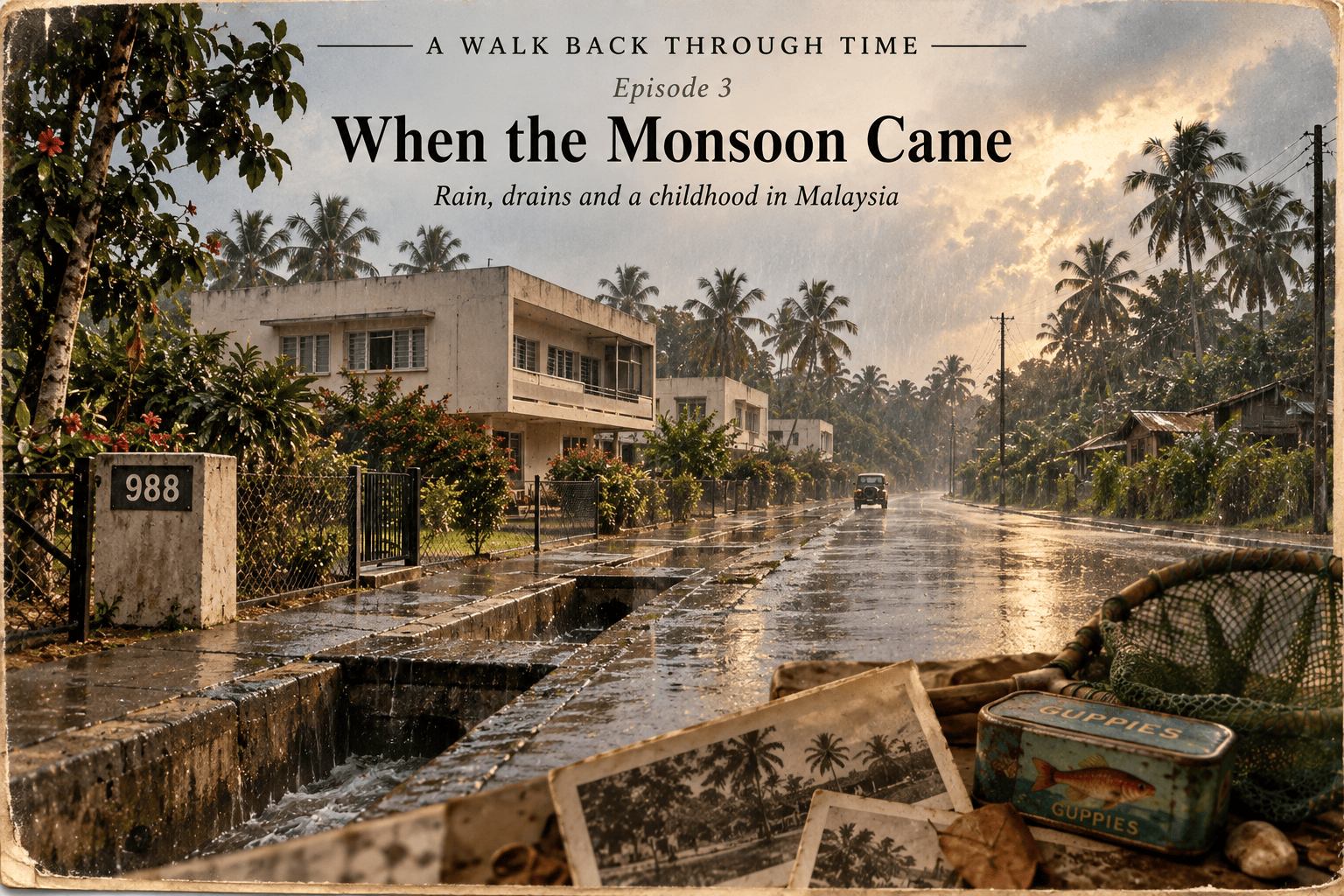
| A Walk Back Through Time Episode 3 |
| Sometimes all it takes is one word. This particular walk back through time began in the comments beneath one of our articles, If Growth Became Too Fast to Manage. My friend, Sadje, mentioned that where she lives, rapid seasonal growth is associated with the monsoon season. Monsoon. That was it. One word, and suddenly I was thinking about Malaysia. I lived there between 1968 and 1971, when I was between five and eight years old. At the younger end of that, I certainly wasn’t thinking about weather systems or understanding what caused a monsoon. It was simply part of the world I lived in. Only when I became older did I really understand what it was. More than fifty years later, though, some of those memories remain remarkably clear. The first is the rain. I have seen extraordinarily heavy rain in Britain in recent years, including downpours that people might reasonably describe as monsoon-like. But nothing quite compares with Malaysian monsoon rain. It wasn’t simply the amount of water. It was the intensity. The sound could become a thunderous roar. Looking through it was rather like trying to look through corrugated glass. You could still see what was beyond it, but everything became opaque and distorted behind this enormous moving curtain of water. Then the drains began to fill. Our home was in Robina Park, part of the military quarters used by officers and NCOs. My father was an NCO with the RAAF Military Police based in Butterworth, and the old family photographs show a neighbourhood of low modern houses for the time, gardens, quiet roads and tropical vegetation. |
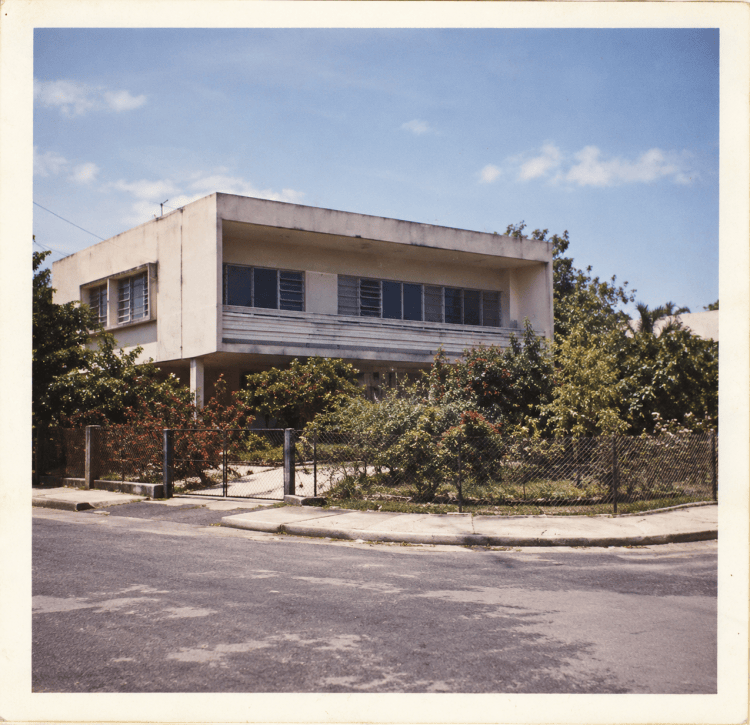
| The military quarters where we lived as a family 1968-1971 [Tidied up using AI] |
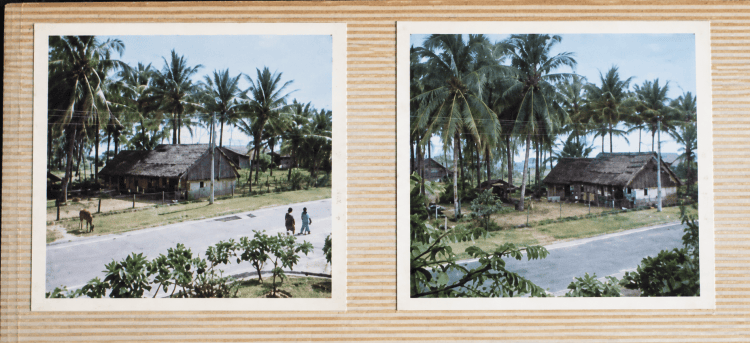
| Across the road was a kampung, its houses sitting amongst coconut palms and dense tropical growth. Looking at those photographs today is slightly strange. To someone seeing them for the first time, the setting probably looks unmistakably tropical. To me it was simply home. |
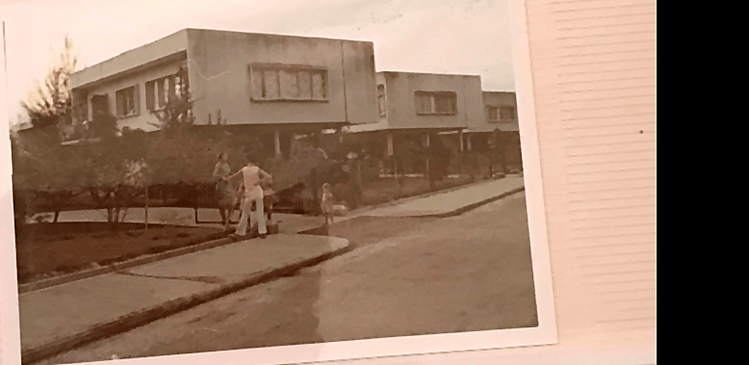
| The drains ran through that ordinary childhood landscape. We called them monny drains. They followed the roads and gardens, carrying the tremendous quantities of water that came with the rain. They varied in size and design, but many of the ones I remember were open concrete channels perhaps two feet wide and around two feet deep. Some were stepped, and larger drains met at junctions before eventually carrying the water onwards towards the sea. One of our old photographs captures just how ordinary they were. My mother stands talking to a neighbour, with one foot on either side of a drain. Nobody was photographing the drain. It just happened to be there, part of the street and part of everyday life. |
| To the adults, they were drainage infrastructure. To us children, they were another world to explore. I would climb into them wearing shorts and flip-flops — although we called them thongs in those days — carrying a net. I was always trying to catch something. Guppies, frogs, crabs, fish; all sorts of creatures could turn up in those drains. At the larger meeting points, where several drains came together, I would stand on the concrete steps and look into the water to see what had appeared. That curiosity about what lives underneath things has never really left me. More than half a century later, I’m still the person who lifts a sheet of corrugated iron, a slab or a piece of timber and immediately wants to see what is living beneath it. Today I might be doing it as a gardener or wildlife observer. Back then I was simply a small boy with a net. The wildlife in those drains could be rather more impressive than anything I am likely to discover beneath a paving slab in Kent. I saw my first cobra in one. I saw pythons too. Oddly, I don’t remember being frightened by them. Perhaps that was simply childhood confidence. My mother certainly wasn’t particularly enthusiastic about me disappearing into the drains, but all the children did things that, looking back now, would probably horrify many parents. And in fairness to my mother, she had good reason to worry. On one occasion I fell into one of the larger drains when it was carrying water. I must have been about six. My memory of what happened is incomplete, but the pieces that remain are remarkably vivid. I remember being carried along at speed. I remember travelling through utter darkness. Then I remember seeing daylight again. And my father. I was being swept towards the sea, and somehow my father managed to catch me at the seaward end of the drain. In my memory, he effectively netted me up. Quite how everything happened around those few remembered moments has disappeared with time. I don’t want to reconstruct it from imagination and turn fragments of a six-year-old’s memory into something more certain than they are. What remains is darkness, speed, light — and Dad. |
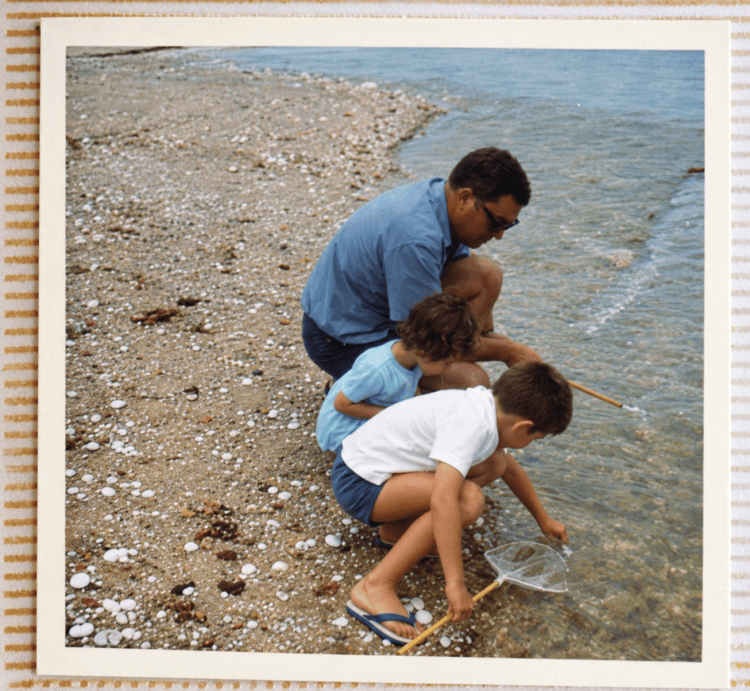
| My father, my sister and me during our Malaysian years |
| Perhaps that should have cured me of monny drains. It didn’t. That is one of the peculiar differences between remembering childhood and judging it as an adult. As a child, much of what surrounded me in Malaysia seemed normal. Tropical storms were normal. Open drains were normal. Snakes were normal. Catching guppies with a net was normal. The monsoon wasn’t an exotic event I waited for with excitement. It was weather. Once the tremendous rain had passed, the world changed again. The heat returned, the humidity climbed, and the wildlife seemed to come back to life. I remember frogs especially well—sometimes it seemed like a swarm of them. Toads, bullfrogs, mosquitoes, and countless other creatures responded in their own ways to the wet conditions. The whole environment was alive. That is something else the photographs bring back. One shows my mother standing on the verandah in 1968. Behind her are palms and tropical vegetation. It is difficult now to separate memories of Malaysia from that greenery because it seemed to surround everything. |
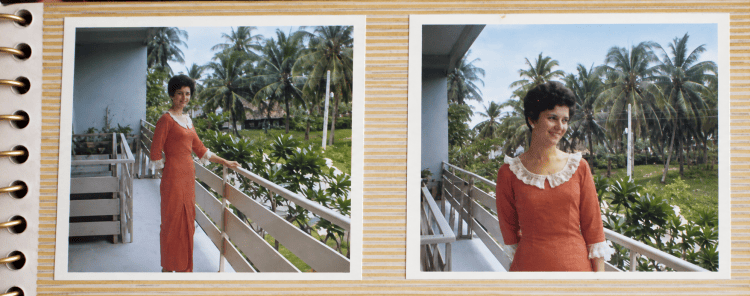
| Mum on the verandah, 1968 |
| There were flash floods too, although as a child I don’t remember carrying the concern about them that the adults presumably did. Children inhabit a different version of events. The things that make parents watch the water level or worry about getting somewhere are often simply part of a child’s day’s adventure. I don’t have particularly strong memories of monsoon nights. I was young, and by night-time I was generally where a five-, six- or seven-year-old was supposed to be: in bed. It is the daylight images that stayed — the rain, the distorted view through it, the drains filling, the concrete steps, the net in my hand and the creatures. When we returned to Australia in 1971, the weather wasn’t completely alien after Malaysia. Australia could produce its own extremes of heat and rain. Britain, when I eventually returned permanently in 1977, was another matter. British rain seemed rather tame. The snow and biting cold certainly didn’t. Having spent my childhood in Australia and Malaysia, British winter cold could absolutely cripple me. But rain? My childhood gave me a different benchmark for what heavy rain looked like. Even now, working outdoors as a gardener, I sometimes think about it when somebody describes a particularly heavy British downpour. A line from Crocodile Dundee has become part of popular culture. Faced with somebody else’s knife, Dundee produces his own considerably larger one: that’s not a knife… My version involves rain. Standing in a British downpour, I feel the temptation to say: That’s not rain… Because I remember rain, or at least I remember the rain of a small boy’s world. And perhaps that distinction matters. These are memories more than fifty years old. I don’t claim to remember every storm, every creature or every detail correctly. Childhood compresses years into images, sounds and moments. The photographs do something rather wonderful, though. They give those fragments somewhere physical to belong. There really was number to our house. There were the military quarters and their gardens. There was the kampung across the road amongst the palms. Mum stood astride a monny drain, talking to a neighbour: Dad, my sister, and I. The photographs themselves have faded and softened with age. Strangely, some of the memories haven’t. If I could take a reader back there for five minutes, I wouldn’t put them safely behind a window watching the monsoon. I’d put them beside the young me, standing in a monny drain with nets in our hands, looking into the water to see what had been washed down. Or perhaps we’d stand at the great outward drain towards the sea, catching guppies and watching this tropical world move around us. Except, of course, it wasn’t extraordinary to me. For five minutes, you would see Malaysia as I saw it, not as a tourist destination, not as a climate, not even as a monsoon. Just as home. And then, more than half a century later, somebody would write one word beneath an article. Monsoon. And you would be there again. |
| About our writing & imagery Most articles reflect our real gardening experience and reflection. Some use AI in drafting or research, but never for voice or authority. Featured images may show our photos, original AI-generated visuals, or, where stated, images credited to others. All content is shaped and edited by Earthly Comforts, expressing our own views. |


Oh Rory, what a beautiful, endearing post. ❤️ I loved every bit of it, and the beautiful photographs of you and your family made it all the more special. How wonderful that you still have them and can revisit those precious memories after all these years.
That last part, though — how one single word, Monsoon, could take you straight back to that little boy you once were, with all those sights, sounds and adventures still alive inside you. I think that’s the magic of memory. Sometimes it takes just one word, one photograph or one familiar sound to bring an entire world rushing back, almost as though the years between have simply disappeared.
Thank you for taking us back there with you, Rory. I felt as though I was standing right beside you, net in hand, ready to see what treasures the rain had brought along! ❤️😊
LikeLiked by 1 person
Kind words of thanks Sonel – indeed, that is the beauty of memory, usually like dreams, these are short flash slices of memory 🙂
LikeLiked by 1 person