
| Hesperis matronalis The Flower That Saves Its Best for the Evening |
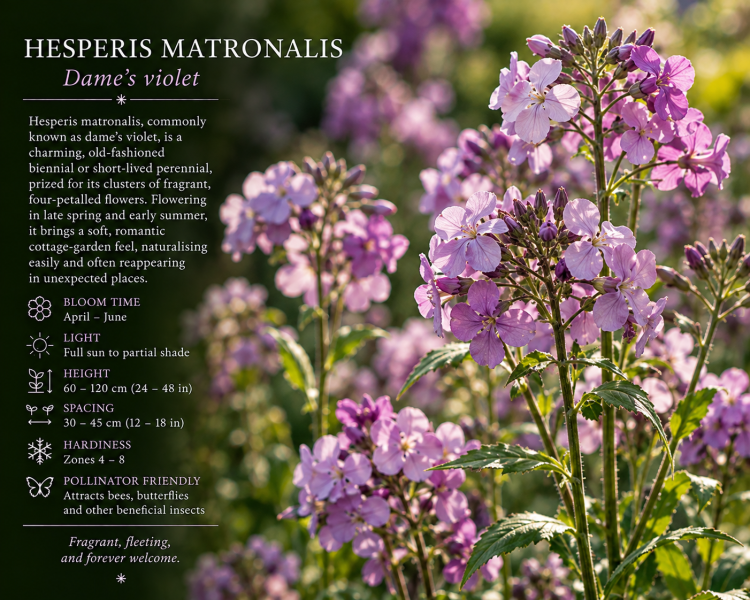
| There is a particular pleasure in walking through a garden at the end of a working day, when the tools have been put away, and there is no longer any pressing reason to examine everything that needs doing. The light has softened, the birds are beginning to settle, and plants that barely attracted attention during the afternoon suddenly become rather more interesting. Sometimes it is a colour change, sometimes the way a flower catches the last of the sunlight, and occasionally it is a fragrance that seems to have appeared from nowhere. Dame’s rocket is particularly good at the last of these. Known botanically as Hesperis matronalis, it is an old-fashioned garden plant that has quietly fallen out of favour in some modern planting schemes. That is a shame, because it offers something rather different from the carefully bred perennials that dominate many garden centres. Its flowers are modest, its growth habit can be slightly untidy, and it has an unfortunate tendency to make its own decisions about where it would prefer to grow. In other words, it behaves like a plant rather than an ornament. A member of the cabbage family, Brassicaceae, Hesperis produces loose clusters of four-petalled flowers, usually violet, lilac, pinkish-purple or white. The individual blooms are simple, almost unremarkable when examined alone, but gathered together above leafy stems they create a wonderfully informal display. In late spring and early summer, the flowers bring a gentle haze of colour to borders, particularly when allowed to mingle with other plants rather than being confined to rigid groups. The name Hesperis comes from the Greek for evening, referring to the fragrance that becomes particularly noticeable as daylight fades. It has a sweet, slightly spicy scent that can catch you by surprise if you’ve spent the day working nearby without noticing anything unusual. This timing has a botanical reason. Many fragrant flowers use scent to attract pollinating insects, and evening fragrance can be particularly useful for attracting moths. Dame’s rocket is also visited by bees and butterflies during daylight, making it a useful addition to a garden where ornamental planting and wildlife interest are intended to coexist. What interests me is how readily we overlook fragrance when choosing plants. We spend considerable time discussing flower colour, height, spread and flowering period, yet scent is often treated as an optional luxury. Perhaps that is because it cannot be appreciated properly in a photograph or represented by a colourful label. A scented garden requires us to be physically present, preferably without rushing towards the next job. Dame’s rocket also has an interesting approach to permanence. It is generally grown as a biennial or short-lived perennial, producing leafy growth before flowering, setting seed and eventually declining. With suitable conditions, however, it can persist through self-seeding. A plant disappears, but its descendants appear nearby, sometimes in places we would never have chosen ourselves. This can be delightful or mildly irritating, depending upon how much control you expect to exercise over your borders. In reasonably fertile, well-drained soil, with sun or light shade, Hesperis is usually straightforward to grow. It appreciates moisture during establishment but doesn’t demand elaborate treatment. If you want it to return, allow some seed heads to mature. If you would rather keep it contained, remove the fading flowers before seeds develop. The plant can self-seed freely, and in some regions outside Britain it has become invasive, so allowing it to spread indiscriminately is not always appropriate. That distinction matters. People tend to describe every self-seeding plant as either wonderfully natural or terribly troublesome, when the reality is usually more complicated. A few seedlings appearing amongst established perennials can create attractive combinations that no planting plan anticipated. Hundreds of seedlings overwhelming smaller plants are rather less charming. The gardener’s job is not necessarily to prevent everything from spreading, but to recognise when enthusiasm needs a little guidance. Dame’s rocket is also easily confused with certain garden phloxes, particularly from a distance. The simplest distinction is the flowers: Hesperis has four petals, characteristic of the cabbage family, while phlox flowers have five. It is a small botanical detail, but exactly the sort of thing that becomes interesting once you start looking at familiar plants more carefully. And perhaps that is the real attraction of this unassuming flower. It isn’t especially rare, spectacular or difficult to grow. It doesn’t require specialist equipment or a complicated maintenance programme. It offers colour, fragrance, insect interest, and a reminder that a garden changes character throughout the day. We tend to judge gardens in full daylight, when everything is clearly visible, and the flowers are performing for our benefit. Yet some of their most appealing qualities only emerge when the sun begins to disappear. Dame’s rocket asks very little of us, apart from a suitable place to grow and perhaps the occasional decision about its seedlings. In return, it gives us a reason to wander outside in the evening, when the day’s work is finished, and the garden can finally be enjoyed without feeling obliged to do something about it. That seems a perfectly reasonable exchange. |
| About our writing & imagery Most articles reflect our real gardening experience and reflection. Some use AI in drafting or research, but never for voice or authority. Featured images may show our photos, original AI-generated visuals, or, where stated, credited images shared by others. All content is shaped and edited by Earthly Comforts, expressing our own views. |

