| Introduction Part Two 1968–1972: The Films, the Faces and the Memories |
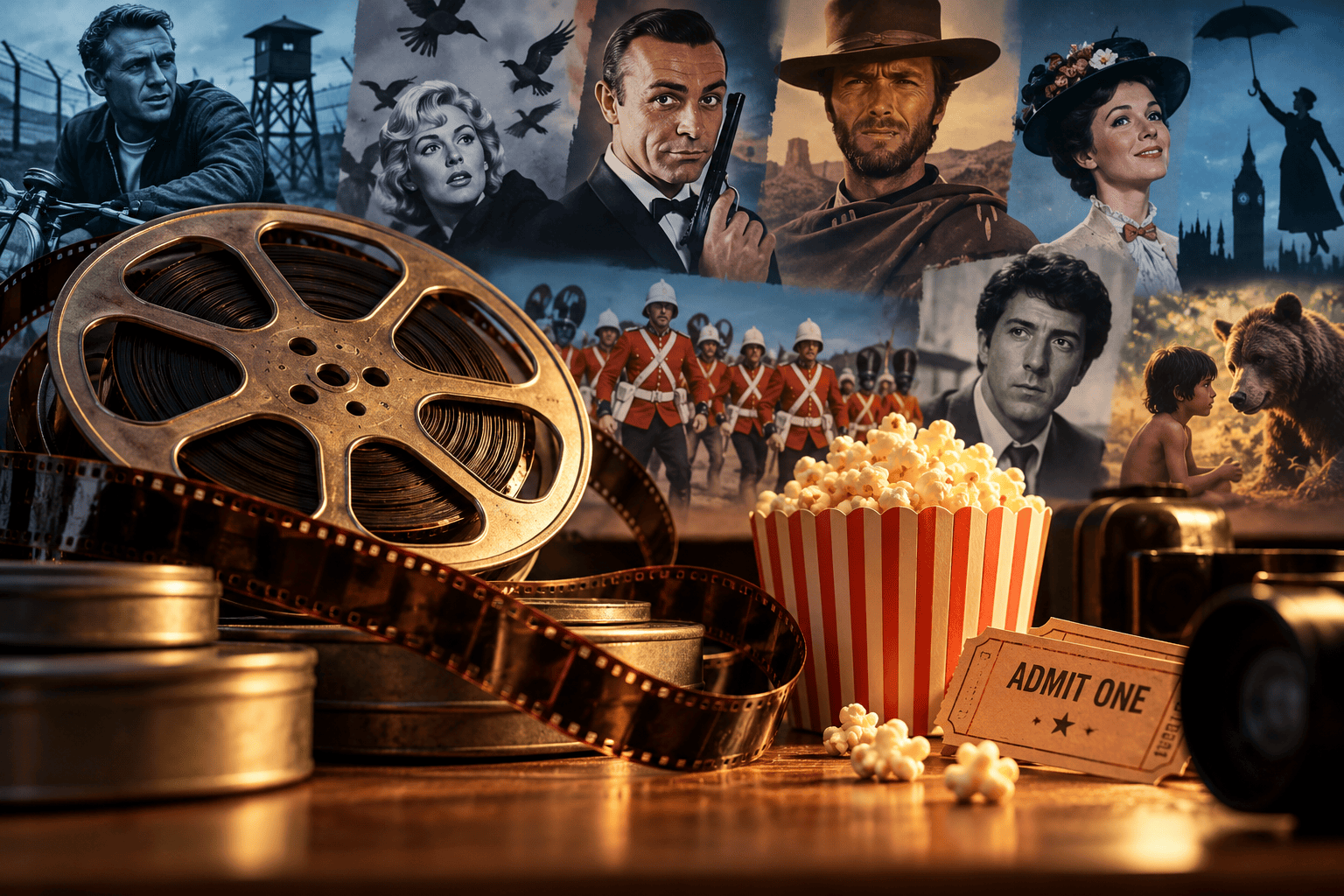
| By 1968, I was five years old, and the cinema had already accumulated another five years of films since my birth. I wasn’t particularly aware of that, of course. At five, I wasn’t studying film history or keeping track of which actor had appeared in what. Films were simply part of the world around me, something to be encountered on television, at the cinema or, much later, through video and DVD. It would be years before I began deliberately seeking out particular films, but many of the titles released during this period would eventually become familiar companions. In Part One, covering 1963–1967, I explained how this series works. AI helps me assemble a broad working selection of films from each year, and I add the personal side: what I watched, what I remember, which actors interested me, and what I thought of the films themselves. We are not compiling a definitive list of cinema’s greatest achievements. We are using film history as a starting point for exploring my own rather peculiar relationship with the moving image. For 1968–1972, our working selection contained another forty films, eight from each year. This time I had seen every one of them, although not necessarily when they were first released. Some I encountered during childhood, others as a teenager, and quite a few much later. One interesting thing about this exercise is discovering how little the release date sometimes has to do with when a film actually becomes part of your life. |
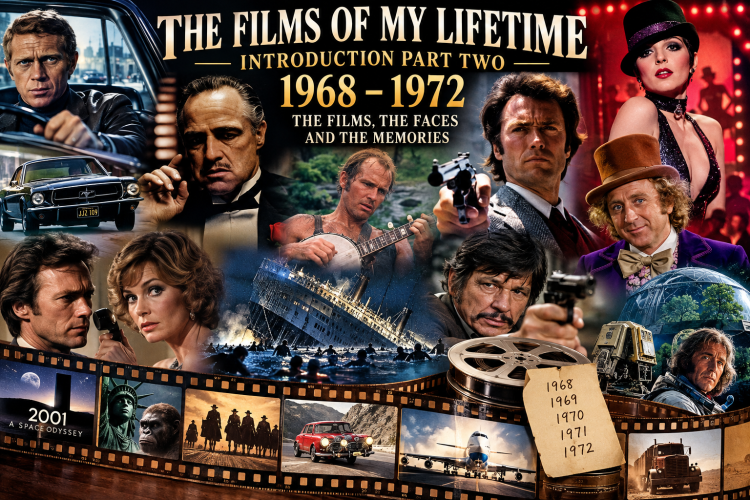
| 1968 — Not Every Classic Is a Favourite Our first year brought 2001: A Space Odyssey, Planet of the Apes, Bullitt, Oliver!, The Odd Couple, Rosemary’s Baby, Chitty Chitty Bang Bang and Where Eagles Dare. It is quite a mixture, and it immediately demonstrates why I would never want to turn this series into a straightforward exercise in praising famous films. Take 2001: A Space Odyssey. I appreciate Stanley Kubrick as a director, and I understand why the film is considered important, but I have never been a huge fan of it. Science fiction has never been my first choice of entertainment, and a film’s reputation doesn’t automatically make it enjoyable for me. The original Planet of the Apes was more to my liking, although I actually prefer the later films in the franchise. I have never believed that an original must necessarily be better simply because it arrived first. Bullitt, on the other hand, was much more my sort of entertainment. Steve McQueen was already one of those actors whose work I enjoyed following, and the film had everything I liked about that particular style of crime thriller, including the famous car chase. Jacqueline Bisset was another familiar face, and the whole production had a coolness that has stayed with me. It is the sort of film that reminds me how much of my enjoyment comes from the people on the screen rather than from analysing the story in any formal way. I also loved The Odd Couple. Jack Lemmon and Walter Matthau were a wonderful pairing, and their performances made the film for me, although I never followed the television sitcom that came afterwards. Rosemary’s Baby was different again because I had read Ira Levin’s novel before seeing the film. I thought the adaptation captured the book remarkably well, and it was wonderfully unsettling, although Mia Farrow was never an actress I particularly followed. The childhood films occupied another part of my memory. Oliver! was everywhere when I was growing up, while Chitty Chitty Bang Bang was something I watched as a youngster without ever wanting to revisit it. Where Eagles Dare was an excellent action film with a terrific cast, although I think I have only watched it a couple of times. Already, several distinctions emerge: films I admire, films I enjoy, films I remember from childhood, and films I would willingly watch again. They are not necessarily the same things. 1969 — McQueen, Caine, Newman and the Importance of a Good Line If 1968 showed how varied my tastes could be, 1969 brought several films that fitted them rather nicely. Butch Cassidy and the Sundance Kid was a particular favourite, not least because of Paul Newman and Robert Redford. I loved the combination of Western, crime story, and humour, and both actors became familiar figures in my film-watching. I also enjoyed The Wild Bunch, which belonged to the grittier style of Western that appealed to me, particularly during the 1980s. Then there was The Italian Job. Michael Caine was one of my favourite actors, and the original film was fantastic. I still much prefer it to the later remake, which never stayed with me in quite the same way. The original also contains one of those lines that became part of my everyday collection of film dialogue: “You’re only supposed to blow the bloody doors off!” I have always enjoyed remembering lines like that, sometimes using them in conversation long after I have forgotten other details of the film. Midnight Cowboy was another excellent film, although I have only watched it once. True Grit was enjoyable, and I liked John Wayne’s screen presence, even though I have never felt obliged to admire everything about an actor as a person just because I enjoy their films. Easy Rider was another memorable production, partly because of its cast and the interesting assortment of performers. Even someone like Toni Basil could catch my attention, which is typical of how I have always noticed unexpected faces and connections. Battle of Britain offered another tremendous ensemble cast, with Michael Caine appearing once again. I have always enjoyed films that bring together a large collection of recognisable actors, particularly when the historical setting interests me. On Her Majesty’s Secret Service was less successful as entertainment for me. I never particularly took to George Lazenby as Bond, although I enjoyed Telly Savalas as Blofeld. I watched the film, but I wasn’t compelled to return to it. What strikes me about 1969 is how much of it I remember through actors and particular moments. A film can be enjoyable because of its story, certainly, but it can also become memorable because of one performance, one scene or even a single sentence. Those fragments stay in my head for years. 1970 — Entertainment Without the Need for Great Meaning By 1970, the selection included Patton, MASH*, Love Story, Kelly’s Heroes, Tora! Tora! Tora!, The Aristocats, Airport and Cromwell. Once again, I had seen all eight, although they produced very different reactions. Patton was an impressive film, even though George C. Scott was never one of my favourite actors. MASH* was entertaining, and I later watched the television series during the 1980s. Kelly’s Heroes was another enjoyable production, with Clint Eastwood and a splendid collection of supporting actors. I particularly liked that mix of war film, action, and humour, which made it feel different from some of the more solemn productions set in the same period. Tora! Tora! Tora! appealed because of its treatment of the attack on Pearl Harbour, while Cromwell was another film with an excellent cast, including Richard Harris, Alec Guinness, Timothy Dalton and Robert Morley. I have always enjoyed recognising actors in historical productions and seeing how their performances differ from the other roles I know them for. Airport introduced another type of entertainment that would become increasingly important to me: the disaster film. I also read Arthur Hailey, so I connected books with cinema. I didn’t necessarily realise at the time how much I would come to enjoy the disaster genre, but looking back, its appeal makes sense. A large cast, several stories unfolding together, a growing sense of danger and the uncertainty of who might survive all make for absorbing entertainment. The Aristocats belongs more to childhood, while Love Story belongs firmly among the films I disliked. Its popularity did nothing to change that, although I did notice the young Tommy Lee Jones, who would become a familiar actor in later decades. That is another example of the way a film can remain useful to my memory even when I didn’t particularly enjoy watching it. There is something else worth saying here. None of these films fundamentally changed my life. I enjoyed some, disliked others and remembered particular scenes or performers. Still, I don’t feel the need to invent some profound personal transformation every time a film appears in the story. Sometimes a film is simply a couple of hours of entertainment, and that is quite enough. I have often described films as a form of visual candy. I can enjoy part of a film over lunch, return to it later, or move between several different films without feeling I must consume each one in a single uninterrupted sitting. That may seem strange to somebody who approaches cinema as an experience requiring complete concentration from beginning to end, but it is how I have often enjoyed visual entertainment. It also reminds me of the way I used to read. As a teenager, I could get through an extraordinary number of paperback books in a month, moving between different stories, authors and subjects with tremendous enthusiasm. Books and films were not separate interests so much as different ways of satisfying the same appetite for stories, characters and information. 1971 — Famous Films, Favourite Actors and Lasting Impressions The next year brought A Clockwork Orange, The French Connection, Dirty Harry, Willy Wonka & the Chocolate Factory, Diamonds Are Forever, The Last Picture Show, Duel and Bedknobs and Broomsticks. As with the previous years, the films were familiar, but their reputations didn’t necessarily match my reactions. I first watched A Clockwork Orange only around ten years ago, long after hearing people talk about it. Given everything I had heard, I expected considerably more and came away thinking it was overrated. I have never been the biggest fan of Malcolm McDowell, either. I know the film has an enormous reputation, but that doesn’t oblige me to share the enthusiasm. I felt something similar about The Last Picture Show, which I didn’t particularly enjoy. The French Connection was another matter entirely. I first watched it during the 1990s and thought it was brilliant. I greatly admired Gene Hackman, and his presence certainly added to my enjoyment. Dirty Harry was equally appealing, although in a different way. I was a huge Clint Eastwood fan and eventually watched all five films in the series. The dialogue was memorable, too, from Harry’s famous question about feeling lucky to the later “Go ahead, make my day” line in Sudden Impact. Those are the kinds of quotations that stick with an actor and follow him throughout his career. Clint Eastwood also brings another 1971 film into the discussion, although it wasn’t among our original eight: Play Misty for Me. I remember watching it on television in the early 1990s and being impressed by the psychological tension. Jessica Walter and Donna Mills were excellent, and Walter’s portrayal of an obsessive admirer has stayed with me. Watching it reminded me of the territory later explored in Fatal Attraction, with Glenn Close’s character becoming notorious for the expression “bunny boiler”. Eastwood’s earlier film had already explored the frightening consequences of obsession, and it remains one of those thrillers that I can recall vividly. Willy Wonka & the Chocolate Factory was another favourite, largely because Gene Wilder was such a wonderful performer. I still prefer his version to the later interpretations. Johnny Depp wasn’t bad, but Timothée Chalamet’s portrayal appealed to me considerably less. Once again, my preference isn’t simply about whether the production is older or newer. It is about the performance and whether the film works for me. Duel, with Dennis Weaver, was a fantastic road thriller, and it is particularly interesting now because of Steven Spielberg’s later career. A seemingly ordinary journey becomes a relentless ordeal, and the tension is extraordinary. Diamonds Are Forever was another Bond film I watched without feeling especially enthusiastic about the franchise at the time. My greater interest in Bond developed when Roger Moore took over. I watched Bedknobs and Broomsticks later, when I was around fifteen, and although I was never an indiscriminate Disney enthusiast, I did enjoy individual films. The interesting thing about 1971 is that I encountered some of its films many years apart. A Clockwork Orange arrived in my viewing history around 2016, The French Connection during the 1990s and Bedknobs and Broomsticks during my teenage years. They all belong to 1971 in film history, but they belong to very different periods of my own life. 1972 — The Disaster Film Arrives By 1972, I was nine years old, and another eight films entered our working selection: The Godfather, Deliverance, Cabaret, The Poseidon Adventure, Frenzy, The Getaway, The Mechanic and Silent Running. Of all the years in this second introductory period, this one seems particularly revealing because it brings together several interests that would continue for decades. The Godfather was terrific. I watched the trilogy on video during the 1990s, and all three films offered an extraordinary collection of actors. The performances, the characters and the sheer scale of the story made them absorbing entertainment. I have always enjoyed productions that bring together a truly impressive cast, and few film series offer a better example. Deliverance was unforgettable for rather different reasons. Some of its scenes were genuinely disturbing, particularly the notorious assault sequence and the line “Squeal like a pig.” Yet the film also contains that extraordinary banjo sequence, which has remained in my memory for decades. Even now, as I write about it, I can visualise it. That is something I find fascinating about films: a particular sequence can remain almost perfectly preserved in the mind long after the rest of the experience has faded. Deliverance also had another excellent cast, which naturally added to its appeal. Cabaret was not for me. I found myself getting bored, and Liza Minnelli was never a performer I particularly followed. Silent Running was another film I didn’t particularly enjoy, although I recognise its cult reputation and its place in the development of science-fiction cinema. I did like Bruce Dern as an actor, but science fiction has never been the genre I instinctively turn to for entertainment. Frenzy was much more enjoyable. Alfred Hitchcock had been a familiar name in my film watching and reading for years, and this was another excellent thriller. The Getaway was fantastic, with Steve McQueen once again demonstrating why he was one of my favourite actors. The Mechanic was another great action film, this time with Charles Bronson, another performer whose work I enjoyed following. These films remind me that a familiar actor can be a powerful reason to choose what to watch, although that never guaranteed I would like every film they made. Then we come to The Poseidon Adventure, which may be one of the most significant discoveries from our discussions over the past five years. I loved the film, particularly its tremendous ensemble cast, and I still regard the original as the best version. More importantly, it marked the beginning of my affection for disaster movies, a genre I still enjoy today. I think something about the disaster-film formula particularly appeals to me. You have a collection of characters, often played by actors you already know, suddenly placed in an extraordinary situation. Their separate stories connect through a single catastrophe, and the film moves between moments of danger, courage, selfishness, and survival. It’s large-scale entertainment, and I have always enjoyed that combination. Do Films Stand the Test of Time? One question that has emerged while revisiting these early years is whether a film still entertains us decades after it was made. Some films stand the test of time remarkably well. You can watch them today and become just as involved as audiences were when they first appeared. Others seem to have aged badly, whether through their dialogue, acting styles, pacing or attitudes. Occasionally a film that once seemed exciting can now feel rather conventional, particularly when compared with the faster pace of modern entertainment. That doesn’t necessarily make the older film bad. It may simply mean that the world around it has changed, along with our expectations. A scene that once seemed shocking may now appear tame, while a special effect that astonished audiences fifty years ago might look rather unconvincing today. On the other hand, a good performance, a clever story or a genuinely suspenseful sequence can survive almost any technological change. Remakes make this particularly interesting. I loved the original The Italian Job, but the remake never made the same impression. I prefer Gene Wilder’s Willy Wonka and Michael Caine’s Alfie to their later interpretations. Yet I prefer the 2004 remake of The Flight of the Phoenix to the original, and I enjoy the newer Planet of the Apes films more than the earlier productions. So I don’t subscribe to the idea that the original is always superior. Sometimes a remake brings new energy, better pacing or a different approach that makes the story more entertaining. At other times, it seems to lose precisely the qualities that made the first film memorable. For me, the deciding factor isn’t the date on the film, but whether I enjoy watching it. As we continue through the decades, I suspect this question will become increasingly important. A film’s original reputation tells us one thing; whether it still works for somebody watching it many years later tells us something else. The Visual Collector Another aspect of my relationship with films is becoming clearer through these conversations. I have never been especially interested in approaching cinema as a critic. I don’t watch films primarily to examine their technical achievements, compare their artistic merits or decide where they belong in some grand ranking of cinema history. I watch them because they entertain me, interest me or introduce me to something worth remembering. Sometimes that something is an actor. Sometimes it is a scene, a line of dialogue, a historical connection or an obscure fact. Sometimes it is a book that I read before seeing the adaptation, or a performer whose appearance sends me looking for other films in which they appeared. I can become as interested in the connections surrounding a film as I am in the film itself. Looking back, I also wonder whether autism has played a part in how I have approached films. I was diagnosed with Asperger’s in 2007, and I have always tended to develop deep interests and accumulate information about subjects that fascinate me. Whether my enthusiasm for actors, films, dialogue and obscure facts is connected to that, I cannot say with certainty. It is simply a question that occurs to me now as I examine habits that have accompanied me for much of my life. I have also never felt that every film needs to be watched in one sitting. Even today, I might watch fifteen minutes of something over lunch, return to it in the evening or have several films on the go at once. That approach probably wouldn’t appeal to everybody, but it suits me. I enjoy the visual stimulation, the characters and the stories without necessarily treating each film as an occasion requiring my undivided attention. In some respects, it resembles the way I read as a teenager. I could move through thirty, forty or even fifty paperback books in a month, absorbing stories and information at an extraordinary rate. Films eventually became another way of feeding that curiosity, and the people and details I encountered accumulated in my memory. Much later, that collecting instinct would become physical. Between 2008 and 2012, I bought and sold DVDs, acquiring collections, keeping the films that interested me, and selling those I didn’t want. At its peak, my personal collection numbered around four thousand films, many of them horror. That is a story for another stage of this journey, but it is worth mentioning here because the habit of collecting films had begun long before the collection itself existed. Ten Years of Cinema — And Still Only the Beginning We have now travelled from 1963 to 1972, the first ten years of my lifetime, and already some interesting patterns emerge. I have encountered films I loved, films I disliked, films I admired without particularly enjoying and films that remain memorable because of a single scene or performance. Some were childhood experiences; others I didn’t discover until I was well into adulthood. The actors are becoming familiar companions. Steve McQueen, Michael Caine, Clint Eastwood, Gene Hackman, Paul Newman, Robert Redford, Charles Bronson, Gene Wilder and many others are beginning to form a network of connections that will undoubtedly become more complicated as the years progress. Books are appearing alongside films, memorable lines are accumulating, and particular genres are emerging as favourites. What I am not discovering is a neat list of films that changed my life. That was never really the point. Most films haven’t changed anything about me. They have entertained me, amused me, frightened me, bored me, introduced me to actors or occupied a few enjoyable hours. Some have remained in my memory for decades, while others have almost disappeared until a title or familiar face brings them back. Perhaps that is what makes this journey worthwhile. It is not an attempt to prove that my favourite films are better than anybody else’s, nor is it a catalogue of cinema’s greatest achievements. It is an exploration of what happens when more than sixty years of films are placed alongside one person’s memories, interests and habits. And we are still only at the beginning. In 1972, I was nine years old. Films were accumulating, actors were waiting to be discovered, and books were beginning to compete for my attention. But the real turning point in my film watching was still several years away. In 1977, at fourteen, I returned to Britain from Australia, and my appetite for reading and watching films began to develop into something much more deliberate. Before we reach that point, however, four more years remain to explore. |
| Next: Introduction Part Three — 1973–1976: Approaching the Turning Point |
| About our writing & imagery Most articles are grounded in our real gardening experience, observations and reflections. AI may assist with research, drafting and editing, but the experiences, opinions and editorial direction are our own. Featured images may include our photography, original AI-generated visuals or, where stated, images credited to others. All published content is reviewed and shaped by Earthly Comforts before publication. |

