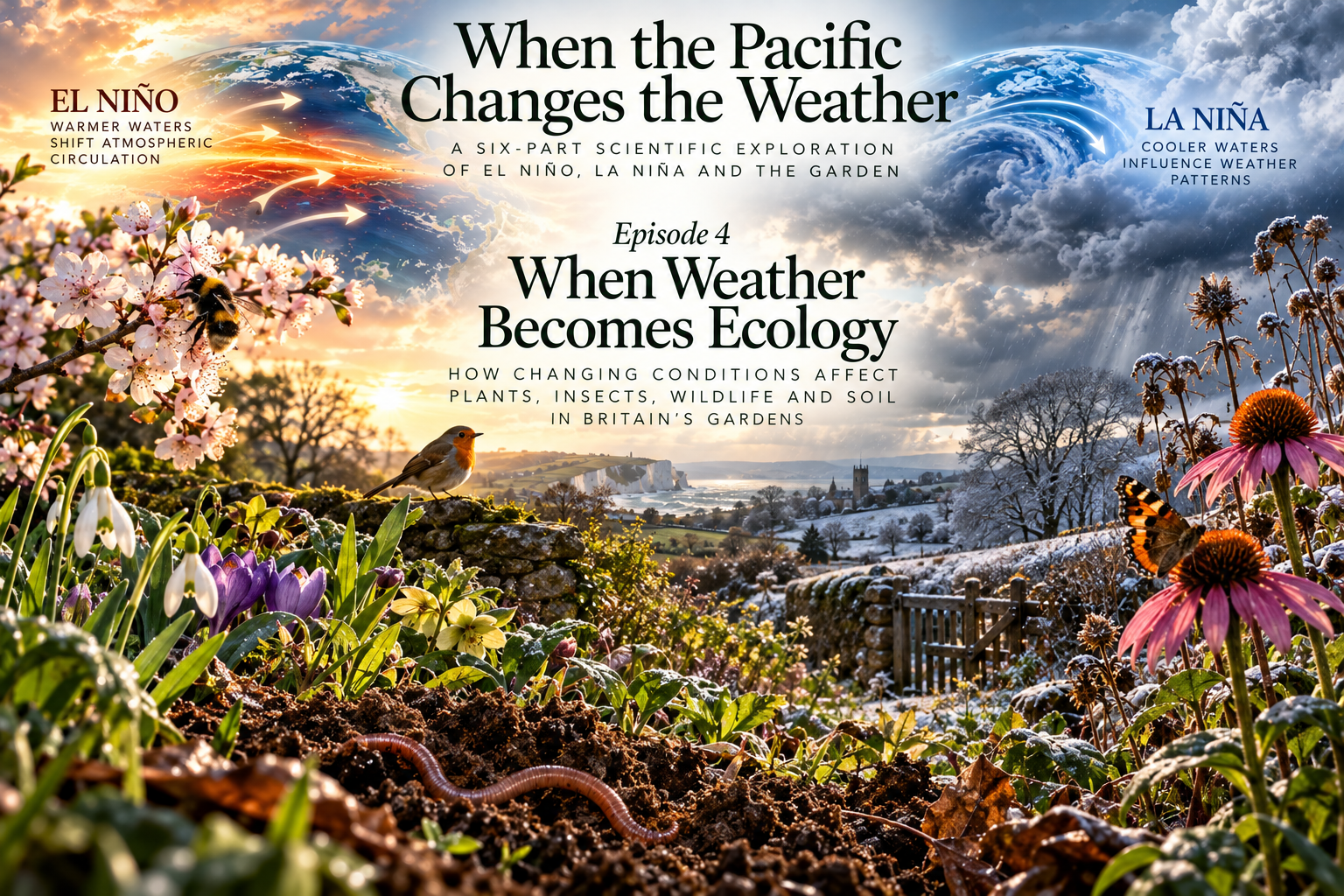
| Episode 4 When Weather Becomes Ecology |
| In every garden, there is a moment when the weather stops being something happening around us and becomes something happening to the living things within it. A warm February afternoon brings a queen bumblebee out of hibernation. A week of heavy rain leaves the soil saturated, slowing the growth of plants whose roots can no longer obtain sufficient oxygen. An unexpected frost blackens the tender leaves of a shrub that had already begun its spring growth. None of these events is particularly unusual in a British garden. Weather has always shaped the natural world, and plants and animals have evolved ways of coping with its seasonal changes. What makes the relationship so interesting is that the consequences of a particular spell of weather can continue long after the conditions themselves have disappeared. In the previous episode, we followed El Niño and La Niña from the tropical Pacific towards Britain, discovering how changes in ocean temperatures can influence atmospheric circulation and alter the probabilities of particular weather patterns. We also established something important: ENSO does not dictate British weather, and its influence here is neither direct enough nor consistent enough to predict what any individual season will bring. But suppose a period of unusual weather does occur, whether or not ENSO has contributed to its likelihood. What happens next? How does a prolonged wet winter, an unusually warm spring or a dry summer influence the plants, insects, birds and countless other organisms sharing our gardens? This is where meteorology becomes ecology, and where the consequences of weather begin to reveal themselves in the relationships between living things. Nature has its own calendar. Every gardener knows that the natural world follows a seasonal rhythm, although it rarely consults the calendar hanging on our kitchen wall. Snowdrops may appear while winter still seems firmly established, blackthorn flowers before its leaves emerge, and the first butterflies begin appearing as temperatures rise. By late spring, hedgerows fill with foliage, insects become more active, and birds focus on nesting and raising their young. The scientific study of these recurring seasonal events is called phenology. It examines the timing of biological activities such as flowering, leaf emergence, insect development, migration, breeding and autumn leaf fall. Environmental cues, particularly temperature, daylight, and, for some species, moisture availability, influence these events. Day length provides a remarkably dependable annual signal because it changes according to Earth’s orbit and axial tilt. Temperature is less predictable and varies considerably between years. Many plants respond to a combination of signals, including accumulated warmth, winter chilling and day length, rather than simply reacting to the first mild afternoon. This distinction matters. A warm spell in January does not persuade every dormant tree to begin growing, because some species need sufficient exposure to winter cold before their buds can fully respond to spring warmth. Others respond more readily to unusual temperatures, which helps explain why some plants flower unexpectedly early. The result is a seasonal calendar that is flexible but not infinitely adaptable. Plants and animals can adjust their activities to changing conditions, although different species respond at different rates and to different environmental signals. Long-term British observations demonstrate how sensitive these timings can be. Research involving the Met Office and the Woodland Trust has shown that warmer spring temperatures are associated with earlier budburst in many tree species. At the same time, records of flowering, insects and bird activity reveal considerable variation between years. The important point is not simply that spring can arrive early. It is that different members of an ecological community may respond to that early arrival in different ways. When the seasons fall out of step Consider an oak tree, the caterpillars feeding on its young leaves and the blue tits searching for those caterpillars to feed their chicks. Their relationship depends partly upon timing. Young oak foliage feeds many caterpillars, and the period of greatest caterpillar abundance can provide an important food source for breeding woodland birds. If leaf emergence timing changes, caterpillar development may change with it. Birds also respond to seasonal conditions, but several factors influence their breeding schedules, including daylight, temperature, food availability, and their own physiological development. They cannot necessarily adjust their nesting dates at the same rate as the insects their chicks depend on. Scientists describe the resulting possibility as a phenological mismatch. It occurs when closely connected species shift their seasonal timing by different amounts, potentially reducing the overlap between food availability and demand. British research examining oak trees, caterpillars and woodland birds has found evidence of such mismatches, particularly during unusually early springs. However, consequences vary by species and location, and not every timing shift is damaging. The same principle can apply to flowering plants and pollinators. If a plant flowers unusually early but suitable pollinating insects are not yet active, pollination opportunities may be reduced. Equally, an early-emerging insect may find fewer suitable flowers available than it would during a more typical spring. Nature is not a collection of independent organisms responding to the weather in isolation. It is a network of relationships, and changes affecting one species can sometimes spread through the wider community. Rainfall changes more than soil moisture. Temperature often receives the greatest attention in discussions of seasonal change. Still, rainfall can be equally important, particularly in a country where the difference between a workable garden and a waterlogged one may depend upon several weeks of persistent wet weather. Soil contains a mixture of mineral particles, organic matter, water and air. Healthy root systems require access to both moisture and oxygen, while soil organisms depend upon suitable conditions for their biological activity. When prolonged rainfall saturates the ground, water fills many of the spaces normally occupied by air. Oxygen moves through water far more slowly than through air, and roots may begin experiencing oxygen deficiency. This can restrict respiration, reduce nutrient uptake and, if conditions persist, damage or kill susceptible roots. The consequences extend beyond the plants themselves. Soil microorganisms respond to changes in oxygen availability, with some biological processes slowing and others becoming more prominent. Under waterlogged conditions, anaerobic processes may increase, altering how nitrogen and other nutrients transform in the soil. Earthworms and other soil invertebrates also respond to moisture conditions. Some move closer to the surface when the ground becomes saturated, while others may retreat or experience stress if unsuitable conditions persist. The response depends upon the species, soil structure, temperature and duration of waterlogging. A wet winter can therefore influence far more than the appearance of a muddy lawn. It can affect root health, nutrient cycling, decomposition and the conditions experienced by the organisms responsible for maintaining soil fertility. And when the rain eventually stops, recovery is not necessarily immediate. Soil may remain saturated, damaged roots may need time to regenerate, and biological processes may continue reflecting the conditions of the preceding weeks. The ecological consequences of drought Now consider the opposite extreme. During prolonged dry weather, plants face increasing difficulty obtaining enough water to replace what they lose through transpiration. Many respond by partially closing the tiny pores in their leaves, known as stomata, reducing water loss but also restricting the carbon dioxide available for photosynthesis. Growth may slow, leaves may wilt and, under more severe conditions, plants can suffer tissue damage or die. Some species have adaptations that help them tolerate drought, while others depend more on reliable soil moisture. But drought also changes the wider ecological environment. Reduced plant growth can affect the quantity and quality of food available to herbivorous insects. Flowering may shorten or shift, affecting nectar and pollen availability. Soil organisms may become less active as the moisture required for their biological processes becomes scarce. Even after rain returns, the effects can continue. Plants that have lost roots or foliage may require time to recover. At the same time, severely dried soils can absorb water unevenly at first, particularly where surface conditions have become compacted or water-repellent. For wildlife, water availability becomes increasingly important. Birds, mammals, amphibians and invertebrates may all experience changing conditions as ponds shrink, damp refuges disappear, and vegetation becomes less productive. A drought is therefore not simply a period when plants need watering. It can alter the resources and habitats entire communities depend on. A warm spring followed by a cold surprise One of the more deceptive weather patterns for the natural world is an unusually mild period followed by a return to colder conditions. Warmth can encourage plants to break dormancy, develop tender new foliage or begin flowering. Yet early growth does not mean the risk of frost has disappeared. Newly emerging tissues are often more vulnerable to freezing temperatures than dormant buds or mature, hardened growth. A late frost can therefore damage plants that have responded to an earlier warm spell, sometimes reducing flowering, fruit production or the development of new shoots. Wildlife can face similar difficulties. Early activity may increase exposure to subsequent cold conditions, particularly where food availability becomes restricted. The Met Office has highlighted this problem in discussions of Britain’s changing seasonal patterns. Although the number of frost days has declined as the climate has warmed, early biological activity can still expose vulnerable organisms to damaging cold spells. This is an important reminder that a season’s average temperature does not tell us everything about its ecological consequences. The sequence of events matters, as does their timing. A relatively mild spring containing one damaging frost can produce very different results from a spring with the same average temperature but without that frost. Insects, fungi and the changing balance of life Weather also influences the organisms that gardeners sometimes regard as pests, diseases or unwelcome visitors, although their ecological roles are often considerably more complicated. Temperature strongly influences insect development. Within suitable limits, warmer conditions can accelerate growth and reproduction, potentially allowing some species to complete additional generations during a favourable season. Other insects may suffer when temperatures become excessive or when drought reduces the quality of their food plants. Moisture is equally important. Some insects require damp habitats during particular life stages, while others thrive under comparatively dry conditions. Their predators, parasites, and competitors respond to weather too, making population changes difficult to predict from temperature or rainfall alone. Fungi and fungal-like organisms are similarly sensitive to environmental conditions. Many plant diseases are favoured by prolonged leaf wetness, high humidity or particular temperature ranges, although each pathogen has its own requirements. A damp summer may encourage certain foliar diseases, while prolonged drought can weaken susceptible plants and make them more vulnerable to other problems. However, it would be misleading to suggest that wet weather automatically means more disease or that warm weather always produces more insect pests. The ecological response depends upon which organisms are present, the condition of their hosts and the sequence of weather conditions experienced. In a functioning ecosystem, these relationships are constantly changing. A rise in one insect population may provide more food for predators, while poor conditions for a particular plant may influence several species that depend upon it. What appears to be a simple weather response can become a complicated ecological chain. The difference between a weather event and a changing climate At this point, we should distinguish between two processes that are sometimes discussed together but are not interchangeable. ENSO produces natural variability in the climate system, influencing the probabilities of particular weather patterns over months and seasons. Climate change, by contrast, alters the longer-term background conditions within which that variability occurs. The two can interact, but they are not the same phenomenon. A warm spring may result from several interacting atmospheric influences, while the longer-term tendency towards earlier spring activity in Britain is associated with a warming climate. Neither observation, by itself, establishes that El Niño caused a particular ecological event. This distinction is especially important when interpreting unusual years. If butterflies emerge early, a tree flowers ahead of its usual schedule, or a garden suffers prolonged drought, we should not automatically attribute the event to ENSO simply because El Niño or La Niña happened to be present. Establishing such a connection would require evidence linking the Pacific event to the relevant regional weather conditions, followed by evidence of the biological response. The scientifically defensible chain is therefore conditional: ENSO may influence atmospheric circulation; that influence may alter the likelihood of particular weather conditions; and those conditions, if they occur, may affect ecological processes. Each stage introduces uncertainty, and the ecological outcome also depends upon local circumstances. What a garden can tell us Gardens are particularly valuable places to observe these relationships. Unlike a distant weather station or an abstract climate map, a garden lets us see biological responses develop before our eyes. We can observe when the first snowdrops flower, when particular trees begin opening their buds, when queen bumblebees become active and when birds begin collecting nesting material. We can notice whether soil remains saturated unusually late into spring, whether flowering shortens during a hot spell, or whether particular plants recover slowly after drought. Individual observations do not establish a climate trend. A blackthorn flowering early in one garden during one year tells us something about that plant and its immediate environment. Still, it cannot explain the behaviour of an entire region. Repeated observations, however, become more useful. When records are collected consistently across many years and locations, patterns can emerge that would otherwise be difficult to recognise. Britain has a long tradition of recording seasonal events. The Woodland Trust’s Nature’s Calendar project continues that work by gathering observations of plants and wildlife, providing researchers with valuable information about how seasonal timing varies and changes. For gardeners, participating in such recording schemes offers an opportunity to contribute to scientific understanding while developing a closer appreciation of the environments they care for. The value lies not in predicting the next season, but in noticing how living systems respond to the conditions they actually experience. From ecology to the garden We began this episode with a queen bumblebee emerging during a warm February afternoon, a waterlogged lawn and a shrub damaged by unexpected frost. These are familiar events, but they illustrate a much larger principle. Weather is not merely a background against which nature performs. It influences the timing, growth, reproduction, and survival of living organisms, and it also affects the relationships that connect them. Sometimes the consequences are immediate and obvious. At other times, they emerge gradually through changes in soil conditions, food availability, flowering or the success of breeding wildlife. And although ENSO can influence the likelihood of particular weather patterns, we must resist the temptation to trace every ecological change directly back to the Pacific. The relationship is real in principle, but the chain of influence becomes increasingly complex as we move from global atmospheric circulation towards individual habitats. For gardeners, this understanding matters. A garden is not simply a collection of plants growing in soil. It is a living ecological system, shaped by weather and dependent upon countless interactions above and below the ground. Recognising those interactions changes how we think about gardening. It encourages us to look beyond whether a plant is growing well today and consider what conditions might mean for its roots, the insects visiting its flowers and the organisms maintaining the soil beneath it. Our journey has now brought us from the Pacific Ocean, through the atmosphere, across Britain and into the living natural world. Next, we finally step through the garden gate. We will examine what prolonged rainfall, drought, heat, frost and abrupt seasonal changes mean for the plants and soils we work with, and why understanding those responses is far more useful than attempting to predict an entire gardening year from the state of the tropical Pacific. Episode 5 — What El Niño and La Niña Mean for the Garden |
| Further Reading & Scientific Sources These sources support the article’s discussion of seasonal timing, ecological relationships and weather-related biological changes. Met Office — Earlier Spring in the UK Research into changing flowering, leaf emergence and wildlife activity in British landscapes. Met Office — Climate Change and the Natural World Explains how seasonal observations reveal changes in British plant and wildlife activity. Nature Ecology & Evolution — Phenological Match and Mismatch Peer-reviewed research examining the timing relationships between oak trees, caterpillars and woodland birds. Nature Ecology & Evolution Defra — England’s Spring Index Official monitoring of seasonal biological events, including flowering, butterfly emergence and migratory birds. Met Office — Wildlife Banking on a Warm Spring Examines early seasonal activity and the risks associated with subsequent cold spells. |
| About our writing & imagery Most articles are grounded in our real gardening experience, observations and reflections. AI may assist with research, drafting and editing, but the experiences, opinions and editorial direction are our own. Featured images may include our photography, original AI-generated visuals or, where stated, images credited to others. Earthly Comforts reviews and shapes all published content before publication. |

