| Episode 7 The European Turtle Dove: The Summer Voice We Are Losing |
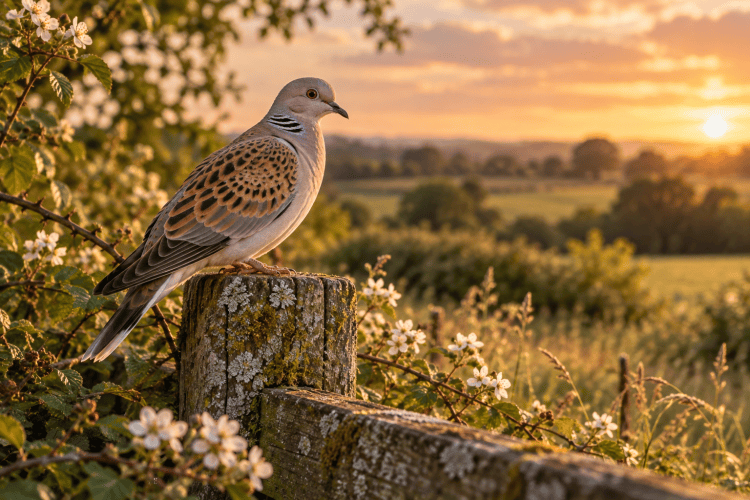
| There is something rather peculiar about the way we remember the countryside. We remember the smell of freshly cut grass, the warmth of a summer afternoon, the sound of bees working through flowering borders and the familiar chorus of birds that seems to accompany everything we do outdoors. Yet when you return to a place after many years, it is sometimes difficult to identify precisely what has changed. The trees may still be standing, the hedgerows may look much the same, and the fields continue to stretch towards the horizon. Everything appears reassuringly familiar, but something feels different. It can take a while to realise that what is missing isn’t something you can see at all. It is something you can no longer hear. For generations, one of the characteristic sounds of the British summer was the gentle, rolling purr of the European Turtle Dove (Streptopelia turtur). It was never a particularly commanding sound, certainly nothing like the enthusiastic performance of a Skylark or the unmistakable announcement of a Cuckoo. Instead, it was a soft, rhythmic turrr-turrr, carrying from a hedge or small woodland somewhere beyond the garden. It was the sort of sound that could become part of the background of a summer’s day without anybody feeling the need to stop and identify its owner. The bird was there, another familiar participant in the countryside’s annual activities. Today, hearing a Turtle Dove in Britain is a much less ordinary experience. In many areas where it was once a regular summer visitor, it has become exceptionally scarce, and across much of the country an entire generation is growing up without knowing its distinctive voice. That is particularly unsettling. We tend to imagine the disappearance of wildlife as a dramatic event, perhaps involving a threatened forest or a spectacular animal approaching extinction. Yet sometimes it happens almost politely, one quiet summer after another, until the absence itself becomes normal. A Dove Unlike the Others Most people in Britain are familiar with doves, although they may not always distinguish between the different species. Woodpigeons are practically unavoidable in many gardens, particularly when young brassicas are involved, and Collared Doves have become such established residents of our towns and villages that their repetitive calling is part of everyday life. Both can make their presence known, and Woodpigeons in particular seem to regard freshly planted vegetables as a personal invitation. The Turtle Dove is rather different. It is smaller and more delicately built than a Woodpigeon, with warm chestnut and black markings across its wings, a beautifully patterned patch on either side of its neck and a long tail edged with white. Its elegance photographs reasonably well, though they cannot quite convey the impression of seeing one moving quietly through a sunlit hedgerow. It looks like a bird of warm weather, which is appropriate because, unlike our familiar resident pigeons and doves, the European Turtle Dove is a long-distance migrant. Its arrival in Britain is usually associated with late April and May, when birds return from their wintering grounds in sub-Saharan Africa. They come to breed, using hedgerows, scrub, woodland edges, and farmland with suitable nesting cover and feeding opportunities. The breeding season is relatively short, and by late summer the birds begin departing again. For much of the year, therefore, a species we regard as part of the British countryside is living thousands of miles away. This raises an interesting question: what makes a bird British? We tend to think of wildlife as belonging to particular countries, yet a Turtle Dove’s life cannot be divided so conveniently. It depends upon suitable conditions in Africa, safe passage across Europe and the Mediterranean, and sufficient food and nesting habitat when it reaches Britain. A problem anywhere along that enormous journey can affect whether the bird returns to a familiar hedgerow the following spring. National boundaries, so important to human beings, are of remarkably little interest to migrating birds. The Bird of Love and Devotion The Turtle Dove has occupied a rather special place in human culture for centuries. Its gentle voice and association with paired birds helped establish it as a symbol of love, fidelity and devotion. It appears in religious traditions, poetry, folklore and seasonal songs, including the familiar reference to two Turtle Doves in The Twelve Days of Christmas. Given that the birds normally spend Christmas considerably farther south than Britain, their presence in that song is more symbolic than ornithologically practical. Some biological foundation supports the romantic reputation. Turtle Doves form breeding pairs, and both parents help raise their young. Like other pigeons and doves, they feed their chicks with a remarkable substance known as crop milk, produced within the lining of the crop. It is rich in nutrients and allows young birds to develop rapidly during their early days. Both parents can produce it, a more equal arrangement than we find among some bird species. However, the idea that Turtle Doves necessarily remain devoted to one partner for life is more romantic tradition than established universal fact. Pair bonds matter during breeding, but their duration can vary, and we should be cautious about imposing human ideas of lifelong fidelity on birds simply because their behaviour appears affectionate to us. I find that distinction interesting because we are remarkably inclined to turn wildlife into reflections of ourselves. Owls become wise, foxes become cunning, robins become friendly, and doves become romantic. The animals themselves, meanwhile, continue with the practical business of surviving, feeding and reproducing, apparently unaware of the reputations we have assigned them. Perhaps nature is more interesting when we allow its creatures to be themselves rather than requiring them to represent our preferred virtues. The Importance of an Untidy Field Edge For a gardener, one of the most interesting aspects of the Turtle Dove’s life is its relationship with seeds. Unlike the Swallow, which hunts flying insects, or the Cuckoo, which feeds heavily upon caterpillars, the Turtle Dove is predominantly a seed-eating bird. It searches for food on the ground, taking seeds from a range of wild plants and, where available, cultivated crops. Historically, the British agricultural landscape provided a considerable variety of these resources. Arable weeds, field margins, fallow land, rough tracks and less intensively managed corners offered opportunities for seed-bearing plants to grow. Turtle Doves could feed amongst these plants while using nearby hedges and scrub for nesting. Modern agriculture has changed much of that landscape. More effective weed control, changes in cropping, and the reduction of seed-rich habitats have contributed to the difficulties the species faces. A field can remain green and productive from an agricultural perspective while offering relatively little food to a bird that depends upon the seeds of plants we have become extremely efficient at removing. This is where the gardener’s relationship with weeds becomes relevant once again. We spend a great deal of time distinguishing between plants we want and plants we don’t, usually according to whether they are growing where we intended. There are perfectly sound reasons for controlling vigorous weeds in cultivated borders, and I have no intention of suggesting that every garden should become an experimental collection of docks, thistles and bindweed. Anyone who has spent a morning extracting established bindweed roots would probably have something to say about that. But a plant’s usefulness to wildlife is not determined by whether we happen to approve of its location. Many wild plants produce seeds eaten by birds, flowers used by insects and foliage supporting caterpillars. Their value changes according to where they grow and how much space is available. A thistle in the middle of a carefully maintained border may be inconvenient, while the same plant in a rough meadow margin can support an extraordinary amount of life. Thoughtful management differs from wholesale removal of everything that grows without permission. The Turtle Dove’s story illustrates why that distinction matters. When the Countryside Becomes Too Efficient It would be unfair to attribute the Turtle Dove’s decline entirely to changes in British farming. Its problems are more complicated than that. Habitat loss and food shortages on breeding grounds are important, but the species also faces pressures during migration and on its wintering grounds. Hunting along parts of its migratory route has historically added further mortality, although restrictions and conservation measures have been introduced in several countries. The scale of the decline makes the situation especially troubling. Britain’s breeding Turtle Dove population has fallen by well over 90 per cent since the late twentieth century, making it one of the country’s most dramatically declining breeding birds. Its remaining distribution is heavily concentrated in parts of eastern and south-eastern England, with many former breeding areas now lacking the species altogether. These figures are hard to grasp until we translate them into something more familiar. Imagine a countryside where the gentle purring of Turtle Doves could once be heard from numerous hedgerows during summer. Then imagine returning several decades later and discovering that nearly all those voices have disappeared. The hedges may remain, the crops may still grow, and the roads may carry just as much traffic as before, but the living landscape has changed profoundly. An uncomfortable parallel emerges with gardening. We can make a garden increasingly efficient to maintain by removing difficult plants, simplifying borders, replacing mixed planting with uniform surfaces, and reducing the number of places where things are allowed to grow naturally. Each decision may make practical sense on its own. Eventually, however, we may find ourselves with a garden that requires less work but supports considerably less life. Efficiency is not inherently bad. Gardeners and farmers alike need to work within financial, physical and practical limitations. The problem arises when efficiency becomes the only measure of success, leaving little room for the complicated relationships that allow wildlife to flourish. Giving the Turtle Dove Somewhere to Return To Fortunately, the Turtle Dove’s story is not entirely one of disappearance. Conservation organisations, farmers and landowners have been working to improve conditions in the areas where the species still breeds. Initiatives such as Operation Turtle Dove have encouraged the creation and management of suitable feeding habitat, including seed-rich plots close to nesting cover, alongside wider efforts to understand and reduce the pressures affecting the birds. One important lesson from this work is that providing food is not simply a matter of scattering seed somewhere convenient. Turtle Doves need accessible feeding areas with suitable vegetation structure, close enough to safe nesting habitat for birds to use efficiently. A dense mass of vegetation may contain seeds but still be difficult for a ground-feeding bird to exploit. Habitat management therefore requires understanding how the bird actually behaves, rather than merely providing something that looks wildlife-friendly to us. Gardeners encounter this lesson frequently. A pond may be beautifully constructed but offer little value to amphibians if they cannot enter or leave it safely. A hedge may contain suitable plants but become less useful if cut too severely or at the wrong time. A wildflower area may initially look magnificent but gradually lose diversity without appropriate management. Good intentions are important, but understanding the needs of the creatures we hope to support is what makes those intentions effective. An individual garden has limits in what it can achieve for Turtle Doves, particularly outside their remaining breeding areas. A small suburban plot cannot recreate an entire agricultural landscape, and it would be misleading to suggest otherwise. Nevertheless, gardens, allotments, orchards and smallholdings can contribute to a more varied environment by retaining suitable shrubs, reducing unnecessary pesticide use, allowing selected plants to set seed and maintaining areas of less intensively managed vegetation. For those fortunate enough to live where Turtle Doves still occur, the opportunity is greater. Suitable feeding plots, carefully managed scrub and cooperation between neighbouring landowners can make a genuine difference. Conservation becomes particularly valuable when it operates beyond individual boundaries, recognising that birds need connected landscapes rather than isolated gestures. A Different Kind of Silence Something about the Turtle Dove’s decline feels particularly poignant because the bird itself is so unobtrusive. It lacks the commanding presence of a bird of prey or the energetic visibility of a flock of Swallows. Its song is quiet, its movements can be discreet, and its preferred habitats are often places people pass without paying much attention. Perhaps that explains why its disappearance has not always attracted the public attention we might expect from such a severe decline. We tend to notice the loss of spectacular wildlife more readily than the gradual absence of familiar background sounds. Yet those sounds are part of what gives a landscape its character. Think of a summer morning without birdsong, a pond without dragonflies or a flowering border without the movement of bees. The physical landscape might remain recognisable, but the experience of being there would be entirely different. A garden is not simply an arrangement of plants, any more than a field is simply an area of crops. Both are living places, shaped by countless relationships that we may only partially understand. This is why I find myself increasingly interested in the ordinary creatures that once seemed too common to require much thought. Their abundance let us take them for granted, and their decline reminds us that familiarity is not the same as security. The Turtle Dove also challenges another assumption: that once a species has declined severely, there is little point trying to help it. Recovery is difficult, and there are no guarantees, particularly for a bird facing pressures across several countries. But conservation measures can improve breeding conditions, protect remaining populations and create expansion opportunities. International action to reduce unsustainable hunting is another important part of the picture. We cannot promise that every missing summer voice will return. We can, however, avoid treating its absence as inevitable. Remembering What Summer Sounded Like I sometimes wonder how many changes in the natural world we have accepted simply because they happened gradually enough that we didn’t notice. A few fewer butterflies one summer, a familiar bird absent the next, a hedge removed from a field and another patch of rough ground brought into cultivation. Individually, none of these events necessarily announce themselves as important. Together, they can alter the character of an entire countryside. For the Turtle Dove, the consequences have been particularly severe. A bird once woven into the sounds and traditions of rural Britain has become a rare encounter in much of its former range. Its gentle call, celebrated for centuries as a symbol of summer and affection, now carries a different meaning for those who recognise it. But there is still something encouraging about the fact that Turtle Doves continue to return. Each spring, surviving birds make their way north from Africa, crossing continents to reach the places where they may breed. In suitable parts of Britain, males still settle into hedgerows and deliver that soft, rolling purr across the surrounding fields. Nests are built, eggs are laid, and young birds begin another generation of an extraordinary migratory life. The countryside has not fallen completely silent. Perhaps what the Turtle Dove asks of us is not simply to mourn what has disappeared, but to become more interested in what remains. To look at a field margin and see more than weeds. To recognise that a hedge is more than a boundary. To understand that the birds we associate with a particular season may depend upon decisions made thousands of miles away. And to remember that a beautiful landscape is not necessarily a healthy one simply because it still looks beautiful. The next time we hear a Turtle Dove, if we are fortunate enough to do so, we may find ourselves listening a little longer than previous generations needed to. Not because its song has changed, but because we have begun to understand how easily such ordinary wonders can become extraordinary rarities. Watching For… European Turtle Doves are summer visitors to Britain, generally arriving from late April and May and departing during late summer and early autumn. Their remaining breeding strongholds are concentrated in parts of eastern and south-eastern England, particularly in landscapes with suitable scrub, hedgerows, woodland edges, and seed-rich feeding areas. Their soft, repeated purring call is often the best way to detect them, as the birds can remain remarkably inconspicuous amongst vegetation. If you are visiting an area where Turtle Doves still breed, listen patiently from public paths and avoid approaching suspected nesting sites. A bird perched quietly within a hedge may be difficult to see, but its warm chestnut wing pattern and distinctive striped neck markings are unmistakable once you have a clear view. Above all, give the birds space. For a species working so hard to maintain its place in the British countryside, a successful breeding season matters far more than someone getting the perfect photograph. |
| About our writing & imagery Most articles reflect our real gardening experience and reflection. Some use AI in drafting or research, but never for voice or authority. Featured images may show our photos, original AI-generated visuals, or, where stated, credited images shared by others. All content is shaped and edited by Earthly Comforts, expressing our own views. |

