| A 5-Part Series |
| A curated exploration of South America’s most iconic, curious, and ecologically important insects |
| Part One — Ants, Bees & Wasps: Societies in Abundance |
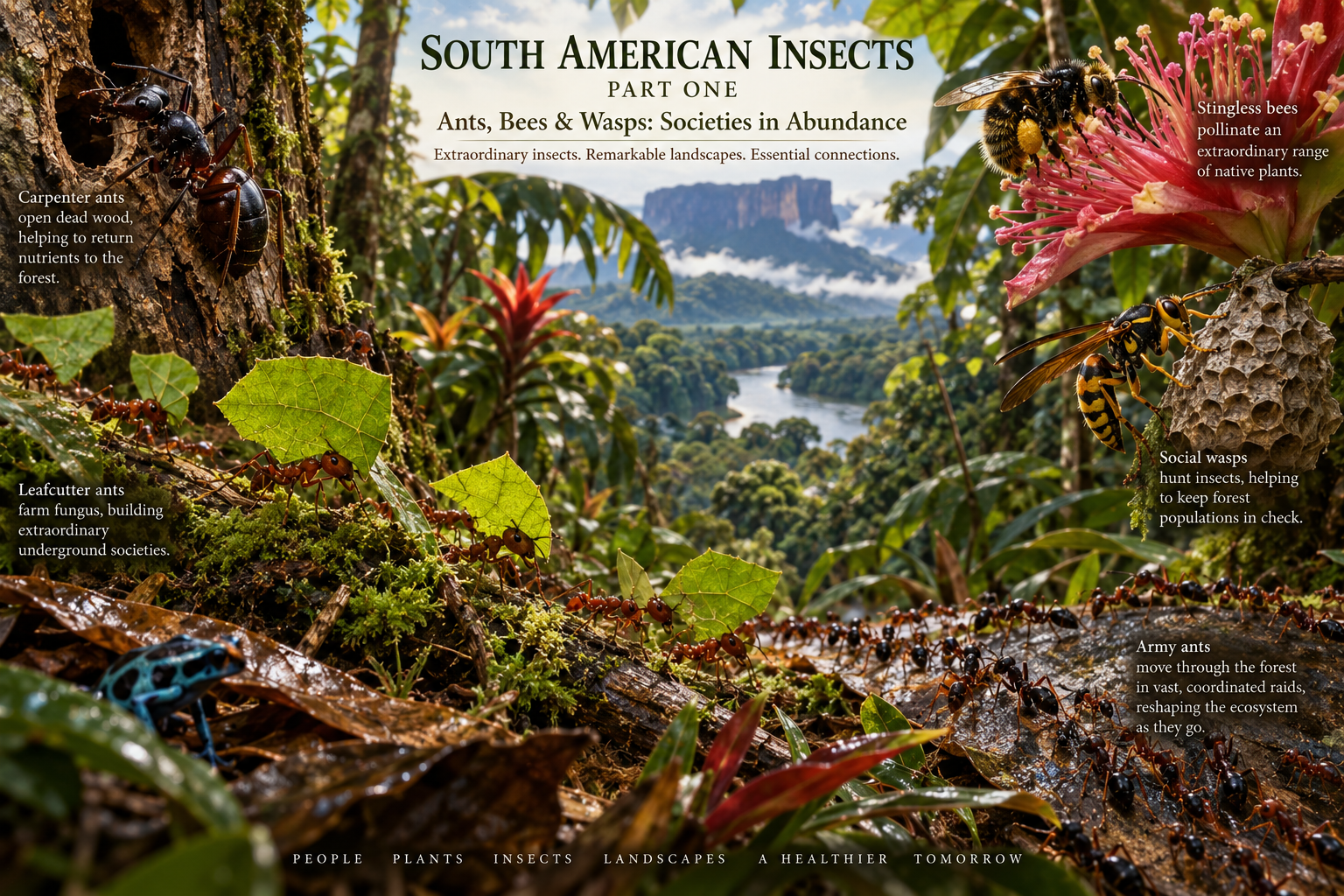
| In some places in South America, trying to understand insect life one species at a time misses the point. In tropical forests especially, insects operate within dense networks of plants, fungi, soil organisms, and other animals, so the relationships between them can be more interesting than the individual creatures themselves. Ants, bees and wasps are particularly good examples. They build, cultivate, pollinate, hunt and recycle, often creating systems that continue day and night. The scale can be deceptive. A line of ants crossing the forest floor may look like a temporary trail until we realise that it connects a colony containing thousands, sometimes millions, of individuals to a carefully managed food supply. A small stingless bee disappearing into a tree cavity may be connecting flowers scattered throughout the surrounding forest. A wasp carrying prey back to its nest represents another small piece of population control taking place without anyone directing it. None of these insects understands the ecosystem they help create, yet their activities collectively shape the landscape around them. For a gardener, this feels familiar. We spend a great deal of time trying to manage relationships between soil, plants, pollinators, predators and decay. South American social insects have been doing their own versions of the same thing for millions of years, although on a scale and with an efficiency that can make our efforts look rather modest. Leafcutters: farmers beneath the forest Leafcutter ants are among the most conspicuous insects in tropical South America. Once a trail becomes established, it can resemble a tiny procession through the vegetation, with workers carrying pieces of leaf above their bodies like green sails. The obvious assumption is that the ants are taking those leaves underground to eat them. They are not. They carry the vegetation into the nest and process it into material on which the colony cultivates specialised fungus. This fungus, rather than the leaves themselves, forms the colony’s central food resource. In effect, leafcutter ants practise agriculture. That comparison is more than a convenient metaphor. The ants harvest plant material, prepare a growing medium, maintain their fungal crop and remove waste. Different workers perform different jobs, while conditions inside the nest must remain suitable for the fungus to thrive. They control contamination and carry away unwanted material. What appears above ground as a trail of insects collecting leaves is merely the visible end of an elaborate underground farming system. The colony’s scale can also alter surrounding vegetation. Leafcutters may remove substantial quantities of foliage and concentrate organic material below ground, influencing soil structure and nutrient movement around their nests. In a garden we might understandably object if an insect began carrying away sections of our plants, but in the wider forest the relationship is considerably more complicated. The ants are not simply consuming vegetation; they are moving energy from the canopy and understorey into a subterranean biological system. There is also something wonderfully unsettling about discovering that agriculture was not our invention. Humans arrived very late to that particular idea. Army ants and a forest that moves with them Army ants create an entirely different kind of society. Rather than establishing the same relationship with vegetation, many are predators whose large coordinated raids move through the forest in search of other animals. The effect extends well beyond the ants themselves. Insects, spiders, and other small creatures try to escape the advancing swarm, creating opportunities for nearby animals. Some birds are famously associated with army-ant raids, taking prey flushed from hiding rather than eating the ants themselves. This transforms an ant colony into a moving ecological event. The interesting part is not simply the number of ants involved, but the chain reaction their behaviour creates. Prey moves because of the ants; birds move because of the prey; other animals alter their behaviour in response to the disturbance. A process that begins at ground level reaches upward through several layers of the forest. It is a useful reminder that predators influence ecosystems not only by what they catch. The threat of predation changes where other animals go, when they feed and how they behave. An army-ant raid reorganises a small part of the forest temporarily simply by passing through it. Gardeners see much smaller versions of this. Disturb a patch of vegetation, and insects scatter, immediately attracting birds’ attention. Lift an old pot, and creatures disappear in every direction. Movement creates movement. In a South American rainforest, army ants turn that principle into something altogether more impressive. Carpenter ants and the speed of decay Carpenter ants work less dramatically but occupy another important part of the cycle. They excavate galleries in dead or weakened timber, creating nesting space within wood that has already begun its journey back towards the soil. As we saw with their North American relatives, carpenter ants do not eat wood in the way termites do. Their excavation nevertheless contributes to decomposition by opening timber to moisture, fungi and other organisms. In a warm, humid forest where plant growth is extraordinarily rapid, nutrients cannot remain locked indefinitely within fallen trunks and branches. Material must be broken down and returned to circulation. This is particularly important when thinking about tropical rainforest soils. The lush vegetation can give the impression of extraordinary fertility beneath it, yet many tropical soils are relatively poor in available nutrients. Much of the system’s fertility is held within living organisms and the rapidly cycling layer of organic material near the surface. Decomposition therefore matters enormously. A fallen tree is not simply a dead object lying on fertile ground. It is itself a substantial store of nutrients waiting to be dismantled. Ants are among the many organisms helping to open that store. Stingless bees and the quieter pollinators South America’s stingless bees offer a gentler contrast to the armies and agricultural colonies of ants. They are social bees found throughout tropical regions, and their relationships with flowering plants run deep in both natural forests and human cultivation. As their name suggests, stingless bees lack the functional defensive sting familiar from honeybees, although that certainly does not mean every species is defenceless. Colonies can protect themselves in other ways, including biting and using sticky materials. Their ecological importance, however, comes principally through pollination. Different species visit a wide variety of native plants and crops, moving pollen as they collect food for their colonies. Some nest in tree cavities, while others use hollows, crevices, and occasionally human structures. People across tropical America have long recognised their presence, and stingless-bee keeping has traditions far older than the arrival of European honeybees. For gardeners, they illustrate an important point about pollination that applies almost everywhere. The most familiar bee is not necessarily the only one doing the work. Pollination is usually distributed among many species, each responding differently to flower shape, weather, season and habitat. Diversity provides resilience. If we reduce the pollinator community to one familiar species, we lose many of those different relationships. Honeybees in a landscape that already had bees The European honeybee is now widespread in South America, but it is an introduced insect. By the time honeybees arrived, the continent already supported an extraordinary variety of native pollinators. That makes their modern ecological position more complicated than simply describing honeybees as beneficial because they pollinate flowers. They certainly do provide pollination, including for many crops, and beekeeping has considerable agricultural and economic importance. At the same time, managed and feral honeybees can compete with native insects for floral resources, particularly where food is limited. The relationship varies by habitat, season, plant community, and bee abundance, so sweeping conclusions are rarely helpful. Introduced species do not enter empty ecosystems. They join networks that already contain competitors, predators, parasites and mutual relationships. This corrects another common assumption: more bees do not automatically mean a healthier pollinator system. Which bees are present, how many there are and whether the landscape provides sufficient resources for the wider community all matter. Supporting pollination means supporting diversity, not merely increasing hive numbers. Wasps among the leaves Social wasps add predation to this already complicated system. Tropical conditions can support enormous numbers of plant-feeding insects, particularly when rain and fresh growth create sudden abundance. Wasps respond by hunting many of those insects to provide protein for developing larvae. Their reputation, as elsewhere in the world, tends to be shaped by encounters with people rather than by the work they perform when we are not watching. Yet a wasp moving methodically through foliage is part of the same regulatory network as a mantis, spider or predatory beetle. Gardeners should remember this. We often notice the caterpillar chewing a leaf long before we notice the predator searching for it. Natural control is often less visible than damage. That does not mean predators prevent every outbreak, nor that wasps should be welcomed indiscriminately wherever they build a nest. Human safety and practical circumstances matter. But ecologically, social wasps are not simply aggressive insects waiting to sting somebody. They are active hunters woven into the same food webs as the prey they pursue. Societies within societies Leafcutter ants cultivate fungus. Army ants reorganise patches of forest as they move. Carpenter ants help break down dead timber. Stingless bees connect flowers, introduced honeybees add another competitor and pollinator to an already complex community, and social wasps put pressure on insects feeding among the vegetation. Each system is impressive on its own, but the real story lies in their overlap. The leaf an ant carried underground came from a plant that depends on nutrients released by decomposition. That plant may require an insect for pollination. Its leaves may feed another insect that later becomes prey for a wasp. Eventually every participant dies and returns its nutrients to the same system. Nothing operates entirely alone. Perhaps that is what makes South America’s social insects so fascinating from a gardener’s perspective. A garden can sometimes tempt us into thinking in individual problems: this plant needs feeding, that insect is eating something, another needs encouraging. Healthy ecosystems are less compartmentalised. They function through relationships. South America’s ants, bees and wasps take those relationships to extraordinary levels of complexity. Their societies sit inside larger biological societies, altering the forest while simultaneously depending upon it. The individual insect may be tiny. The system it belongs to can reshape the ground beneath an entire forest. |
| About our writing & imagery Most articles reflect our real gardening experience and reflection. Some use AI in drafting or research, but never for voice or authority. Featured images may show our photos, original AI-generated visuals or, where stated, credited images shared by others. All content is shaped and edited by Earthly Comforts, expressing our own views. |


Another fascinating read, Rory! ❤️🦋 I love how you show us that there is so much more going on in the insect world than we realise. Those leafcutter ants cultivating their own fungus really caught my attention — nature came up with farming long before we did! 😂
It’s wonderful how you connect all these little creatures and their roles in the bigger picture. The more I photograph and learn about nature, the more I realise just how much there is still to discover. Nothing operates entirely alone, indeed!
Thank you for another lovely journey into the natural world. 🤗🌿📸
LikeLiked by 1 person
Glad you enjoyed the read Sonel 🙂
LikeLiked by 1 person