| A Walk Back Through Time Episode 4 |
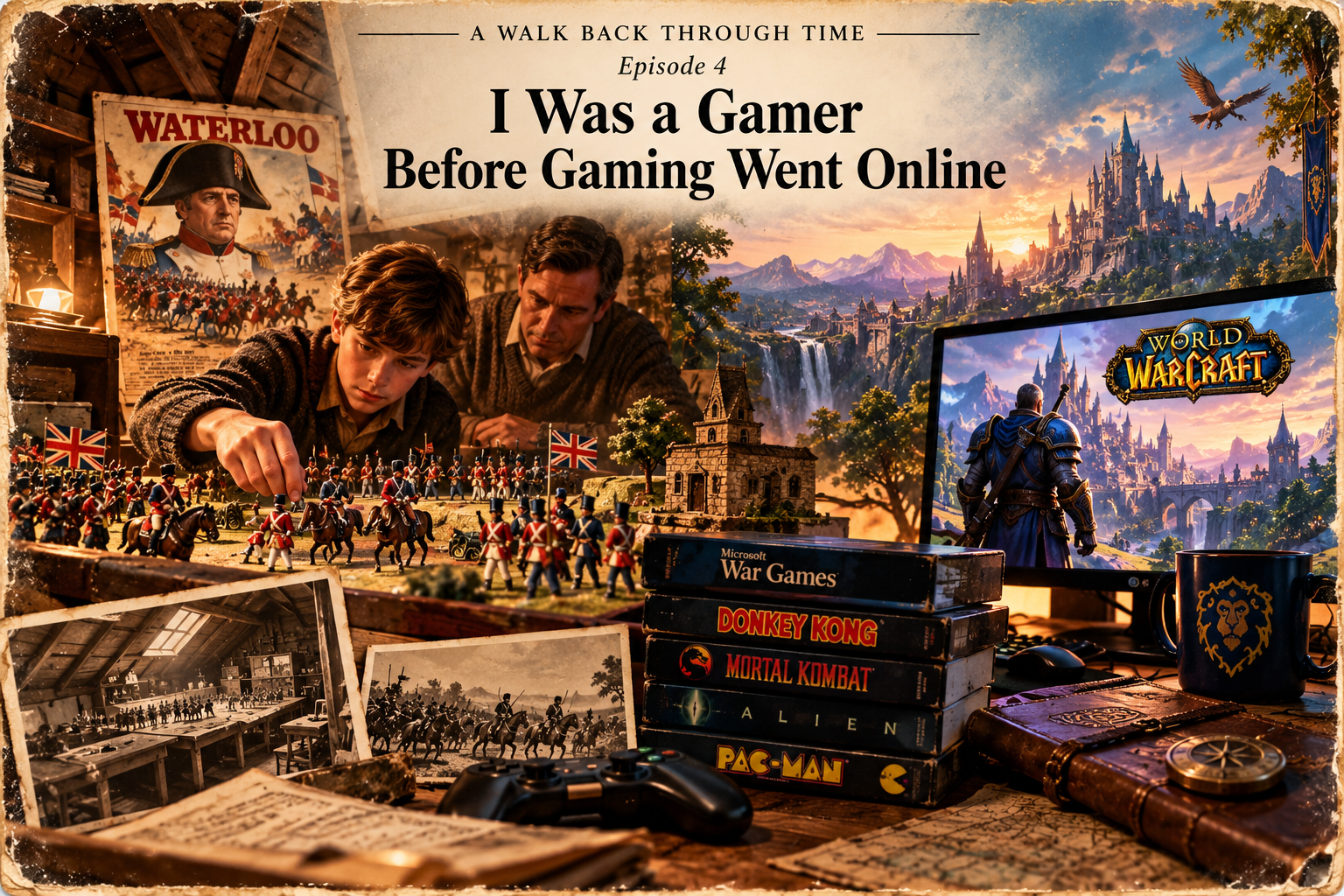
| People are sometimes surprised to learn that I am an online gamer. Perhaps I don’t fit whatever picture they have in their mind. I’m a professional gardener, and much of my working life now revolves around gardens, plants, soil, wildlife and running a gardening business. Yet when I have some genuinely free time, I might disappear into World of Warcraft for a while. The funny thing is that I don’t think of this as particularly unusual. From my perspective, gaming didn’t suddenly arrive in my life when computers did. I’ve been disappearing into constructed worlds for around fifty years. The technology has changed beyond anything I could have imagined when I started, but I’m not entirely convinced that the attraction has changed nearly as much. My gaming began with military history and tabletop wargaming. One period captured me particularly strongly: the Napoleonic Wars. Part of the attraction was visual. The uniforms were extraordinarily vibrant, with different armies and regiments immediately recognisable by their colours and appearance. Then, when I was twelve, I saw the film Waterloo. The sheer spectacle of those enormous formations and brightly uniformed soldiers moving across the battlefield captivated me. I saw the film again when I was fifteen, by which time my fascination with the period was firmly established. Before long, I had armies of my own. They were mainly 1:32-scale [2.12in] Airfix and Britains figures, and what began relatively modestly grew steadily throughout my teenage years. Eventually, I probably owned around 4,500 figures and pieces. There were French, British, Prussian and Scottish Highlander forces, infantry, cavalry, cannon and assorted buildings. Somewhere amongst them were Napoleon and Wellington themselves, both mounted on horseback. I never painted the figures. That side of modelling didn’t particularly interest me because, as far as I was concerned, these weren’t display pieces. I wanted armies because armies could be used. What interested me was putting them on a battlefield, making decisions, and seeing what happened next. I was drawn to strategy rather than modelling. My father shared my interest in military history, and that gave us something important in common. Dad and I loved one another, as fathers and sons do, but we weren’t particularly close. He wasn’t especially good at being a dad, and I don’t see any reason to rewrite the past to make the relationship tidier than it actually was. Military history and wargaming, however, gave us somewhere we could meet, and that somewhere was often the loft. We would set up battles amongst these armies, although they weren’t necessarily recreations of Waterloo or some other historical engagement. Some were much closer to what we would now call a sandbox battle: we had the armies, the battlefield, the rules, and loads of dice, and then we discovered what happened. Dad tended to favour the French, while I often took the English and Scottish regiments, although neither of us was precious about it and we both enjoyed playing either side. There is something about tabletop wargaming that is hard to explain to someone who’s never been interested in it. You know perfectly well that the cavalry aren’t going anywhere until somebody moves them and that the cannon cannot actually fire, but once a battle begins the tabletop stops being merely a collection of toy soldiers. Decisions acquire consequences. You commit forces somewhere, discover you’ve left yourself vulnerable somewhere else and begin trying to anticipate what the person sitting opposite you is going to do. Thousands of figures aren’t necessary, of course, although they certainly add to the spectacle. Looking back, there is an obvious connection with another passion I’ve already written about in this series: model villages. I have always responded strongly to visual worlds that I can look into, explore and understand. With the Napoleonic armies, there was another ingredient. I wasn’t simply looking at the miniature world. I could manipulate it, organise it and change what happened within it. For several years those armies grew alongside me, and then they disappeared. I was moving house, and the collection had been packed into boxes. A friend helping with the move forgot to load them, and the boxes were left behind. When we returned for them, they were gone. Years of collecting disappeared because of something as ordinary as boxes left in the wrong place. I don’t want to retrospectively attach some enormous emotional significance to the loss that I don’t specifically remember feeling at the time. What I do know is what disappeared: thousands of pieces accumulated throughout my adolescence, and with them the physical remains of countless battles fought with my father in the loft. Gaming itself, however, wasn’t finished with me. A considerable gap passed before electronic gaming really took hold. I didn’t begin playing heavily until the early 1990s, with games such as Donkey Kong, Mortal Kombat, Alien and Pac-Man. Over the years, I tried hundreds of games across all sorts of genres. My interests have always been fairly eclectic, although military history, strategy, and micro-management games have repeatedly pulled me back. By the early 2000s I was playing Microsoft war games on my own desktop computer, and something familiar had returned. The soldiers were now pixels rather than plastic, but once again I could look at a battlefield, make decisions and see what happened because of them. The physical armies had disappeared, but the fascination with strategy hadn’t. Then I encountered World of Warcraft. My memory of exactly how I first played it through a friend’s setup has blurred over more than twenty years, and I’m not going to manufacture details to make the story neater. What I remember is playing through my friend’s setup initially and starting as Horde. Eventually I got the ten-day trial in 2005, played it, loved it, and bought the original World of Warcraft. That began a relationship with one game that has now lasted, with interruptions, for more than twenty years. I subsequently bought almost every expansion. I started in Horde, eventually switched to Alliance, spent another period back in Horde, then returned to Alliance, where I have largely remained. My early years were very different from how I play today. World of Warcraft was genuinely social for me. There were guilds and communities, grouping, raids, conversations and friendships. Some became actual friendships rather than simply names attached to characters on a screen. For a period of my life, logging into WoW wasn’t simply entering a game. It meant entering a community in which I knew people and people knew me. I also quickly discovered that I understood its economy. In the early years, when many players found accumulating gold remarkably difficult, I found it remarkably easy. I farmed, traded, flipped items and dealt in transmog, sometimes making hundreds of thousands of gold through those activities. Eventually I accumulated something like ten million gold. Perhaps that shouldn’t be surprising. For somebody who had enjoyed strategy and micromanagement since childhood, the economy was simply another system to understand. There were patterns, opportunities and decisions, and I enjoyed working them out. Eventually, I decided to leave WoW and gave away about ten million gold to friends. That should probably have been the end of the story. Curiously, although I stopped playing for a period, I continued paying my subscription. I tried other online MMORPGs, never particularly liked them, and eventually wandered back into WoW. Almost inevitably, I started accumulating gold again. Today I have around three million and in today’s game, that’s not a lot. I don’t particularly need it, and l no longer specifically play to make gold; I play to enjoy the game itself. The gold? It’s there for a rainy day. Something else changed over the years, though gradually rather than through a conscious decision. The highly social player became increasingly solitary. Life changed, the times when I could get online changed, and people drifted apart. The guild communities and friendships belonged to a particular period of my life, and eventually my relationship with the game evolved into something quite different. These days, my style of play is best described as a hard-core soloist, which is remarkably accurate. Hard-core soloists aren’t necessarily people who only dip into the easy or solitary corners of the game. We enjoy as much content as we can, but tend not to belong to guilds, interact very little with other players, and often have few, if any, in-game friends. We experience this enormous shared world largely on our own. That suits me perfectly now. I have 32 characters and can choose whichever one appeals to me. I can revisit old content, explore places I haven’t seen for years, collect something, finish something I missed or wander around. There doesn’t always have to be an objective anymore. I don’t need to keep pace with everybody else, get richer, or prove I’ve completed the latest content. In fact, Suze has wanted to buy me the newest expansion as a belated birthday present, and I’ve deliberately held off. Earthly Comforts has become so busy that I don’t feel I have the time to give a new expansion the concentration it deserves. When I have a few spare hours, I’d rather choose one of the characters I already have and disappear into somewhere familiar. When I take a longer break from WoW, I tend to return to The Witcher 3 or Fallout 4. They are very different games, but when I look at them alongside everything that came before, I can see the common threads: large visual worlds, exploration, collecting, character development, decision-making and, particularly with Fallout 4, building and micromanagement. There is another reason gaming has remained important to me. Gaming and writing are the two places where I tend to find a kind of therapy, although they achieve it in almost opposite ways. Writing lets me take thoughts, memories, and ideas out of my head, examine them, and put some order around them. Gaming lets me step away from those thoughts for a while and go somewhere else. Perhaps that also helps explain why playing alone suits me so well now. Much of everyday life involves people, decisions, responsibilities and things that need sorting out. Writing requires nobody else to be present, and neither does the way I play games now. I can sit down and write, or choose one of my characters and disappear into another world for a few hours. Both give me a space where the normal noise of life becomes quieter. Perhaps that’s why I find the expression online gamer slightly misleading when it is applied to me. The online part arrived relatively late. I was already a gamer. When I first started, the world existed physically in front of me. Thousands of soldiers, cavalry, and cannon stood there, and if the French were going to advance across the battlefield, my father had to move them physically. Today the landscape can stretch beyond the horizon. Entire worlds exist beyond the edge of the screen, and the people I encounter might be sitting at computers thousands of miles away. The technology would have been almost unimaginable to the boy sitting amongst those Napoleonic armies, but I think he would have understood what I was doing. He would recognise the pleasure of entering another world for a while. He would understand wanting to explore it, organise things within it, collect things, make decisions and discover what happens next. Most of all, I think he would recognise that peculiar satisfaction of being visually surrounded by a world that exists partly because somebody created it and partly because your imagination agrees to enter it. Perhaps he’d be astonished that one day his thousands of plastic soldiers would be replaced by entire worlds contained inside a computer. I’m not sure he’d be remotely surprised that I was still playing. Those armies disappeared decades ago. The loft belongs to another time. Dad belongs to another time. The friends I once knew in WoW have largely moved on, just as I did, and even the digital worlds themselves have changed repeatedly. Yet the thread running through it all remains remarkably intact. Once, I could disappear for hours into a battle fought across a tabletop or a loft. Today, I can choose one of 32 characters and disappear for a while into an entirely different world. I didn’t become a gamer when gaming went online. Gaming grew up alongside me. |
| About our writing & imagery Most articles reflect our real gardening experience and reflection. Some use AI in drafting or research, but never for voice or authority. Featured images may show our photographs, original AI-generated artwork, or, where stated, credited images shared by others. All content is shaped and edited by Earthly Comforts, expressing our own views |

