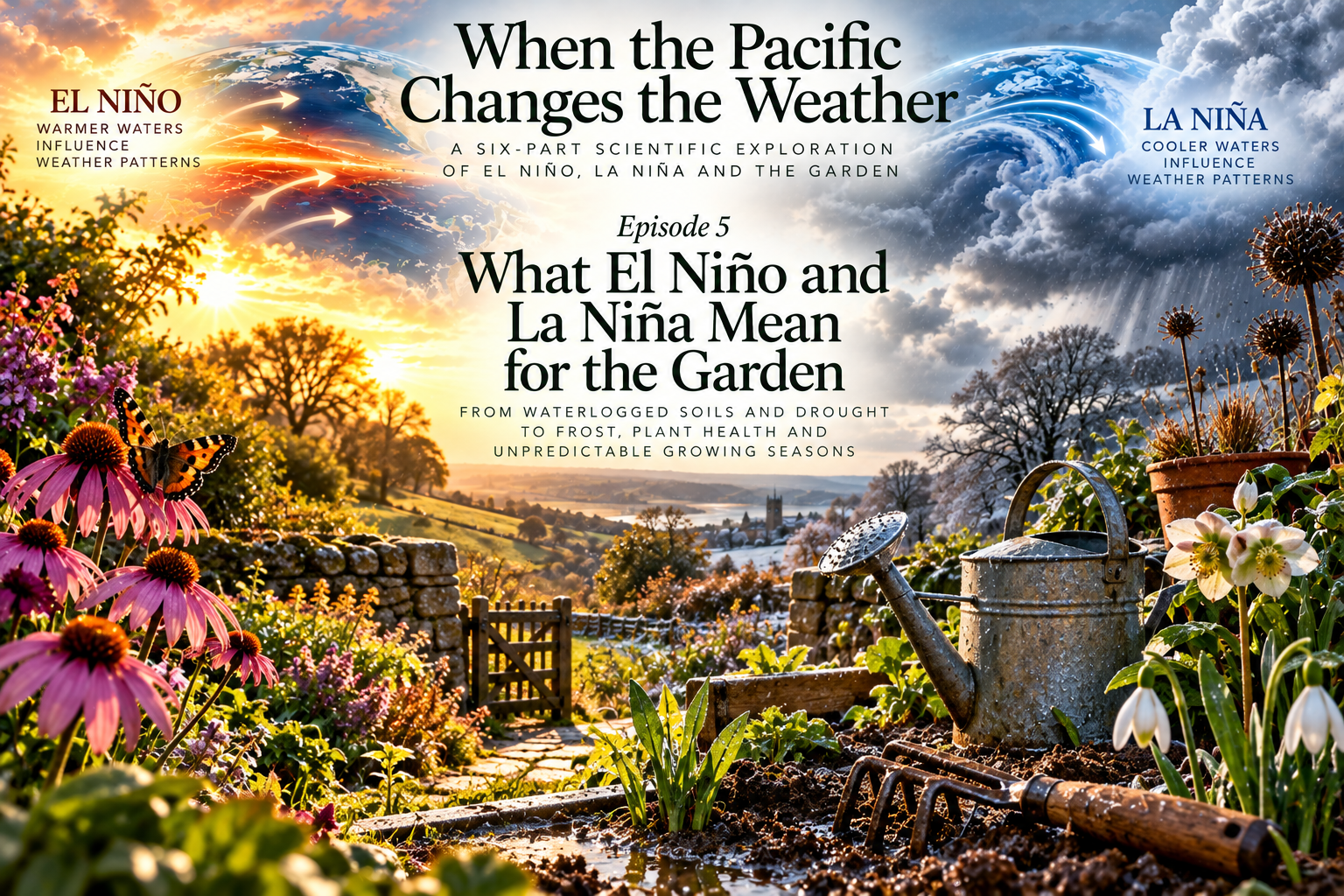
| Episode 5 What El Niño and La Niña Mean for the Garden |
| A particular frustration is familiar to anyone who has spent years working in gardens. You can prepare a border beautifully, improve the soil, select plants suited to the location and carry out every task at what appears to be the appropriate time, only to discover that the weather has other ideas. A winter that refuses to dry out is followed by a spring that arrives three weeks early; a sudden frost damages the new growth. By July you are standing in the same border wondering how soil that was almost liquid in February has become hard enough to resist a garden fork. Gardening has never been an exact science, no matter how much we might wish otherwise. It is an occupation in which knowledge, observation and experience continually meet circumstances beyond our control. We can influence the conditions in which plants grow, but we cannot command the atmosphere, persuade the rain to arrive on schedule or prevent a cold night simply because the fruit trees have begun flowering. Throughout this series, we have followed the remarkable relationship between the tropical Pacific Ocean and the atmosphere. We have explored El Niño, La Niña and the vast circulation systems through which changes in ocean temperatures can influence weather far beyond the Pacific itself. We have also examined the uncertainties surrounding Britain’s response and the ecological consequences that follow when seasonal conditions depart from their familiar patterns. Now we reach the garden itself, where those wider processes become practical problems involving soil, plants, roots, water and the decisions gardeners make. Before going further, however, we must keep an essential distinction in mind. Neither El Niño nor La Niña provides a reliable forecast for an individual British garden. Their influence on our weather is indirect, variable and affected by numerous other atmospheric processes. What we can examine with much greater confidence is how gardens respond to the kinds of conditions that ENSO may sometimes help make more or less likely. And those responses are often rather more complicated than they first appear. The trouble begins beneath our feet. When gardeners discuss weather, the conversation usually begins with what is happening above ground. We notice the rain, complain about the wind, welcome the sunshine and worry about frost. Yet many of the most important consequences of unusual weather develop below the soil surface, where they may remain invisible until a plant begins showing signs of distress. Consider a prolonged wet winter. At first glance, the problem seems straightforward: there is too much water. Lawns become soft, borders are difficult to work, and the familiar sight of standing water suggests that the ground has reached its limit. But the difficulty is not merely the presence of moisture. Healthy soil contains spaces between its particles and aggregates, allowing water and air to move through the ground. Plant roots require oxygen for respiration, the process that releases energy needed for growth, nutrient uptake and other essential functions. When these spaces remain filled with water for prolonged periods, oxygen becomes increasingly scarce. The consequences can be serious. Roots may cease functioning efficiently, nutrient uptake becomes restricted, and susceptible tissues can begin to die. Certain root diseases may then exploit the weakened plant, although waterlogging itself can already cause considerable damage. This explains one of gardening’s more deceptive sights: a plant that appears to wilt while surrounded by wet soil. The instinct might be to assume that wilting means insufficient water. Yet, the roots may be so badly affected by oxygen deficiency that they can no longer absorb the moisture available to them. The above-ground symptoms can therefore resemble drought even when the underlying problem is the opposite. Not every plant responds equally. Willows and some moisture-loving irises possess adaptations that allow them to tolerate conditions unsuitable for many other garden plants. Lavender, rosemary, and numerous plants associated with freely draining habitats are generally much less forgiving of prolonged winter saturation. The difference between moist soil and waterlogged soil matters. A plant may thrive where moisture is consistently available while suffering badly if its roots remain deprived of oxygen. That is why understanding a garden’s structure and drainage can be more useful than knowing how much rain has fallen across the county. When a wet winter creates a dry summer problem One less obvious consequence of waterlogging is that it can leave plants more vulnerable when dry weather eventually arrives. A shrub that has lost part of its root system during winter may appear to recover as temperatures rise and new leaves emerge. Yet the plant’s ability to obtain water can remain impaired. When summer brings increased evaporation and transpiration, its reduced root system may struggle to meet the demands of the above-ground foliage. The gardener then faces an apparent contradiction. A plant damaged by excessive moisture during winter becomes unusually susceptible to drought during summer. This is not uncommon, particularly where prolonged saturation has caused significant root injury. Recovery depends upon the species, the severity of the damage and whether conditions allow healthy new roots to develop. Soil structure can make the situation worse. Repeatedly walking or operating machinery on wet ground compresses the spaces between soil particles, particularly in vulnerable clay soils. The resulting compaction restricts drainage, reduces aeration and can make root penetration more difficult. Once the soil dries, the compacted areas may become hard and resistant to water infiltration. Heavy clay can also shrink and crack during dry weather, producing a garden that alternates between winter saturation and summer drought. It is tempting to regard these as two separate seasonal problems. In reality, they may be different expressions of the same underlying soil conditions. The practical lesson is simple but frequently inconvenient: sometimes the best thing a gardener can do is stay off the ground. Working saturated soil merely because the calendar says it is time to cultivate can create structural damage that persists long after the immediate wet weather has passed. Drought is not simply the absence of rain. Now imagine a different sequence. Spring rainfall has been limited, temperatures rise steadily, and the ground begins drying earlier than expected. By the time summer arrives, established plants are already drawing upon moisture reserves that would ordinarily last considerably longer. Visible symptoms may include wilting, reduced growth, scorched leaf margins, and premature leaf fall. But the processes responsible begin before these signs become obvious. Water moves from the soil through plant roots and into the leaves, where much of it eventually escapes into the atmosphere through transpiration. As the soil dries, obtaining that water becomes increasingly difficult. Plants respond with physiological mechanisms that reduce water loss, including partial stomatal closure. These responses help protect the plant, but they come at a cost. Stomata also allow carbon dioxide to enter the leaves, and restricting that exchange can reduce photosynthesis. Growth slows, and the plant may devote more resources to survival than to producing flowers, fruit, or new foliage. Different plants use different strategies to cope with limited moisture. Some have extensive root systems that can explore a considerable volume of soil. Others possess small, leathery or hairy leaves that help reduce water loss. Certain herbaceous perennials survive dry periods by allowing their above-ground growth to die back while retaining living underground structures. Yet drought tolerance does not guarantee survival. A plant adapted to relatively dry conditions may still suffer if the drought is sufficiently severe, particularly before its root system has become established. This distinction matters enormously when selecting plants for British gardens. A lavender planted in freely draining soil may cope well with a dry summer, but that same lavender may struggle through a prolonged wet winter. An astilbe may appreciate reliable moisture yet suffer considerably if planted in a border that becomes exceptionally dry. The most successful planting choices therefore account for the full annual range of conditions, not merely the weather that happens to be causing trouble when the plants are purchased. The remarkable importance of an established root system Garden centres understandably sell plants for their visible qualities. We admire the flowers, consider the eventual height and spread, examine the foliage and imagine how a particular specimen might transform an empty border. But the part of the plant we cannot see often determines whether it will survive a difficult season. An established root system gives a plant access to more soil, increasing its chances of obtaining moisture and nutrients. It also provides anchorage and, in many species, stores reserves that support recovery after seasonal stress. Newly planted specimens do not yet possess these advantages. Their roots may remain concentrated within the original container compost or recently disturbed planting area, leaving them dependent upon a comparatively small supply of accessible moisture. This explains why newly planted trees and shrubs often require careful watering even when mature examples of the same species are considered drought tolerant. A well-established shrub may endure several weeks without significant rainfall, while an identical specimen planted only a few months earlier begins wilting after a much shorter period. There is also an important difference between encouraging roots to establish and repeatedly supplying small quantities of water to the soil surface. Shallow watering may moisten only the uppermost layer, leaving deeper portions of the root zone dry. Thorough watering, applied at appropriate intervals according to the soil and plant, is generally more effective. The objective is not to keep the ground permanently wet. It is to provide sufficient moisture for healthy root development while allowing the soil to retain the aeration necessary for normal growth. This balance matters most during unpredictable seasons, when excessive watering can be almost as unhelpful as neglect. When the seasons arrive in the wrong order Gardeners often speak of early springs and late winters, but the real difficulty is frequently the order in which weather events occur. Imagine a mild February encouraging a magnolia to develop its flower buds ahead of the usual schedule. The gardener begins anticipating a particularly splendid display. Then a sharp frost arrives in March, and the petals turn brown before the flowers have properly opened. The problem is not that frost is unusual in March. The problem is that the plant’s development has advanced far enough for vulnerable tissues to be exposed. A similar sequence can affect fruit trees. Apples, pears, plums, and cherries have flowering periods that vary by species, cultivar, and local conditions. Warmth may encourage earlier flowering, but a subsequent frost can damage blossoms and reduce fruit set. The extent of the damage depends upon the developmental stage of the flowers, the minimum temperature reached, the duration of exposure and the characteristics of the plant itself. No single temperature destroys every flower. Some tissues tolerate brief exposure to temperatures that would damage others, while sheltered parts of a garden may experience different conditions from exposed areas only a short distance away. This brings us to the importance of microclimate. A south-facing wall can accumulate warmth and encourage earlier growth, but it may also increase the risk of frost damage if tender growth begins too early. A sheltered courtyard may retain heat, while a low-lying part of the garden becomes a collection point for cold air on still, clear nights. Even on a relatively small property, the same weather event can have very different consequences. For the gardener, this means that understanding exposure, shelter, slope and the behaviour of cold air can be as important as knowing the forecast minimum temperature. Heat changes the rules of the garden. Heat and drought are often discussed together, but they are not the same problem. A garden can experience very high temperatures while adequate soil moisture remains available. Conversely, a prolonged drought can develop without exceptional heat. When both occur together, however, plants may face particularly demanding conditions. High temperatures increase evaporative demand, especially when accompanied by strong sunshine, low humidity or wind. Plants can lose water rapidly, and their ability to replace that loss depends upon soil moisture and root function. Heat can also directly affect plant physiology. Photosynthesis and respiration respond differently to temperature, and prolonged exposure beyond a species’ tolerance can damage tissues, impair reproductive processes and reduce growth. Flowers may fade more rapidly, pollen viability or fertilisation may be affected in susceptible crops, and tender leaves may scorch. Containers are particularly vulnerable because their limited volume of growing medium can dry quickly and experience substantial temperature fluctuations. Dark pots exposed to direct sunshine may become considerably warmer than surrounding garden soil, adding stress to root systems. The familiar practice of moving vulnerable containers into temporary shade can therefore be valuable during extreme heat. So can reducing unnecessary disturbance, avoiding heavy pruning during severe stress and ensuring that watering reaches the root zone rather than merely wetting the foliage. Yet no single response fits every plant. A drought-adapted perennial in well-drained soil may need little intervention, while a newly planted hydrangea nearby requires close attention. Good gardening is rarely about applying the same treatment everywhere. Wind, rain and the damage we overlook Rainfall and temperature receive most of our attention, but wind deserves a place in any discussion of difficult gardening seasons. Strong winds can physically damage plants, breaking stems, tearing foliage and uprooting trees where anchorage is inadequate. Even without obvious damage, persistent wind moves moisture away from leaf surfaces, potentially accelerating water loss. This becomes particularly important during dry weather, when plants are already struggling to replace moisture lost through transpiration. Winter winds can also contribute to evergreen foliage desiccation. On cold days, roots may be unable to replace water lost from exposed leaves, especially when the ground is frozen or root activity is restricted. Salt-laden winds introduce another challenge in coastal gardens, where exposed foliage can suffer injury and planting choices must account for conditions that differ substantially from those experienced inland. Heavy rainfall creates its own physical problems. Intense downpours can erode exposed soil, dislodge seedlings and flatten unsupported growth. Water may run rapidly from compacted surfaces rather than soaking into the ground, particularly where rainfall intensity exceeds the soil’s infiltration capacity. As a result, a garden can experience substantial rainfall without receiving the full benefit of that water in its root zones. These examples demonstrate why total rainfall figures tell only part of the story. Twenty millimetres falling gently over many hours can have a different effect from the same quantity arriving during a brief, intense downpour. For the gardener, how weather occurs may matter almost as much as the amount recorded. The temptation to choose plants for the last bad year After a particularly difficult season, it is natural to want to prevent the same problems happening again. A wet winter may persuade a gardener to reconsider plants that dislike saturated soil. A drought may encourage replacing thirsty plants with species better adapted to dry conditions. After severe frost damage, you may pay more attention to hardiness and shelter. There is considerable sense in learning from experience. Problems arise when one unusual year becomes the sole basis for every future decision. A garden designed entirely around drought tolerance may contain plants that struggle through prolonged winter waterlogging. A planting scheme selected exclusively for damp conditions may perform poorly during an exceptionally dry summer. The challenge is not to identify a single future climate and plant accordingly. It is to recognise the range of conditions a particular garden may experience and select plants that can cope with that range. This does not mean every plant must tolerate everything. Such a garden would be difficult to achieve and would unnecessarily restrict the extraordinary variety available to us. Instead, it means matching plants to the conditions of individual locations, improving soil where appropriate and recognising which areas naturally favour particular types of planting. A low-lying border that remains moist may be an excellent home for moisture-loving perennials. At the same time, a sunny, freely draining bank offers opportunities for plants that would be unhappy in heavier ground. Trying to make every part of a garden behave identically often creates more work than allowing its natural differences to guide the planting. Can we prepare a garden for El Niño? We can now return to the question that has accompanied us throughout this series. If El Niño or La Niña develops in the Pacific, should a British gardener change their plans? The scientifically responsible answer is that the ENSO phase alone is not enough to make major gardening decisions. ENSO can influence seasonal weather probabilities, but its effects on Britain vary considerably. The North Atlantic Oscillation, jet stream behaviour, stratospheric processes and other atmospheric influences can reinforce, weaken or overwhelm any ENSO-related signal. Even when seasonal forecasts indicate a higher likelihood of particular conditions, they cannot tell us whether a specific garden will experience damaging frost, prolonged waterlogging, or a summer drought. A forecast suggesting a greater chance of a wetter-than-average season does not mean that every week will be wet. Nor does it tell us whether rain will fall gradually, arrive in a few intense events or affect all parts of Britain equally. It would therefore be unwise to undertake expensive drainage works, remove established plants or substantially alter a planting scheme solely because an El Niño event has been announced. ENSO information provides a broader understanding of the climate system and the factors contributing to seasonal uncertainty. For practical gardening, local observations remain indispensable. Soil conditions, exposure, drainage, plant establishment and the weather actually experienced are the evidence upon which immediate decisions should be based. The Pacific may influence the atmosphere, but it does not know whether the ground beside your greenhouse is compacted clay. A garden’s greatest strength is its ability to recover. One final aspect of difficult weather deserves attention: recovery. Plants are not passive objects that endure favourable or unfavourable conditions. They possess a remarkable range of responses that allow them to survive damage, redirect growth and take advantage of improving circumstances. A herbaceous perennial may lose its foliage during drought yet survive through its underground crown. A shrub damaged by frost may produce new shoots from surviving buds. A lawn that has become brown during a dry summer may recover when sufficient moisture returns, provided its growing points and roots remain alive. But recovery is not automatic, and it is rarely without cost. A plant that has exhausted substantial reserves surviving one stressful period may be less able to cope with another. Repeated droughts, prolonged waterlogging or successive episodes of damage can gradually reduce vigour, even where no single event appears catastrophic. This cumulative effect is easily overlooked. A tree may continue producing leaves for several seasons while its overall condition deteriorates. A shrub may flower less freely after repeated stress, and a perennial that once formed a vigorous clump may gradually become smaller. The gardener who notices these changes early is better positioned to respond than one who considers each season in isolation. Recovery also depends upon restraint. Heavy feeding does not necessarily repair a damaged root system, and severe pruning may remove foliage a recovering plant still needs. Sometimes the most useful intervention is to improve growing conditions, remove clearly dead material when appropriate and allow the plant time to rebuild its reserves. There is considerable horticultural wisdom in recognising when intervention is necessary and when patience is the better course. What the Pacific has taught us about our gardens At first, the idea that changes in the tropical Pacific Ocean might have anything to do with a British garden seems almost absurd. The distances are enormous, the atmospheric mechanisms complicated, and the weather experienced in Britain influenced by forces much closer to home. Yet the connection is scientifically meaningful. Changes in tropical ocean temperatures can influence atmospheric circulation, and atmospheric circulation shapes the conditions plants and gardeners experience around the world. The difficulty lies in treating that connection as a prediction rather than an influence. El Niño does not instruct a particular garden to become wet, and La Niña does not guarantee a cold winter or a dry summer. Neither event determines whether the roses will flower well, the lawn will recover, or the apple blossom will escape frost. Those outcomes depend upon a complicated combination of weather, soil, plant biology, local conditions and previous seasons. What the study of ENSO offers gardeners is something more valuable than a supposed shortcut to predicting the weather. It reminds us that the atmosphere is connected, that seasonal conditions vary, and that the garden continually responds to influences operating on scales far beyond its boundaries. The practical response is not to chase every forecast or redesign the garden whenever a climate pattern changes. It is to understand the vulnerabilities of the ground we cultivate, the requirements of the plants we grow and the consequences of the weather that actually arrives. We began our journey thousands of miles away, in the warm waters of the tropical Pacific. We have followed the movement of heat through the atmosphere, considered the uncertain consequences for Britain and examined the responses of wildlife, soil and plants. Now only one question remains. If we cannot know with confidence what the next gardening year will bring, how should we plan? In the sixth and final episode, we will explore the practical meaning of resilience: how soil management, plant selection, water conservation, seasonal flexibility and thoughtful observation can help us create gardens better equipped to withstand uncertainty. Because the greatest lesson of this entire journey may be surprisingly simple. Don’t prepare the garden for the forecast. Prepare it for uncertainty. Next: Episode 6 — Gardening for an Uncertain Year |
| The Science Behind the Garden For readers wishing to explore the horticultural principles discussed in this episode, the Royal Horticultural Society provides detailed, practical guidance. RHS — Waterlogging and Flooding How saturated soils affect root respiration, plant health and recovery. RHS — Plants for Seasonally Wet and Dry Soils Choosing plants for gardens that experience both winter saturation and summer drought. RHS — Watering Plants Wisely Understanding root-zone moisture, establishment and efficient watering practices. RHS — Drought-Resistant Gardening Plant selection, soil preparation and approaches to managing prolonged dry weather. RHS — Plants with Low Water Use Research-led guidance distinguishing low water consumption from genuine drought tolerance. |
| About our writing & imagery Most articles are grounded in our real gardening experience, observations and reflections. AI may assist with research, drafting and editing, but the experiences, opinions and editorial direction are our own. Featured images may include our photography, original AI-generated visuals or, where stated, images credited to others. All published content is reviewed and shaped by Earthly Comforts before publication. |

