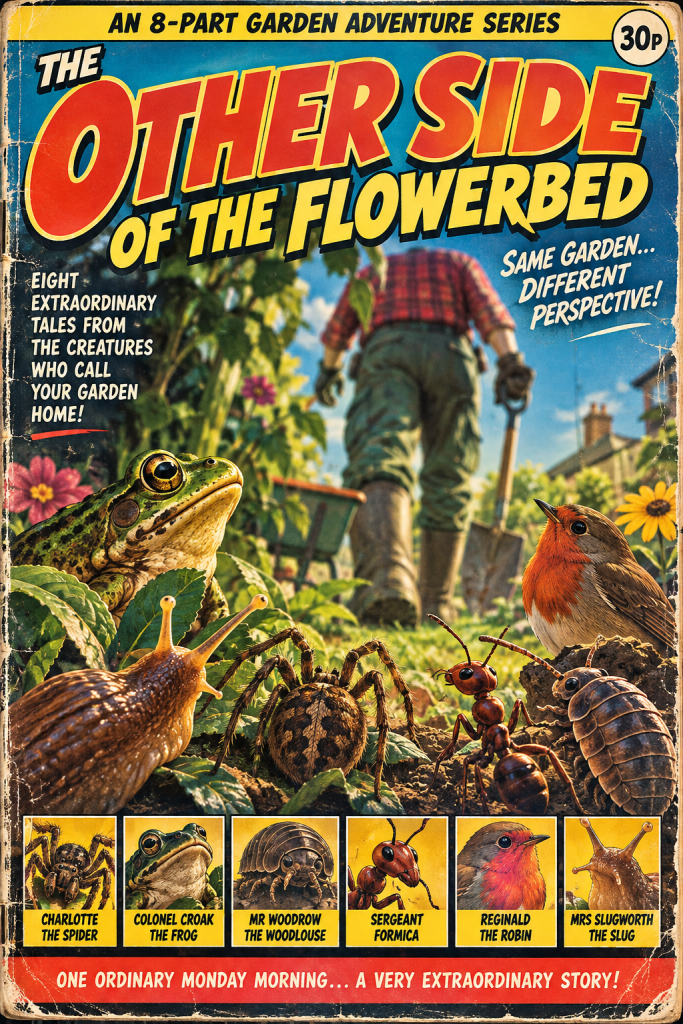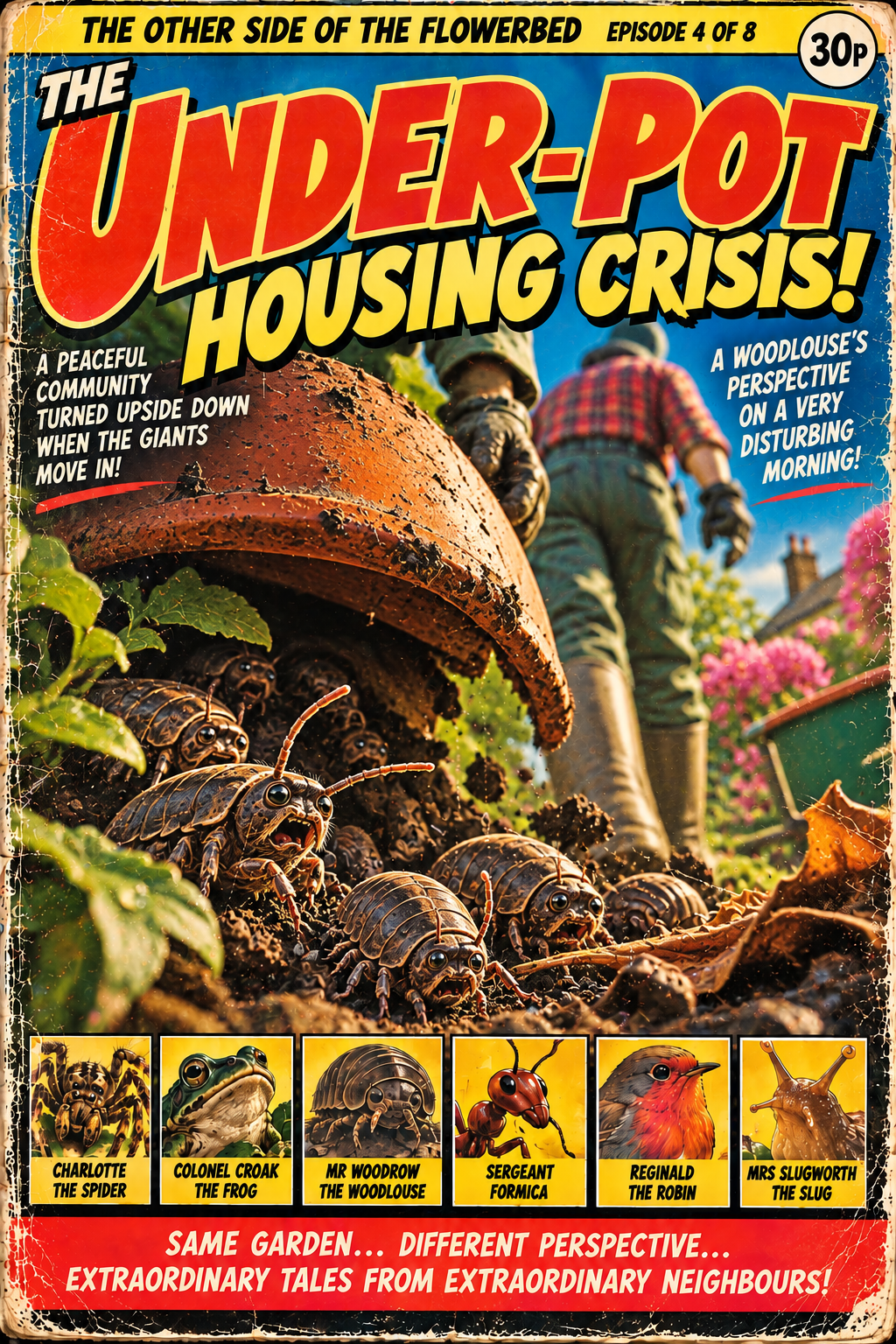
| Episode 4 The Under-Pot Housing Crisis! |
| Of all the residential arrangements available in the garden, Mr Woodrow considered life beneath a terracotta flowerpot among the most civilised. Some preferred the unpredictable shelter of fallen leaves, others made their homes beneath stones, and a considerable number of creatures seemed perfectly content to wander about without any permanent address whatsoever. Mr Woodrow regarded such arrangements as evidence of a regrettable decline in residential standards. A properly positioned flowerpot, by contrast, offered security, dependable moisture, protection from direct sunlight and, most importantly, a clearly defined boundary between one’s own accommodation and the wider world. It was an environment in which a respectable woodlouse could establish a home, raise a family and conduct the occasional committee meeting without being interrupted by every passing beetle. The particular flowerpot beneath which Mr Woodrow resided had occupied its position beside the wooden shed for longer than most of its inhabitants could remember. Its broad terracotta base rested upon a slightly uneven patch of soil, leaving several narrow entrances around the perimeter through which residents could come and go. Over time, moisture had accumulated beneath the pot, creating a comfortable environment of damp earth, decaying vegetation and the occasional fragment of moss. To the enormous two-legged creatures who visited the garden, it was simply an old flowerpot containing a rather neglected plant. To the woodlice beneath it, however, it was a substantial residential development with established boundaries, several generations of occupants and a surprisingly complicated system of informal property rights. Mr Woodrow had taken it upon himself to bring order to this arrangement. As chairman of the Under-Pot Residents’ Association, he maintained that all matters affecting the community should be discussed through appropriate channels, preferably at meetings conducted according to an established agenda. He introduced a voluntary system of residential registration, proposed a schedule for maintaining entrance passages, and attempted, without much success, to regulate the accumulation of decaying leaves in communal areas. Most residents tolerated these initiatives with varying degrees of patience, although several had quietly observed that the community had functioned perfectly well before Mr Woodrow began organising it. The chairman, naturally, regarded such comments as evidence of resistance to progress. On the morning of the Giant’s arrival, the association had already been discussing moisture distribution when the first vibrations passed through the soil. Mr Woodrow initially tried to continue proceedings, insisting that external disturbances should not interfere with established administrative processes. Unfortunately, the growing rumble from beyond the garden boundary, followed by the unmistakable sounds of the Giant entering the property, made further discussion impossible. Several residents had abandoned the meeting altogether, while others had begun demanding assurances that the roof would remain in place. Mr Woodrow had provided those assurances without hesitation. “The structure is perfectly secure,” he announced, addressing the remaining occupants from a slightly raised piece of bark. “This flowerpot has stood in its present position for a considerable period, and I see absolutely no reason to suppose that its circumstances are about to change. We must not allow ourselves to be influenced by alarmist speculation.” An elderly woodlouse named Mrs Crumble, who had lived beneath the pot for several seasons and possessed a distinctly practical outlook, suggested that the Giant might have other ideas. She reminded the chairman that humans occasionally moved objects around the garden, sometimes for reasons that were entirely incomprehensible to those living beneath them. “That may be so,” Mr Woodrow replied, “but any proposed alteration to an established residential property ought to involve proper consultation. There are procedures to consider, not to mention the rights of existing occupants.” Mrs Crumble observed that the Giant had never shown the slightest interest in their procedures, but Mr Woodrow dismissed the objection as unnecessarily pessimistic. He was preparing to resume the original agenda when a sudden vibration travelled through the earth, causing several loose fragments of soil to fall from beneath the pot. The chairman paused. A second tremor followed, accompanied by the heavy thud of an enormous boot landing nearby. Mr Woodrow glanced towards the narrow entrance and experienced the first uncomfortable suggestion that his assurances might have been premature. Outside, the Giant had completed some work among the shrubs and was making his way towards the shed. The collection of flowerpots beside it had gradually grown untidy, with weeds between the containers and several plants needing attention. One pot in particular had settled awkwardly into the soil, and the gardener decided that moving it temporarily would allow him to clear the weeds and improve the arrangement. It was a perfectly ordinary decision, made without the slightest awareness that the object in question contained an entire residential community. Beneath the terracotta roof, Mr Woodrow tried to restore order when the first unmistakable signs of interference appeared. A faint scraping sound came from above, followed by a movement so slight that most residents might have ignored it had the chairman not immediately demanded everyone’s attention. The pot shifted fractionally against the soil, disturbing the carefully accumulated layer of damp earth beneath its rim. “Unauthorised structural activity,” Mr Woodrow announced, trying to maintain a suitably professional tone. “I must insist that everyone remain calm while I investigate the situation.” Before he could investigate anything, the Giant gripped the flowerpot with both hands and lifted it clear of the ground. The effect upon the residents was extraordinary. For creatures accustomed to a world of perpetual shade, the sudden disappearance of their roof was an event of almost unimaginable proportions. Daylight poured across the damp earth, revealing passages, fragments of decaying vegetation and numerous startled woodlice who had never expected to see the open sky from the comfort of their own homes. The familiar ceiling vanished upwards, the protective darkness disappeared, and the entire community found itself exposed to a world considerably larger and brighter than anyone had anticipated. Mr Woodrow stared upwards in disbelief. His roof was leaving. Not leaking, not cracking, not requiring minor maintenance, but physically departing from the premises without permission. For several moments he remained motionless, apparently unable to reconcile the situation with any existing association regulation. Then, regaining enough composure to recognise the seriousness of the emergency, he called for an immediate evacuation. “All residents to the nearest available cover! This is a temporary structural emergency! Please proceed in an orderly fashion and avoid unnecessary congestion at the exits!” Unfortunately, no exits remained, because the entire building had disappeared. Woodlice scattered in every direction, seeking shelter beneath loose leaves, small stones and the neighbouring pots. Some curled themselves into defensive postures, while others hurried towards the darker soil beneath the shed. Mrs Crumble, displaying considerably more practical intelligence than the chairman, immediately made for a damp crevice beside a paving slab and encouraged several younger residents to follow her. Mr Woodrow, meanwhile, remained beside the former meeting area, attempting to establish whether the disaster constituted a breach of tenancy arrangements, an unlawful eviction or a particularly extreme form of property maintenance. Above him, the Giant examined the underside of the pot, brushed away some loose soil and placed it a short distance away. “Bit of a mess under there,” he remarked. Mr Woodrow, who could not understand the words but recognised the tone of casual judgement, was profoundly offended. “A mess?” he exclaimed. “That is an established residential community, you enormous philistine!” The Giant continued clearing the weeds from the exposed patch of soil, carefully working around the small creatures that were still moving towards shelter. He had noticed the woodlice and understood perfectly well why they had gathered beneath the pot. Damp, protected spaces were precisely the sort of places they preferred, and there was no reason to harm them. He needed to tidy the area before returning the container to a more suitable position. Mr Woodrow, however, interpreted the activity as the systematic destruction of the neighbourhood. The Giant’s hand fork entered the soil near the former northern entrance, lifting a small clump of weeds and disturbing several fragments of decaying vegetation. To the chairman, this represented the demolition of a principal access route, the removal of established landscaping, and the destruction of an area recently designated for possible communal improvement. “This is outrageous!” he declared to a passing beetle. “Absolutely outrageous! No notice, no consultation, no environmental assessment and not the slightest consideration for the existing residents!” The beetle glanced towards the enormous gardener and suggested that Mr Woodrow might be better occupied finding somewhere to hide. “Hide?” the chairman repeated indignantly. “I am the elected representative of this community!” “Did anyone elect you?” Mr Woodrow hesitated. “That is an administrative technicality.” The beetle decided not to pursue the matter and disappeared beneath a nearby stone. News of the disaster spread rapidly through the surrounding garden. Sergeant Formica received a report that a major residential structure had been removed from the shed district. At the same time, Colonel Croak was informed that the Giant’s latest offensive had displaced an entire civilian population. Charlotte, still occupied with rebuilding her damaged web, heard that the gardener had demolished a substantial building and expressed a certain satisfaction that she was no longer the only resident suffering from human interference. Colonel Croak regarded the incident as particularly serious. He had warned the garden repeatedly about the dangers of relying upon fixed defensive structures, and the removal of an entire flowerpot appeared to confirm his assessment that nowhere was truly secure while the Giant remained at large. He emerged cautiously from beneath the hostas and called towards the scattered woodlice, offering to coordinate a withdrawal to safer ground. Mr Woodrow was not impressed. “We do not require a military evacuation, Colonel. We require immediate reinstatement of the property and a formal explanation from the responsible authority.” The Colonel surveyed the exposed soil, the displaced residents and the enormous creature continuing its work. “Your headquarters has been captured, your defences have collapsed, and your population is scattered. I’d say you require considerably more than an explanation.” “It is not a headquarters,” Mr Woodrow replied sharply. “It is a residential development.” “Not anymore, it isn’t.” Mr Woodrow found this observation deeply unhelpful. As the Giant continued clearing the area, the chairman attempted to gather the remaining members of the association beneath a broad fallen leaf. Attendance was poor, partly because several residents had already found alternative accommodation and partly because attending a committee meeting during an actual emergency struck many as an exceptionally foolish use of their time. Mrs Crumble eventually arrived, accompanied by two younger woodlice who had taken refuge beneath the paving slab. She listened as Mr Woodrow outlined the seriousness of the situation, including the lack of prior notification, the destruction of communal facilities, and the possibility that the entire development might have been permanently removed. “Well,” she said when he had finished, “we could always move under that other pot.” Mr Woodrow regarded her with astonishment. “Move? Without a relocation assessment? Without reviewing the available accommodation? Without considering the long-term implications for the association?” Mrs Crumble looked towards the neighbouring pot, beneath which several woodlice had already settled quite comfortably. “It looks damp enough.” “That is hardly the point!” Mrs Crumble sighed. She had lived through storms, droughts, frosts and several previous encounters with the Giant, and she had developed a healthy appreciation for the practical advantages of simply moving somewhere else when circumstances required it. Mr Woodrow, by contrast, appeared determined to resolve the crisis through a process of administrative deliberation that might well continue until the following season. Before the discussion could proceed, Private Derek arrived carrying a small fragment of dried leaf. Sergeant Formica had dispatched him to investigate the disturbance and report whether the ant colony’s transport routes were likely to be affected. Unfortunately, Derek had been distracted by the unusual gathering beneath the fallen leaf and now stood before the chairman with polite curiosity. “What’s happened here, then?” he asked. “Our entire residential property has been removed without authorisation,” Mr Woodrow explained. Derek looked towards the enormous flowerpot standing a short distance away. “Is that it over there?” “Yes.” “Doesn’t look very far.” Mr Woodrow closed his eyes for a moment. He was beginning to understand why Sergeant Formica so frequently appeared exhausted. “The distance is irrelevant, young man. The principle is what matters. One cannot simply relocate an established community without proper arrangements.” Derek considered this thoughtfully before suggesting that the residents might follow the pot to its new position. He then offered to help by carrying something, though his contribution was limited because most of the displaced woodlice were considerably larger than he was. Mrs Crumble thanked him for his concern and gently suggested that he return to his own duties. Derek departed toward the shed, which was unfortunately the opposite direction from the ant colony. The crisis continued for several more minutes while the Giant finished clearing the weeds. He loosened the compacted soil, removed a few unwanted seedlings and swept away the debris that had accumulated between the pots. The exposed patch now looked considerably tidier, and he decided that the original flowerpot would be better positioned slightly farther from the shed, where the plant inside would receive a little more light. He lifted the container once more. Mr Woodrow watched in horror as the enormous terracotta structure rose above the garden, moved through the air and descended towards its new position. The pot settled upon the soil with a gentle thud. Silence followed. Then Mrs Crumble, who had been observing from beneath the paving slab, cautiously approached the relocated container. She examined the narrow gap beneath its rim, investigated the damp soil and disappeared into the darkness. A few moments later, she reappeared and announced that the accommodation was perfectly satisfactory. “Quite nice, actually,” she observed. “A little more room underneath, and the soil’s lovely and damp.” Several other residents followed her, exploring the new surroundings with increasing enthusiasm. The Giant had placed the pot upon a slightly uneven patch of ground, creating several convenient entrances, and the soil beneath it offered exactly the kind of sheltered conditions that woodlice preferred. Decaying organic matter lay nearby, the neighbouring vegetation provided additional cover, and the position was sufficiently protected to make the prospect of relocation considerably less alarming than it had first appeared. Mr Woodrow approached reluctantly. He examined the new entrances, inspected the surrounding soil and conducted a brief assessment of the available space. The accommodation was, he had to admit, rather good. The principal chamber offered more room than the previous location, the northern entrance was wider, and there appeared to be excellent opportunities for future development. This presented him with an uncomfortable problem. For most of the morning, he had denounced the Giant’s actions as an outrageous assault on residential rights. He had called for emergency meetings, demanded explanations and threatened formal complaints. Yet the result of the disturbance was a new location that might, by any reasonable standard, be considered an improvement. Mr Woodrow disliked being placed in situations where the facts interfered with his principles. He therefore decided the relocation could not be considered acceptable until the association properly reviewed it. “Naturally,” he announced to the returning residents, “we cannot simply approve these arrangements without due consideration. There will need to be an inspection, a review of access points and a formal assessment of moisture conditions.” Mrs Crumble looked around the comfortable new shelter. “Seems all right to me.” “That is not the issue.” “It never is,” she murmured. As the residents gradually settled into their new accommodation, Mr Woodrow began preparing an emergency meeting to consider the relocation’s implications. He proposed establishing a temporary housing committee, appointing an officer to oversee entrance maintenance, and conducting a full review of the association’s procedures in the event of future disturbances. Several woodlice quietly disappeared into the darker recesses of the new shelter before he could assign them any responsibilities. Outside, the Giant finished arranging the flowerpots and prepared to move to another part of the garden. He glanced at the tidied area beside the shed, seemed satisfied with the result, and continued his work. From his perspective, the entire operation had taken only a few minutes. It had involved nothing more complicated than shifting a pot, removing some weeds and putting things back in a better arrangement. Beneath the relocated container, however, Mr Woodrow was still addressing the remaining members of the association. “Let the record show,” he declared solemnly, “that the residents of this development have endured an unprecedented housing emergency, resulting in the temporary loss of their established accommodation and the compulsory relocation of the entire community.” Mrs Crumble, who was already settling comfortably into a damp corner, observed that the new accommodation was rather pleasant and that everyone appeared to have survived without serious difficulty. Mr Woodrow acknowledged this point with considerable reluctance. “Nevertheless, the manner in which the relocation was conducted remains entirely unacceptable. We must establish safeguards to ensure that such an event cannot occur again.” “How?” asked one of the younger residents. The chairman paused. This was an awkward question. The Giant was enormous, apparently immune to committee resolutions and entirely unaware that the association existed. Mr Woodrow had no practical means of communicating with him, no authority over his activities and no realistic prospect of preventing him from moving the flowerpot again whenever the mood took him. After several moments of careful consideration, he announced that he would refer the matter to a special subcommittee. Mrs Crumble sighed and settled deeper into the damp soil. The other residents gradually resumed their customary activities, exploring the new surroundings and investigating the fragments of decaying vegetation that had accumulated nearby. Within a surprisingly short time, the community had returned to something approaching normality. The entrances were being used, the sheltered chambers were occupied, and several younger woodlice had already discovered a particularly promising patch of decomposing leaf material beneath the western edge. Mr Woodrow surveyed the scene with a mixture of relief and professional dissatisfaction. The residents were safe, the accommodation was satisfactory, and the immediate crisis had passed, but he remained troubled by the complete absence of proper administrative procedure. He decided that the association’s next meeting would require a particularly substantial agenda. The agenda would include the relocation review, the moisture-distribution policy, the proposed emergency evacuation arrangements, and the outstanding question of whether the Giant could legally be classified as a landlord. He also intended to revisit his earlier proposal for a residents’ register, which several members had postponed after objecting to the requirement that they provide permanent addresses. For the moment, however, one matter was immediately important. Mr Woodrow climbed onto his familiar piece of bark, cleared his throat and called the meeting to order. “Right, ladies and gentlemen. Item one: approval of the new premises.” Mrs Crumble raised her head from the comfortable patch of damp soil she had just discovered. “Do we really need another meeting?” Mr Woodrow regarded her with genuine astonishment. “My dear Mrs Crumble, we’ve just experienced the greatest housing crisis in the history of this association. Of course we need a meeting.” And beneath the newly positioned flowerpot, in accommodation that was arguably better than the property they had occupied earlier that morning, the residents of the Under-Pot Association settled down to endure what many privately considered the most exhausting consequence of the entire disaster. Another speech from Mr Woodrow. |
| To be continued in Episode 5 — Operation Formica! |
| Wander through the Article Directory and see where curiosity takes you next. |
| Author’s Note The Other Side of the Flowerbed is an original work of humorous fiction. All characters, personalities, dialogue and events are fictional. Any similarity in character names to those appearing in existing literary works or other fictional creations is coincidental and does not imply any connection with, or endorsement by, their respective creators or rights holders. © 2026 Rory Matier. All rights reserved. |
| Story inspired by Sonel of The Creative Soul |