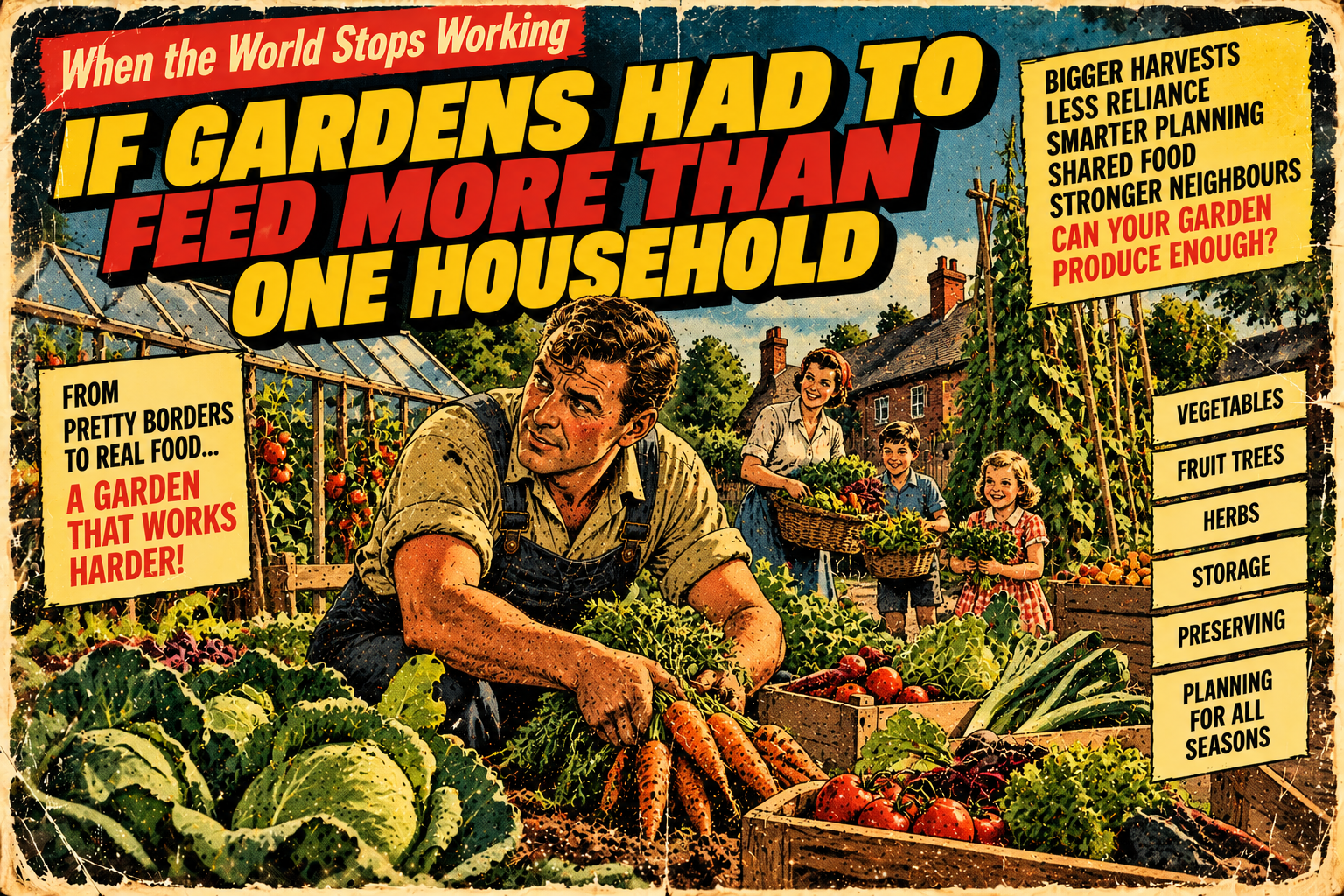
| Most gardens in Britain are no longer expected to earn their keep. We may grow a few tomatoes, some herbs, runner beans or perhaps an apple tree, but for most households the garden is primarily somewhere to enjoy rather than somewhere upon which dinner depends. Even enthusiastic vegetable growers generally have supermarkets sitting quietly in the background. If the potatoes fail, nobody starves. If the courgettes become powdery with mildew, we are disappointed rather than hungry. Gardening for food is therefore something many of us can choose to do, which is very different from needing the garden to produce. But imagine that changed. Food remains available, shops remain open, and this isn’t an apocalypse, but shortages, rising prices, or unreliable supplies mean gardens are suddenly expected to contribute much more seriously. Then add another complication: perhaps the people next door don’t have a usable garden, an elderly relative lives nearby, or another household doesn’t possess enough growing space. The ordinary back garden is no longer being asked to produce a few pleasant additions to one family’s meals. It is expected to help feed two households. The first surprise would probably be how little of many gardens is actually devoted to producing anything edible. We have patios, lawns, sheds, paths, ornamental borders, hedges, trees and perhaps an area occupied by children’s equipment or garden furniture. None of those things is inherently wasteful; gardens have many purposes beyond food production. But if somebody suddenly asked how many meals the average garden could provide over the next twelve months, the answer might be rather less impressive than its size suggested. That doesn’t mean the lawn would immediately have to disappear beneath rows of potatoes. The more interesting question would be how much food we could produce without destroying everything else we value about gardens. A garden that becomes nothing more than an outdoor agricultural plot might feed people, but it would lose shade, wildlife habitat, flowers, privacy and much of the pleasure that made it a garden in the first place. The challenge would therefore be integration rather than wholesale conversion. Some ornamental plants would suddenly be assessed very differently. A shrub occupying several square metres and producing nothing edible might have to justify its position against a fruit bush capable of producing crops for years. An ornamental tree might remain because it provides shade and habitat, while an apple, pear or plum replaces an unremarkable shrub beside it. Currants could sit within borders. Herbs could edge paths. Strawberries could become ground cover. Climbing beans might share structures previously occupied entirely by ornamental climbers, while fruit trees could be trained against walls and fences where they used relatively little ground space. The garden would begin producing food in three dimensions rather than simply in vegetable beds. That would matter enormously because space would become the limiting factor. A traditional vegetable plot spreads crops across the ground, but a small garden can use walls, fences, containers, raised beds and vertical supports. Runner beans and climbing French beans head upwards. Fruit trees can be trained as espaliers, fans or cordons. Tomatoes grow in containers. Herbs occupy awkward corners. Strawberries hang from edges and creep beneath taller plants. Squashes may travel wherever they can find room, although anyone who has grown one knows that the plant’s interpretation of where there is room can be rather ambitious. Gardeners would quickly learn that producing food and producing useful amounts of food are different things. Six strawberries are delightful, but they aren’t feeding two households. A handful of herbs adds flavour but very few calories. Salad leaves grow quickly and make excellent use of small spaces, yet nobody is going to get through February on rocket. If gardens were genuinely expected to contribute to food security, we’d have to think about yield, storage, nutrition and seasonality rather than simply growing whatever looked enjoyable in a seed catalogue. Potatoes would become interesting for precisely that reason. They take up space, but they produce substantial food that people actually eat and can store. Beans and peas provide something different nutritionally, while onions, garlic, carrots, beetroot and other crops can contribute over extended periods if grown and stored successfully. Courgettes would remain courgettes, meaning three plants would feed two households until both households begged us to stop. Fruit would become particularly valuable because much of it comes from perennial plants. An established apple tree doesn’t need sowing again every spring, and soft-fruit bushes can crop for years. Rhubarb returns. Herbs return. Asparagus, given suitable conditions and considerable patience, returns. The more perennial food a garden contains, the less its productivity depends on starting again from seed every year. We might rediscover something gardeners once understood extremely well: a productive garden needs planning across the whole year. The exciting bit is harvesting tomatoes in August. The less glamorous question is what everybody eats in January. If two households depended on the garden, gluts would become almost as important as shortages. Forty runner beans arriving simultaneously are only useful if somebody eats, freezes, preserves or shares them. Twenty kilograms of apples are wonderful until they begin deteriorating together in a warm kitchen. Storage would therefore return as a gardening subject. Cool, dark places would become valuable. Freezers would fill. Bottling, preserving, drying and fermenting would attract renewed interest. People who had previously regarded jam making as a pleasant weekend activity might discover that preserving seasonal abundance is actually part of making a productive garden work beyond harvest day. The garden wouldn’t stop at the back door; kitchens, cupboards and freezers would become part of the growing system. Compost would matter again too. So would soil. So would water. We keep returning to these subjects because a productive garden makes their importance impossible to ignore. Harvesting food physically removes material and nutrients from the site, so maintaining fertility becomes essential. A poorly structured soil may grow a few ornamental plants reasonably well but struggle under repeated cropping. Water shortages that merely make a lawn brown can ruin vegetables at critical stages. Composting kitchen and garden material becomes less about environmental virtue and more about maintaining the ground’s productive capacity. That is when our imagined two-household garden starts becoming quite organised. There might be several compost bays, water butts connected to roofs, propagation space, a small greenhouse or cold frame, areas for perennial fruit and carefully planned annual beds. Successional sowing would help prevent everything becoming ready at once. Another crop could follow early potatoes. Salad leaves could be sown repeatedly. Empty ground would become an opportunity rather than somewhere waiting until next year. Failures would also happen, and that is where people unfamiliar with growing food might get a shock. Gardening doesn’t become dependable simply because we urgently need it to be. Slugs don’t become more considerate during a shortage. Pigeons remain perfectly willing to eat brassicas intended for humans. Aphids, caterpillars, mildew, blight, drought, excessive rain and late frost all continue doing what they do. A crop can occupy ground for months and still produce almost nothing useful. Growing for two households would therefore encourage redundancy. You wouldn’t put every hope into one crop or variety. Several different things would be growing because different conditions favour different plants. A poor year for one crop might be a good year for another. Some potatoes might fail while beans thrive; tomatoes might struggle outside while courgettes produce absurd quantities. Diversity would become practical insurance rather than simply an interesting way to fill a plot. Then we would have to confront the question of who does the work. It is easy to romanticise the productive garden because photographs generally show the harvest rather than the hours that produced it. Beds need preparing, seeds need sowing, seedlings need protecting, weeds need controlling, crops need watering and produce needs harvesting at the right moment. A garden that can contribute meaningfully to two households requires time, particularly during the growing season. If one household owns the garden but both benefit from it, sooner or later someone will wonder why they are doing all the watering. That could change the relationship between neighbours. The household without growing space might contribute labour, seeds, compostable material or money towards equipment. One person might be better at propagation while another handles preserving. Somebody with a greenhouse could raise plants for several gardens. Rather than every household attempting to be entirely self-sufficient, groups of gardens might begin specialising and exchanging produce. One garden grows excellent tomatoes. Another has established fruit trees. Somebody down the road has enough space for potatoes. An allotment holder produces beans in quantities bordering on irresponsible. Instead of imagining each property as an isolated food-producing unit, neighbourhoods could begin functioning as small networks. That may be more realistic than expecting every garden to provide everything. Allotments would become extraordinarily important. They already demonstrate how much food can be produced from relatively modest areas when the ground is deliberately managed for that purpose. Waiting lists would almost certainly grow, and neglected plots would attract considerably more attention. Community gardens, school grounds, church land, and unused corners of public space might be reconsidered based on whether they could produce food. Yet I don’t think every ornamental plant would disappear, and I don’t want it to. Flowers attract pollinators and beneficial insects. Trees provide shade and shelter. Hedges support wildlife and protect gardens from wind. A garden filled exclusively with edible crops isn’t automatically a better ecological system than one containing a thoughtful mixture of productive and ornamental planting. In fact, the most resilient version might deliberately combine both. Gardens would look different, though. Straight rows wouldn’t necessarily dominate, but edible plants would become much more visible. Apple trees would appear in front gardens. Herbs would grow beside paths. Beans would climb attractive structures. Currants and gooseberries would occupy mixed borders. People might finally discover that vegetables themselves can be rather beautiful when we stop hiding them at the bottom of the garden. Front gardens could become particularly interesting. Many receive good light and are currently occupied by little more than paving, gravel or a few shrubs. In a world where growing space mattered, an unused, sunny front garden would be hard to ignore. Raised beds and fruit trees might appear between cars, although protecting edible crops from traffic pollution and other local conditions would need sensible consideration. Social awkwardness would inevitably follow, too. If food became expensive enough for gardens to matter, produce would acquire value. A neighbour casually helping themselves to three tomatoes might feel rather different when those tomatoes represent part of somebody’s planned food supply. Fruit hanging over fences would become the subject of surprisingly serious conversations. Allotment theft, already infuriating when it happens, would feel far more significant when people relied on the crops. Gardeners might become unexpectedly protective of courgettes. That would be a remarkable change in itself. Professional gardeners would adapt as clients began asking different questions. Instead of, “What can we put in this border that flowers all summer?” we might hear, “What can we grow here that we’ll actually eat?” Garden assessments would include sunlight, soil and water as they always should, but also expected yield, storage and how much time the client realistically wanted to spend maintaining crops. There would be little point installing an elaborate productive garden for somebody who had neither the time nor inclination to look after it. We might also find ourselves maintaining food gardens for people who couldn’t physically manage them. Older clients could have established fruit trees and productive beds but need help with pruning, planting, harvesting or heavier work. Gardening services would therefore become part of local food production rather than simply maintaining appearance. That would be an interesting return to the idea that gardeners don’t merely make places look pleasant; we manage useful pieces of land. This What If? has historical echoes that are difficult to miss. During periods of shortage, gardens and allotments have been pressed into food production before. Britain has plenty of cultural memory around growing vegetables when circumstances demand it, even if many individual households no longer possess those skills. The difference today is that many gardens are smaller, lifestyles are different and a considerable amount of former garden space has been paved, built upon or otherwise removed from cultivation. Reversing that would take time. A fruit tree planted because food prices rose this year doesn’t produce a mature crop immediately. Soil neglected for decades may need improvement. People need to learn skills, and infrastructure such as composting, water storage and propagation doesn’t appear overnight. The most resilient productive garden is the one that began becoming productive before it absolutely had to. That doesn’t require converting the lawn into a potato field tomorrow. It might simply mean planting an apple tree instead of another purely ornamental specimen, adding a few herbs, keeping some strawberries, learning to compost properly or discovering which vegetables genuinely grow well in your particular garden. A household that already knows how to produce some food has a much easier starting point than one opening its first packet of seeds after supermarket shelves become unreliable. And perhaps that is where our imagined crisis would leave us. Gardens wouldn’t feed Britain by themselves, and it would be foolish to pretend that they could replace agriculture or modern food distribution. What they could do is contribute. A garden producing potatoes, beans, fruit, herbs, salads and seasonal vegetables doesn’t make a household self-sufficient. Still, it makes that household slightly less dependent upon everything arriving through one external system. Multiply that across streets and neighbourhoods, and the contribution becomes more interesting. John and I might eventually find our working days changing too. We’d still cut lawns and prune shrubs, but there would be more fruit trees to look after, more vegetable beds to prepare and more clients asking whether they could squeeze another productive plant into a border. One afternoon we’d finish planting several rows of potatoes in what had once been an ornamental bed. John would stand up, straighten his back and look at the remaining patch of ground. “What are we putting there?” “Courgettes.” “How many?” I’d look at the two households the garden was supposed to feed. “Two plants.” John would think about this for a moment. “One?” He’d have a point. |
| Wander through the Article Directory and see where curiosity takes you next. |
| About our writing & imagery Most articles are grounded in our real gardening experience, observations and reflections. AI may assist with research, drafting and editing, but the experiences, opinions and editorial direction are our own. Featured images may include our photography, original AI-generated visuals or, where stated, images credited to others. Earthly Comforts reviews and shapes all published content before publication. |

