| Halloween Special 1950–1979 |
| There was a time when a perfectly ordinary insect could become a threat to civilisation simply by wandering too close to a laboratory, encountering a little radiation or finding itself in the wrong place when a scientist decided to improve upon nature. Spiders grew to the size of houses, ants developed an appetite for humanity, and snakes became the unfortunate subjects of experiments that really ought never to have received funding. Between 1950 and 1979, cinema enjoyed three remarkable decades of such catastrophes. Some productions were genuinely frightening, others were unintentionally hilarious, and a few managed to achieve both. The special effects ranged from extraordinarily inventive to creatures that looked as if they’d been assembled in someone’s garden shed. Yet something about these films is irresistible. Their makers often worked with limited budgets, considerable imagination and an admirable willingness to ignore the laws of biology. Sometimes the results were magnificent. Sometimes they were dreadful. Occasionally they were so dreadful that they became magnificent all over again. For this Halloween special, we’re counting down thirty insect, arachnid and reptile horrors, from the most gloriously awful to the very best of the genre. And we begin at the bottom, where scientific credibility has already packed its bags and gone home. |
| The Countdown Part One — Numbers 30–21 Ambition was enormous, budgets were modest, and scientific credibility was often optional. |
| 30. Mesa of Lost Women (1953) Giant spiders and spider-women If ever a film demonstrated that imagination and coherent storytelling were not necessarily related, Mesa of Lost Women would be a leading contender. Deep in the Mexican desert, a scientist conducts experiments involving enormous spiders and genetically altered women, apparently with ambitions extending towards world domination. Jackie Coogan, later famous as Uncle Fester in The Addams Family, plays the scientist with admirable seriousness. Unfortunately, the narrative wanders through flashbacks, strange encounters and bewildering explanations, accompanied by a musical score that seems determined to overwhelm the proceedings. It is gloriously peculiar cinema, and a fitting occupant of our bottom position. 29. Horrors of Spider Island (1960) Spider-human mutation A troupe of dancers survives an aircraft crash, reaches an isolated island and discovers that the local wildlife is rather less welcoming than anticipated. This West German production blends exploitation cinema with spider horror, though the monster appears only intermittently. Following a particularly unfortunate encounter, one survivor undergoes a grotesque transformation, producing a creature unlikely to trouble anyone familiar with convincing special effects. Much of the film focuses on the stranded performers and their complicated relationships, with the horror occasionally feeling like an afterthought. Nevertheless, it has the unmistakable charm of a production trying to satisfy several audiences at once. 28. The Giant Gila Monster (1959) Giant lizard An enormous reptile terrorises rural Texas, though it often seems more interested in exploring the scenery than pursuing its victims. Director Ray Kellogg used a real Mexican beaded lizard photographed against miniature landscapes, creating effects that range from surprisingly effective to wonderfully unconvincing. Meanwhile, the teenage hero finds time to repair cars, investigate disappearances and perform musical numbers. The combination of giant-reptile horror and rock-and-roll entertainment is distinctly peculiar, but entirely characteristic of late-1950s drive-in cinema. The monster itself deserves considerable credit for performing without apparently understanding that it was supposed to be terrifying. 27. The Bees (1978) Killer bees By the late 1970s, cinema had become convinced that bees were planning humanity’s destruction. The Bees combines ecological anxiety, international conspiracy and swarms of aggressive insects into an increasingly extravagant disaster. John Saxon and Angel Tompkins attempt to make sense of the unfolding catastrophe. At the same time, the screenplay introduces enough political intrigue to suggest that the bees are not the only dangerous creatures involved. Beneath the absurdity lies a genuine concern about environmental interference and the commercial exploitation of wildlife. Unfortunately, the film’s ambitions frequently exceed its execution, making it a particularly entertaining example of ecological horror gone gloriously astray. 26. Monster from Green Hell (1957) Giant wasps Scientific experiments involving insects and rockets were never likely to end well in 1950s cinema. Here, wasps exposed to cosmic radiation return to Earth as enormous monsters, prompting an expedition into Africa. The premise promises spectacular insect mayhem, although much of the running time is devoted to the expedition’s progress rather than encounters with the creatures. When the wasps finally appear, their oversized models and stop-motion movements provide some enjoyable moments of vintage monster cinema. The film is rather slow, but its central idea remains irresistible. Ordinary wasps are formidable enough without being enlarged to the dimensions of small aircraft. 25. Beginning of the End (1957) Giant grasshoppers Bert I. Gordon transforms agricultural experimentation into a national emergency when radioactive grasshoppers grow to enormous proportions and advance towards Chicago. Peter Graves plays the scientist attempting to understand the catastrophe, although the insects themselves are undoubtedly the main attraction. Gordon photographed real grasshoppers against miniature scenery and images of buildings, producing sequences in which the creatures appear to climb the Chicago skyline. The illusion isn’t always convincing, but the ingenuity is admirable. Few films better illustrate low-budget filmmakers’ determination to create enormous monsters with whatever materials were available. 24. The Wasp Woman (1959) Human-wasp hybrid Roger Corman turns the cosmetics industry into a source of horror when an ageing businesswoman experiments with a rejuvenation treatment derived from wasps. Susan Cabot plays Janice Starlin, whose determination to regain her youth produces consequences considerably more alarming than a few unwanted wrinkles. The transformation effects are modest, but the underlying story offers an interesting commentary on vanity, ageing and the commercial exploitation of beauty. As with so many Corman productions, the film achieves a surprising amount with limited resources. It also provides a useful warning against accepting experimental beauty treatments from scientists whose qualifications have not been thoroughly examined. 23. The Savage Bees (1976) Killer bees New Orleans becomes the setting for a deadly bee infestation in this American television horror film. Unlike the radioactive monsters of earlier decades, the insects remain ordinary-sized, relying on numbers and aggressive behaviour to create their menace. The story follows attempts to contain the swarms before they cause further casualties, drawing upon contemporary anxieties surrounding Africanised honeybees. Although its television origins limit the spectacle, the film benefits from a relatively straightforward premise and a recognisable environmental threat. It demonstrates that creature-feature cinema does not always require enormous mutations. Several thousand angry insects can cause plenty of trouble without scientific assistance. 22. The Giant Spider Invasion (1975) Giant spiders Wisconsin experiences an invasion of enormous spiders after mysterious cosmic disturbances, laying the groundwork for one of the decade’s most gloriously inventive low-budget monster films. Director Bill Rebane’s production is best remembered for its gigantic mechanical spider, built around a Volkswagen Beetle as part of the underlying mechanism. The resulting creature is certainly memorable, although its movements occasionally resemble those of a determined motorcar negotiating difficult terrain. Nevertheless, the ambition is admirable. Few productions demonstrate quite so enthusiastically that limited resources need not prevent filmmakers from putting an enormous monster on screen. 21. The Deadly Bees (1966) Killer bees A young pop singer seeking rest on an isolated English island discovers that the local beekeeping community harbours some rather disturbing secrets. Directed by Freddie Francis and based on H. F. Heard’s novel A Taste for Honey, this British production combines detective mystery with insect horror. Rather than presenting enormous monsters, it explores the possibility of ordinary bees being deliberately used as instruments of murder. The atmosphere is restrained, the mystery suitably eccentric and the creature effects relatively modest. It may lack the spectacle of its American counterparts, but it offers an entertaining reminder that British horror often preferred suspicious villagers to collapsing skyscrapers. |
| The Countdown Part Two — Numbers 20–11 The monsters become more convincing, although the scientists remain dangerously enthusiastic. |
| 20. Rattlers (1976) Rattlesnakes The American desert becomes considerably less hospitable when rattlesnakes begin attacking people with unusual aggression. A herpetologist investigates the mysterious deaths, eventually uncovering a connection with military experimentation. Unlike the giant-monster films of the previous generation, Rattlers relies upon the natural menace of venomous reptiles, although their behaviour has been considerably exaggerated for dramatic effect. Its ecological warning is hardly subtle, but the film has the gritty atmosphere characteristic of 1970s exploitation cinema. One suspects that the local tourist industry was less than delighted with the publicity. 19. The Strange World of Planet X (1958) Giant insects and spiders British science fiction could produce its own extraordinary scientific catastrophes. In this unusual production, experiments involving magnetic fields produce mysterious phenomena, including the appearance of enormous insects. Forrest Tucker stars in a story that blends speculative science, espionage, and creature horror, starting in the laboratory and escalating into increasingly alarming developments. The effects are modest, but the atmosphere is enjoyably peculiar. It also reminds us that Britain’s contribution to the giant-insect tradition extended beyond watching American monsters demolish cities from a safe distance. 18. The Snake Woman (1961) Snake-human transformation An unusual British horror involving a young woman whose origins are linked to experiments with snake venom. Set against a background of rural superstition and suspicion, the story combines scientific interference with the familiar Gothic tradition of the monstrous outsider. Its creature effects are restrained, relying more upon suggestion than spectacle, while the atmosphere owes considerably more to traditional horror than atomic-age science fiction. The result is an intriguing little production that shows how easily the boundaries between folklore, medical experimentation, and reptilian terror can become entangled. 17. Cult of the Cobra (1955) Cobra and supernatural transformation A group of American servicemen witness a forbidden ceremony involving snake worship, only to discover that their interference carries terrible consequences. This Universal horror combines exotic mystery, supernatural revenge and the possibility of a woman transforming into a deadly cobra. Faith Domergue provides the central menace, while the film’s atmosphere reflects an older tradition of Gothic and supernatural cinema. It is less spectacular than the giant-monster productions of its decade, but its mysterious transformations and sinister rituals make it a distinctive entry in our reptilian collection. 16. Stanley (1972) Rattlesnakes A troubled Vietnam veteran living in the Florida Everglades develops an extraordinary attachment to his snakes and eventually uses them to exact revenge on those he considers enemies. Chris Robinson plays the title character, whose relationship with his reptilian companions becomes increasingly disturbing. Unlike conventional animal-attack films, the snakes aren’t simply rampaging monsters; they’re recruited into a deeply personal campaign of vengeance. The result is an uncomfortable mixture of psychological drama and exploitation horror. It also demonstrates why keeping venomous snakes as instruments of personal justice is unlikely to end happily. 15. Return of the Fly (1959) Human-fly hybrid One might reasonably assume that the disastrous teleportation experiments of the original The Fly would have persuaded the Delambre family to abandon the subject permanently. Apparently not. This sequel follows the next generation as further scientific investigations produce another horrifying transformation. Vincent Price returns, bringing considerable dignity to proceedings that become increasingly improbable. Although the film lacks the emotional power of its predecessor, it remains an entertaining continuation of the story, with an impressive insect-headed creature and enough laboratory machinery to suggest that scientific progress remains a thoroughly dangerous occupation. 14. The Reptile (1966) Snake-human hybrid Hammer Films brought its distinctive Gothic atmosphere to reptilian horror with this unsettling tale of mysterious deaths in a Cornish village. Jacqueline Pearce portrays a woman afflicted by a dreadful transformation, while the surrounding characters gradually uncover the secret behind the killings. The creature makeup is memorable, and director John Gilling creates an oppressive atmosphere through shadowy interiors, isolated locations and mounting suspicion. Unlike many American productions, The Reptile has no interest in gigantic monsters destroying cities. Its horror is intimate, tragic and considerably more effective because of that restraint. 13. The Swarm (1978) Killer bees Michael Caine, Henry Fonda, Richard Widmark and an extraordinary supporting cast confront an invasion of killer bees in Irwin Allen’s spectacularly misguided disaster epic. The production possesses enormous ambitions, elaborate action sequences and dialogue delivered with a seriousness that occasionally makes the proceedings even more entertaining. Unfortunately, the bees prove difficult to transform into convincing cinematic villains, despite the considerable resources devoted to the enterprise. The Swarm is a fascinating example of how an expensive production can achieve the spirit of a low-budget B-movie. Its failures are magnificent, and its entertainment value remains considerable. 12. Earth vs the Spider (1958) Giant spider A gigantic spider discovered in a cave threatens a small American community, leaving local teenagers and authorities struggling to contain the creature. Directed by Bert I. Gordon, the film embraces the familiar ingredients of 1950s monster cinema: mysterious disappearances, scientific investigation and an enormous animal that has apparently escaped the normal limitations of biology. The effects are uneven but enjoyable, and the spider’s appearances provide the spectacle audiences expected. It is straightforward drive-in entertainment, produced during a period when a suitably enlarged arachnid was apparently enough justification to declare war on the entire planet. 11. Empire of the Ants (1977) Giant ants Joan Collins discovers that a Florida property-development venture has become rather more hazardous than anticipated when toxic waste produces enormous, aggressive ants. Bert I. Gordon’s loose adaptation of an H. G. Wells story combines ecological anxiety with increasingly outrageous insect attacks. The visual effects range from surprisingly effective to gloriously unconvincing, while the ants develop ambitions extending beyond simply consuming unfortunate human beings. It is an entertaining example of 1970s environmental horror, suggesting that pollution, commercial greed and giant insects make a particularly unfortunate combination. Anyone considering an investment in coastal property might wish to inspect the local ant population first. |
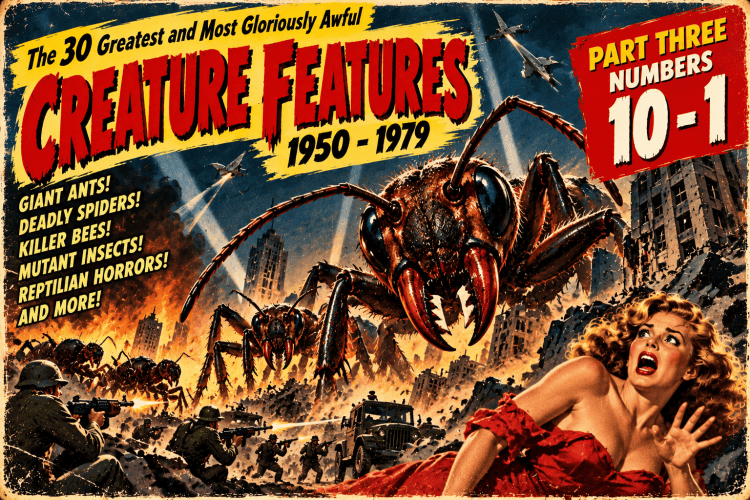
| The Countdown Part Three — Numbers 10–1 The finest monsters, the most memorable nightmares and the films that helped define an extraordinary era of cinema. |
| 10. The Naked Jungle (1954) Army ants Charlton Heston plays a South American plantation owner confronting an advancing army of destructive ants in this remarkably effective adventure thriller. Known as the marabunta, the insects form an apparently unstoppable force, consuming everything in their path. Unlike many of our other contenders, the film requires no radioactive mutations or impossible growth experiments. The threat comes from the extraordinary collective behaviour of ordinary insects, exaggerated for cinematic effect. Its mounting tension and spectacular climax make The Naked Jungle one of the most accomplished insect-attack films of the period. 9. Bug (1975) Fire-producing cockroaches An earthquake releases a previously unknown species of subterranean insect capable of generating fire, creating a scientific mystery that becomes increasingly disturbing. Bradford Dillman plays a scientist whose fascination with the creatures develops into a dangerous obsession. Based on Thomas Page’s novel The Hephaestus Plague, Bug combines ecological horror with speculative biology and some memorably unpleasant insect encounters. Its creatures are neither gigantic nor particularly interested in world domination, but their extraordinary abilities make them formidable opponents. It is one of the decade’s more imaginative productions, showing that insects need not become enormous to inspire cinematic nightmares. 8. Kingdom of the Spiders (1977) Tarantulas William Shatner confronts an invasion of tarantulas in rural Arizona, where the spiders begin appearing in increasingly alarming numbers. Rather than relying on oversized monsters, the production uses large numbers of living spiders to create a disturbing sense of infestation. The environmental explanation reflects the ecological concerns of the 1970s, while the film’s increasingly bleak atmosphere distinguishes it from more conventional animal-attack adventures. Its memorable conclusion is particularly effective; for anyone uncomfortable around spiders, Kingdom of the Spiders offers the unpleasant possibility that one tarantula is merely the beginning of the problem. 7. Sssssss (1973) Snakes and human-snake transformation Strother Martin plays Dr Carl Stoner, a scientist who experiments with transforming humans into snakes. Dirk Benedict portrays the unfortunate assistant gradually subjected to the process, with increasingly horrifying consequences. The film benefits from effective practical makeup, genuine reptilian imagery and a central performance that makes scientific obsession genuinely unsettling. Unlike many contemporary creature features, Sssssss treats its extraordinary premise with considerable seriousness. It also offers another valuable lesson from the history of science-fiction cinema: never volunteer for experimental treatment when the researcher appears excessively enthusiastic about reptiles. 6. The Deadly Mantis (1957) Giant praying mantis A prehistoric praying mantis emerges from Arctic ice and begins terrorising North America, providing one of the most wonderfully improbable premises of the atomic-monster era. The creature’s enormous grasping forelegs, triangular head and distinctive appearance make it a particularly effective cinematic monster. Military investigations, scientific explanations and spectacular attacks follow the familiar formula, but the mantis itself remains memorable. Real praying mantises are already remarkable predators, possessing extraordinary hunting abilities. Enlarging one to aircraft size was perhaps scientifically questionable, but from a filmmaking perspective, it was an inspired decision. 5. The Black Scorpion (1957) Giant prehistoric scorpions Volcanic disturbances in Mexico release enormous scorpions from underground caverns, creating one of the most visually memorable monster films of the 1950s. Its main attraction is the remarkable stop-motion animation by Willis O’Brien and Pete Peterson, which gives the creatures an unsettling physical presence. Their enormous claws, threatening tails and distinctive movements make them considerably more convincing than many contemporary monsters. Although the story follows familiar patterns, the scorpions themselves are magnificent creations. The Black Scorpion remains a splendid demonstration of what imaginative practical effects could accomplish before computer-generated monsters became commonplace. 4. Phase IV (1974) Highly intelligent ants Saul Bass’s extraordinary science-fiction film presents ants developing a collective intelligence that challenges humanity’s assumed dominance over nature. Scientists attempt to understand the increasingly organised insects, only to discover that the colony may be manipulating events rather than merely responding to them. The remarkable insect photography and unusual visual style give the production an almost hypnotic atmosphere. Unlike the giant-ant films of the 1950s, Phase IV requires no enormous monsters. Its terror lies in the possibility that intelligence, cooperation and evolutionary success might ultimately matter more than physical size. 3. The Fly (1958) Human-fly hybrid David Hedison portrays a scientist whose teleportation experiments go disastrously wrong when a housefly enters the apparatus. The resulting transformation creates one of the most memorable creatures in science-fiction horror, but the film’s real strength lies in its tragic human story. Vincent Price provides an excellent supporting performance, while the gradual revelation of the scientist’s fate generates genuine suspense. Rather than treating its monster simply as something to be destroyed, The Fly explores the terrible consequences of scientific ambition. Its haunting imagery and emotional impact have ensured its lasting place in horror history. 2. Tarantula (1955) Giant tarantula Jack Arnold’s desert-set classic remains one of the finest giant-spider films ever produced. Scientific experiments involving a growth formula create an enormous tarantula, which escapes into the surrounding countryside and begins terrorising the population. The film builds suspense through mysterious deaths, isolated landscapes and the gradual revelation of its monster. Its effects, achieved through photographing a living tarantula against miniature scenery, remain remarkably effective. Unlike some contemporary productions, Tarantula understands the importance of atmosphere and restraint. Its creature is genuinely menacing, and the film remains a defining achievement of atomic-age science-fiction horror. 1. Them! (1954) Giant radioactive ants Our Number One begins with mystery rather than spectacle. A traumatised young girl is discovered wandering through the New Mexico desert, while investigators uncover evidence of something extraordinary. Gradually, the horrifying truth emerges: atomic testing has produced enormous ants, and humanity faces a threat unlike anything previously encountered. Director Gordon Douglas combines detective mystery, scientific investigation and spectacular monster horror with remarkable effectiveness. The giant ants are memorable creations, their distinctive sounds adding considerably to the atmosphere. Them! captures the anxieties of the atomic age while delivering genuinely accomplished entertainment. Of all the extraordinary insect nightmares produced between 1950 and 1979, it remains the genre’s finest example. |
| About our writing & imagery Most articles reflect our real gardening experience and reflection. Some use AI in drafting or research, but never for voice or authority. Featured images may show our photos, original AI-generated visuals or, where stated, credited images shared by others. All content is shaped and edited by Earthly Comforts, expressing our own views. |