| Why business development sometimes means owning less equipment, … not more |
| Something rather curious happens in how a small business develops. We tend to associate growth with accumulation. More clients, more employees, more vehicles, more equipment, and, inevitably, more space to keep everything. It seems perfectly reasonable that a business undertaking more work should require more machinery. In many respects, of course, it does. But at some point, the relationship between business growth and equipment ownership becomes less straightforward. Sometimes, the most sensible thing a growing business can do is start getting rid of things. This is something we have been considering rather carefully at Earthly Comforts as we look towards the next stage of our development. Over the years, we have accumulated a considerable assortment of gardening machinery, tools and specialist equipment. Each purchase had a reason at the time. We bought some machines to undertake particular tasks, others because they seemed more convenient, and a few with future requirements in mind. Yet as our business has developed, we have discovered that some of these machines no longer suit the way we work. More practical alternatives have overtaken others, while some equipment has barely been used. It raises an interesting question. Does a progressive business necessarily need more equipment, or does it simply need better equipment? |
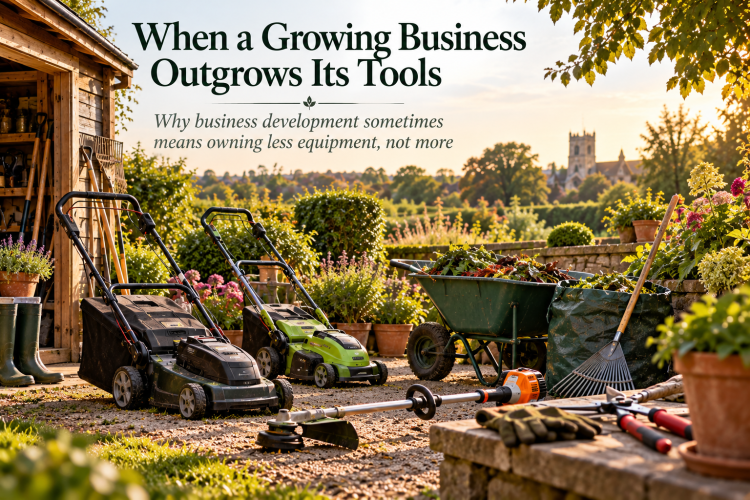
| The Difference Between Growth and Accumulation In the early stages of running a gardening business, equipment purchases are usually driven by immediate necessity. You need a mower because lawns must be cut. A hedge trimmer becomes essential because customers have hedges. A scarifier might be purchased when lawn renovation becomes part of the services offered. Gradually, the collection grows. There is nothing inherently wrong with this. Indeed, a business cannot develop its capabilities without investing in the tools required to undertake the work. The difficulty arises when purchasing decisions are made individually, without occasionally examining the equipment collection as a whole. A machine purchased three years ago might have been entirely appropriate for the business as it existed then. But today’s business may have different customers, different working methods, a larger workforce, and a much better understanding of which equipment genuinely earns its keep. The result can be an accumulation of machinery that is technically useful but operationally unnecessary. There is an important distinction here. A machine does not have to be broken, worn out or obsolete to become redundant. It can be in perfect working order and still have no meaningful place in the business. Indeed, some of the equipment we are currently considering selling has seen remarkably little use. One or two machines have never been used. When Bigger Doesn’t Mean Better One of the more interesting lessons we have learned concerns the relationship between a machine’s size and its practical usefulness. Take a large garden shredder or woodchipper. On paper, a substantial machine with impressive processing capacity might seem like an excellent investment. It can handle considerable quantities of material and potentially save the expense of disposing of bulky garden waste. But gardening businesses do not operate exclusively on paper. Our working days often involve travelling between properties, unloading equipment, doing the required work, clearing up, and moving on to the next customer. Every additional minute spent transporting, positioning or manoeuvring machinery has a consequence. A large machine might be exceptionally capable once it is operating. Still, if it is cumbersome to transport and impractical for most of our visits, that capacity becomes far less valuable. We purchased a substantial Forest Master machine for approximately £1,200. We have never used it, and we have now found a buyer willing to pay £800. At first glance, that represents a £400 loss. But retaining an unsuitable machine simply because it originally cost £1,200 would achieve very little. The money has already been spent. Selling it releases capital that can be invested in equipment better suited to our everyday requirements. A smaller, more portable machine may ultimately prove far more productive, even if its technical capacity is considerably lower. The lesson is straightforward: the best equipment is not necessarily the most powerful. It is the equipment that fits the work. The Changing Economics of Battery and Petrol Machinery Another area in which our thinking has evolved concerns battery-powered garden machinery. Battery technology has transformed horticultural equipment over recent years. Modern cordless machines offer considerable advantages, particularly where noise, weight, convenience and the absence of exhaust emissions at the point of use are important considerations. We use battery-powered equipment extensively, and we have little hesitation in retaining certain machines. However, commercial gardening demands differ from occasional domestic use. A homeowner might mow a lawn once a week, recharge the battery and put the machine away until the following weekend. A professional gardener might use a mower repeatedly throughout the day, travelling between properties and encountering widely varying conditions. Battery endurance, charging arrangements, replacement battery costs and the availability of sufficient power all become important considerations. We have found that some of our lightweight battery mowers remain exceptionally useful, particularly for smaller gardens and properties where manoeuvrability matters. We use them regularly, and they’ve earned their place in our equipment collection. Other machines, however, have become unnecessary duplicates. We are therefore planning to introduce a petrol maintenance mower while retaining our useful lightweight battery machines and dedicated striping mowers. This is not a rejection of battery technology. It acknowledges that different machines have different strengths, and that the most economical arrangement for a commercial gardening business may involve a carefully selected combination of technologies. What matters is the cost and practicality of completing the work, rather than allegiance to one particular type of machinery. Three Scarifiers, but Only One We Really Need Scarifiers provide another example. Over time, we acquired three machines, including two battery-powered models and a Hyundai petrol scarifier. All three can do lawn renovation work, but experience has shown us which machine best suits our commercial needs. The Hyundai has become our preferred option, leaving the other two largely unnecessary. There is little commercial advantage in keeping three machines simply because we already own them. Each occupies storage space, ties up capital in equipment, and may introduce additional maintenance considerations. Of course, there are circumstances where retaining a spare machine is sensible. A busy business cannot always afford interruptions from equipment failure. But there is a difference between maintaining appropriate backup capacity and retaining several machines without a clear operational reason. In our case, the decision is relatively simple. Keep the scarifier that best serves the business and sell those that no longer contribute meaningfully. Investing in Less Physical Work Perhaps the most significant change in our equipment philosophy concerns physical effort. Gardening is an inherently physical occupation. There is no escaping the fact that much of the work involves lifting, bending, carrying, sweeping, raking, digging and repeating movements over extended periods. Some practical occupations also tend to regard physical exertion as an unavoidable measure of a day’s productivity. But working harder and working more efficiently are not necessarily the same thing. If a task can be completed to the same standard in less time, with less physical strain, there is a strong argument for examining how to achieve that. We are currently considering equipment such as a power broom and a leaf vacuum, not because we want to add more machines to our collection, but because we want to reduce the amount of repetitive manual work our gardeners do. Raking leaves, for example, can be surprisingly demanding when repeated across numerous properties throughout autumn. Sweeping extensive paved areas can be equally time-consuming. Mechanisation will not eliminate these tasks. There will always be corners, delicate planting areas, awkward surfaces and circumstances where traditional hand tools remain the most appropriate solution. Nevertheless, reducing repetitive physical work can have considerable advantages. It may allow a gardener to complete a task more quickly, take on additional work during the day, or finish the week with less accumulated fatigue. The last of these deserves particular attention. A gardening business depends upon the physical wellbeing of the people doing the work. Equipment that reduces unnecessary strain should not be seen as merely a convenience. It can be an investment in the workforce’s long-term sustainability. The Hidden Costs of Keeping Everything Another aspect of equipment ownership is easily overlooked: storage. Small businesses often accumulate machinery without fully appreciating how much space it takes up. One mower becomes three. Another joins a scarifier. Ladders of different lengths appear, followed by specialist attachments, spare batteries, chargers, hand tools and equipment purchased for jobs that may never be repeated. Eventually, the business requires more storage. Garages, workshops and commercial units all carry costs, and those costs continue whether the equipment inside is being used or not. There are also less obvious consequences. Crowded storage makes it harder to locate equipment, increases the time required to load vehicles and can make routine maintenance more awkward. A machine that is rarely used may therefore cost more than its original purchase price. Selling unnecessary equipment can free up money, but it can also free up space, simplify organisation, and make the working day run more smoothly. Sometimes, the benefit of disposing of a machine is not merely what somebody is prepared to pay for it. It is the space and convenience it frees up when it leaves. More Employees Do Not Necessarily Mean More of Everything As Earthly Comforts expands its workforce, equipment planning becomes increasingly important. A business employing several gardeners will naturally need enough machinery to keep people working productively. If two teams are operating independently, each may need access to essential equipment without repeatedly waiting for the other. But this does not mean every employee requires an identical collection of machines. Equipment needed for daily operations differs from specialist machinery used occasionally. Mowers, strimmers and hedge cutters may need to be available across several working teams. A scarifier, woodchipper or specialist cleaning machine might be shared according to the week’s schedule. This requires more planning, but it can prevent considerable unnecessary expenditure. It also encourages the business to think carefully about how it organises work. Rather than buying another machine whenever two jobs appear to require the same equipment, it may be possible to schedule those jobs differently. Equally, where shared equipment regularly causes delays, purchasing an additional machine may be entirely justified. The objective is not to own as little as possible. It is to own enough to operate efficiently without accumulating equipment that serves no worthwhile purpose. Learning to Recognise a Poor Purchase One of the harder parts of running a business is acknowledging that a purchasing decision hasn’t worked out as expected. Nobody particularly enjoys selling an unused machine for considerably less than its original price. There can be a temptation to retain it indefinitely, partly because it is in excellent condition and partly because selling it feels like admitting a mistake. But a machine does not become more useful simply because we are reluctant to part with it. We make business decisions using the information available at the time. Sometimes expectations prove correct; sometimes experience reveals that a different approach would have been better. The important thing is to recognise the difference and respond accordingly. A piece of equipment that has spent two years gathering dust is unlikely to become an excellent investment merely because another year passes. Recovering part of its value and putting that money towards something genuinely useful may be the more sensible course. There is no particular virtue in keeping a machine that the business no longer needs. From Buying Equipment to Managing Equipment At Earthly Comforts, we’re beginning to recognise that equipment ownership needs to become a planned part of business management. Rather than purchasing machinery whenever a particular requirement arises, we want to consider how each investment fits into our wider operations. Will it be used regularly? Will it reduce working time? Can it improve the quality of the finished job? Does it reduce physical strain? Is it practical to transport between properties? Will it remain useful as the workforce expands? These questions are more valuable than simply asking whether a machine looks impressive or offers an attractive specification. It also makes sense to review equipment you already own periodically. A machine that was essential two years ago may now be rarely used. Another that once seemed unnecessary may have become indispensable as customer requirements change. An equipment collection should therefore evolve alongside the business rather than remain a permanent record of every purchasing decision ever made. And there will always be exceptions. Some specialist tools may be used infrequently but remain worth keeping because they are difficult to hire, expensive to replace or essential when a particular situation arises. Good equipment management requires judgement, not rigid rules. A More Thoughtful Approach to Business Growth It is easy to measure business development through visible signs of expansion. More employees, more vehicles, more customers and larger premises all suggest progress. Equipment purchases can create the same impression. But the real measure of progress is not how much a business owns. It is how effectively the business uses its available resources. A company with twenty carefully selected machines may be considerably more productive than one with forty machines accumulated without much thought. Likewise, investing in equipment that saves time and reduces fatigue may be more valuable than buying machinery that lets the business advertise another service. As we look towards the future of Earthly Comforts, we are certainly not planning to stop investing in equipment—quite the opposite. We expect to acquire machinery that allows our growing team to work more efficiently, comfortably and professionally. But we also expect to sell equipment that no longer fits our requirements. Some of those decisions will recover relatively little money. Others may release substantial sums we can reinvest. Taken together, they should leave us with a more practical, manageable and productive equipment collection. And perhaps that is one of the quieter lessons of running a developing business. Growth is not always about adding something. Sometimes, progress begins with recognising what you no longer need. |
| Author’s Note This article draws upon our ongoing experience of developing Earthly Comforts GPM Ltd, a small gardening, property and maintenance business based in Sandwich, Kent. As our business grows, we are learning that investment isn’t simply a matter of buying additional equipment. It is about selecting machinery that suits our work, supports our people, and lets us provide a reliable service without unnecessary expense or physical effort. We are still learning, and no doubt some of our future purchasing decisions will prove better than others. But I suspect that’s part of running any business. Experience gradually teaches us the difference between what we think we need and what we actually use. |
| Wander through the Article Directory and see where curiosity takes you next. |

