| An Earthly Comforts follow-up to “Under the Surface What the Drowned Worms Taught Us” |
| An Earthly Comforts follow-up to “Under the Surface — What the Drowned Worms Taught Us” Sometimes in gardening, something ordinary makes you reconsider a practice you have followed for years. It might be a plant behaving unexpectedly, a change in the weather that exposes a weakness in the way a garden has been managed, or the discovery that something intended to benefit wildlife has inadvertently created a problem for it. Sometimes the smallest creatures teach the most uncomfortable lessons, especially when we realise the conditions behind their difficulties were partly our own making. Back in February, we wrote about the distressing discovery of earthworms drowning in water-filled containers around our allotment. These were not isolated casualties. There were enough to make us wonder why so many worms had apparently abandoned the safety of the soil and ended up in places they could not escape. It was unsettling, not least because earthworms are among the creatures we actively encourage through our gardening practices. We follow no-dig principles, return organic material to the soil, and generally try to create conditions in which the natural processes of a garden can continue with as little unnecessary interference as possible. Yet there they were, the very creatures helping us maintain healthy soil, trapped in water. As another autumn advances towards winter, the question has returned. What caused so many worms to emerge in the first place, and is there anything practical we can do to prevent it from happening again? We’ve considered several possibilities, from improving the winter environment in our raised beds to preventing worms from entering the water containers themselves. What began as a discussion about decomposing leaves has become a rather interesting exploration of earthworm biology, clay soil, winter rainfall, and the surprisingly complicated business of breathing beneath our feet. Before deciding what to change, however, we need to understand what might have been happening. |
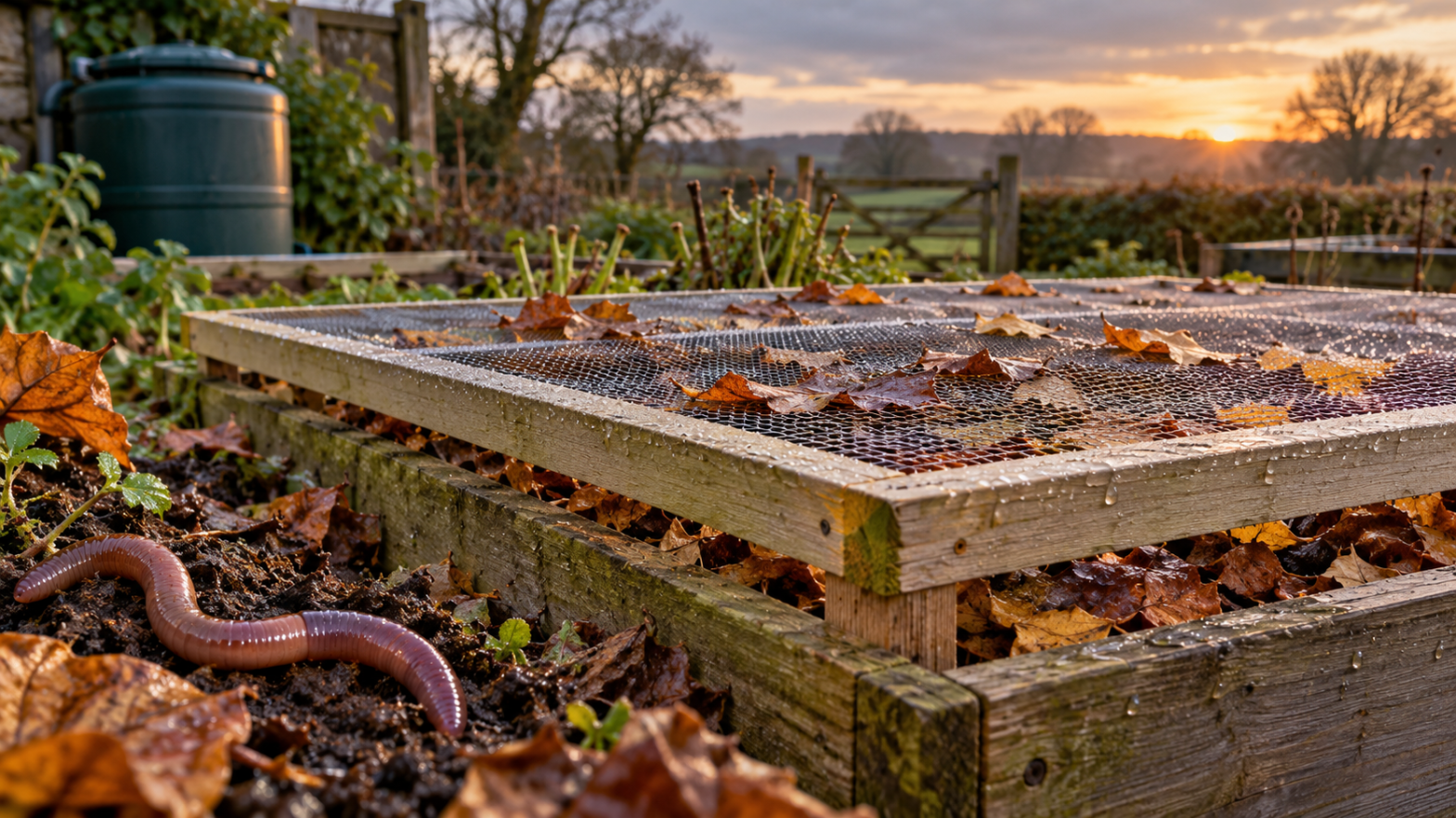
| The Curious Business of Breathing Without Lungs To understand why earthworms sometimes appear in extraordinary numbers after prolonged rainfall, we first need to understand something rather remarkable about their anatomy. Earthworms have no lungs. They have no gills in the conventional sense, and no small opening through which they draw breath. Instead, their entire body surface helps with respiration, exchanging gases directly with the surrounding environment. An earthworm’s skin is covered by a thin, moist cuticle, beneath which lies a network of tiny blood vessels. Oxygen dissolves in the moisture covering the skin and diffuses through the body wall into the bloodstream. Carbon dioxide, produced by the worm’s metabolism, travels in the opposite direction and escapes into the surrounding soil or water. The process is continuous, remarkably effective under suitable conditions, and entirely dependent upon the skin remaining moist. This explains why earthworms are so vulnerable to drying out. A worm exposed to strong sunlight or a dry surface can quickly lose the moisture it needs for respiration. Without that protective film, gas exchange becomes increasingly difficult. Moisture is not simply something an earthworm prefers; it is fundamental to remaining alive. But this creates an apparent contradiction. If earthworms need moisture to breathe, why should prolonged rainfall make them abandon the soil? Surely a wet environment ought to be ideal for an animal whose entire respiratory system depends upon water? The answer lies in the difference between moisture and oxygen availability. Healthy soil contains an intricate arrangement of mineral particles, organic matter, microscopic spaces, and larger channels. Some of those spaces contain water, while others contain air. Oxygen moves through the air-filled spaces and becomes available to organisms living beneath the surface. The balance changes constantly as rainfall enters the ground, water drains away, roots absorb moisture and soil organisms consume oxygen. When prolonged rainfall saturates the soil, water fills many of those air-filled spaces. Oxygen moves far more slowly through water than through air, while living organisms in the soil continue consuming whatever oxygen remains. If the saturated conditions persist, oxygen concentrations can fall considerably. For an earthworm, the problem is not necessarily being surrounded by water. Many earthworm species can survive submerged in sufficiently oxygenated water, sometimes for surprisingly long periods. The danger arises when the surrounding environment cannot supply enough oxygen to meet their needs. A worm living in saturated, oxygen-poor soil may therefore encounter something resembling the predicament of a person in a poorly ventilated room. Moisture is present, but the essential gas needed to sustain life becomes increasingly difficult to obtain. Some species tolerate these conditions better than others. Some reduce their activity, while others move towards the surface or into areas offering more favourable conditions. The precise response depends upon the species, soil temperature, oxygen concentration and duration of saturation. This distinction matters because it challenges the simple explanation that worms emerge during rain. After all, they are drowning underground. Sometimes reduced oxygen availability may indeed be responsible. But that is not the entire story. Why Earthworms Take to the Surface One of the most interesting aspects of earthworm behaviour is that their emergence after rainfall is not necessarily a sign of distress. In many cases, it is a normal activity. An earthworm moving underground must negotiate soil particles, roots, stones and the walls of existing burrows. Progress can be slow and physically demanding, particularly in compacted soil. By comparison, travelling across the surface can cover considerably greater distances. The difficulty is that the surface is normally a dangerous place for an earthworm. Exposure to sunlight, dry air and warm conditions can rapidly lead to dehydration. Predators, particularly birds, are another obvious hazard. Rain changes the situation. When the ground is wet and the air humid, an earthworm can travel across exposed soil with much less risk of drying out. Darkness provides additional protection, which helps explain why surface activity is often particularly noticeable during wet nights. These movements may be associated with dispersal, finding new feeding opportunities, locating suitable habitat or encountering potential mates. Some earthworms also emerge naturally to gather organic material from the soil surface, dragging fallen leaves and other plant debris towards their burrows. What appears to us as a sudden evacuation may therefore be a combination of several behaviours occurring simultaneously. This is particularly important when interpreting our February experience. We found a substantial number of worms in the water tubs, but we did not see every worm leave the raised beds. Nor could we establish whether the individuals had emerged because of oxygen stress, normal dispersal or some combination of the two. It is tempting to imagine the worms abandoning the beds in droves, driven upwards by increasingly uncomfortable conditions. That may have happened to some extent, especially following weeks of rainfall. But a large number of worms accumulating in a container does not necessarily mean they all entered on the same night. The tubs may have been collecting unfortunate visitors over a considerable period. There is also another possibility. Our no-dig beds, with their organic matter and established soil structure, may support a relatively healthy earthworm population. A garden with plenty of worms will naturally show more visible surface activity under favourable conditions than one where earthworms are scarce. In other words, the number of casualties might partly reflect the success of our soil management rather than its failure. That is not a particularly comforting conclusion, but it is an important one. The Particular Problem of Heavy Clay Our allotment sits on clay soil, something that influences almost every aspect of how we manage it. Clay can be extraordinarily productive when its structure is healthy, retaining nutrients and moisture that might rapidly disappear through lighter soils. It can also become difficult to work during prolonged wet weather, and once thoroughly saturated, it may take a considerable time to drain. The difficulty lies in how the soil particles are arranged. Clay particles are extremely small, creating a structure containing numerous fine pores. These retain water very effectively, but water can move slowly through compacted or poorly structured clay. In winter, when evaporation is limited and plants use relatively little moisture, prolonged rainfall may leave the ground saturated for extended periods. This does not mean that every clay garden is permanently waterlogged. Well-structured clay can contain cracks, root channels, earthworm burrows and larger pores through which water can move. Indeed, one of the great advantages of encouraging earthworms is that their activities help maintain precisely these pathways. Nevertheless, the contrast between summer and winter can be striking. During a dry summer, clay may shrink and develop substantial cracks. During a wet winter, those cracks may close as the soil swells, while persistent rainfall fills the available pore spaces. Our raised beds offer some advantages over the surrounding ground. Their elevated growing surface can encourage drainage and provide deeper cultivated soil, particularly where organic matter has been added over successive seasons. But raised beds are not automatically immune to waterlogging. If they are open to saturated clay beneath, or if the growing medium itself becomes saturated, drainage may still be restricted. The question, therefore, is not simply whether our beds are wet. Earthworms generally appreciate moist soil. What matters is whether sufficient oxygen remains available within the soil structure. A bed can feel remarkably wet to a gardener and still provide perfectly suitable conditions for earthworms. Equally, a bed that remains saturated for days or weeks may develop oxygen-poor areas even without obvious standing water. This is why we should be cautious about interpreting surface movement as proof of unhealthy soil. The worms may be responding to unfavourable conditions, but they may also be taking advantage of a damp evening to travel. We need to observe before concluding. Why We Continue to Favour No-Dig Gardening Our approach to gardening has increasingly followed no-dig principles. Rather than routinely turning the soil, we prefer to add organic material to the surface and allow natural biological processes to incorporate it gradually. For earthworms, this has considerable advantages. Some earthworm species live in the upper soil layers, feeding on organic matter and creating temporary tunnel networks. Others establish deeper, more permanent burrows, sometimes returning repeatedly to the same openings. Regular digging can damage these burrows, disrupt soil structure, and expose the animals to predators or unsuitable conditions. No-dig gardening reduces much of that disturbance. Organic matter added to the surface feeds soil organisms, while plant roots and earthworm activity gradually build a more stable structure. Over time, the combination of organic matter, fungal activity, plant roots and earthworm burrows can improve the movement of water and air through the soil. This is especially valuable on clay, where preserving existing channels is often more beneficial than repeatedly breaking the soil apart. People often assume heavy clay must be loosened mechanically to improve it. Yet digging wet clay can cause considerable damage, smearing and compressing the soil rather than creating lasting improvements. The resulting structure may be less favourable to drainage and biological activity than the undisturbed soil it replaced. We therefore have no intention of abandoning our no-dig approach because of what happened last winter—quite the opposite. We want to build upon it, using the natural processes already taking place within the beds to create more resilient conditions. And this brings us to autumn leaves. The Case for Leaving the Leaves Every autumn, gardens produce enormous quantities of fallen leaves. Some are collected for leaf mould, others are composted, while many disappear into green-waste collections despite being a valuable source of organic material. In a woodland, fallen leaves are not regarded as waste. They form an essential part of the forest floor, gradually decomposing through the combined activities of fungi, bacteria, earthworms and numerous other organisms. Nutrients are recycled, organic matter accumulates, and the soil beneath remains protected from direct exposure to the weather. We have been considering whether we could apply a similar principle to our raised beds throughout winter. The idea is straightforward. Rather than clearing every bed completely at the end of the growing season, we would retain suitable healthy plant roots, remove diseased material where necessary, and spread a generous layer of partially decomposed leaves across the surface. These leaves would provide a protective covering while supplying organic material for the soil food web. Earthworms that feed at or near the surface could exploit the decomposing material, while deeper-burrowing species might gradually draw suitable fragments into their tunnels. The leaf layer could also moderate fluctuations in soil temperature, reduce the impact of heavy rainfall on the soil surface, and help prevent the formation of a hard surface crust. However, there is an important limitation. Leaves do not automatically improve drainage simply because they are organic. A thick, compacted layer of wet leaves can become matted, restricting air movement and potentially creating oxygen-poor conditions within the decomposing material itself. For that reason, we would favour a loose covering about five to eight centimetres deep, adjusting the amount based on the condition and type of leaves available. Partially decomposed leaves may be particularly useful because their breakdown has already begun, although they should still be loose enough to avoid forming a dense, waterlogged blanket. We would also avoid adding large quantities of diseased plant foliage or material that might introduce problems into the following growing season. The intention is not to create a miniature compost heap on top of each bed. It is to reproduce something of the natural process by which woodland soils are protected, fed and gradually improved. A Tupperware Lid for the Garden There is, of course, one rather obvious practical difficulty with spreading loose leaves across raised beds in autumn. The wind. A layer of carefully distributed leaves may look wonderfully natural when first applied, only to find itself scattered across the paths, neighbouring beds and surrounding garden following the first substantial autumn gale. Our initial discussion centred upon securing the leaves beneath a breathable membrane stapled directly to the wooden sides of the beds. That would certainly help retain the material, but it introduces another inconvenience. We would need to detach the covering whenever we wanted to inspect the soil, add material, or begin preparing the beds for spring. Then came a much simpler idea. Why not make lightweight wooden frames, each slightly larger than the raised bed it is meant to cover, with fine garden mesh stretched across the opening? The finished frame would drop over the top of the bed, rather like the lid of a large plastic food container. No elaborate construction, complicated hinges or permanent attachment would be necessary. Four lengths of lightweight timber, a handful of screws and a suitable piece of mesh would provide the basic arrangement. For larger beds, a central support might be needed, but the intention would be to keep the design as uncomplicated as possible. The frames could be lifted off whenever necessary, returned immediately afterwards and stored during the growing season. Small locating blocks beneath the frame could prevent sideways movement, while a simple retaining clip might be useful where winter winds are particularly strong. We would use fine, taut, wildlife-safe mesh rather than loose bird netting, which can entangle small animals. The mesh would need to allow rainfall and air to pass through freely while retaining the leaves beneath it. This is an important distinction. We are not attempting to seal the raised beds or prevent earthworms from moving. The frames are intended to hold the organic covering in place while allowing the soil beneath to function normally. There is something rather appealing about the simplicity of the arrangement. It requires very little material, can be made from timber offcuts, and can be reused for several winters. It also fits comfortably with the practical philosophy of Earthly Comforts: use what is available, avoid unnecessary expense and make improvements that serve a genuine purpose. Whether the frames will influence earthworm behaviour remains to be seen. They may improve conditions beneath the leaf layer, but they are not barriers that prevent worms from travelling elsewhere. Nor should they be. Earthworms must remain free to move through their environment. Our objective is to improve the habitat, not confine its inhabitants. Should We Leave the Plants in Place? Another aspect of the experiment concerns what happens to the plants already growing in the raised beds. Traditional autumn clearance often involves pulling spent plants from the soil, removing roots and leaving the growing surface relatively bare until spring. Under no-dig principles, however, leaving healthy root systems undisturbed has considerable value. As annual plants die, their roots gradually decompose, leaving channels that water, air, new roots and soil organisms may subsequently occupy. The decaying material also contributes to the biological processes taking place beneath the surface. We therefore intend to cut suitable spent annual plants down to soil level rather than removing their entire root systems. We can then spread the leaves across the bed and place the removable mesh frame over the top. Naturally, this approach requires some judgement. Plants affected by serious disease may need to be removed, and certain perennial weeds should not be left to regenerate unchecked. Living winter crops would also require different treatment, since a flat mesh cover cannot simply be placed over actively growing vegetables without allowing adequate space. But for beds containing finished annual crops, leaving the roots in place seems entirely consistent with our broader objectives. We are not trying to create a perfectly tidy winter garden. We are trying to create a functioning one. The Water Tubs Remain the Real Danger Improving the raised beds is only part of the problem. Even if we create excellent winter conditions, earthworms will keep emerging during suitable weather. Some may be dispersing, some may be feeding, and others may be responding to changes in the soil. We therefore cannot regard the leaf-cover experiment as a complete solution to the drowned-worm problem. We must also consider the water tubs themselves. One lesson from February was that a container designed to collect and store water can become an unintended wildlife trap. Smooth plastic sides, deep water and limited opportunities for escape create difficulties for animals that accidentally enter. We have considered several inexpensive modifications, including secure covers, fine mesh over openings, repositioning containers and providing roughened escape routes. The most reliable approach is likely to involve preventing access wherever possible, rather than relying on an animal to escape after falling into the water. A loose board or poorly fitted lid may not be sufficient. Earthworms can move through narrow spaces, and their flexible bodies let them exploit openings that might seem insignificant to us. Any protective covering must therefore fit securely, with particular attention given to inlets, overflows and gaps around the rim. A rough escape strip extending above the maximum water level might provide additional protection for some small animals, although we should not assume every earthworm could use it successfully. The intention is to examine the existing tubs and adapt them using inexpensive materials wherever possible. We do not need an elaborate engineering solution, but we do need to remove the obvious hazards. If the worms are going to continue their winter travels, we should at least try to ensure that those journeys do not end at the bottom of a water container. What We Hope to Learn This Winter The most interesting part of the proposed changes is that we do not yet know how effective they will be. We can explain why earthworms require moisture, why oxygen availability matters and why prolonged rainfall may influence their movements. We can also recognise that surface activity is often perfectly natural. What we cannot honestly claim is that adding leaves and covering raised beds with mesh will prevent worms from emerging during winter. That remains a question, not a conclusion. We intend to observe the beds over the coming months, paying particular attention to periods of sustained rainfall. We can examine the condition of the leaf layer, check whether the soil beneath remains reasonably aerated and look for evidence of continuing earthworm activity. It would also be interesting to leave one comparable bed under its usual winter management, while treating another with leaves and a removable mesh frame. Such a comparison would not constitute a controlled scientific experiment, but it might provide useful practical observations. We should also keep a record of any worms discovered in or around the water tubs, particularly after heavy rainfall. If modifications to the containers reduce casualties, that may prove more significant than any change in the raised beds themselves. There is another consideration worth remembering. Earthworm populations fluctuate naturally, and the species living in one part of a garden may behave differently from those elsewhere. Surface-feeding worms, soil-dwelling worms and deep-burrowing species occupy different ecological niches. A treatment that benefits one group may have little immediate influence upon another. We therefore need to resist the temptation to judge the experiment solely by whether worms continue appearing on the surface. A healthy garden is not necessarily one in which earthworms remain permanently hidden underground. It is one in which they can feed, reproduce, move and survive without encountering unnecessary hazards. Returning to the Surface When we wrote the original article in February, the experience was still fresh. Seeing so many drowned worms left us questioning how something meant to support the garden could have caused such unintended harm. Several months later, the emotional response has given way to something more practical, although the original discomfort has not entirely disappeared. We now look at the same problem from several angles: the biology of the worms, the characteristics of our clay soil, the advantages of no-dig gardening, the role of decomposing leaves, and the design of the containers that created the danger. What has become increasingly apparent is that there may never have been a single explanation for the worms’ movements. Some may have been responding to saturated, oxygen-poor soil. Others may have taken advantage of wet conditions to travel. The very abundance of worms could even indicate that the soil was supporting a healthy population. Perhaps the mistake would be to concentrate entirely upon preventing them from leaving. Earthworms have been moving through soil and across damp surfaces for millions of years. Their movements are part of the natural processes that make soil such a remarkable living environment. We cannot reasonably expect to stop that behaviour, nor should we. What we can do is improve the conditions in which they live and remove some of the artificial dangers they encounter. So this winter, we intend to explore a simple arrangement: healthy roots left undisturbed, partially decomposed leaves spread across our raised beds, and lightweight wooden mesh frames resting over them like oversized Tupperware lids. Alongside that, we will examine how to make the water tubs safer for wandering wildlife. These measures won’t guarantee we won’t make another difficult discovery. Gardening rarely offers guarantees, particularly when weather, soil and living organisms interact in ways that cannot be entirely predicted. But something is reassuring about moving from observation to thoughtful action. We have identified a problem, questioned our original assumptions and arrived at a practical experiment that costs relatively little and may benefit the soil regardless of its influence upon earthworm movements. And perhaps that is the real continuation of February’s story. The first article was about discovering a problem we had not anticipated. This one is about trying to understand it well enough to do something useful. We may never know precisely why those particular worms left the soil, or whether they were seeking oxygen, new territory, or simply making the most of a wet winter evening. What we do know is that they deserved a better ending than the one they found. If we can provide that, while making the garden a little healthier in the process, then those unfortunate creatures will have taught us something worth remembering. |
| Author’s Note This article follows our original February 2026 essay, Under the Surface – What the Drowned Worms Taught Us The winter arrangements described here are proposals we are exploring at Earthly Comforts, not completed experiments or proven methods of preventing earthworm migration. We intend to observe their effects through the coming winter and report on what we discover. As always, we work with the soil wherever possible, rather than against it. |
| Wander through the Article Directory and see where curiosity takes you next. |
| About our writing & imagery Most articles reflect our real gardening experience and reflection. Some use AI in drafting or research, but never for voice or authority. Featured images may show our photos, original AI-generated visuals, or, where stated, credited images shared by others. All content is shaped and edited by Earthly Comforts, expressing our own views. |

