| An Introduction to the Extraordinary Stories Behind Our Everyday Words and Expressions |
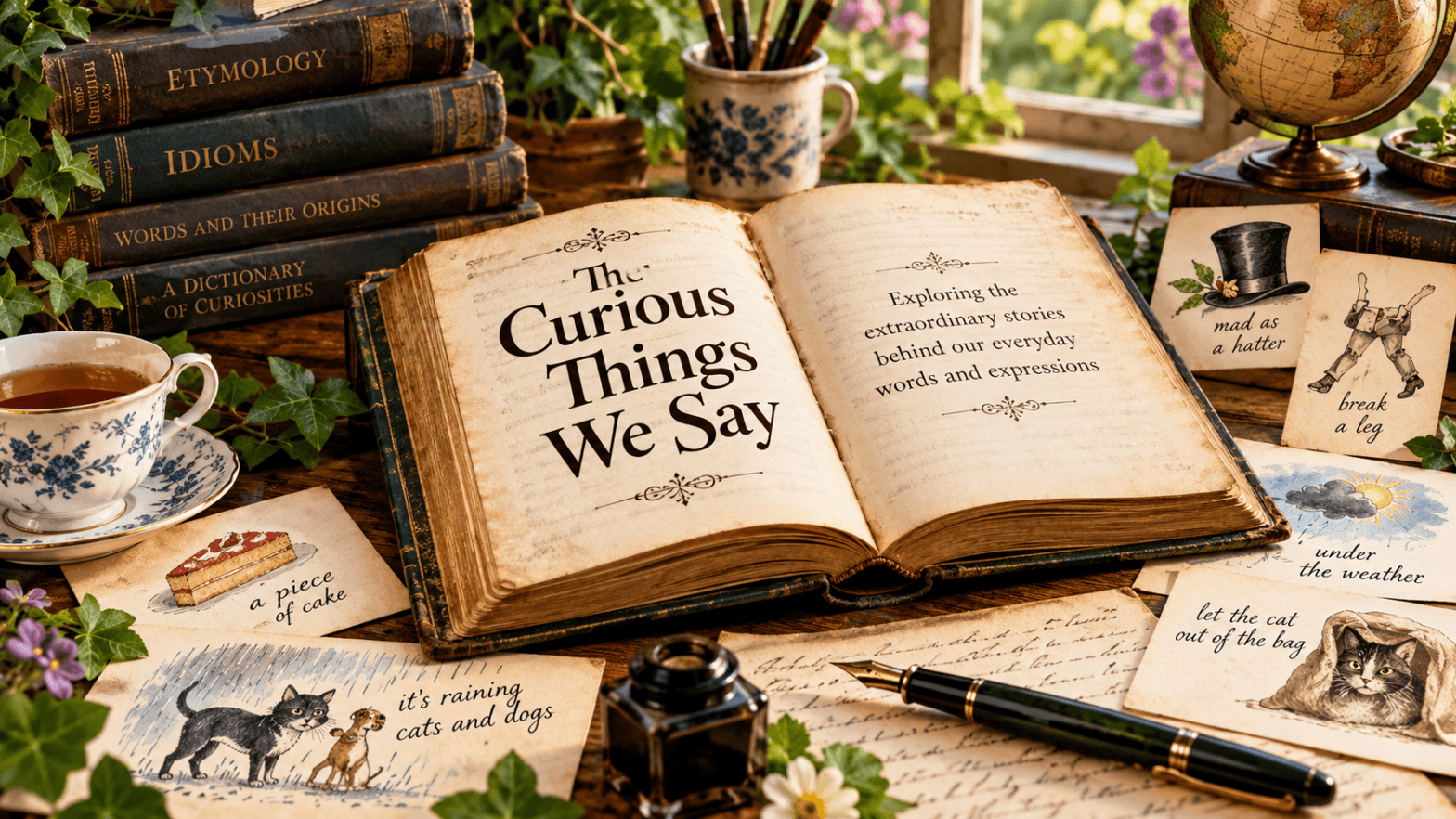
| Have You Ever Wondered Why We Say That? Have you ever found yourself under the weather, decided to bite the bullet, or discovered that something you expected to be difficult was actually a piece of cake? Perhaps you’ve let the cat out of the bag, been told to break a leg, or watched someone make a mountain out of a molehill. We say these things without giving them a second thought. They slip into our conversations as naturally as breathing, understood by almost everyone, yet often making little sense when taken literally. After all, what has a cake got to do with something being easy? Why would anyone wish a broken leg upon a performer? And who first decided that a particularly heavy rainstorm should involve cats and dogs? The English language is an extraordinary collection of borrowed words, forgotten customs, historical accidents, cultural influences and expressions that have somehow survived centuries of change. Sailors and soldiers, farmers and merchants, playwrights and politicians, ordinary working people, and countless generations have shaped it, adapting what they heard into something of their own. And hidden within that language are thousands of stories waiting to be rediscovered. Welcome to The Curious Things We Say. A Language Full of Peculiarities One of the wonderful things about English is that it has never been particularly concerned with behaving itself. It borrows shamelessly from other languages, changes the meanings of perfectly respectable words, invents expressions that defy logic and occasionally preserves phrases long after the circumstances that created them have disappeared. Consider how readily we accept descriptions such as stone deaf, dead tired or tickled pink. Nobody imagines that a tired person has actually died, or that someone enjoying a good laugh has necessarily changed colour. We understand these expressions because they belong to a shared linguistic tradition, one we absorb almost unconsciously from childhood. Some expressions have surprisingly ancient origins. Others emerged comparatively recently, finding their way into common speech through literature, entertainment, technology or popular culture. A few have travelled enormous distances, changing along the way as different countries developed their own versions of English. And then there are those expressions whose supposed histories are almost as entertaining as the expressions themselves. The internet is filled with confident explanations of where familiar sayings originated. Unfortunately, confidence and historical accuracy are not always travelling companions. A particularly colourful story may be repeated so often that it becomes accepted as fact, even when little evidence supports it. Part of our journey will involve separating what we know from what we merely like to believe. Sometimes the truth will prove stranger than the legend. Occasionally, the legend will turn out to be complete nonsense. And every so often, we may have to accept that the origins of a particular expression have disappeared into the mists of time. That uncertainty is part of the fascination. More Than Just Words Language is also a remarkable record of how people once lived. Our expressions preserve traces of occupations that have vanished, technologies that have become obsolete, beliefs that no longer hold sway and social customs that would seem decidedly peculiar today. The vocabulary of sailing has influenced everyday conversation far beyond the decks of ships. Agriculture has contributed expressions that remain familiar even to people who have never worked a field. The theatre, the military, religion, trade and traditional crafts have all left their marks upon the way we communicate. Even our gardens have contributed to the language of everyday life. We speak of nipping something in the bud, reaping what we sow, turning over a new leaf, and the grass being greener on the other side. For a gardening journal, that seems rather appropriate. But this series will not confine itself to horticulture—quite the opposite. We shall wander wherever curiosity takes us, exploring everything from medieval expressions and Victorian slang to modern terminology, regional sayings and peculiar linguistic imports from around the world. We may discover why a particular word once meant something entirely different, how an insult became a compliment, or why an expression familiar in Britain might leave someone elsewhere completely bewildered. There will be humour, history, occasional surprises and, I suspect, more than a few moments when we find ourselves wondering how on earth such a phrase became part of ordinary conversation. Twenty Episodes, and Only the Beginning Our first collection will consist of twenty episodes, each exploring three words, phrases or expressions connected by a common theme. We shall investigate the language of weather, food, animals, good fortune, bad luck, human behaviour and the countless other subjects that have inspired the curious things people say. Some expressions will be instantly recognisable. Others may be unfamiliar, old-fashioned or peculiar to particular places. Where possible, we shall uncover their earliest recorded appearances, explore the circumstances surrounding their development and consider how their meanings have changed over time. But twenty episodes will barely scratch the surface. With thousands of possibilities available, The Curious Things We Say is intended to become an ongoing feature of The Gardener’s Curious Journal, with further collections following as our exploration develops. There is no particular destination and certainly no need to hurry. Language has been evolving for centuries, and it is unlikely to stop providing us with interesting material anytime soon. The Joy of Asking Why Perhaps the greatest pleasure in exploring everyday language is discovering that something entirely ordinary can conceal an extraordinary history. A phrase overheard in a supermarket, an expression used by a grandparent, or a peculiar word encountered in an old book might lead us towards forgotten occupations, historical events, distant countries or the wonderfully inventive minds of people who lived long before us. And once you begin noticing these things, it becomes surprisingly difficult to stop. You may find yourself listening to familiar conversations differently, wondering why someone has gone off the rails, what makes a person the black sheep of the family, or how an unfortunate individual came to be described as having egg on their face. The answers may be amusing, unexpected, historically revealing or occasionally impossible to establish with certainty. But that is precisely what makes the investigation worthwhile. So, whether you enjoy the peculiarities of English, have a fascination with history, or simply like discovering the stories behind things we ordinarily take for granted, I hope you will join us. After all, we have barely begun to scratch the surface. And speaking of scratching the surface… Where did that expression come from? Well, that is exactly the sort of question we intend to explore. Welcome to The Curious Things We Say. The first of many journeys into the extraordinary history of ordinary language. |
| Author’s Note The Curious Things We Say is an ongoing exploration of everyday language, its history, peculiarities and unexpected connections with the world around us. Each collection will contain twenty episodes, each exploring three expressions. Our aim is not simply to repeat familiar explanations, but to investigate the evidence, enjoy the stories and acknowledge the mysteries that remain. Because sometimes the most interesting question is also the simplest: Why do we say that? |
| Wander through the Article Directory and see where curiosity takes you next. |


Rory, how on earth do you keep coming up with these fascinating ideas? 😂 I absolutely love this new series!
What particularly appeals to me is that you’re not simply looking at the meanings of everyday expressions, but exploring the history, culture and people behind them. It’s amazing to think how much of our everyday language carries little pieces of history that most of us never stop to consider.
I also love that you’re making a point of separating historical evidence from those colourful stories that have been repeated so often that people accept them as fact. I suspect some of the real explanations will be even more entertaining than the legends!
And twenty episodes, with three expressions in each? I think you’ve given yourself quite a project here! 😂
I have a feeling this series is going to send me down quite a few rabbit holes. I’ll probably find myself stopping halfway through a conversation to wonder where on earth a particular expression came from.
I’m looking forward to joining you on this linguistic adventure. ❤️
LikeLiked by 1 person
This is set to be a wonderfully long series l feel Sonel, so l am glad you will enjoy it, there are just so many observations and nuances to be found in this topic 🙂
LikeLiked by 1 person
Oh absolutely, my friend! 😂 I’m looking forward to it already. English is actually my second language, but you know, sometimes I find myself enjoying it even more than my first language. There are just so many fascinating expressions, little quirks and hidden meanings to discover. LOL! I think this series is going to keep me entertained! ❤️🤗
LikeLiked by 1 person
🙂
LikeLiked by 1 person