| A 5-Part Series |
| A curated exploration of South America’s most iconic, curious, and ecologically important insects |
| Part Three — Beetles: Mass, Strength & Specialisation |
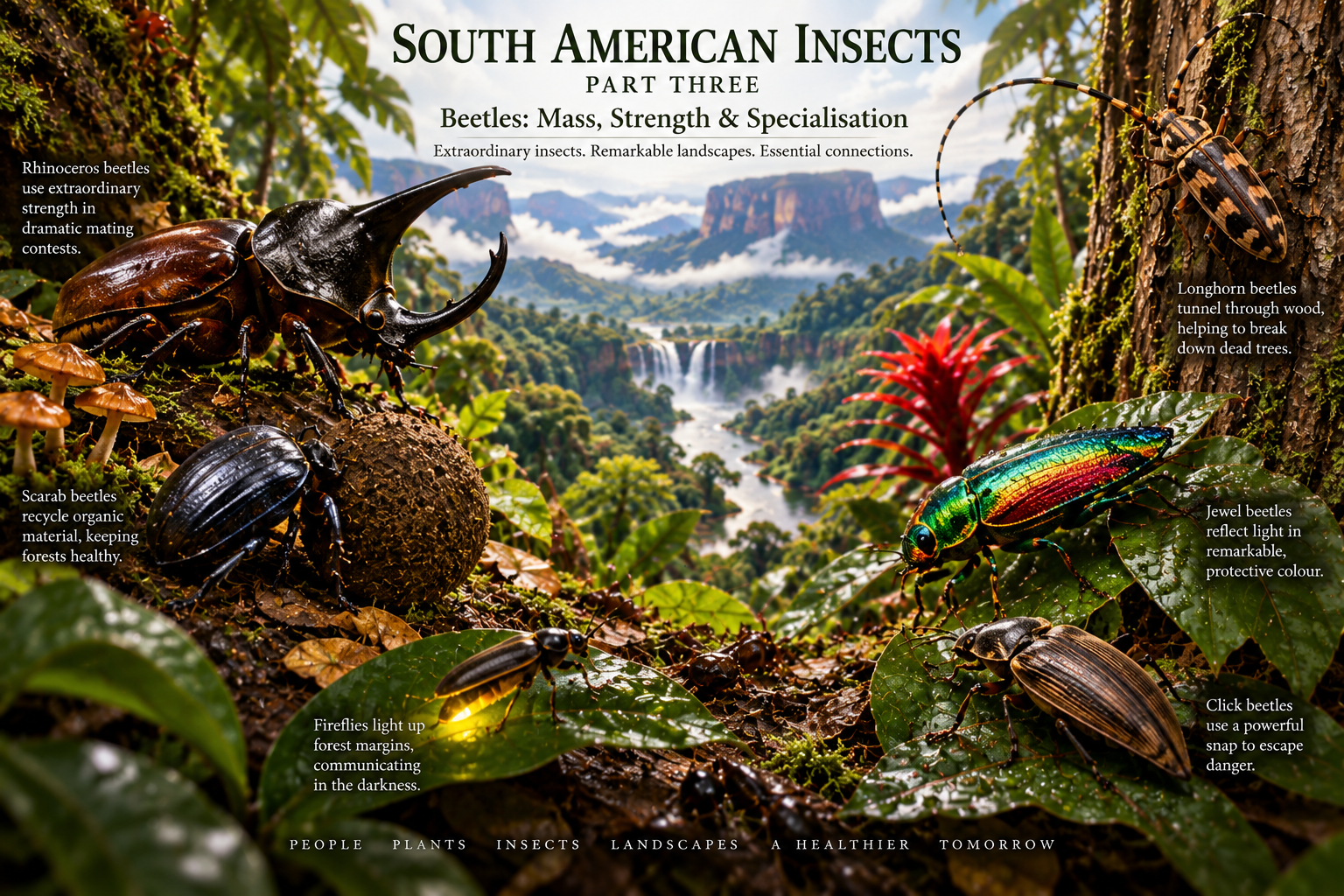
| Beetles are extraordinary. They occupy almost every imaginable terrestrial habitat, appear in an astonishing variety of shapes and sizes, and have developed survival solutions ranging from brute strength to remarkable mechanical ingenuity. In South America, where tropical forests, grasslands, wetlands, and mountains provide such varied conditions, their diversity becomes particularly apparent. Some are spectacular enough to attract immediate attention, while others spend their entire lives beneath fallen timber or among forest-floor debris. What makes beetles especially interesting is not simply their appearance, but the extraordinary range of work they perform. Some dismantle dead vegetation, others recycle animal waste, hunt smaller invertebrates or feed upon living plants. Their hardened forewings, known as elytra, protect the more delicate flying wings beneath and help shield their bodies from damage and environmental conditions. This basic arrangement has proved remarkably adaptable, allowing beetles to exploit habitats that would be difficult for many other insects. For a gardener, beetles are a familiar presence, although we rarely appreciate the full extent of their activities. We notice the ladybird feeding on aphids, perhaps a ground beetle disappearing beneath a stone, or a chafer moving awkwardly through summer foliage. South America’s beetles reveal how far those familiar ecological roles can develop, particularly in landscapes where competition is intense, and opportunities are extraordinarily varied. Scarab beetles and the business of recycling Few insects demonstrate the importance of decomposition more clearly than scarab beetles. The group includes dung beetles, whose work is especially valuable in grasslands, forests, and other habitats supporting substantial mammal populations. Animal dung contains organic matter and nutrients that can be returned to the soil, but only if organisms are available to process it. Dung beetles approach this task in different ways. Some roll portions of dung away from the original deposit, others bury it directly beneath the source, while certain species live and reproduce within the material itself. Their activities reduce the time dung remains exposed on the surface, incorporate organic matter into the soil and provide food for developing larvae. In South America’s tropical forests, dung beetles are closely connected to the mammals moving through the vegetation. Monkeys, tapirs, peccaries and other animals provide resources that different beetle species exploit. When mammal communities change, the insects that depend on them can be affected as well. A decline in large forest animals may therefore have consequences extending far beyond the animals themselves, altering the organisms responsible for recycling their waste. The relationship is particularly revealing because it demonstrates how decomposition depends upon living connections. Dung does not simply disappear because the climate is warm and humid. Beetles, fungi, bacteria and other organisms participate in its breakdown, each contributing to the return of nutrients. In gardening, we know the value of organic matter and the importance of soil organisms. Dung beetles perform a comparable service across enormous landscapes, although without the compost bins, forks and wheelbarrows we seem to consider indispensable. Rhinoceros beetles and the mechanics of strength Rhinoceros beetles bring a very different quality to the forest. Some South American species, including the impressive Hercules beetles, possess enormous horns that can make them appear almost prehistoric. Their bodies are heavily built, and the males of certain species use their horns during contests over access to females or breeding opportunities. These structures are not simply weapons for defending against predators. They are largely associated with competition between males, and their form reflects the particular methods by which rivals grapple, lift or dislodge one another. A horn that appears excessive to us may provide a considerable advantage during a contest. An important distinction exists between strength and aggression. A rhinoceros beetle is not necessarily a constantly combative animal. Much of its life may involve feeding, searching for suitable habitat and avoiding danger. The extraordinary equipment males carry becomes especially relevant during reproduction, when brief encounters can influence which individuals pass their traits to the next generation. Their larvae often develop within decaying wood or other decomposing plant material, contributing to processes very different from the dramatic contests of adulthood. This contrast between life stages is easy to overlook. We admire the adult’s horns while forgetting the years that some species spend developing within organic material. The spectacular beetle that eventually emerges from a rotting log is therefore the visible result of a much longer, quieter existence. Jewel beetles and the value of a hardened body Jewel beetles offer another kind of spectacle. Many possess brilliant metallic colours, with green, blue, copper and gold surfaces that seem almost polished. The effect can be particularly striking when sunlight reaches an insect resting upon bark or foliage. Their colours arise from a combination of pigments and microscopic structures that shape how light interacts with the outer body. In some species, structural effects contribute to the metallic appearance, although the ecological purpose of such colouration varies and is not always fully understood. It would be tempting to assume these reflective surfaces exist primarily to prevent overheating, but the relationship between colour and temperature is more complicated. Depending upon species and circumstances, appearance may contribute to camouflage, recognition or other interactions, while behaviour and habitat selection remain important in managing exposure to heat. Jewel beetles are also closely associated with woody plants. The larvae of many species develop beneath bark or within wood, feeding on plant tissues and creating galleries as they grow. Some exploit stressed or dying trees, while others can attack living plants and become economically important for timber or cultivated trees. Gardeners are familiar with this mix of ecological usefulness and potential damage. An insect feeding within dead wood may contribute to decomposition, while a closely related species attacking a healthy tree can create genuine problems. The distinction lies in the circumstances, not simply in the beetle’s appearance. Longhorn beetles and the hidden life of timber Longhorn beetles get their name from their often exceptionally long antennae, which may equal or exceed the length of their bodies. South America supports an extraordinary variety of these insects, from relatively modest species to some of the world’s largest beetles. Many longhorn larvae develop within wood, tunnelling through branches, trunks or roots as they feed. Some specialise in dead or decaying timber, while others use living or recently weakened trees. Their galleries alter the wood’s physical structure and can create opportunities for fungi and other decomposition-related organisms. A fallen tree in a tropical forest is not merely an obstacle gradually disappearing into the undergrowth. It becomes habitat for an enormous community. Beetles occupy different sections of the timber, fungi spread through its tissues, and other invertebrates use the cavities and softened material that develop over time. The process may continue for years, with different species appearing as the wood changes from relatively firm timber to increasingly fragmented organic matter. Gardeners sometimes regard dead wood as untidy or potentially troublesome, particularly where space is limited. Damaged branches and unstable trees certainly require attention, but removing every piece of dead timber also removes habitat. A carefully positioned log or section of decaying wood can support a surprising variety of organisms without compromising the wider garden. South America’s longhorn beetles demonstrate this principle on a much greater scale. Their relationship with timber is not simply one of consumption, but part of the gradual transformation of fallen trees into new biological opportunities. Click beetles and mechanical ingenuity. Click beetles are less imposing than rhinoceros beetles and often less colourful than jewel beetles, but they possess one of the insect world’s most entertaining mechanical adaptations. When placed on their backs or threatened, many can produce a sudden snapping movement that launches them into the air. This is achieved through a specialised mechanism between sections of the thorax, which stores energy and releases it rapidly. The resulting movement may help the beetle regain its footing or escape an immediate threat. It is a surprisingly effective solution for an insect whose body shape does not always make turning over particularly easy. Their larvae, commonly called wireworms, occupy another ecological role. Many live in soil or decaying vegetation and feed on plant material, roots, or other organisms, depending on the species. Some are important agricultural pests, particularly where they damage developing crops, while others contribute to decomposition or predation. Once again, the adult’s most memorable characteristic tells us only a small part of the story. The familiar clicking movement is remarkable, but the insect’s wider ecological significance includes the often lengthy period spent developing out of sight. It is a useful reminder that the insects we notice are frequently only the brief, visible stages of lives largely conducted elsewhere. Fireflies and communication after dark Fireflies introduce something quite different to South America’s beetle diversity. Although their common name suggests flies, they are beetles, belonging to a group that includes many species that can produce light through bioluminescence. Chemical reactions in specialised tissues generate the light, allowing some species to communicate through flashes or sustained glows. In many fireflies, these signals help them find suitable mates, with different species using characteristic patterns or behaviours. The result can be extraordinary. Along suitable forest margins, wetlands and other habitats, small points of light may appear after darkness, each representing an insect participating in a communication system that evolved long before artificial lighting transformed the night. Not all fireflies communicate in the same way, and some species rely more heavily upon chemical signals. Their larvae often prey on soft-bodied invertebrates, including snails and other small animals, giving them another role in the food web. Artificial lighting can interfere with the visual communication of certain fireflies, making the increasing illumination of human landscapes a genuine conservation concern. This is particularly relevant to gardens, where lighting is often installed for convenience or appearance, with little consideration for nocturnal wildlife. A dark corner can be habitat just as surely as a flowering border. Strength, specialisation and the wider system The diversity of South America’s beetles makes it difficult to describe them through any single characteristic. Rhinoceros beetles invest in strength and leverage, jewel beetles display extraordinary body structures, longhorns occupy timber, click beetles rely upon mechanical escape, and fireflies use light as a means of communication. Scarabs perform essential recycling work, often linking mammals’ activities directly to the soil beneath them. Yet these specialisations are not isolated achievements. Each depends upon relationships with plants, fungi, animals and the physical environment. A dung beetle requires suitable waste. A wood-boring larva needs an appropriate host. A firefly communicating through light depends upon conditions in which its signals can be detected. Specialisation can provide remarkable advantages, but it also creates vulnerabilities. An insect closely associated with a particular habitat or resource may struggle when that resource disappears. Forest clearance, changes in mammal populations, intensive land management and the removal of dead timber can therefore affect beetles in ways that are not immediately obvious. This is perhaps the most useful lesson for gardeners. Biodiversity is not simply a matter of counting the insects present. It is also about recognising the variety of habitats and relationships that allow different species to complete their life cycles. More than armour and strength Beetles have succeeded across an extraordinary range of environments, and South America provides some of the most remarkable examples of that success. Their hardened bodies offer protection, but the diversity of their behaviour, development, and ecological relationships makes the group so important. Some spend years within timber before appearing briefly as adults. Others work continuously through animal waste, return organic matter to the soil, or communicate through flashes of light after sunset. Their lives may seem unrelated, yet together they move nutrients, develop habitats, and regulate other organisms. For a gardener, recognising these processes can be reassuring. A decaying log, a patch of undisturbed soil or a quiet corner left free from unnecessary lighting may support creatures whose work continues without our attention. We may never see the full extent of their activities, but that does not make them any less important. South America’s beetles demonstrate that ecological success is rarely achieved through strength alone. It comes from finding a particular opportunity within a landscape and developing the means to exploit it. Some do so with horns, some with armour, some with extraordinary antennae and others with light. And beneath the spectacle lies a quieter truth: much of the living world depends upon organisms that spend their lives taking things apart so that life can begin again. |
| Wander through the Article Directory and see where curiosity takes you next. |
| About our writing & imagery Most articles reflect our real gardening experience and reflection. Some use AI in drafting or research, but never for voice or authority. Featured images may show our photos, original AI-generated visuals or, where stated, credited images shared by others. All content is shaped and edited by Earthly Comforts, expressing our own views. |


Rory, what a fascinating post! ❤️ I absolutely love beetles, and we have quite a variety here in South Africa too. I’ve always been particularly fond of rhinoceros beetles and longhorn beetles. There’s something quite extraordinary about those impressive horns and the ridiculously long antennae. They look as though they’ve arrived from another planet! 😂
I’ve also managed to photograph quite a few different beetles over the years, and I always enjoy coming across another one to add to my little collection. They are such interesting creatures, and the more I look at them, the more I appreciate just how much variety there is in the insect world.
I particularly enjoyed reading about the different roles beetles play in nature. We often notice their unusual appearance first, but there’s so much more going on behind the scenes, especially with their larvae and their contribution to breaking down organic material.
Thank you for another wonderful insect adventure, Rory. You’ve certainly given me an excuse to go through my beetle photographs again! 😂❤️
LikeLiked by 1 person
Beetles are awesome, and l have plans for a Beetle series of their own next year – you’ll enjoy that too 🙂
LikeLiked by 1 person
Oh, I fully agree there my friend and Yay! I am sure I will! 🙌🤗❤️
LikeLiked by 1 person