| Episode 8 The Willow Warbler: A Little Bird With an Extraordinary Journey |
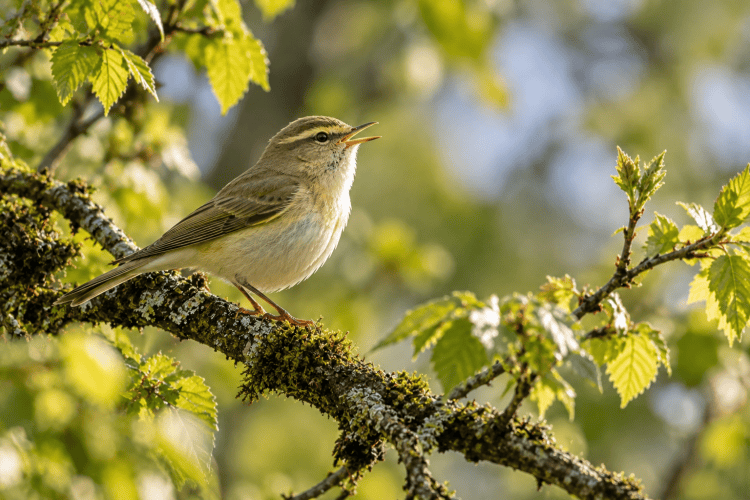
| There is a particular stage in spring when the garden seems to change faster than we can reasonably keep up with. Trees that were bare only a fortnight earlier suddenly carry a delicate haze of green, hedges begin pushing out fresh growth, and the borders fill with those enthusiastic little shoots that require a second look before deciding whether they are something we planted or something that has invited itself along. It is a busy time for gardeners, particularly when the weather cannot quite decide whether winter has finished with us. One morning may be warm enough to work without a coat, while the next reminds us that April has never been especially interested in keeping its promises. It is also the time when the countryside begins filling with voices that were absent throughout winter. Some are immediately recognisable. The Chiffchaff repeats its name from the trees, Blackbirds begin their wonderfully confident performances, and somewhere beyond the hedgerow a Cuckoo may be announcing its return. Amongst this growing chorus is another little bird whose song is rather less repetitive and considerably more delicate. It begins with a bright, cheerful series of notes before gradually descending into something softer, almost as though the singer has run out of enthusiasm halfway through the performance. That is the Willow Warbler (Phylloscopus trochilus), one of Britain’s most remarkable summer visitors and a bird that many people have probably heard without ever realising it. At first glance, there is nothing particularly spectacular about a Willow Warbler. It is a small, slender bird, generally olive-green to brownish above, with paler yellowish underparts and a faint pale stripe above the eye. It moves quickly through leaves and branches, searching for insects and rarely staying still long enough for someone trying to identify it. In fact, it looks so similar to the Chiffchaff that even experienced birdwatchers sometimes prefer to wait until one sings before deciding which species they are looking at. Yet beneath that modest appearance lies a story of migration, survival and an extraordinary connection between the British countryside and places thousands of miles away. A Song That Falls Through the Trees Birdsong is one of those things we tend to appreciate without necessarily understanding. We enjoy the dawn chorus, recognise a few familiar voices and occasionally stop to admire something particularly beautiful. Still, the purpose behind all that music is rather more practical than our enjoyment of it. For the male Willow Warbler, singing helps establish and defend a breeding territory and attract a mate. Its distinctive descending song is therefore not simply an expression of springtime enthusiasm. It declares that this particular patch of woodland, scrub, or young trees is occupied, and that the singer hopes to persuade a female that it offers a suitable place to raise a family. What I find interesting is how such a small bird can fill a surprisingly large space with sound. You may be standing beside a woodland path, surrounded by fresh leaves and the smell of damp earth, when the song comes from somewhere above your head. You search the branches, expecting to see something obvious, but there is nothing. The song comes again, and eventually you catch a fleeting movement amongst the foliage. A tiny bird appears for a moment, then disappears into the leaves. It seems almost unreasonable that something so small can produce such a distinctive performance. The Willow Warbler’s song is also one of the easiest ways to distinguish it from the Chiffchaff. Although their appearance is remarkably similar, their voices differ. The Chiffchaff delivers its familiar repeated two-note phrases, while the Willow Warbler produces a flowing sequence that gradually descends in pitch and energy. Once you learn the difference, the two birds become much easier to recognise, even when neither has the slightest intention of showing itself. This offers a useful lesson in observing wildlife. We often assume that identification begins with looking, yet listening can be just as valuable. A garden or woodland contains far more information than its visible occupants alone reveal. Birds announce territories, insects communicate, frogs call from ponds, and even the changing intensity of the dawn chorus tells us something about the season. Sometimes the most useful thing a gardener can do is stop working for a few minutes and listen. The Importance of Young Woodland Despite its name, the Willow Warbler is not restricted to willow trees. It occurs in a variety of habitats, particularly those containing young woodland, scattered trees, scrub, heathland and areas of developing vegetation. It often favours places with a mixture of low cover and taller growth, rather than dense, mature woodland with little happening beneath the canopy. This distinction matters because we sometimes imagine woodland conservation as simply preserving as many large trees as possible. Mature woodland is enormously valuable, of course, but not every woodland species needs the same conditions. Some depend upon ancient trees and dead wood, while others thrive in the earlier, more open stages of woodland development. The Willow Warbler belongs largely to that second group. It builds its nest on or very close to the ground, usually concealed among vegetation. The female constructs a domed structure using grasses, leaves and other plant material, creating a sheltered space in which to lay her eggs. Unlike birds that nest high in trees, Willow Warblers depend upon suitable cover at ground level, where the nest can remain hidden from predators and protected from the weather. That makes the structure of the surrounding vegetation particularly important. A woodland containing only tall trees and bare ground may look impressive to us but offer relatively little suitable nesting habitat for this species. Areas containing young trees, shrubs, grasses and other low vegetation can provide the combination of shelter and feeding opportunities it requires. Gardening offers a direct parallel. We often concentrate on the upper layers of planting because they provide the most obvious visual impact. Trees establish the framework, shrubs create shape and flowering plants supply seasonal colour. Yet the spaces beneath them can be just as important to wildlife. A garden where every shrub has been lifted to expose bare soil, every fallen leaf removed and every patch of groundcover eliminated may be wonderfully tidy. Still, it offers fewer opportunities for creatures that depend upon sheltered lower vegetation. The Willow Warbler reminds us that habitat exists in layers, and that the layers closest to the ground are often the easiest to overlook. A Journey Far Greater Than Its Size Suggests Perhaps the most astonishing aspect of the Willow Warbler is its migration. Every autumn, these small birds leave Britain and travel towards their wintering grounds in sub-Saharan Africa. The precise routes and destinations vary between populations. Still, the journey covers thousands of miles, crossing landscapes and environmental conditions very different from the British woodland where they spent the summer. Consider the size of the bird making that journey. A Willow Warbler typically weighs only around ten grams, although its weight changes as it builds up fat reserves for migration. It is a creature small enough to sit comfortably in the palm of your hand, yet it undertakes journeys that would be formidable even for much larger animals. The contrast is extraordinary. We spend considerable time preparing for even a relatively modest journey. Vehicles need fuel, routes are checked, weather forecasts consulted, and somebody inevitably asks whether we have remembered everything. The Willow Warbler follows a migratory programme shaped by evolution, using environmental cues and navigational abilities that allow it to travel between continents. Of course, the journey is not without danger. Bad weather, exhaustion, predation and changes in habitat along migration routes can all affect survival. A bird that successfully raises young in Britain still has to negotiate an enormous journey before it can return the following spring. This is why migratory birds present such complicated conservation challenges. Protecting breeding habitat in Britain is essential, but it cannot guarantee survival if conditions elsewhere deteriorate. The Willow Warbler’s life connects woodland in Britain with landscapes across Europe and Africa, making its future dependent upon circumstances far beyond the places where we hear it singing. The garden, woodland or heathland where a Willow Warbler breeds is therefore only one chapter in a much longer annual story. When Woodland Changes The Willow Warbler remains a widespread summer visitor in Britain, but its population trends reveal an interesting geographical contrast. Numbers have declined substantially in parts of southern and eastern England over recent decades, while populations in some northern and western areas have fared better. That uneven pattern is important because it reminds us that wildlife decline is rarely a simple matter of a species disappearing everywhere at once. A bird may remain common in one region while becoming noticeably scarcer in another. Someone walking through suitable woodland in Scotland may encounter numerous singing Willow Warblers, while a gardener in southern England might hear far fewer than they remember from earlier years. The reasons are complex. Changes in woodland structure, habitat availability, climate and conditions encountered during migration may all contribute. It would be misleading to attribute the entire pattern to a single cause, particularly when the species depends upon such a wide range of environments throughout the year. However, the importance of suitable breeding habitat is clear. Woodland does not remain static. Left to develop naturally, young trees grow taller, shrubs become shaded and open areas gradually close over. This process, known as succession, is perfectly normal, but it changes which species can thrive in a particular place. A young woodland rich in scrub and low vegetation may provide excellent habitat for Willow Warblers. Several decades later, the same woodland may have developed a dense canopy and a relatively sparse understorey, making it less suitable for the birds that once bred there. That does not mean mature woodland is undesirable. It simply means different stages of woodland development support different wildlife communities. In gardens, we see a smaller version of the same process. A newly planted border changes as shrubs mature, trees cast increasing shade and groundcover spreads. Plants that once flourished may struggle as conditions alter, while others become more successful. A garden is never really finished, no matter how confidently we may declare the planting scheme complete. Nature has an unfortunate habit of continuing to grow after the gardener has put the tools away. The Insects Beneath the Leaves Like many small warblers, the Willow Warbler feeds primarily on insects and other small invertebrates. Caterpillars, flies, aphids, and spiders all form part of its diet, and the availability of suitable food becomes particularly important during the breeding season. This brings us back to one of the recurring themes of our bird series: the relationship between birds and the smaller creatures they depend on. We tend to notice birds because they are visible, attractive and often vocal. Insects are less consistently appreciated. A butterfly crossing the garden is welcome, but an aphid colony on a rose may receive a rather different reception. Caterpillars can be admired when they belong to a beautiful butterfly, although enthusiasm sometimes fades when they begin eating the plants we have spent money cultivating. Yet these creatures are essential components of the food web. A garden containing healthy insect populations can support birds in ways that a perfectly maintained but biologically impoverished garden cannot. That does not require abandoning horticultural standards or allowing pests to destroy valuable planting. It requires a little judgement about when intervention is genuinely necessary. I have always thought that one of the most useful gardening skills is learning to distinguish between damage that matters and damage that merely offends our sense of perfection. A few aphids on a vigorous plant may be feeding ladybirds, hoverfly larvae and small birds. Caterpillars consuming a modest number of leaves may be contributing to the next generation of moths and butterflies. A patch of long grass can shelter insects that later become food for nearby birds. The temptation is to treat every visible imperfection as a problem requiring immediate correction. But a living garden is not a showroom, and expecting every leaf to remain untouched is rather like expecting a restaurant to operate without anybody eating the food. The Willow Warbler’s dependence upon insects offers another reason to think carefully before reaching for a pesticide or removing every untidy corner. A Bird That Asks Us to Look More Carefully There is something particularly appealing about wildlife that does not immediately advertise its importance. The Willow Warbler is not brilliantly coloured, exceptionally large or especially dramatic in its behaviour. Most people walking through a woodland would probably overlook it entirely unless its song attracted their attention. Yet the closer we look at its life, the more remarkable it becomes. Here is a tiny bird that travels between continents, builds an intricate nest close to the ground, raises its young amongst the vegetation of British woodlands and contributes one of the loveliest songs to our spring countryside. It depends upon insects, young woodland, suitable ground cover and conditions thousands of miles beyond our shores. All of that is contained within a creature that weighs little more than a few teaspoons of sugar. Perhaps this is why I enjoy writing about birds that are not necessarily the most famous or spectacular. They remind us that the natural world does not arrange its wonders by size, colour, or popularity. Some of its most extraordinary stories belong to creatures that pass through our lives almost unnoticed. As gardeners, we are fortunate to spend so much time outdoors, although familiarity can occasionally work against us. When you visit the same gardens week after week, it becomes easy to concentrate entirely upon the jobs waiting to be done. The hedge needs cutting, the lawn needs mowing, the border requires weeding, and somebody has discovered that a shrub planted twenty years ago has developed ambitions considerably beyond its original description. Meanwhile, the wildlife continues around us. A small bird moves through the leaves. A caterpillar feeds beneath a branch. A spider repairs its web. Somewhere above the garden, a migrant that has travelled thousands of miles begins singing from a young tree. None of these events requires our attention, but all of them reward it. The Quiet Arrival of Spring Perhaps the Willow Warbler’s greatest gift is encouraging us to appreciate the quieter details of the changing seasons. Spring is often described through its most obvious events: daffodils flowering, trees coming into leaf, warmer weather and the return of familiar birds. But the season also includes countless smaller arrivals and changes that we may not immediately recognise. The first Willow Warbler singing from a patch of young woodland is one such moment. It tells us that somewhere far beyond Britain, another migratory journey has been completed. A bird that spent winter in Africa has returned to a particular landscape, found suitable habitat and begun the business of establishing a territory. For the bird, it is simply the continuation of an annual cycle. For us, it is an opportunity to remember how much is happening beyond our immediate concerns. There is something rather comforting about that. Gardens change, weather frustrates our plans, plants fail to behave as expected, and the countryside continues to face enormous environmental pressures. Yet every spring, Willow Warblers still arrive, and in suitable places their descending songs drift through the trees. Perhaps the most valuable thing we can do is make sure places still exist worth returning to. Not necessarily perfect places, nor landscapes managed to within an inch of their lives, but living environments with the shelter, food, and variety wildlife requires. The Willow Warbler does not need us to admire it. It needs us to leave enough of the world functioning for its extraordinary little life to continue. And if we happen to stop beneath a tree and listen to its song along the way, that seems a rather pleasant reward. Watching For… Willow Warblers generally arrive in Britain from late March and April, with their songs becoming a familiar feature of suitable habitats throughout spring and early summer. Look and listen in young woodland, scrub, heathland, woodland clearings, and areas with a mixture of trees and low vegetation. They are particularly associated with developing woodland habitats rather than dense, heavily shaded stands of mature trees. The easiest way to identify a Willow Warbler is usually by its song, a sweet, flowing sequence of notes that gradually descends and fades. Its resemblance to the Chiffchaff can make visual identification difficult, although Willow Warblers often show paler legs and a slightly longer-winged appearance. These features are not completely reliable on their own, so listening remains particularly useful. If you hear one singing, resist the temptation to hurry towards it. Find somewhere comfortable to stand, watch the outer branches and allow the bird to reveal itself naturally. You may only glimpse a small olive-coloured shape moving through the leaves, but once you recognise the song, you will begin noticing Willow Warblers in places where you previously heard nothing more than the general sound of spring. And that, perhaps, is the pleasure of learning about birds. The countryside does not necessarily change, but our experience of it certainly does. |
| Wander through the Article Directory and see where curiosity takes you next. |
| About our writing & imagery Most articles reflect our real gardening experience and reflection. Some use AI in drafting or research, but never for voice or authority. Featured images may show our photos, original AI-generated visuals, or, where stated, credited images shared by others. All content is shaped and edited by Earthly Comforts, expressing our own views. |


Oh Rory, what a lovely post! ❤️🐦
I always enjoy your bird stories, but this one felt particularly special because these little travellers connect your part of the world with mine. You share their lives with us from Britain, while here in South Africa we have the pleasure of welcoming some of them when they make their way down to our warmer shores.
Isn’t it wonderful to think that a tiny bird can travel such enormous distances, linking our two corners of the world? I love that we can be thousands of kilometres apart, yet share an appreciation for the very same little creatures. It makes the natural world feel wonderfully connected.
Your posts often make me pause and look a little more closely at the wildlife around me. I find myself imagining these little birds on their incredible journeys and wondering what adventures they have along the way.
Thank you for sharing another beautiful glimpse into their lives, Rory. It’s always a pleasure to wander through nature with you, even from opposite sides of the world. 🙏❤️
Sending a warm hug from South Africa! ❤️🌿🐦
LikeLiked by 1 person
I am always surprised at just how travelled some of our bird species really are. It’s sad that many species are so horribly poached during their migrations to the point that hundreds of thousand never make it back to our shores 😦
LikeLiked by 1 person
You’re right, Rory. It’s quite astonishing when you think about the distances some of these little travellers cover. We tend to admire their arrival without always realising just how far they’ve come and what they’ve had to overcome along the way.
But the poaching is heartbreaking. 😔 It’s dreadful to think that birds which have travelled thousands of kilometres can lose their lives because of human greed. They should be able to follow their natural migration routes safely, without facing that kind of danger.
I suppose that’s another reason I appreciate having these visitors in our gardens and being able to photograph them. Every bird has its own little story, and it’s a privilege to witness even a small part of it. 🤗❤️
LikeLiked by 1 person
Yes it is a privilege and yet so many people takes their little lives for granted.
LikeLiked by 1 person
I totally agree my friend. 🤗❤️
LikeLiked by 1 person