
| Case File 08 The Orang Mawas — Malaysia’s Mysterious Forest Giant |
| Malaysia’s Mysterious Forest Giant Deep within the tropical forests of southern Malaysia, reports of enormous, hairy, upright-walking creatures have circulated for generations. In 2005, a series of extraordinary encounters attracted international attention and prompted an official investigation. But what exactly were people seeing, and could an unknown giant primate really inhabit the Malaysian rainforest? |

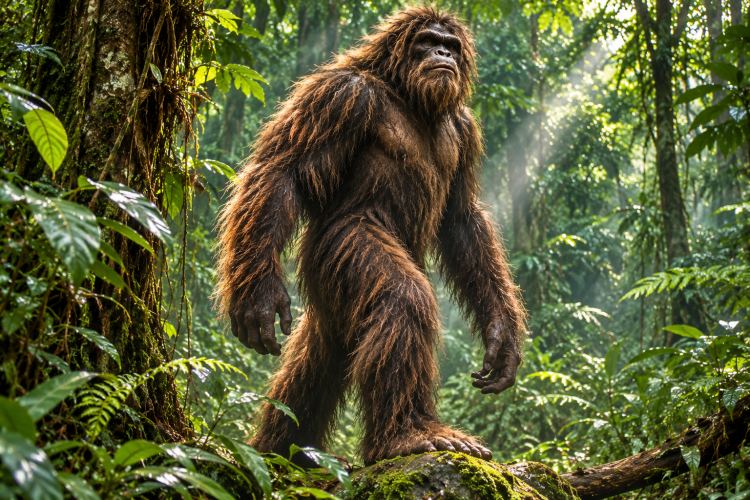
| A Giant in the Rainforest Something about a tropical rainforest makes the possibility of undiscovered wildlife particularly compelling. Beneath the towering canopy, visibility can be reduced to a few yards. At the same time, enormous trees, tangled vegetation and steep valleys create a landscape in which even familiar animals can remain remarkably difficult to observe. Yet the creature at the centre of our latest investigation is hardly something one would expect to overlook. According to some witnesses, it stands between eight and twelve feet tall, possesses enormous shoulders, walks upright and is covered in dark or reddish-brown hair. Its appearance has been compared with that of a gorilla, although gorillas are native to Africa and no comparable great ape is known to inhabit the forests of Peninsular Malaysia. The creature is commonly called the Orang Mawas, sometimes simply the Mawas, and it has acquired another name through international media coverage: the Malaysian Bigfoot. Our previous investigation concerned the Orang Pendek of Sumatra, a comparatively small, muscular creature whose reported appearance could conceivably fit an unknown primate species. The Orang Mawas presents a considerably greater zoological challenge. If the largest descriptions are accurate, we would be dealing with an animal substantially taller than any recognised living ape. And that raises an obvious question. How could such an enormous creature remain undiscovered? The Forests of Johor Our investigation begins in Johor, the southernmost state of Peninsular Malaysia, where extensive areas of tropical forest survive alongside rivers, plantations, settlements and agricultural land. Particularly important is the Endau-Rompin region, an extraordinary landscape of ancient rainforest extending across parts of Johor and neighbouring Pahang. Its rivers, forested hills and relatively inaccessible interior support a remarkable diversity of wildlife. Malayan tigers, Asian elephants, tapirs, sun bears and several primate species inhabit the wider forest ecosystems of Peninsular Malaysia. Many are elusive, and some are exceptionally difficult to observe without specialist equipment or considerable field experience. It is therefore entirely reasonable to acknowledge that these forests may contain wildlife that has not yet been fully documented. However, discovering a previously undescribed insect or small mammal is rather different from establishing the existence of a giant upright-walking ape. An animal of such dimensions would require substantial food resources, suitable breeding partners and a population large enough to persist across generations. It would also be expected to leave identifiable biological evidence. The forest might conceal an individual, but concealing an entire breeding population indefinitely would be much harder. Stories Older Than the Headlines Accounts of unusual forest beings existed in Malaysia long before the international excitement of 2005 and 2006. Some stories have been associated with Orang Asli communities, the Indigenous peoples of Peninsular Malaysia, whose relationships with the surrounding forests extend back many generations. Their knowledge of wildlife, animal movements and forest environments can be exceptionally detailed. Such knowledge deserves serious consideration, particularly when investigating an unfamiliar animal in a landscape where local experience may be more valuable than an occasional scientific visit. Nevertheless, interpreting these traditions requires care. The Orang Asli comprise several distinct peoples with different languages and cultural histories. It would be misleading to suggest that every community shares one identical account of the Orang Mawas. Nor should every traditional description of a forest being automatically treated as a report of an unknown primate. Cultural narratives may concern spiritual figures, unusual people, familiar animals or experiences that do not fit neatly into modern zoological categories. The name itself also presents difficulties. Mawas has been used in parts of the wider Malay-speaking region to refer to orangutans. At the same time, the modern Orang Mawas mystery has become associated with a much larger, supposedly upright-walking animal. Consequently, similarities between names cannot establish that all the stories concern the same creature. What we can say is that accounts of unusual hairy forest beings formed the backdrop against which the events of 2005 would unfold. December 2005 — The Encounter That Started Everything The modern Orang Mawas mystery gained international attention following reports from fish-farm workers near a forest reserve in Johor during December 2005. According to contemporary news coverage, the workers claimed to have encountered three enormous, hairy creatures near the forest’s edge. Two were described as adults, while the third appeared considerably smaller, leading witnesses to interpret the group as a possible family. That detail was particularly significant. A solitary unidentified animal might conceivably be an unusual individual, an escaped captive or a mistaken observation. Three creatures travelling together, apparently including a youngster, would suggest something much more extraordinary: a breeding population. However, the family interpretation depended entirely upon the witnesses’ descriptions—no independently verified photographs established the identity, number or relationship of the reported animals. The story nevertheless attracted attention from local wildlife authorities, journalists and members of the Malaysian Nature Society. Photographs of supposed footprints were circulated, and additional witnesses began reporting encounters of their own. Within weeks, what began as an unusual local incident had become an international cryptozoological sensation. January 2006 — The Investigation Begins As the reports multiplied, Johor National Parks director Hashim Yusoff became one of the most prominent officials associated with the investigation. Contemporary reports described an Orang Asli witness who claimed to have encountered an enormous, brownish, hairy creature in the forest. News coverage estimates its height at around ten to twelve feet. The creature was reportedly standing upright and did not act aggressively, although the witness was startled enough to leave the area. Hashim visited the Sungai Madek forest reserve with rangers and journalists to gather information from local communities. He expressed an interest in obtaining scientific assistance and compiling a record of the sightings. This was an important development because the authorities were not merely responding to an amusing newspaper story. They were trying to determine whether the reports had any factual basis. By late January, Malaysian news agencies were reporting plans for scientific teams to investigate the claims. A telephone hotline was also established to receive information about further sightings. For a brief period, cryptozoology enthusiasts, government representatives, and wildlife officials discussed the possibility of an unknown giant primate. Yet official interest should not be confused with official confirmation. An investigation demonstrates that a claim is being examined. It does not establish that the claim is correct. The Problem With the Footprints As with many investigations into alleged unknown primates, footprints became an important part of the Orang Mawas story. Reports described unusually large impressions discovered in muddy ground or forest vegetation, some supposedly measuring around eighteen inches in length. Photographs appeared in newspapers, encouraging speculation about the enormous feet that might have produced them. Unfortunately, the available evidence was far less convincing than the accompanying headlines. Some published images showed poorly defined depressions rather than clear anatomical impressions. Their shapes were difficult to interpret, and without properly documented trackways it was impossible to establish the movement, size or identity of the animal responsible. Rainforest conditions create particular difficulties for footprint investigations. Heavy rainfall can enlarge impressions, loose vegetation can collapse into tracks, and animals moving through soft ground may leave distorted marks. Even an apparently impressive footprint is of limited value without reliable measurements, scale photographs, detailed environmental observations, and comparisons with known species. The crucial question was whether the impressions contained anatomical features that could be independently examined. No widely accepted footprint evidence emerged that established the existence of the Orang Mawas. The Photographs Nobody Could Verify During the height of the excitement, claims circulated that photographs of the mysterious creatures existed. Some investigators and enthusiasts discussed alleged images supposedly showing unusual, hairy, humanlike animals. Drawings and reconstructions also appeared, offering increasingly elaborate interpretations of what the creatures might look like. But the distinction between a witness’s drawing and a verified wildlife photograph is fundamental. An illustration can communicate what someone believes they saw. It cannot, on its own, demonstrate that the animal exists. Similarly, a photograph whose origin, circumstances or subject cannot be authenticated provides little scientific value, however convincing it may initially appear. The Orang Mawas investigation never produced an unequivocal, independently verified image of an unknown giant ape. As publicity increased, the risk grew that speculation would outpace the available evidence. This is a recurring difficulty in cryptozoology. Once an intriguing possibility captures public attention, each new claim can appear to strengthen the original story, even when the claims themselves remain unverified. A dozen uncertain reports do not necessarily combine into one reliable conclusion. The Baby Bigfoot That Wasn’t By April 2006, the excitement had reached another remarkable stage. A Malaysian newspaper reported claims that wildlife officers had captured a young Bigfoot near Kota Tinggi after tranquillising it. If the story were true, it would have been an extraordinary zoological discovery. A living specimen could have been examined, photographed, genetically tested and compared with recognised primates. However, Malaysia’s Wildlife and National Parks Department denied the report. Its director-general, Musa Nordin, said the department conducted no such operation during the period in question. No captured animal was produced, and no verifiable evidence emerged to support the story. The episode demonstrated how rapidly an unresolved wildlife mystery can generate increasingly dramatic claims. It also reminded everyone that a reported event and a documented event are not the same. December 2006 — The Official Sceptics Respond By the end of 2006, the investigation had taken a more sceptical turn. Malaysia’s Environment Ministry publicly questioned the existence of the supposed creatures. Officials pointed to the absence of reliable physical evidence, including hair, droppings and identifiable photographs. They also noted that wildlife-monitoring cameras had failed to record the alleged animals. One official suggested that witnesses might have mistaken familiar wildlife for something extraordinary. Supporters of further investigation disagreed, arguing that research required time and that the absence of immediate proof did not justify dismissing every witness. Both positions deserve examination. It is reasonable to investigate an unusual report, especially when it concerns a potentially important wildlife discovery. It is equally reasonable to demand stronger evidence before accepting the existence of an entirely unknown giant primate. The central difficulty remained unchanged: despite considerable publicity and investigative interest, the Orang Mawas had not been scientifically demonstrated to exist. Could a Known Animal Explain the Sightings? Several recognised animals deserve consideration. The Malayan sun bear is perhaps the most frequently suggested explanation. Although they normally move on four legs, sun bears can stand upright, and their dark fur, powerful forelimbs, and unusual posture may create a surprisingly humanlike impression. However, an adult sun bear is considerably smaller than the giant creature described in some Orang Mawas reports. That discrepancy does not eliminate misidentification, because estimating an animal’s size in dense forest can be remarkably difficult. Distance, vegetation and brief viewing conditions can all affect perception. Gibbons are another possibility. These long-armed primates can move upright when travelling on the ground, sometimes raising their arms for balance. Yet they are relatively small animals and cannot readily account for descriptions of an enormous, heavily built creature. Orangutans are sometimes mentioned because of their physical resemblance to certain descriptions. However, wild orangutans no longer inhabit Peninsular Malaysia. Their natural range today is Borneo and Sumatra. An escaped captive animal might theoretically explain an isolated sighting, but no verified evidence shows escaped orangutans caused the Johor reports. Ultimately, the known-animal explanation does not require every witness to have mistaken the same species. Different sightings may have involved different animals, environmental conditions or misunderstandings. Could a Giant Ape Have Survived? Perhaps the most dramatic possibility involves Gigantopithecus blacki, an extinct giant ape known from fossil evidence in Asia. This remarkable primate lived during the Pleistocene and was considerably larger than many modern apes. Researchers have found its remains in southern China and studied its teeth and jaws to understand its diet and evolutionary history. Because the Orang Mawas is described as exceptionally large, comparisons with Gigantopithecus are understandable. But the connection is speculative. Scientists do not possess a complete skeleton of Gigantopithecus, so reconstructions of its appearance and locomotion involve uncertainty. No established evidence shows it habitually walked upright like a human. No evidence shows that a population survived into modern times in Malaysia. Fossils demonstrate that large apes existed in prehistoric Asia. They do not establish that an enormous unidentified primate inhabits Johor today. The distinction matters because prehistoric possibility is often mistaken for contemporary evidence. A Forest Worth Investigating One of the most interesting aspects of the Orang Mawas story is that the investigation drew attention to the extraordinary biological richness of Malaysia’s remaining forests. The search for an unknown giant ape may have captured public imagination, but the region’s recognised wildlife faces very real challenges. Habitat fragmentation, forest clearance and pressure from human development affect numerous species, including animals whose existence is beyond dispute. This creates an interesting contrast. People may become fascinated by a mysterious creature that has never been photographed convincingly, while overlooking endangered animals that scientists have spent decades studying. That does not mean unusual reports should be ignored. Investigating them can encourage closer observation, generate interest in conservation and occasionally produce unexpected discoveries. But scientific curiosity is most valuable when it remains connected to evidence. Whether or not the Orang Mawas exists, the forests associated with its story deserve protection. Listen. Investigate. Reach your own conclusion. Case File 08 — Closed, pending further evidence. |
| Case Assessment |
| STATUS: UNCONFIRMED — NO SCIENTIFICALLY ACCEPTED EVIDENCE OF A GIANT UNKNOWN PRIMATE The Orang Mawas mystery rests upon reported encounters, local traditions and disputed footprint evidence, particularly from the Johor investigations of 2005 and 2006. The involvement of wildlife officials and the announcement of scientific investigations demonstrate that the reports attracted serious attention. However, they do not establish that the witnesses encountered an unknown species. The absence of a verified specimen, diagnostic biological material or unequivocal photographic evidence remains the central weakness. Misidentification of known wildlife offers a plausible explanation for at least some encounters, although individual reports cannot always be reconstructed sufficiently to determine what was observed. The proposed connection with Gigantopithecus is unsupported by direct evidence. Our assessment: The Orang Mawas remains an interesting example of how local traditions, eyewitness testimony, media attention and scientific curiosity can combine to create a modern wildlife mystery. Its existence as a distinct giant primate has not been demonstrated. |
| Research Notes Case File 08: The Orang Mawas Closing the File — Two Mysteries, Two Very Different Creatures Our investigations into the Orang Pendek and Orang Mawas have taken us through some of Southeast Asia’s most remarkable forests, but they have also revealed an important distinction. The Orang Pendek is generally described as a small, powerful, upright-moving creature. The Orang Mawas, by contrast, is portrayed as an enormous forest giant, sometimes exceeding the height of any recognised living ape. Both mysteries involve eyewitness testimony, challenging environments and the possibility of unfamiliar wildlife. Both also suffer from the same fundamental problem: the absence of decisive, independently verifiable evidence. Perhaps the most interesting lesson is that a mystery’s size does not determine its credibility. An enormous animal is not necessarily easier to identify from a fleeting encounter. At the same time, a comparatively modest creature may prove equally difficult to document if it inhabits dense forest and avoids human contact. For now, the Orang Mawas remains an intriguing but unconfirmed inhabitant of Malaysia’s cryptozoological landscape. Our next investigation takes us across the Pacific to the southeastern United States, where reports describe another enormous, hairy forest-dwelling creature. Unlike the Malaysian mystery, however, this one comes with a particularly unpleasant reputation. Next Case File: 09 — The Skunk Ape: Florida’s Mysterious Swamp Dweller. |
| Geographical focus: Johor and neighbouring forested regions of Peninsular Malaysia, particularly the Endau-Rompin landscape. Reported appearance: A large, heavily built, hairy creature, frequently described as walking upright. Published height estimates vary considerably. Historical context: Local accounts of unusual forest beings predate the modern investigation, although their relationship to the specific Orang Mawas reports remains uncertain. Principal modern events: A series of sightings reported in December 2005 led to substantial media coverage, official enquiries, and proposed scientific investigations in 2006. Key individuals: Hashim Yusoff, then director of Johor National Parks, and Vincent Chow, a Malaysian Nature Society adviser who supported investigation of the reports. Evidence considered: Eyewitness descriptions, alleged footprints, unverified photographic claims and reports of unusual forest activity. Possible explanations: Misidentified sun bears or primates, inaccurate size estimates, folklore, mistaken observations or an unidentified animal. Scientific position: No recognised zoological species corresponding to the reported Orang Mawas has been established. |
| Selected Research References 1. Reuters / ABC News — 2 January 2006 Bigfoot fever grips Malaysian rainforest. Contemporary reporting on the Johor sightings, Hashim Yusoff’s involvement, and the early official investigation. 2. AFP / ABC News — 8 January 2006 Bigfoot excitement builds in Malaysia. Reporting on the alleged family group, Indigenous eyewitness testimony, local investigations and scientific uncertainty. 3. Reuters / ABC News — 28 January 2006 Malaysian teams to track ‘Bigfoot’. Documents the announcement of plans for scientific teams to investigate the reports. 4. AFP / Mail & Guardian — 20 April 2006 Malaysia denies capturing baby ‘Bigfoot’. Documents the alleged capture and the subsequent official denial. 5. AFP / Mail & Guardian — 16 December 2006 Malaysian ministry scoffs at Bigfoot claims. Records the official sceptical response and the continuing disagreement over whether further investigation was justified. 6. Zhang, Y. et al. (2024) The demise of the giant ape Gigantopithecus blacki. Nature, 625, 535–539. Peer-reviewed research examining the extinction of Gigantopithecus blacki. Relevant to prehistoric giant apes, but not evidence for the modern Orang Mawas. Research Assessment The Orang Mawas has a documented history of public investigation, particularly during 2005–2006. However, the available evidence does not support scientific recognition of a giant unknown primate. Research classification: Unconfirmed cryptid — disputed eyewitness accounts and physical traces. Editorial note: Any AI-generated illustration accompanying this article represents an artistic interpretation of reported descriptions, not a photograph of a scientifically verified animal. Research verification: The principal events in this article are supported by contemporary reporting from 2006, including the original Johor sightings, proposed scientific investigations, the disputed capture story and the government’s subsequent scepticism. ABC News |
| About our writing & imagery The Edge of Discovery explores cryptozoology and unexplained encounters through research, scientific understanding and critical investigation. AI may assist with research, drafting, editing and imagery, but all editorial direction and final content are shaped and reviewed by Earthly Comforts. Images may include historical photographs, credited third-party material or original AI-generated illustrations. AI artwork is an artistic interpretation, not authentic evidence. Our aim is to explore the mysteries fairly and encourage readers to reach their own conclusions. |

