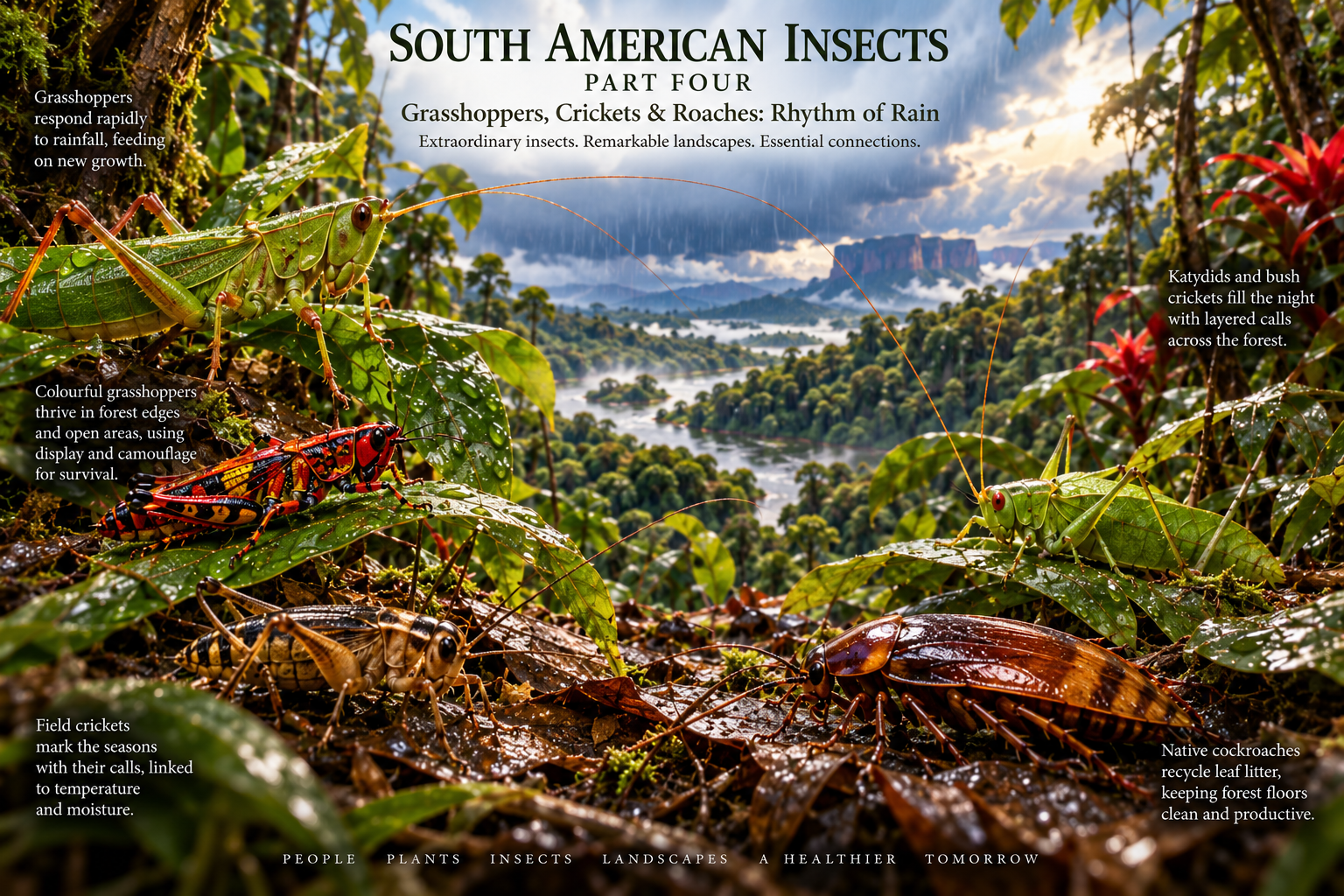
| A 5-Part Series |
| A curated exploration of South America’s most iconic, curious, and ecologically important insects |
| Part Four — Grasshoppers, Crickets & Roaches: Rhythm of Rain |
| Rain has an extraordinary influence upon the living landscapes of South America. Across tropical forests, open grasslands, wetlands, and seasonally dry regions, its arrival can transform the conditions insects experience in a remarkably short time. Vegetation responds, fresh growth becomes available, and creatures that were previously difficult to find may suddenly appear in considerable numbers. Grasshoppers, crickets, katydids and cockroaches are among the insects whose lives are closely connected to these changing conditions, although each responds in its own particular way. It would be misleading to suggest that the whole continent follows one simple wet-and-dry rhythm. The Amazon contains regions with substantial rainfall throughout much of the year, while the Cerrado, parts of the Chaco and other seasonal landscapes experience much more pronounced changes. Further south, temperature and winter conditions matter more. Yet across these environments, moisture shapes vegetation, breeding opportunities, and food availability, making rainfall one of the great organising forces in insect life. For a gardener, this relationship is familiar, even if the scale is rather different. A period of warm rain can bring a noticeable increase in growth, followed by insects taking advantage of tender leaves and newly favourable conditions. We often notice the result without considering the sequence that produced it. South America’s grasshoppers, crickets and cockroaches provide a particularly interesting opportunity to examine that connection between weather, abundance and the wider ecological system. Grasshoppers and the sudden availability of food Grasshoppers are among the most visible insects in open South American landscapes. They occupy grasslands, savannas, agricultural land, woodland margins and other habitats where suitable vegetation provides both food and shelter. Many feed upon grasses and herbaceous plants, although their diets and habitat preferences vary considerably between species. In seasonally dry environments, the arrival of rain can produce a flush of fresh vegetation that creates favourable conditions for feeding and development. Depending upon the species, temperature, previous breeding success and other environmental factors, grasshopper numbers may increase as these resources become available. Their populations do not respond to rainfall alone, but the connection between moisture and plant growth can be particularly important. This abundance has consequences beyond the insects themselves. Grasshoppers transfer energy from plants into the wider food web, becoming prey for birds, reptiles, amphibians, spiders and predatory insects. A period of rapid population growth may therefore support an equally significant increase in feeding opportunities for other animals. Their relationship with vegetation is not always harmless. Large populations can damage crops and grazing land, particularly where suitable food is concentrated across agricultural landscapes. In such circumstances, practical intervention may be necessary. However, it is worth distinguishing between genuine economic damage and the simple presence of numerous plant-feeding insects. A grasshopper consuming vegetation is not automatically evidence of ecological imbalance. In natural systems, herbivory is one way energy moves through the landscape, and the insects responsible are themselves part of a much larger network of predators and competitors. Colour, camouflage and survival in open landscapes South America’s grasshoppers demonstrate considerable variation in appearance. Some are predominantly green or brown, blending into grasses and foliage, while others display conspicuous colours or markings that stand out when they move. Camouflage is a clear advantage for insects that spend much of their lives exposed among vegetation. Remaining difficult to distinguish from leaves, stems or dry ground can reduce the likelihood of detection by predators. Behaviour reinforces this protection: many species remain motionless until disturbed, then escape with powerful jumps or flight. Other grasshoppers use more conspicuous strategies. Some species have warning colours linked to chemical defences, while others reveal brightly coloured hindwings only when flying. The sudden change in appearance may make it harder for a predator to follow the insect when it lands and becomes less conspicuous again. These differences are worth considering because we often assume that successful camouflage requires an insect to be uniformly dull. In reality, concealment can depend upon posture, movement, background and the timing of visual displays. A grasshopper that seems spectacularly coloured in flight may become remarkably difficult to locate once it settles among vegetation. As with the butterflies in our previous episode, appearance is not simply decoration; it is part of a much more complicated relationship between the insect and the animals attempting to catch it. Katydids and the voices of the forest If grasshoppers are often noticed through movement, katydids are frequently recognised through sound. Known in Britain as bush crickets, these insects are particularly diverse in tropical South America, where many species inhabit shrubs, trees and forest canopies. Their calls contribute to the extraordinary acoustic character of tropical forests, especially after darkness. Male katydids generally produce sound by rubbing specialised parts of their forewings together, a process known as stridulation. Different species produce different patterns, frequencies and rhythms, allowing individuals to communicate with potential mates. The result is far more complex than a continuous background chorus. What we hear as a general mixture of chirping, buzzing and clicking may contain numerous distinct signals, each associated with a particular species and behaviour. Some katydids are remarkable mimics of leaves, complete with shapes, veins and markings that make them difficult to recognise when resting among vegetation. Others resemble bark or twigs, while some species have defensive structures or behaviours that discourage predators. Sound, however, introduces its own difficulties. A calling insect may attract a mate, but it can also reveal its position to predators and parasites that can locate prey through acoustic signals. Communication therefore involves balancing being heard by the intended recipient with avoiding unwanted attention. This is one of the more fascinating aspects of insect behaviour. A call that appears to us simply part of the atmosphere of a tropical evening may represent a carefully evolved compromise between reproduction and survival. Crickets and the influence of temperature True crickets occupy a similarly important place within South America’s soundscape, although they belong to a different group from katydids. Many live among grasses, leaf litter, soil crevices and other sheltered habitats, while some species are particularly successful in disturbed ground and agricultural margins. Like katydids, male crickets commonly communicate through stridulation. Their calls vary between species and are influenced by environmental conditions, particularly temperature. In some crickets, the rate of chirping increases predictably as temperatures rise, although the relationship is not identical across all species. This has encouraged the familiar idea that crickets can function as natural thermometers. Some truth underlies the observation, but it should not be applied indiscriminately. Calling behaviour also depends upon species, maturity, time of day and other conditions, making a cricket’s song a biological response rather than a universally reliable temperature reading. Moisture influences cricket habitat too. Leaf litter, soil structure and vegetation provide shelter from drying conditions, while rainfall can alter the availability of suitable places for feeding and reproduction. For gardeners, crickets offer another reason to consider what happens at ground level. A border may appear well planted above the soil while providing relatively little shelter beneath it if every fallen leaf is removed and the ground is repeatedly disturbed. Leaving some organic material in appropriate places can create habitat for a variety of invertebrates. A garden does not need to become completely untidy, but some structural variety can make a considerable difference to the creatures living within it. Cockroaches beyond their reputation Few insects carry a less favourable reputation than cockroaches. Their association with buildings, food contamination and difficult infestations has shaped how people respond to the entire group, often without recognising that most cockroach species are not domestic pests. South America supports an enormous diversity of cockroaches, many of which live outdoors in forests, grasslands and other natural habitats. They occupy leaf litter, fallen timber, vegetation and soil-level shelters, where they feed upon a range of organic materials. Many contribute to decomposition by consuming dead plant matter and other debris, breaking material into smaller fragments that microorganisms and other soil organisms can process further. Their activities form part of the continuous recycling upon which productive ecosystems depend. Distinguishing between outdoor cockroaches and pest species matters. A cockroach living beneath bark in a tropical forest is not an insect that has somehow escaped from a kitchen. It belongs to an ecological community in which its feeding and behaviour have developed over countless generations. Some South American forest cockroaches are surprisingly large, while others are small, colourful or adapted to particular microhabitats. Certain species live among vegetation rather than on the ground, and their feeding habits can be considerably more varied than the familiar image of a scavenger suggests. Their diversity makes it difficult to generalise about the group beyond recognising that cockroaches have proved exceptionally successful at occupying environments rich in organic material. Perhaps there is a lesson here about reputation. We are inclined to judge insects by the species that inconvenience us most, even when those species represent only a small fraction of the wider group. Giant cockroaches and the value of decay Some of South America’s larger forest cockroaches are particularly associated with humid habitats containing substantial quantities of fallen vegetation and decaying wood. Their size can make them appear formidable, although many are relatively slow-moving insects whose principal activities involve feeding, sheltering and reproduction. The importance of their work becomes clearer when we consider how much organic material a tropical forest produces. Leaves fall, branches break, trees die, and vegetation is continually replaced. All of this material contains nutrients that must eventually return to circulation. Cockroaches are only one component of the decomposition community, alongside fungi, bacteria, termites, beetles, millipedes and numerous other organisms. Their feeding fragments material and contributes to the broader process that transforms dead vegetation. This does not mean that finding a particular cockroach proves a forest is healthy. Individual species differ in their habitat requirements, and some tolerate disturbance more readily than others. Nevertheless, diverse decomposer communities are an important feature of functioning forest ecosystems. The comparison with gardening is straightforward. We understand the value of composting and organic matter, yet often overlook the organisms that carry out similar processes in natural habitats. The forest does not need a compost heap because decomposition happens throughout the landscape. Cockroaches are among the less celebrated participants in that work. Rainfall, abundance and the limits of control One of the most interesting features of insect populations is their ability to change rapidly when conditions become favourable. Warmth, moisture and fresh vegetation can create opportunities for feeding and reproduction, while drying conditions, predators, disease and competition may subsequently reduce numbers. It is tempting to describe this as a simple cycle of abundance followed by correction, but natural populations rarely behave quite so neatly. Different species respond at different speeds, and changes in land use, habitat fragmentation or unusual weather can alter relationships that would otherwise help regulate numbers. A grasshopper population may increase without producing a corresponding rise in predators quickly enough to prevent crop damage. A cricket species may decline because suitable ground cover disappears, even when rainfall remains favourable. Cockroaches dependent upon particular forest conditions may struggle following clearance or prolonged disturbance. These examples remind us that ecological balance is not a fixed state in which every population remains constant. It is an ongoing process of adjustment, shaped by many relationships operating simultaneously. For gardeners, this distinction is useful. We often prefer predictable conditions, yet living systems naturally fluctuate. More insects after favourable weather does not automatically require action, just as a sudden decline should not always be interpreted as an improvement. The important question is whether the habitat continues to support the relationships necessary for populations to persist and respond to change. The rhythm beneath the rain Grasshoppers, katydids, crickets and cockroaches occupy very different positions within South America’s ecosystems, yet all reveal something about the relationship between climate and insect life. Grasshoppers respond to vegetation and become food for predators. Katydids communicate through the dense acoustic environment of tropical forests, while crickets connect temperature, habitat and behaviour through their familiar calls. Cockroaches continue the less conspicuous work of decomposition, returning organic material to the wider biological cycle. None of these activities occurs independently of the landscape. Rain influences plants, plants support herbivores, vegetation and leaf litter provide shelter, and decomposers help release nutrients that support further growth. The relationships are not always simple, nor do they produce perfectly predictable outcomes, but together they contribute to the remarkable productivity of South America’s varied environments. As gardeners, we recognise parts of these processes every year. Rain brings growth, warmth encourages activity, and the insects present in a garden change as the seasons progress. South America shows how elaborate those familiar relationships can become when expressed across forests, savannas, wetlands, and grasslands on a continental scale. The sound of crickets after rain, a grasshopper rising from fresh vegetation or a cockroach disappearing beneath fallen leaves may seem like unrelated observations. In reality, each belongs to a landscape that responds to its surroundings. Rain does not simply make the forest wet. It influences what grows, what feeds, what reproduces and what eventually returns to the soil. And somewhere within that continuing cycle, the insects are already responding. |
| Wander through the Article Directory and see where curiosity takes you next. |
| About our writing & imagery Most articles reflect our real gardening experience and reflection. Some use AI in drafting or research, but never for voice or authority. Featured images may show our photos, original AI-generated visuals or, where stated, credited images shared by others. All content is shaped and edited by Earthly Comforts, expressing our own views. |


Rory, another gorgeous instalment! ❤️
I absolutely love all these little creatures, but grasshoppers have always been my favourites. We have quite a few species here in South Africa too, and one of my absolute favourites is the Koppie foam grasshopper. It’s so colourful and quite adorable! Then we have the Elegant Grasshopper (Zonocerus elegans). I was lucky enough to have the opportunity to photograph one a few years ago, and I thoroughly enjoyed that little encounter.
And the katydids! Aren’t they just the cutest little things? I love their unusual shapes and those wonderfully long legs and antennae. There’s so much character in these little insects!
Now, the cockroaches are a slightly different story. WHAHAHAHA! 😂 It’s those prickly little legs that give me the creeps! We usually catch them and put them outside when they wander into the house, but goodness me, nobody wants to discover one hiding in a kitchen cupboard! 🤣
At least the grasshoppers have the good sense to stay outside where they belong! 😂
Thank you for another fascinating look at the insect world, Rory. I always enjoy these posts, and you’ve certainly given me plenty to appreciate about our little six-legged neighbours! They do such an amazing job working with nature.
Looking forward to the next instalment! ❤️🤗
LikeLiked by 1 person
Last one of the series l think has just been published – recently. I still have 6 segments of the International Insects series to create. I think the next series is starting in December.
LikeLiked by 1 person
Oh, so there’s still plenty more insect adventures coming our way! 😂 I really enjoy these series, Rory. It’s fascinating to see the variety of creatures you’ve been documenting, especially when you share a little information about them as well. I’ll look forward to the International Insects series and whatever you have planned for December. You certainly keep us supplied with plenty of interesting reading! 😊🤗🙏🏻
LikeLiked by 1 person
🙂
LikeLiked by 1 person
Urban Insects
Island Insects
Asian Insects — Beyond Malaysia
Antarctic & Subantarctic Insects
Pacific Islands Insects
LikeLike