| A Walk Back Through Time Episode 5 |
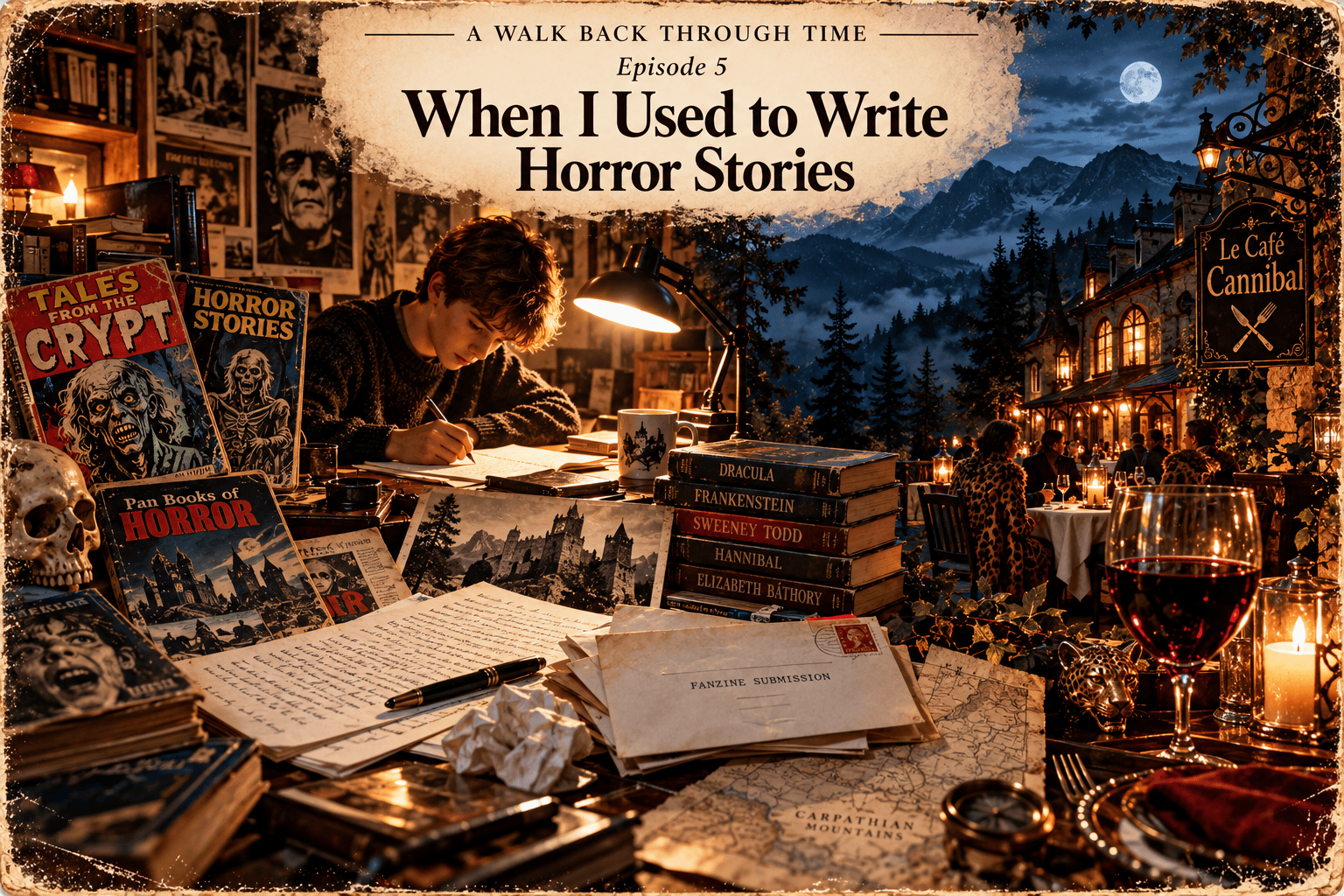
| Long before I wrote about gardens, plants, soil, and many of the other subjects that fill so much of my writing today, I wanted to write about something considerably darker. I was a teenager, and horror fascinated me. This was the world of horror stories, Tales of Terror, the Pan collections of horror, Tales from the Crypt comics and all those wonderfully unsettling stories in which perfectly ordinary people could walk through perfectly ordinary doors and discover something quite extraordinary waiting on the other side. I loved the imagination behind them, but I also loved the anticipation, the atmosphere, and that moment when a story suddenly changed direction and you realised what you thought you were reading wasn’t really the story at all. Horror could make the familiar unfamiliar, and for a young imagination that was an enormously attractive playground. I didn’t just read those stories either; I tried writing them. I wrote short horror tales of my own and submitted some to pulp magazines and fanzines, which now seem to belong to an entirely different age of writing. There were no online submission forms, emails disappearing instantly across the world, or helpful little messages telling you your story had been successfully received. You wrote something, typed or prepared it as best you could, put it into an envelope and sent it away. Then you waited. Whether those teenage efforts were actually any good is perhaps less important to me now than the fact that I did it at all. I was discovering the peculiar pleasure of creating something that existed nowhere except inside my own head and then attempting, through words, to make somebody else see it as clearly as I did. Horror gave me enormous freedom to experiment because almost anything was possible. Reality could be stretched without necessarily being broken. Ordinary people could find themselves in extraordinary circumstances, humour could sit surprisingly comfortably beside terror, and something that initially appeared ridiculous could become deeply uncomfortable simply by changing the perspective from which it was being viewed. Looking back, I suspect that interested me as much as monsters, murderers or things going bump in the night. The best horror wasn’t necessarily about showing you something terrible; sometimes it was about allowing you to realise for yourself that something terrible had been standing in front of you for quite some time. Eventually, of course, life moved on. The teenage horror writer became buried beneath work, relationships, businesses and all the other experiences accumulated while becoming an adult. I never completely lost my interest in horror, history, or the stranger corners of human behaviour, but writing horror gradually became something that belonged to another period of my life. It became one of those things I could remember having done without seriously considering that I might ever do it again. Yet, as I have discovered repeatedly while writing A Walk Back Through Time, things we once loved have an inconvenient habit of not disappearing quite as completely as we imagine. Sometimes they become quiet. The Horror Writer Comes Back Many years later, in 2012, I belonged to a book group and was asked to review Cannibal Serial Killers: Profiles of Depraved Flesh-Eating Murderers by Christopher Berry-Dee. It was hardly a book likely to encourage a gentle literary response over tea and biscuits, and somewhere during the process I suggested that, alongside reviewing it, I could write a dark-humour comedy piece inspired by the subject. It was one of those suggestions that probably sounded relatively simple at first, then became something considerably larger once I started thinking about it. I have rarely been particularly good at doing things by half. If I was going to create a fictional restaurant specialising in perhaps the most inappropriate cuisine imaginable, then I wanted the restaurant itself to work. I wanted to understand who owned it, who cooked there, where it was situated, how the kitchen operated, how it obtained its ingredients, what appeared on its menu, and what sort of clientele would willingly travel enormous distances to eat there. Most importantly, I needed to understand the sort of man who could preside over the whole establishment while genuinely believing himself to be a perfectly respectable chef, businessman and restaurateur. That man became Jacques Montana Pettifers, an elderly chef, traveller, entrepreneur and enthusiastic gourmand who had established an exclusive restaurant and holiday complex in the Carpathian village of Magura. His establishment was called Le Café Cannibal, and one of the things that made Jacques work for me was that he never regarded himself as the villain of his own story—quite the opposite. Jacques considered himself cultured, courteous, experienced and extremely professional. He believed passionately in standards, good service, quality ingredients and treating one’s customers properly. He believed that if something was worth doing, then it should be done correctly, with skill, knowledge and attention to detail. The slight difficulty was that Jacques’s definition of properly differed rather dramatically from that of most other people. Once I had Jacques, I needed to build the world around him, and that was when the small dark-comedy idea began turning into something considerably more elaborate. I returned to many of the things that had fascinated me when I was younger: horror fiction, tales of cannibalism, strange historical characters, folklore and those uncomfortable places where fact and fiction sometimes overlap. Thomas Harris and Hannibal Lecter inevitably contributed something to the mixture, but they were only part of it. I researched stories surrounding the Asmat, the Leopard Society and Michael Rockefeller, along with historical accounts and legends of cannibalism. Other influences came from figures and stories surrounding Elizabeth Báthory, Sweeney Todd, Dracula, Frankenstein, Sawney Bean and several notorious murderers whose identities would eventually be distorted and rearranged to create the extraordinary collection of chefs, hunters, barbers, clothiers and assorted specialists employed by Jacques. Something much closer to my own life lay behind it. When I was a child living in Malaysia, my father was an RAAF officer at Butterworth and headed the Military Police there. He once recounted a story involving a case of murder and cannibalism in a local kampung that he had been sent to investigate. It was one of those stories you hear when you’re young that somehow stays tucked away in the back of your mind for years afterwards. Added to that was my own later experience as a qualified chef and butcher. Consequently, when I started writing about kitchens, knives, cuts of meat, cooking techniques and the organisation of a professional restaurant, I wasn’t approaching everything entirely through imagination. It was a rather peculiar collection of life experience, research, horror fiction, history and extremely black humour. Still, eventually all of those ingredients found their way into the same rather disturbing pot. The result was Le Café Cannibal. Sixty-Five Minutes of Cannibalism The finished piece took me three days to write, and what had started as a relatively straightforward idea became enormous. I also enthusiastically added another complication: I wrote the whole thing as a rhyming narrative poem. This wasn’t just a short piece of comic verse with a few convenient rhymes scattered throughout. I decided to tell the entire story of Jacques Montana Pettifers, Madame Janine Might, and Le Café Cannibal in rhyme, from the opening introduction and interview through the restaurant, the increasingly grotesque dinner service, and eventually the epilogue. Once I started writing it that way, I committed to maintaining the rhythm and rhyme while still telling a coherent story, introducing the characters, explaining Jacques’s extraordinary establishment, and steadily escalating the absurdity. That also helps explain why the original feels so peculiar when I read it again today. Jacques doesn’t simply speak to the reader; he almost performs for them. The rhyming structure gives his voice a slightly theatrical quality, which suited a man who regards himself as chef, host, raconteur and master of ceremonies all at once. Some rhymes were deliberately ridiculous, some stretched almost to the breaking point, and that became part of the fun. The increasingly gruesome subject matter was delivered in this almost jaunty rhyming form, creating a deliberate collision between what the audience was hearing and the cheerful manner in which Jacques described it. When it was eventually performed for the book group, the complete poem took approximately sixty-five minutes to read aloud. I didn’t perform it myself; a friend did, and the intention was for Jacques to be delivered in the most ridiculously exaggerated French accent that could be maintained for over an hour. The combination of rhyme, accent, and Jacques’s extraordinary self-satisfaction mattered because Le Café Cannibal wasn’t originally meant to frighten anybody. It was a spoof: grotesque, excessive, deliberately outrageous and extremely black comedy, with much of the humour coming from Jacques’s complete inability to recognise anything remotely unusual about his own behaviour. He enthusiastically described his restaurant, his chefs, his hunters, his menus and his increasingly questionable culinary practices as though he were showing somebody around a perfectly respectable country hotel. The more appalling the revelations became, the more pleased Jacques seemed with himself. Everything was about quality, freshness, presentation and customer satisfaction. People became “game”, murder became procurement and butchery became culinary craftsmanship, all delivered through rhyme as though this were the most natural subject in the world for a poem. The joke depended on Jacques maintaining the same courteous enthusiasm no matter how grotesque the events became. At the same time, his unfortunate visitor gradually discovered that the language being used inside Le Café Cannibal was considerably more literal than she had initially assumed. Somehow, it worked. The poem was performed in its entirety, people apparently survived the sixty-five minutes, and I was awarded £35 worth of book vouchers. There is something wonderfully appropriate about producing a very long rhyming poem involving cannibalism, serial killers, dubious chefs, and an extremely unfortunate restaurant critic, and emerging from the experience with enough vouchers to buy yet more books. Then, having done what it was created to do, Le Café Cannibal was put away. And Then I Found It Again That might quite reasonably have been the end of Jacques Montana Pettifers and his unusual little restaurant. The piece had been written, performed and enjoyed, and eventually it joined all the other things we create during our lives and assume belong permanently to the period in which they were made. Yet recently I have found myself looking backwards rather more often, particularly through this series. A Walk Back Through Time has repeatedly taken me into parts of my life that I hadn’t properly visited for years. Model villages led me back to one childhood fascination; old tabletop armies to another. Eventually, the journey always led me back to the teenager who once sat down and tried to write horror stories for pulp magazines and fanzines. Thinking about that younger version of myself, Le Café Cannibal began to look different. Reading it again, I could still see the joke, and I could certainly see the deliberate excess that made the original work as a performance. But underneath all that comedy, I began noticing something else that had probably been there from the beginning. I could see the bones of a genuine horror story. There was already an isolated restaurant in the Carpathian Mountains, an eccentric elderly proprietor, a collection of decidedly unusual employees, an exclusive dining society, hunters, strange menus, an extraordinarily potent house wine, disappearing travellers and a restaurant critic who had travelled into the mountains without understanding quite what she had been invited to experience. Almost everything a horror story needs was already sitting there. The difference was that the original told the audience the joke almost immediately. That raised a rather interesting question: what if Jacques wasn’t funny? Or, perhaps more accurately, what if Jacques remained funny but the situation surrounding him no longer was? What if we took the basic premise seriously and let Madame Janine Might arrive at Le Café Cannibal without either her or the reader knowing precisely what awaited her? Jacques could still be Jacques. He could remain charming, eccentric, pompous, courteous, and enormously proud of his restaurant, because changing him completely would destroy what made the original character interesting. What would change would be everything happening around him. Imagine arriving alone in the Carpathians as daylight is disappearing behind the mountains. Somewhere ahead is an exclusive restaurant and small resort that you have travelled a considerable distance to review. Its elderly proprietor welcomes you personally and proves charming, if somewhat eccentric. The staff are attentive, the surroundings extraordinary and the food apparently exceptional. Jacques offers you a glass of the house red and explains that it is produced locally. It tastes unlike anything you remember drinking before, although after the second glass you find yourself considerably less concerned about that than you probably should be. There are peculiarities, certainly, but exclusive establishments often have peculiarities. The gamekeeper seems rather intense and talks about hunting with an enthusiasm that makes you slightly uncomfortable. The barber is remarkably interested in knives. The tailor produces unusual garments for certain regular customers, although nobody seems particularly willing to explain what material he uses. An enormous cooking vessel occupies a surprisingly prominent position inside the restaurant, and occasionally you hear sounds from somewhere beyond the kitchens that you cannot quite identify. None of these things alone amounts to much, and Jacques always explains with such confidence and courtesy that questioning him begins to feel rather impolite. Then, as evening settles properly over the mountains, expensive cars begin arriving outside. Wealthy and apparently influential guests enter the restaurant dressed in spotted hides and skins. They greet Jacques like an old friend and appear to know one another extremely well. You ask what is happening and are told that they belong to the Leopard Society, a private dining organisation whose members visit Le Café Cannibal for certain special occasions. Jacques smiles, pours you another glass of wine, and assures you that you have chosen a particularly fortunate evening to visit. Tonight, apparently, is auction night. That is the story I can now see hiding inside the one I wrote in 2012. Not a replacement for the original, because I don’t want to rewrite history and pretend the earlier piece was something it wasn’t. The original Le Café Cannibal should remain exactly what it was: a ridiculous, grotesque piece of black comedy created for a book group and intended to make people laugh at things they probably shouldn’t have. The new version can grow from it while becoming something quite different, letting atmosphere, uncertainty, and gradually increasing dread do the work that outrageous comedy originally did. And that brings this particular walk back through time almost full circle. More than forty years after I first tried sending horror stories to pulp magazines and fanzines, I find myself contemplating something I never particularly expected to do again. I am going to write horror. Not as the teenager who first discovered how much fun it could be to make ordinary situations become disturbing, and not quite as the man who spent three days in 2012 creating a sixty-five-minute cannibalistic comedy for a book group, but as the person who has lived all of those different lives and can now bring them together on the page. Jacques Montana Pettifers is coming back, and so is Madame Janine Might. Lecter, Wulff, Todd, Gene and the members of the Leopard Society will be waiting for them at Le Café Cannibal. This time, we’ll turn the lights down, let the shadows grow longer, and give Madame Might more time to discover exactly what sort of restaurant she’s travelled all this way to review. After all these years, it seems the teenage horror writer never completely disappeared. Perhaps he was waiting for me to come back. And somewhere high in the Carpathians, the tables at Le Café Cannibal are already being laid. Dinner will be served shortly. |
| About our writing & imagery Most articles reflect our real gardening experience and reflection. Some use AI in drafting or research, but never for voice or authority. Featured images may show our photographs, original AI-generated artwork, or, where stated, credited images shared by others. All content is shaped and edited by Earthly Comforts, expressing our own views |


I wouldn’t even have made it through the front door!
Le Café Cannibal? Excuse me, Jacques, but what exactly is on the menu? And why does the waiter look so pleased to see me? 🤣
I love how you explain the evolution from your original black comedy into a proper horror story. The funniest part is that Jacques Montana Pettifers considers himself a perfectly respectable chef and businessman. Apparently, the only thing wrong with his restaurant is that his definition of quality ingredients differs rather dramatically from ours! 😂
But that ending gave me a little shiver:
“Dinner will be served shortly.”
No, thank you, Jacques! I’ve suddenly remembered that I’ve left Sir Rambo waiting for his dinner at home! 🐾🤣❤️
LikeLiked by 1 person
I must at some point post the sic page rhyme – l did put it in to my old blog years ago, but l will have a look at getting it is again.
LikeLiked by 1 person
Oh, now you’ve made me curious, Rory! Hahahaha! 😂 I’d love to read that rhyme whenever you manage to dig it out. It’s lovely that you’re revisiting some of your older writing as well. I imagine there’s quite a treasure trove tucked away in those old blogs and manuscripts. No rush, though. One thing at a time! 😊🤗
LikeLiked by 1 person
I will let you know, l create a third post for tomorrow and put it up then 🙂
LikeLiked by 1 person
Awesome, Rory! I’ll look forward to reading it. Now you’ve got me curious to see where you’re taking this rhyme! 😂 Thanks for letting me know. 🙏🏻 Enjoy the rest of your weekend! 🤗❤️
LikeLiked by 1 person
Well funnily enough Sonel, there are elements completely moving from this journal into the new journal – sneak preview – The Other Side of Ordinary – https://theothersideofordinary.co.uk/ live but not yet written into. New pen name created from all of the letters of my name 🙂
LikeLiked by 1 person
Rory, I’ve just paid a visit to *The Other Side of Ordinary*, and I must say, I already love it! ❤️
The whole concept is right up my street. Gothic shadows, psychological curiosities, macabre tales and dark humour lurking in unexpected places? What’s not to love? 😂
I also rather like the mysterious new identity of Lucien Mort. And now that I know it’s an anagram of your name, I think you’ve come up with a wonderfully clever pen name that suits the atmosphere of the journal perfectly!
Your welcome page has already left me curious about the stories waiting behind those curtains. I love the promise of the ordinary becoming something rather unsettling, perhaps with a little mischief and dark humour thrown in for good measure.
I’ll definitely be subscribing once everything is up and running. You’ve certainly gained yourself an eager reader, Rory! I can’t wait to see what you have in store for us. Just don’t keep us waiting in the shadows for too long! 🤣
Wishing you every success with this exciting new venture, and congratulations on giving Lucien Mort a home of his own. Here’s to many wonderfully dark and delightfully unusual stories! 🖤📚🤗
LikeLiked by 1 person
Many thanks – the journal layout is now finished, with a new template that was confusing the sheebies out of me! It will start to launch the new Le Cafe Cannibal series on the 1st and then the gardenverse later in the month.
LikeLiked by 1 person
You’re very welcome, Rory! And well done on getting the new layout sorted. I can imagine how confusing a new template can be, especially when it’s determined to test one’s patience! 😂
I’m looking forward to the launch of Le Cafe Cannibal on the 1st, and then the Gardenverse later in the month. It sounds as though Lucien Mort has quite a few dark and intriguing plans up his sleeve!
Wishing you lots of fun and inspiration with the new journal. I’ll be keeping an eye on those curtains! 😉🖤📚🤗
LikeLiked by 1 person
Yep, gotta watch out for curtain twitchers, it may not always be human eyes …
LikeLiked by 1 person
Hahahaha, Rory! 😂 Well, that’s reassuring! I was already keeping an eye on those curtains, but now you’ve got me wondering what might be lurking behind them! Perhaps I’d better leave the investigating to Lucien Mort. I don’t fancy coming face to face with anything that doesn’t have a pulse! 🤣
I’ll be keeping my camera ready, though. You never know what might make an appearance! 😉🖤📸
Hugs to you, Suze and John! 🤗❤️
LikeLiked by 1 person
Must say, that’s quite an achievement. Now you’re bringing Jacques back for a horror story. I hope Madame Might has the sense to check the menu before placing her order this time!
LikeLiked by 1 person
We shall see how she will cope 🙂
LikeLiked by 1 person