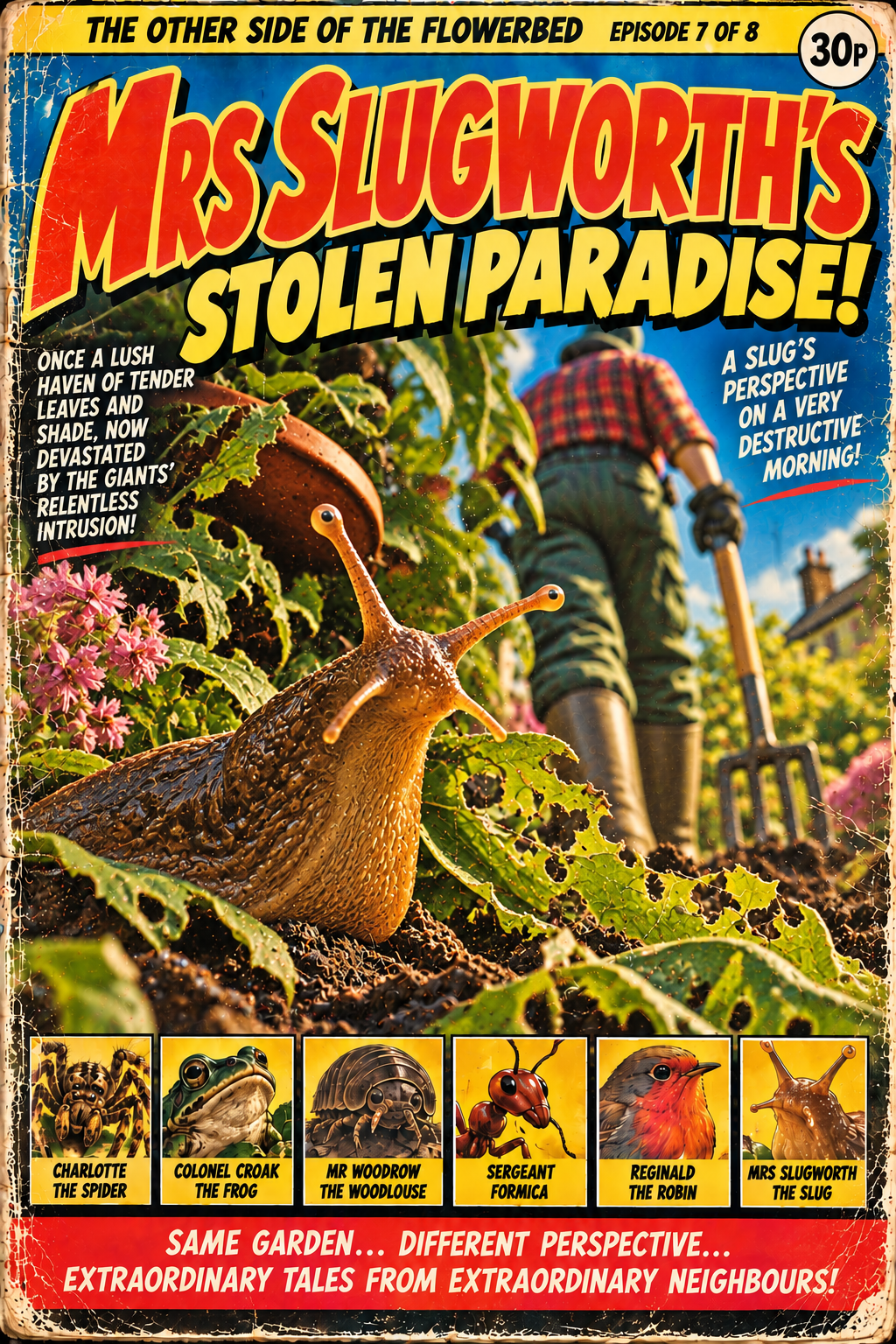
| Episode 7 Mrs Slugworth’s Stolen Paradise! |
| Mrs Slugworth had always considered herself a creature of refined tastes. She appreciated good food, comfortable surroundings and the simple pleasure of knowing that one’s next meal was growing conveniently above one’s head. She disliked unnecessary exercise, regarded excessive sunlight as a thoroughly objectionable invention and believed that the principal purpose of a garden was to provide its inhabitants with somewhere pleasant to live and something agreeable to eat. Unfortunately, she had discovered over several seasons that the enormous two-legged creatures who occasionally entered her world held an entirely different opinion, particularly when it came to consuming ornamental foliage. Her residence beneath the hostas was, by any reasonable standard, a paradise. The broad, overlapping leaves provided excellent protection from direct sunlight, the soil remained pleasantly damp even in warmer weather, and the surrounding vegetation offered an abundance of tender growth that required little effort to reach. Mrs Slugworth had occupied the same general area for a considerable period, gradually developing a detailed understanding of which leaves were most palatable, which routes offered the safest passage and which neighbouring plants were worth investigating when she fancied a change of menu. She was particularly fond of the hostas. Some complained that hostas were excessively vulnerable to slugs, but Mrs Slugworth considered this a most unfair criticism. If a plant insisted upon producing large quantities of soft, succulent foliage in a damp and sheltered environment, it could hardly be surprised when appreciative diners arrived to take advantage of the arrangement. In her opinion, the relationship was perfectly straightforward. The hostas provided accommodation and nourishment, while she contributed an ongoing demonstration of their culinary excellence. The fact that the plants occasionally emerged from these encounters looking rather less attractive than before was, she felt, an unfortunate but unavoidable consequence of popularity. During the previous night, Mrs Slugworth had enjoyed a particularly satisfying excursion. The air had been cool, the vegetation damp and the garden pleasantly free from the enormous disturbances that characterised daylight hours. She had travelled slowly along the underside of a broad leaf, sampled several promising edges and eventually discovered a young hosta shoot of exceptional tenderness. After consuming a generous portion, she had continued towards a neighbouring clump of hardy geraniums, where she investigated several leaves before deciding that they lacked the delicate texture of her preferred hostas. By the time the sky began to brighten, she had returned to her customary shelter, leaving behind a series of silvery trails that marked an entirely successful evening. She had then settled down to sleep. Mrs Slugworth took her rest seriously. Unlike certain creatures who appeared compelled to spend every waking moment rushing about, carrying objects or issuing instructions, she understood the importance of conserving energy. A well-fed slug required peace, moisture and a suitable place to remain undisturbed until conditions became favourable for another excursion. She had no interest in the administrative concerns of Mr Woodrow, the military anxieties of Colonel Croak or the endless logistical difficulties experienced by Sergeant Formica. Indeed, she considered the entire garden community rather too energetic for its own good. Reginald the robin was particularly objectionable in this respect. He appeared to regard every disturbance as an opportunity for excitement and frequently announced his opinions from positions where nobody could reasonably avoid hearing them. Mrs Slugworth had little patience for such enthusiasm, especially from a creature whose dietary preferences occasionally included animals of her general dimensions. For these reasons, she had intended to sleep through the morning. Unfortunately, the Giant had other plans. The first indication that something was wrong came when a heavy vibration passed through the soil beneath her resting place. Mrs Slugworth stirred slightly, extended one eye stalk and considered whether the disturbance warranted further investigation. After a moment, she decided that it did not. Gardens were full of noises, movements and creatures with an unfortunate tendency to interfere with one another, and she had long ago concluded that ignoring most of them was the surest route to a peaceful existence. She withdrew her eye stalk and resumed resting. A second vibration followed, accompanied by a distant rumbling sound and the unmistakable disturbance of something enormous moving through the garden. Mrs Slugworth recognised the general pattern. The Giant had returned, as it did with tedious regularity, and the other residents would undoubtedly be making a tremendous fuss about it. She could already hear Colonel Croak issuing warnings from beneath a neighbouring hosta. “Remain under cover! Avoid exposed ground! The enemy has entered the garden!” Mrs Slugworth sighed. “Must we have this every time?” she murmured. The Colonel’s voice continued, growing increasingly urgent as the Giant moved towards the borders. Somewhere farther away, Mr Woodrow was apparently attempting to convene an emergency meeting, while Sergeant Formica could be heard directing workers along one of the ant colony’s transport routes. The entire neighbourhood seemed determined to conduct its affairs at an unreasonable volume. Mrs Slugworth adjusted her position beneath the leaf and attempted to ignore them. For a while, she succeeded. The Giant was occupied elsewhere in the garden, and the vibrations gradually diminished. Mrs Slugworth drifted back into a comfortable state of inactivity, occasionally noticing distant movement but finding no reason to concern herself. She had enjoyed an excellent meal, her shelter was pleasantly damp, and the remaining hosta leaves promised several more evenings of satisfactory dining. Then the light changed. At first, it was merely a faint increase in brightness near the outer edge of her shelter. Mrs Slugworth noticed it without fully waking, assuming that a passing cloud had moved away from the sun. But the brightness kept growing, accompanied by rustling leaves and the unmistakable sound of disturbed vegetation. She extended both eye stalks. A large section of her protective canopy was moving. Above her, the Giant began removing several older hosta leaves that were yellowing, damaged, or collapsing toward the soil. Some had naturally reached the end of their useful life, while others showed the ragged holes and chewed edges that frequently accompanied the feeding activities of slugs and snails. The gardener intended to tidy the plants, improve the appearance of the border and remove foliage that was no longer contributing much to the display. Mrs Slugworth, naturally, interpreted the operation as an act of extraordinary aggression. One of the broad leaves that had sheltered her favourite resting place was lifted, examined and cut away. A second followed, then a third, leaving a widening gap through which daylight poured onto the damp soil. Mrs Slugworth stared upwards in disbelief. Her ceiling was disappearing. Worse still, several of the leaves being removed were ones she had been saving for future meals. “Excuse me!” she called indignantly. “Those are occupied!” The Giant, unable to hear her protest, continued working. Mrs Slugworth began moving towards the deeper shade beneath the remaining foliage. She was not built for rapid travel, and although her muscular foot allowed her to glide steadily over suitable surfaces, the process was hardly comparable to the sudden leaps of Colonel Croak or the effortless flights of Reginald. She preferred to proceed at a dignified pace, maintaining contact with the damp soil while carefully avoiding exposed areas where moisture might be lost. Unfortunately, dignity became increasingly difficult to maintain as the Giant removed another leaf. A broad shaft of sunlight reached the ground immediately behind her. Mrs Slugworth increased her speed. “Outrageous,” she muttered. “Absolutely outrageous. One cannot even enjoy a respectable morning’s sleep without somebody dismantling the accommodation.” A short distance away, Colonel Croak had already executed his emergency withdrawal from beneath the hostas and was sheltering behind a stone. He watched Mrs Slugworth’s progress with professional concern, though he couldn’t resist reminding her that he had repeatedly warned the community about the dangers the Giant posed. “I told you this would happen,” he announced. Mrs Slugworth continued moving towards the shade. “Yes, Colonel. You tell us every time.” “Your defensive position has been compromised. You should have established an alternative route.” “My alternative route,” she replied irritably, “was beneath that perfectly good leaf he’s just carried away.” The Colonel considered this an unfortunate planning failure. He suggested she retreat toward the compost heap, where the damp organic material provided numerous concealed positions. Mrs Slugworth regarded the proposal with considerable suspicion. The compost heap was some distance away, and reaching it would require an extended journey across unfamiliar ground. “Do you have any idea how long that would take?” she demanded. “Speed is essential during an emergency.” “Then perhaps you should carry me.” The Colonel stared at her. “I beg your pardon?” “If you’re so concerned about the emergency, you could provide transport.” The suggestion offended his military dignity. Colonel Croak explained that he was responsible for coordinating the garden’s defences, not operating a passenger service, and that Mrs Slugworth would have to make her own arrangements. She regarded him with profound disappointment. “Then I suggest you stop offering advice and let me get on with it.” The Colonel withdrew behind his stone, privately concluding that civilian populations were becoming increasingly difficult to manage. Mrs Slugworth continued towards the remaining hosta leaves, only to discover that the Giant had moved farther along the border and was now examining the very area she intended to occupy. His enormous gloved hand lifted another leaf, exposing a patch of damp soil where several small creatures had been sheltering. The gardener noticed a slug moving slowly towards cover. He paused. Mrs Slugworth froze. The enormous face above her seemed to study her with considerable interest, and she felt the deeply uncomfortable sensation of being personally inspected by a creature whose intentions were entirely unknown. She had encountered humans before, and although most had ignored her, others had displayed an alarming tendency to remove slugs from places where they were perfectly content. The Giant regarded her for a moment. “Ah, there’s one of you,” he murmured. Mrs Slugworth could not understand the words, but she disliked the tone. “One of me?” she muttered. “I’ll have you know I’m a longstanding resident.” The gardener carefully lifted a broad fallen leaf with damp soil beneath it, letting the slug stay on the material rather than handling her directly. He carried it a short distance towards a shaded area beneath the shrubs, where the ground was cool and protected, and gently placed it down. To the Giant, this was a simple act of consideration. The slug was merely going about its natural business, and there was no need to injure it while tidying the hostas. To Mrs Slugworth, however, the experience was nothing short of a forced relocation. The world had suddenly risen beneath her, moved through the air and descended into an unfamiliar district without warning, consultation or any apparent consideration for her personal preferences. She remained motionless for several moments, attempting to understand what had happened. Then she extended her eye stalks and examined the surroundings. The new location was damp, shaded and sheltered beneath the lower branches of a shrub. Decaying leaves lay scattered across the soil, and several young plants grew nearby. The conditions were, she had to admit, reasonably comfortable. But there were no hostas. Mrs Slugworth was appalled. She had been removed from a well-established residential and dining arrangement and deposited in a neighbourhood whose culinary facilities were entirely unknown. There was plenty of vegetation, certainly, but she had no intention of accepting just any plant as a substitute for the tender hosta leaves to which she had become accustomed. “This,” she announced to a passing woodlouse, “is completely unacceptable.” The woodlouse paused. “What’s happened?” “I’ve been relocated.” “Have you?” “Against my wishes. Without notice. Without consultation. And without the slightest consideration for my dietary requirements.” The woodlouse examined the damp soil and the surrounding shelter. “Looks quite nice here.” Mrs Slugworth regarded him with disbelief. “Nice? My dear fellow, I have been separated from my favourite restaurant.” The woodlouse considered this information before suggesting that she might return when the Giant had finished. Mrs Slugworth stared at him. “Return? Do you have any appreciation of the distances involved?” The woodlouse looked towards the hostas, which remained visible through the neighbouring vegetation. “Doesn’t look very far.” Mrs Slugworth decided that further conversation would be pointless. Creatures with six or fourteen legs, she had discovered, possessed an entirely unrealistic understanding of travel. For a while, she remained beneath the shrub, investigating the new surroundings with growing dissatisfaction. The soil was pleasantly moist, and the shelter was adequate, but the vegetation lacked the familiarity of her former home. She sampled the edge of a decaying leaf, found it tolerable and continued exploring. However, she did so with the air of someone forced to dine at an establishment considerably below her usual standards. Eventually, she encountered Charlotte nearby, occupied with rebuilding her web. The spider had endured her own difficulties that morning, having lost much of her original structure when the Giant pruned the supporting shrubs. She was now establishing a new framework between two branches and appeared thoroughly absorbed in the task. Mrs Slugworth called up to her. “Charlotte! Have you seen what that dreadful creature has done?” Charlotte paused. “To which part of the garden?” “My hostas! My accommodation! My entire dining arrangement!” Charlotte regarded her sympathetically, although she was still irritated by the destruction of her own home. “He’s been doing much the same to everybody. My web was demolished earlier. I’ve spent most of the morning rebuilding.” Mrs Slugworth examined the delicate strands suspended between the branches. “At least you can build another. I can’t exactly grow a replacement hosta whenever I feel like it.” Charlotte considered this a fair observation. She had little interest in slugs’ culinary preferences. Still, she understood the frustration of having one’s established arrangements disrupted by a creature that appeared entirely unaware of the inconvenience it caused. “Perhaps you should speak to Mr Woodrow,” she suggested. “He’s been discussing residential rights all morning.” Mrs Slugworth made a distinctly unpleasant noise. “That dreadful woodlouse? I’d rather crawl across a gravel path.” Charlotte returned to her construction, privately concluding that Mrs Slugworth was unlikely to find much satisfaction in the garden’s existing administrative arrangements. As the morning progressed, the Giant gradually moved away from the hostas and continued attending to other parts of the garden. The disturbance diminished, the vegetation settled, and the smaller inhabitants began returning to their customary activities. Mrs Slugworth, however, remained deeply dissatisfied. She had been deprived of her favourite resting place, separated from her preferred food source and deposited beneath an unfamiliar shrub where nobody appeared particularly concerned about her circumstances. The other residents were preoccupied with their own difficulties, and even Colonel Croak had lost interest in her predicament after discovering that she had no intention of following his tactical recommendations. Then Reginald arrived. The robin landed upon a low branch above the shrub, looking exceptionally pleased with himself. He had enjoyed a remarkably successful morning following the Giant’s activities and was now surveying the garden for any remaining opportunities. “Hello, Mrs Slugworth!” he chirped brightly. “Settling into your new home?” Mrs Slugworth regarded him with profound suspicion. “I have been forcibly removed from my established residence, Reginald. I am not settling into anything.” The robin examined the sheltered patch of soil. “Looks rather comfortable.” “That is entirely beside the point.” “Plenty of shade.” “Yes.” “Nice damp ground.” “Yes.” “Lots of leaves.” Mrs Slugworth hesitated. “Well, there are leaves.” Reginald tilted his head. “Seems quite pleasant, really.” Mrs Slugworth was beginning to suspect that the robin’s cheerful observations were deliberately intended to provoke her. She told him the new location lacked the principal feature that had made her previous accommodation so desirable: an abundant supply of tender hosta foliage. Reginald considered this with mild curiosity. “Couldn’t you eat something else?” Mrs Slugworth stared at him. “Reginald, that is rather like suggesting that somebody accustomed to excellent dining should be perfectly satisfied chewing the furniture.” The robin thought this an unnecessarily dramatic comparison, but he had learned that arguing with Mrs Slugworth rarely produced a satisfactory result. He wished her a pleasant afternoon and flew towards the lawn, leaving her to contemplate the extraordinary insensitivity of creatures who could travel considerable distances without the slightest effort. For some time, Mrs Slugworth remained beneath the shrub, examining the unfamiliar vegetation and considering her options. She could attempt to return to the hostas immediately, but the ground between the two locations was comparatively exposed, and the Giant was still moving about the garden. Alternatively, she could stay where she was until the light faded and the air cooled, then make the journey under more favourable conditions. The second option was clearly preferable. Slugs depend upon moisture to remain active, and Mrs Slugworth understood instinctively that travelling across exposed ground during daylight was an unnecessary risk. The sheltered soil beneath the shrub provided a safe place to wait. Although the available food was not entirely to her liking, enough decaying vegetation sustained her until conditions improved. She settled into a shallow depression beneath a fallen leaf and began planning her return. It would require patience, careful navigation and a willingness to cross unfamiliar territory, but she was determined to reclaim her former dining arrangements. The Giant might have removed several damaged hosta leaves. Still, plenty of healthy foliage remained, and Mrs Slugworth had no intention of allowing a temporary inconvenience to deprive her of a perfectly respectable food source. By the time the gardener began collecting his equipment, she had developed a satisfactory plan. She would remain beneath the shrub until darkness returned, then follow the dampest available route towards the hostas. Once there, she would inspect the remaining leaves, identify the most promising feeding opportunities and establish a new resting place beneath the surviving foliage. It was a simple arrangement, requiring no committees, military strategies or complicated transport networks. Mrs Slugworth considered it considerably more sensible than anything the other residents had proposed all morning. As the Giant made his way towards the gate, she extended her eye stalks and watched the enormous creature depart. He appeared entirely satisfied with his work, carrying away a container of weeds and damaged vegetation that included several leaves she had been particularly fond of. Mrs Slugworth regarded the departing figure with profound indignation. “Enjoy your little victory,” she muttered. “It won’t last.” The Giant closed the gate behind him. Silence gradually returned to the garden. From beneath the hostas, Colonel Croak announced that the enemy had withdrawn. Mr Woodrow was apparently preparing another committee meeting, while Sergeant Formica continued restoring order to the colony’s transport routes. Charlotte had nearly completed her replacement web, and Reginald was still singing from the fence. Mrs Slugworth listened to the familiar sounds with growing satisfaction. The Giant was gone, the garden was settling, and the evening coolness would eventually give her a chance to reclaim what she considered hers rightfully. She tucked herself farther beneath the fallen leaf and prepared to rest. After all, there was no point wasting energy during the day when an important expedition lay ahead. And somewhere across the garden, beneath the broad surviving leaves of the hostas, an entire collection of tender green foliage awaited her return. Mrs Slugworth allowed herself a moment of quiet pleasure. The Giant might believe he had improved the garden. But he had clearly never negotiated with a determined slug. |
| To be continued in Episode 8 — The Great Departure! |
| Wander through the Article Directory and see where curiosity takes you next. |
| Author’s Note The Other Side of the Flowerbed is an original work of humorous fiction. All characters, personalities, dialogue and events are fictional. Any similarity in character names to those appearing in existing literary works or other fictional creations is coincidental and does not imply any connection with, or endorsement by, their respective creators or rights holders. © 2026 Rory Matier. All rights reserved. |
| Story inspired by Sonel of The Creative Soul |


Hahahaha! Poor Mrs Slugworth! 😂 And the poor giant genuinely thought he was doing her a favour. That indignity! 🤣
You’ve made me look at my own gardening habits rather differently, Rory. I suddenly realised how many times I must have unknowingly caused absolute outrage in the slug community. Goodness knows how many little creatures have sworn at me under their breath! 😂
I’ll certainly think twice before interfering with anyone’s flowerbed business again. What a delightful read! Thanks! 🤗🙏🏻🙌
LikeLiked by 1 person
Thanks – it’s funny Butler K and l have a robin following us throughout several gardens – l now call her/him Reginald. But l have been studying wildlife a lot closer recently too 🙂
LikeLiked by 1 person
Hahahaha! So Reginald is based on a real-life robin! 😂 I love that you’ve given him a name, and how lovely that he follows you and Butler K from garden to garden. I suppose he has decided that you are both reliable sources of entertainment and perhaps the occasional food delivery and I love the name! 🤣
It’s wonderful that you’ve been taking a closer interest in the wildlife around you. There’s so much happening in our gardens that we often overlook when we’re busy with our own little worlds. The more we observe, the more fascinating these little creatures become.
I look forward to hearing more about your wildlife discoveries, my friend and thanks for the lovely reply! 😊❤️🙏🏻
LikeLiked by 1 person
Reginald is a cheeky little soul – just like out real Reggie, Some of the characters l can relate to on a very personal level because many of the birds as an example do interact with us in their own ways.
LikeLiked by 1 person
I think it’s so lovely that you can bring the personalities and little interactions of your own birds into your stories. I think that’s what makes the characters so enjoyable to read. Animals certainly have their own ways of making themselves known, don’t they? They may not speak our language, but they certainly know how to get their message across! 🤗❤️
LikeLiked by 1 person
This series l am to be working on for books 🙂
LikeLiked by 1 person
Oh, that’s exciting, Rory! 😊 Turning the series into books sounds like a wonderful idea. I can imagine these stories developing into something rather special when brought together.
I shall certainly be keeping an eye on your progress. I’m already enjoying the world you’re creating, and I’m curious to see where you take it next.
Wishing you every success with the project, Rory. It’s lovely to see your writing growing into something bigger, and I hope it all comes together just as you envision it! 📚🤗❤️
LikeLiked by 1 person