

| Episode Three Mexico’s Remarkable Tarantulas |
| Some animals become so familiar that we almost stop questioning where they came from. The lion belongs to Africa, the kangaroo to Australia, and somewhere in the back of our minds, the tarantula belongs to those distant, sun-baked landscapes where enormous spiders apparently wander about frightening unsuspecting travellers. It is a rather unfair picture, both for the spiders and for the countries they inhabit, but popular imagination has never been particularly concerned with zoological accuracy. Mexico, however, has a genuine claim to being one of the world’s most fascinating countries for tarantulas. Its extraordinary geographical diversity, ranging from dry scrublands and rocky hillsides to tropical forests and mountainous regions, has provided the conditions for an impressive variety of species to evolve. Some are comparatively inconspicuous, while others have such distinctive patterns and colours that people who might struggle to identify almost any other spider have become familiar with them. In this third episode, we focus on three members of the genus Brachypelma: Brachypelma hamorii, Brachypelma boehmei, and Brachypelma emilia. All three are Mexican species, all three are beautifully marked, and all three have become closely associated with the international fascination surrounding tarantulas. Yet behind their attractive appearance lies a much more complicated story involving scientific identification, habitat loss, wildlife collection and the challenges of protecting animals that spend much of their lives hidden underground. What makes these spiders particularly interesting is that they are not enormous by the standards of the giants we encountered in Episode Two. Their appeal comes from something rather different: striking colouration, specialised lifestyles and an evolutionary history shaped by the landscapes of western Mexico. And, as we shall discover, being beautiful can sometimes be a considerable disadvantage. |
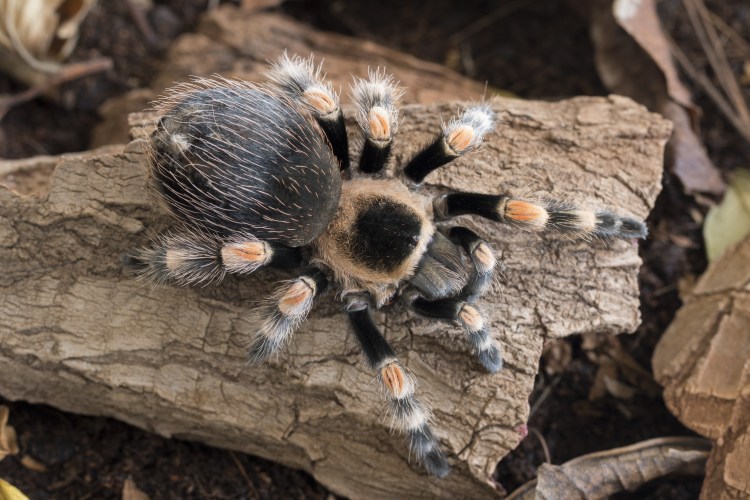
| Mexican Redknee Tarantula –Danny_de_Bruyne |
| The Mexican Redknee Tarantula Brachypelma hamorii If somebody asked me to picture a tarantula without specifying a particular species, there is a reasonable chance that the animal appearing in my imagination would resemble Brachypelma hamorii. Its dark body, contrasting orange-red leg markings and substantial, hairy appearance have become almost a visual shorthand for the entire tarantula family. For decades, spiders of this general appearance have appeared in books, television programmes, films and wildlife collections, often representing everything from harmless curiosity to supposedly terrifying menace. The Mexican redknee is a terrestrial tarantula native to Mexico’s Pacific coastal region, particularly associated with the states of Colima and Michoacán. These landscapes differ greatly from the perpetually damp rainforest environments people sometimes imagine when thinking about tropical spiders. Much of the region experiences pronounced seasonal changes, with dry periods followed by rains that transform the vegetation and influence the activity of countless animals. In this environment, B. hamorii occupies sheltered retreats, often using burrows that protect it from temperature extremes, predators, and the drying effects of the surrounding climate. Its appearance is unmistakably attractive. The body is predominantly dark, while the legs carry vivid orange-red patches around the joints, producing the characteristic red-kneed appearance from which its common name derives. These markings contrast with the darker segments and pale hairs, giving the spider a surprisingly elegant appearance when viewed closely. The colouration is not simply a decorative arrangement for human enjoyment, of course, although the precise evolutionary significance of every marking is not necessarily understood. What we can say is that this combination of colour and structure has made the Mexican redknee one of the most recognisable tarantulas in the world. However, a complication concerns its identity, and it shows why scientific names matter. For many years, spiders circulating under the name Brachypelma smithi included animals later recognised as Brachypelma hamorii. Taxonomic research clarified the distinction between the two species, which share a broadly similar appearance but differ in particular anatomical characteristics and geographical distributions. This may sound like a minor concern confined to specialist journals, but it has practical consequences. When an animal is traded, bred, photographed or recorded in the wild under an incorrect name, information about its distribution and abundance can become confused. Conservation assessments depend upon knowing which species is being studied and where it actually occurs. A familiar common name is not always enough to establish that identity, particularly when closely related animals have been confused with one another for years. Like other terrestrial tarantulas, B. hamorii is an ambush predator rather than a spider that constructs an elaborate aerial web to trap flying insects. It relies upon vibrations and sensory information to detect suitable prey approaching its retreat, responding when an opportunity presents itself. Insects and other small invertebrates form an important part of its diet, and the spider’s powerful fangs allow it to subdue prey before feeding. It uses webbing primarily around its shelter and immediate surroundings, rather than the large suspended capture structures familiar from garden orb-weavers. The burrow itself deserves attention because it is central to the animal’s survival. Underground retreats provide a relatively stable environment compared with the exposed surface, moderating temperature and humidity while reducing the likelihood of predator encounters. A female may remain associated with a suitable burrow for many years, emerging when conditions are favourable, or prey becomes available. Mature males, by contrast, eventually leave their established surroundings to search for females, exposing themselves to dangers that a more sedentary animal might avoid. Another important feature is the presence of urticating hairs on the abdomen. When threatened, the spider can release specialised hairs that irritate potential predators, providing a defensive response without direct physical confrontation. These hairs are a key characteristic of many New World tarantulas and show that an imposing appearance does not necessarily indicate a preference for aggression. Avoiding injury is a considerable advantage for an animal whose external skeleton can be damaged and whose growth depends upon successful moulting. Unfortunately, the Mexican redknee’s beauty has contributed to pressure on wild populations. International demand for attractive tarantulas historically encouraged collection from natural habitats, while agricultural expansion, development, and other landscape changes have reduced suitable environments. International trade in Brachypelma is regulated under CITES, reflecting concerns about these spiders’ vulnerability to excessive collection and the need to control commercial movement across borders. Captive-bred animals can reduce pressure on wild populations, but they do not eliminate the need for habitat protection or accurate identification. A species cannot be conserved simply by ensuring that examples remain available in collections. Its ecological role, natural distribution and relationship with the wider environment deserve protection as well. For me, Brachypelma hamorii represents something of a paradox. It is one of the most familiar tarantulas in the world, yet its natural history is considerably less familiar to the general public than its appearance. We recognise the orange knees, but how often do we consider the Mexican landscape beneath those eight feet? |
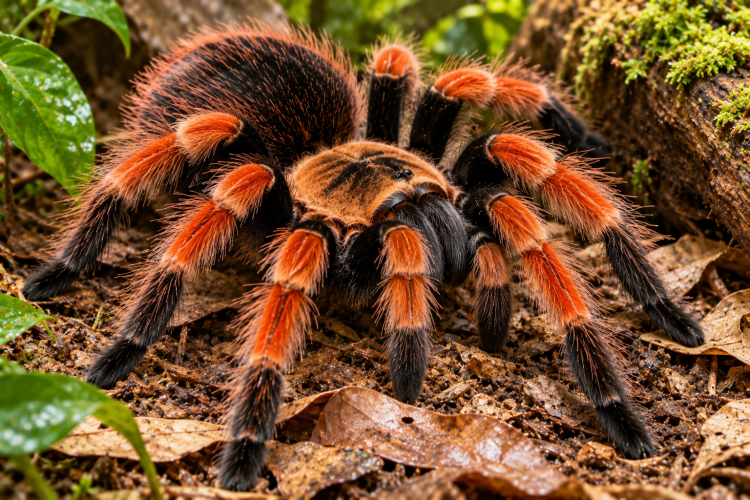
| The Mexican Fireleg Tarantula Brachypelma boehmei If the Mexican redknee is striking, Brachypelma boehmei takes the same idea and turns the colour up considerably. Commonly known as the Mexican fireleg tarantula, it possesses a combination of vivid orange-red leg segments and darker extremities that can make the animal look almost illuminated against the earth beneath it. The effect is especially dramatic in natural light, although photographs sometimes exaggerate the intensity of its colours. This species was scientifically described in 1993, making it a comparatively recent addition to the formally recognised diversity of Mexican tarantulas. Its known distribution is associated with the Pacific coastal region of Guerrero, where dry forest and scrubland environments provide suitable conditions for terrestrial spiders. These habitats may appear relatively harsh when compared with lush tropical forests. Still, they support highly specialised plant and animal communities adapted to seasonal rainfall, heat, and periods of limited moisture. The fireleg’s colouring is perhaps its most immediately recognisable characteristic. Its carapace and much of its body are dark, while its legs show substantial areas of orange or reddish colour, particularly across the upper and middle segments. Unlike the more concentrated knee markings of B. hamorii, B. boehmei’s colour extends across a greater proportion of the legs, producing the fiery appearance that inspired its common name. The precise intensity varies between individuals and can also be influenced by age, moulting and lighting conditions. Remember that a tarantula’s brilliant appearance does not necessarily make it conspicuous in its natural surroundings. Against reddish soil, dried vegetation, fallen leaves, and the broken shadows of scrubland, the contrast may differ from what we see in a carefully lit photograph. Colouration evolves within an animal’s environment, and although we may admire the result, it is unwise to assume that a spider’s appearance exists primarily to attract attention. Like its relatives, B. boehmei is a ground-dwelling species associated with sheltered retreats and burrows. These underground spaces become especially important in seasonally dry environments, where surface temperatures can fluctuate considerably. By remaining concealed during unfavourable conditions, a tarantula can reduce exposure to heat, dehydration and predators while retaining access to prey when circumstances improve. The species is generally considered a relatively slow-growing, long-lived tarantula, particularly in females. Growth occurs through a succession of moults, each allowing the animal to increase in size while replacing its external skeleton. This process is central to tarantula biology, but it also introduces periods of vulnerability. An animal that has recently moulted must allow its new skeleton to harden before resuming normal activity, making a secure retreat especially valuable. One aspect of tarantula biology that I find particularly interesting is the contrast between the apparent simplicity of their hunting methods and the sophistication of their sensory abilities. A terrestrial tarantula may spend long periods apparently motionless, yet it is not necessarily unaware of its surroundings. Sensory hairs and vibration-sensitive structures allow it to detect disturbances that would mean little to us. An insect moving across nearby soil can signal the presence and location of potential prey without the spider relying on sharp eyesight. This distinction matters because human expectations of intelligence and activity sometimes shape how we judge spiders. We tend to regard movement as evidence of purpose and stillness as inactivity, whereas an ambush predator may succeed by remaining almost perfectly stationary. Its strategy depends upon conserving energy, detecting opportunities and responding rapidly when necessary. The Mexican fireleg also possesses urticating hairs, providing a defensive mechanism against potential predators. This ability is particularly useful for a relatively slow-moving terrestrial animal that cannot always escape quickly into a retreat. As with other tarantulas, this defence should not be interpreted as evidence that the animal is habitually aggressive. It is simply one of several adaptations that may improve its chances of surviving an unwanted encounter. Unfortunately, B. boehmei shares some of the conservation concerns affecting other attractive Mexican tarantulas. Its relatively restricted geographical distribution makes habitat changes especially damaging, while historical collection for international trade has added further pressure. The species falls under the CITES protections that apply to the genus, meaning international commercial movement is subject to regulatory controls. This raises a broader lesson about rarity and beauty. An animal does not need to be exceptionally large, venomous or ecologically dominant to become vulnerable. Sometimes a limited distribution, slow reproductive development and an attractive appearance are enough to create a difficult combination. A species that has evolved successfully within a particular environment may still struggle when that environment changes or when human demand removes individuals faster than natural populations can replace them. The Mexican fireleg deserves its place among our fifty because it demonstrates how extraordinary colouration can arise within a group of animals that many people still imagine as uniformly brown and hairy. Yet its real significance extends beyond appearance. It is a specialist of western Mexico’s seasonal landscapes, an accomplished terrestrial predator and another example of why protecting natural habitats matters just as much as protecting individual animals. |
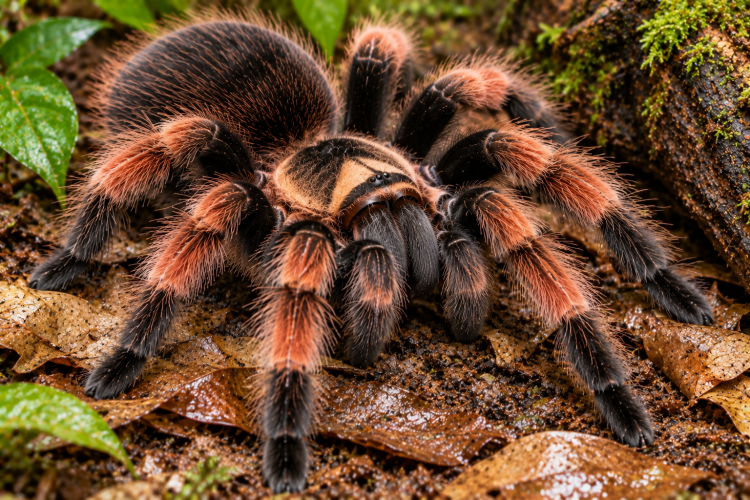
| The Mexican Redleg Tarantula Brachypelma emilia Our third Mexican tarantula is Brachypelma emilia, commonly known as the Mexican redleg. It may lack the particularly vivid colouring of the fireleg, but I would argue that its more restrained appearance is equally attractive. The combination of a dark body, reddish leg markings and a distinctive pale or pinkish triangular area on the carapace gives the species a character of its own, demonstrating that striking beauty does not always require the brightest possible colours. The Mexican redleg was scientifically described in 1856 by the Scottish naturalist Adam White, making it one of the longer-recognised species within our selection. Its distribution extends through parts of western Mexico, including areas associated with the Pacific coastal states, where dry forests, scrublands and other suitable terrestrial environments provide the conditions it requires. As with its relatives, sheltered retreats are particularly important, allowing the animal to remain concealed during unfavourable conditions. One of the most distinctive features of B. emilia is the triangular marking visible on the carapace. This lighter area contrasts with the surrounding dark colouration and can help distinguish the species from other Mexican tarantulas. The legs also carry reddish or orange markings, although their arrangement differs from the more extensive fiery colouring of B. boehmei. Together, these features give the redleg an appearance that is both recognisable and rather elegant. The species illustrates an important point about classification. Closely related tarantulas may share a general body plan, similar ecological habits and overlapping colour patterns, yet remain distinct species with separate evolutionary histories. Scientists examine combinations of anatomical characteristics, reproductive structures, geographical information and, increasingly, molecular evidence to understand those relationships. Appearance can help, but it is not always enough to establish identity with certainty. Like the other two species in this episode, B. emilia is a terrestrial spider that uses burrows and sheltered ground-level retreats. Its hunting behaviour follows the familiar tarantula pattern: detecting suitable prey through sensory information and capturing it when it comes within reach. The spider does not need to pursue insects over long distances or build elaborate capture webs, because its survival strategy depends on using a suitable location efficiently. The relationship between a burrowing tarantula and the surrounding soil is particularly interesting. A burrow is not simply a hole in the ground; it forms part of the animal’s immediate environment, influencing temperature, humidity and exposure to predators. Soil structure, the availability of roots or stones, and surrounding vegetation may all affect where a spider can establish a suitable retreat. For a terrestrial animal that may remain associated with one location for a considerable period, these apparently ordinary details can be extremely important. This is one reason I find the natural history of tarantulas so rewarding. We can spend a great deal of time admiring the animal itself while overlooking the environment that makes its existence possible. A spider may be perfectly adapted to a particular combination of soil, shelter, and seasonal conditions, yet those requirements become invisible when we focus exclusively on its colour or size. Female B. emilia, like many other tarantulas, can be relatively long-lived, while males generally have shorter adult lives after reaching sexual maturity. This difference influences how populations reproduce and recover from disturbance. A mature female may contribute to reproduction over several years, but replacing an established breeding individual can take considerable time. Consequently, removing adult females from wild populations may have effects that are not immediately obvious. The species has abdominal urticating hairs, which it can use defensively when threatened. These specialised hairs are a reminder that even a comparatively slow-moving spider has evolved ways to discourage predators without relying solely on biting. The animal’s first response to disturbance may be to retreat or remain concealed, with defensive behaviour becoming more apparent when escape is limited. As with its relatives, B. emilia has attracted attention through the international tarantula trade, and its inclusion within CITES-regulated Brachypelma reflects the need to control international movement. Habitat loss and degradation are also relevant concerns, particularly where agricultural expansion, development or other land-use changes affect the environments upon which terrestrial tarantulas depend. Conserving such species is challenging because tarantulas are not always easy to study in the wild. Their concealed habits can make population surveys difficult, while seasonal activity and differences between males and females may affect how often researchers encounter individuals. A shortage of sightings does not automatically show that a species is rare, just as an abundance of animals in captivity does not mean wild populations are secure. For me, the Mexican redleg is a particularly fitting species with which to conclude this episode. It is attractive without being flamboyant, recognisable without being quite as famous as the redknee, and biologically fascinating despite sharing many characteristics with its close relatives. Above all, it encourages us to appreciate the quieter distinctions between species rather than constantly searching for the largest, brightest, or most dramatic animal. |
| Three Mexican Tarantulas, One Important Lesson Our journey through Mexico has introduced three closely related spiders whose beauty has helped make them internationally recognisable. Brachypelma hamorii has shown us how a familiar animal can conceal a complicated taxonomic history, while Brachypelma boehmei has demonstrated the extraordinary colouration that can evolve within seasonally dry landscapes. Finally, Brachypelma emilia has reminded us that the relationship between a spider and its environment can be just as interesting as the markings on its body. Another thread connects all three species, and it is perhaps the most important part of their story. Their attractiveness has encouraged generations of people to admire them, photograph them and keep them in collections, but that same fascination has contributed to pressures upon wild populations. It is a familiar contradiction in wildlife conservation: the animals we find most beautiful are sometimes the very ones our desire to possess them puts at risk. International trade controls, captive breeding and scientific research all have roles to play in addressing those pressures, but none can replace the importance of conserving natural habitats. A tarantula is not merely an attractive specimen on a species list. It is a predator, a participant in a complex ecological community and the product of an evolutionary history shaped by the environment in which it lives. Mexico’s tarantulas also demonstrate why the country’s biological diversity deserves far greater recognition than it sometimes receives. Its mountains, forests, dry landscapes and coastal regions support an extraordinary variety of specialised animals, many of which remain unfamiliar outside scientific circles. The three spiders we have encountered are only a small part of that wider story, but they offer an excellent introduction to the region’s remarkable natural history. We have now explored nine of our fifty tarantulas, moving from the giants of South America to the beautifully marked species of Mexico. Along the way, we have encountered differences in size, colour, habitat, defensive behaviour and evolutionary history, yet we have barely begun to appreciate the diversity of this extraordinary family. In our next episode, we will travel northwards into the deserts and dry landscapes of the United States, where another group of tarantulas has developed a rather different relationship with its surroundings. These spiders survive on patience, concealment, and the ability to endure environments that might seem inhospitable to such substantial animals. And one of them carries a name that will be immediately familiar to anyone with even a passing interest in American music. |
| Coming Next — Episode Four: The American Deserts Featuring: Aphonopelma chalcodes — The Arizona Blonde Aphonopelma hentzi — The Texas Brown Aphonopelma johnnycashi — The Johnny Cash Tarantula Three American tarantulas, three very different stories, and a fascinating introduction to the spiders of North America’s dry landscapes. |
| Series: The World’s 50 Most Remarkable Tarantulas Episode: 3 of 17 Species featured: 7–9 of 50 Category: Natural History / Wildlife / Arachnids |


What a fascinating read, Rory! Those Mexican Redknees, Firelegs and Redlegs are absolutely stunning. I could spend hours photographing these little beauties! 😂📸
I particularly enjoyed your insights into their sensory abilities and defensive behaviour. It is a wonderful reminder that stillness doesn’t mean inactivity, and that an animal’s means of protecting itself shouldn’t be mistaken for aggression.
It’s also heartbreaking that their beauty makes them vulnerable to human greed. Protecting their natural habitats is so important.
Thank you for another wonderful wildlife lesson, my friend. You’ve just added Mexico to my ever-growing list of places I’d love to explore with my camera! 😅 🤗❤️
LikeLiked by 1 person
What spiders are there where you are? I should imagine – grass and house spiders, Wolf Spiders? Cave spiders? Probably the jumpers as well?
LikeLiked by 1 person
WHAHAHAHA, Rory! Now that was probably the wrong question to ask if you want to get some sleep tonight! 😂😂 I could keep you busy with spiders for hours!
And yes, we have several species of grass spiders, house spiders, wolf spiders and cave spiders, including the whip spider. Oh, they are amazing! If you’d like, and have the time, you’re very welcome to pop over to my Facebook page and have a look at some photos I took of one we found in our garden:
https://www.facebook.com/media/set/?set=a.10226065814899016&type=3
And don’t even get me started on jumping spiders! They are my absolute favourites. If they weren’t so tiny, I’d probably want to hug and kiss them! 😂❤️
They are just so adorable, with those little faces and curious eyes that look they have sunglasses on and those adorable eyelashes. I always just wish we had the peacock jumping spider here. That is one adorable cutie indeed! I could watch them for hours and of course take thousands of photos. hahahah!
Sorry Rory, you asked for it! 😅 You’ve opened the spider conversation, and I’m not taking responsibility for how long it lasts! 🤣🤗
LikeLiked by 1 person
More spiders are needed l think 🙂
LikeLiked by 1 person
Hahaha, Rory! Be careful what you wish for! 😂🕷️
You’ve given me an idea now. Perhaps I should put together a little blog post dedicated to some of our local spiders, especially those adorable jumping spiders. I have a few photographs tucked away, so I might just have to introduce you to some of our eight-legged neighbours!
It might take me a little while to put it all together, though. I don’t want to overwhelm you with too many legs in one sitting! 🤣
So consider this a warning: you asked for more spiders, and I might just deliver! 😂🕷️🤗❤️
LikeLiked by 1 person
Please do so 🙂
LikeLiked by 1 person
Hahaha, well, you asked for it, Rory! 😂 I’ll see what I can put together from my little collection of eight-legged neighbours. The jumping spiders are particularly adorable, so they’ll definitely get a mention.
Just remember, you encouraged this, so there’ll be no complaints when the legs start appearing on Creative Soul! 🤣🕷️🤗❤️
LikeLiked by 1 person
Yay 🙂
LikeLiked by 1 person
😂🤣🕷️🤗❤️
LikeLiked by 1 person